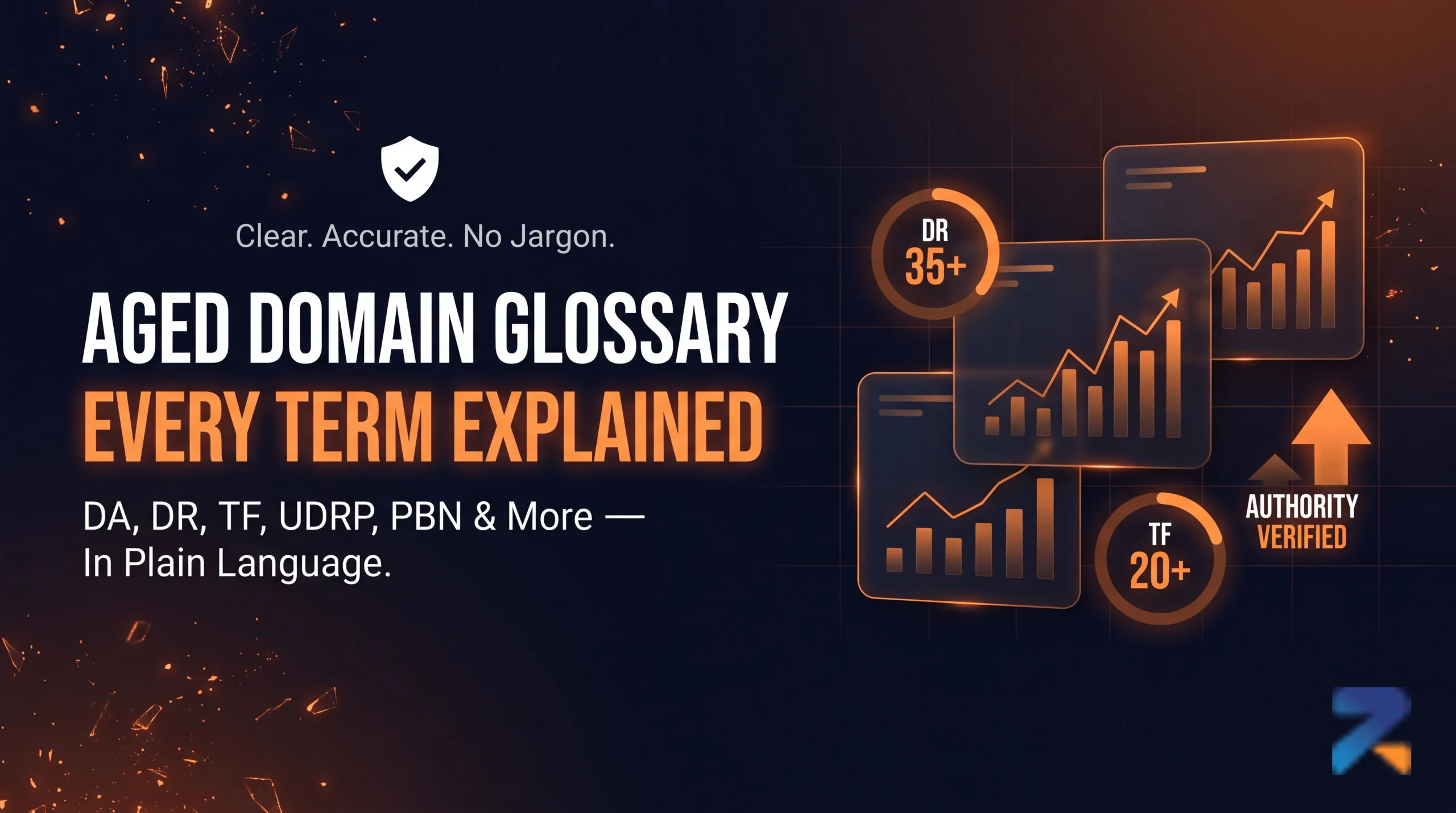

Aged Domain Glossary: Every Term Explained (DA, DR, TF, UDRP, PBN, and More)
An aged domain is a web address that has been continuously registered and used for several years, retaining its original backlink profile and search engine trust. This glossary defines the terms used throughout aged and expired domain buying authority metrics, technical concepts, legal terms, and the buying process in plain language, with no jargon left unexplained.
Last updated: July 2026.
Domain Types
Aged Domain
A domain that has been continuously registered and actively used for multiple years, retaining its indexed content history, backlink profile, and accumulated search engine trust. Age alone doesn’t determine value a domain’s history and backlink quality matter more than raw years of registration.
Expired Domain
A domain whose registration lapsed and was re-released for public purchase, either through an auction, backorder service, or direct registration once available. An expired domain may or may not retain meaningful SEO value depending on how long it sat unregistered and what happened to it during that window.
Dropped Domain
A domain that has completed the full expiration and deletion process and become available for anyone to register at standard registration price, rather than through an auction. Dropped domains are typically less valuable than domains caught earlier in the expiration process, since more time has passed since active use.
PBN (Private Blog Network)
A network of separately owned or disguised websites, often built on aged or expired domains, used to link to a single “money site” to influence its search rankings. PBNs are explicitly against Google’s spam policies when detected, and carry real risk of penalty for both the network and the site it links to.
Authority Metrics
Domain Rating (DR)
An Ahrefs metric, scored 0-100, that estimates a domain’s backlink profile strength based on the quantity and quality of unique referring domains linking to it. DR is a third-party vendor metric, not a Google ranking factor, but it correlates reasonably well with backlink-driven authority.
Domain Authority (DA)
A Moz metric, also scored 0-100, that predicts how likely a domain is to rank in search results based on its backlink profile. Like DR, DA is a third-party estimate rather than a metric Google itself uses, and different tools can produce different scores for the same domain.
Trust Flow (TF)
A Majestic metric that scores how trustworthy a domain’s backlink profile is, based on the quality of the sites linking to it rather than sheer quantity. A domain that receives links primarily from established, reputable sites will show a higher Trust Flow than one with the same link count from lower-quality sources.
Citation Flow (CF)
A Majestic metric measuring the raw quantity and strength of links pointing to a domain, without weighting for source quality. Citation Flow is usually read alongside Trust Flow a large gap between a high CF and a low TF often signals a spammy or low-quality backlink profile.
Spam Score
A Moz metric estimating the likelihood that a domain will be penalized or has spam-associated characteristics, based on patterns observed across known penalized sites. A high spam score on a domain being considered for purchase is a signal to investigate its history more carefully before buying.
Technical Terms
Backlink
A hyperlink from one website pointing to another. Backlinks are one of the primary signals search engines use to evaluate a page or domain’s authority and trustworthiness, though quality and relevance matter far more than raw quantity.
Referring Domain
A unique website that links to a given domain at least once. A domain with 500 backlinks from 10 referring domains is generally viewed as weaker than one with 100 backlinks from 80 referring domains, since link diversity across independent sources signals broader endorsement.
Anchor Text
The visible, clickable text of a hyperlink. Anchor text patterns across a domain’s backlink profile (branded, exact-match, generic, or naked URL) can indicate whether links were built naturally or manipulatively, which matters when evaluating an aged domain’s history.
301 Redirect
A permanent redirect that sends both users and search engines from one URL to another, passing most of the original page’s ranking signals to the destination. This is the standard method for transferring an aged domain’s authority into an existing website.
Indexation
The process by which a search engine crawls, processes, and stores a page so it can appear in search results. A domain’s indexation history how consistently and how much of its content search engines indexed over time is a key signal of its underlying quality.
Manual Action
A penalty applied directly by a human reviewer at a search engine (most commonly discussed in the context of Google) when a site is found to violate spam or quality guidelines. A manual action on a domain transfers to the new owner and must typically be resolved before the domain can perform normally again.
Legal and Risk Terms
UDRP (Uniform Domain-Name Dispute-Resolution Policy)
The standard process trademark holders use to challenge domain ownership without going to court. A successful UDRP complaint can result in a domain being transferred or cancelled, regardless of what the current owner paid for it.
Cybersquatting
Registering a domain name that is identical or confusingly similar to an existing trademark, typically with the intent to profit from the trademark holder’s brand recognition. Domains with a cybersquatting history carry elevated legal risk even after changing ownership.
WHOIS
A publicly queryable record of a domain’s registration details, including registrant contact information (where not privacy-protected), registration and expiration dates, and the domain’s registrar. WHOIS history tools can show a domain’s ownership changes over time.
Trademark Infringement
Using a name, logo, or brand element that a court or trademark authority determines is confusingly similar to a registered trademark, in a way likely to deceive or mislead consumers. A domain name itself can constitute trademark infringement independent of the content published on it.
Buying Process Terms
Escrow
A payment arrangement where funds are held by a neutral third party until both sides of a transaction payment and domain transfer are confirmed complete. Escrow is the standard recommended payment method for private domain sales to protect both buyer and seller.
Due Diligence
The research process a buyer performs before purchasing a domain, covering backlink quality, content history, penalty status, and legal risk. Skipping due diligence is the most common reason buyers end up with a domain that underperforms its advertised metrics.
TLD (Top-Level Domain)
The suffix at the end of a domain name, such as .com, .net, or .org. TLD choice affects both user trust perception and, in some cases, regional search relevance.
ccTLD (Country-Code Top-Level Domain)
A TLD assigned to a specific country or territory, such as .co.uk, .de, or .id. ccTLDs can carry stronger regional relevance signals for search engines targeting that specific country’s audience.
Frequently Asked Questions
What’s the difference between Domain Rating and Domain Authority?
Domain Rating (DR) is Ahrefs’ metric and Domain Authority (DA) is Moz’s metric both estimate backlink-driven authority on a 0-100 scale using different underlying data and algorithms, so the same domain often shows different DR and DA scores.
Is Trust Flow more reliable than Domain Rating?
Neither is inherently more reliable they measure different things. Trust Flow weights link quality more heavily, while DR weights the broader backlink graph. Experienced buyers typically check both alongside Citation Flow rather than relying on a single metric.
Do these metrics directly affect Google rankings?
No. DA, DR, TF, and CF are all third-party vendor metrics, not signals Google itself uses in ranking. They’re useful as estimates and comparison tools, but a domain can rank well with modest third-party scores or rank poorly despite high ones.
What term should I search to learn more about a specific metric?
Search the metric name plus the vendor that created it (for example, “Ahrefs Domain Rating” or “Majestic Trust Flow”) to find that vendor’s own documentation, which explains their specific calculation methodology in more depth than any third-party summary.
Related Guides
- How to Audit an Aged Domain Before You Buy
- Trademark and Legal Risks When Buying an Aged or Expired Domain
- How to Pay Safely When Buying an Aged or Expired Domain
- How to Resell or Flip an Aged Domain: Exit Strategy, Valuation, and Where to List It
- Where to Buy Aged & Expired Domains in 2026: The Complete Buyer’s Guide
- Aged Domain Sellers You Can Trust: How to Vet a Premium Marketplace