Rexusdomain-Logo
  • Aged Domain
  • News
  • Google Update
  • SEO
    • Igaming
  • Tutorial
  • Comparison
  • Company
    • About Us
    • Term Of Use
    • Privacy Policy
    • Cookie Policy
    • Terms And Conditions
No Result
View All Result
Buy Domain
Rexusdomain-Logo
  • Aged Domain
  • News
  • Google Update
  • SEO
    • Igaming
  • Tutorial
  • Comparison
  • Company
    • About Us
    • Term Of Use
    • Privacy Policy
    • Cookie Policy
    • Terms And Conditions
No Result
View All Result
Rexusdomain-Logo
No Result
View All Result
Does an Aged Domain’s Old AMP Pages Cause Problems Today?

Does an Aged Domain’s Old AMP Pages Cause Problems Today?

Rexusdomain by Rexusdomain
September 12, 2026
in Aged Domain, SEO
0
593
SHARES
3.3k
VIEWS
Summarize with ChatGPTShare to Facebook

Does an Aged Domain’s Old AMP Pages Cause Problems Today?

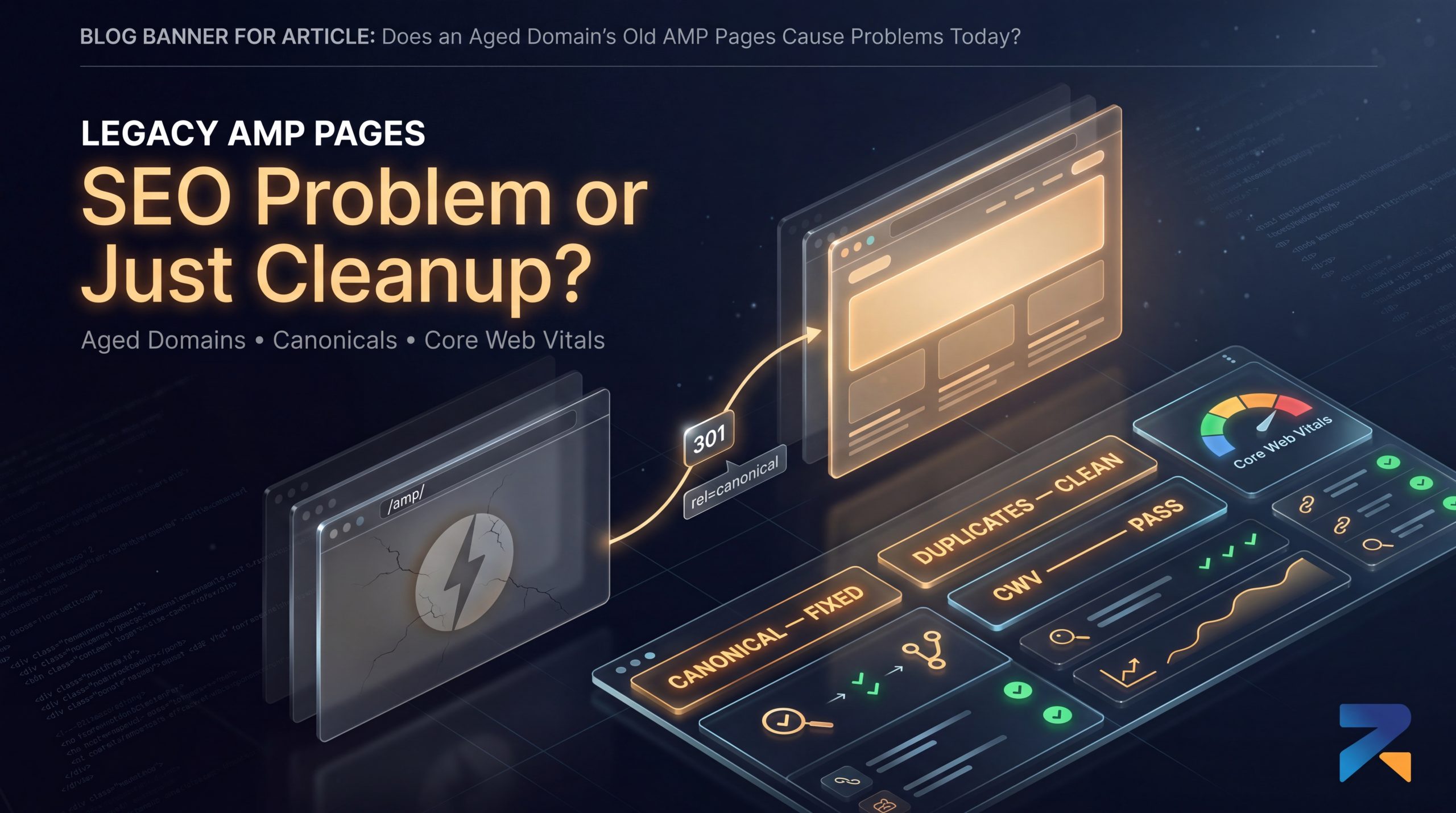
Rarely, but they’re worth cleaning up — Google retired AMP’s special search treatment (the lightning-bolt carousel and mobile ranking boost) between 2021 and 2024, so an aged domain’s leftover AMP pages are now just ordinary duplicate-content risks rather than the ranking advantage they once represented, and the fix is standard canonicalization or removal, not urgent damage control.

Last updated: September 2026.

What AMP Used to Do, and What Changed

Accelerated Mobile Pages launched in 2015 as a stripped-down HTML format that loaded near-instantly on mobile and, for years, was rewarded with a dedicated carousel placement in mobile search results for news content. Google began phasing out AMP’s special treatment as Core Web Vitals became the primary page-experience signal, and by 2024 AMP no longer carried any unique ranking benefit — any page meeting Core Web Vitals thresholds, AMP or not, is eligible for the same search features.

What Leftover AMP Pages Can Actually Cause

  • Duplicate content without canonical tags. If an aged domain’s AMP pages (at /amp/ or on an amp. subdomain) don’t correctly canonicalize to the main version, Google may treat them as separate, competing pages.
  • Indexed AMP URLs outranking the main page. In some legacy setups, the AMP version accumulated its own backlinks and indexing signals separately from the main URL, which can fragment authority that should be consolidated on one canonical version.
  • Broken AMP-specific markup. Old AMP pages sometimes reference deprecated AMP components or scripts that throw console errors — cosmetically irrelevant to rankings now, but worth cleaning up if you’re auditing technical debt.

How to Handle Legacy AMP Pages on an Aged Domain

  • Check whether AMP URLs are still live and indexed via a site: search for inurl:amp on the domain.
  • If AMP pages are still indexed separately, add or fix the canonical tag pointing to the main non-AMP URL, or 301 redirect the AMP version entirely if you’re not maintaining an AMP setup going forward.
  • Remove any AMP-specific structured data or <link rel="amphtml"> tags from the main pages if you’re fully discontinuing AMP, since referencing a redirected or removed AMP URL serves no purpose.
  • Prioritize Core Web Vitals on the main page instead — that’s the actual page-experience signal Google evaluates today, AMP or not.

Frequently Asked Questions

Do old AMP pages still help an aged domain rank in Google?

No. Google retired AMP’s special search treatment and ranking benefits between 2021 and 2024. Any current ranking advantage comes from meeting Core Web Vitals thresholds, which applies equally to AMP and non-AMP pages.

Can leftover AMP pages hurt an aged domain’s SEO?

They can create duplicate content issues if not properly canonicalized to the main page, potentially fragmenting backlink and indexing signals — but this is a technical cleanup issue, not a penalty or trust problem.

Should I keep or remove AMP pages on an aged domain I just bought?

Most sites benefit from removing or redirecting AMP pages today, since AMP no longer provides a ranking advantage and maintaining a separate page format adds technical overhead with no upside.

How do I check if an aged domain has indexed AMP pages?

Run a site search using “site:domain.com inurl:amp” in Google to see if AMP URLs are still indexed separately from the main pages.

Related Guides

  • Core Web Vitals and Aged Domains: Does Legacy Code Still Hurt Rankings?
  • Fixing 404s on an Aged Domain Without Killing Its Authority
  • Subdomain, Subdirectory, or Root Domain: Aged Domain Edition

Sources & Further Reading

  • Google Search Central Blog
  • Google Search Central — Core Web Vitals


SummarizeShare237
Rexusdomain

Rexusdomain

RexusDomain is a marketplace for vetted aged and expired domains, focused on domain sourcing, backlink history verification, and due-diligence checks for SEO professionals and domain buyers.

Related Stories

Can You Erase an Aged Domain’s Previous Niche Footprint?

Can You Erase an Aged Domain’s Previous Niche Footprint?

by Rexusdomain
September 20, 2026
0

Can You Erase an Aged Domain's Previous Niche Footprint? Picture this scenario. You just secured an aged domain with a mouth-watering backlink profile. For eight straight years, it...

Does an HTTPS Migration Reset Trust on an Aged Domain That Was Never Secured?

Does an HTTPS Migration Reset Trust on an Aged Domain That Was Never Secured?

by Rexusdomain
September 17, 2026
0

HTTPS migration is treated as a site move, not a trust reset. What can go wrong in the process, and how to migrate an aged domain to HTTPS...

Do WHOIS Privacy Changes Affect an Aged Domain’s SEO?

Do WHOIS Privacy Changes Affect an Aged Domain’s SEO?

by Rexusdomain
September 16, 2026
0

Google has confirmed WHOIS privacy status isn't a ranking factor. Where it actually matters is buyer due diligence, not search visibility.

404 vs 410: Does the Status Code You Choose Matter for Aged Domain Cleanup?

404 vs 410: Does the Status Code You Choose Matter for Aged Domain Cleanup?

by Rexusdomain
September 15, 2026
0

A 410 status can speed up deindexing of intentionally removed pages compared to 404 - useful for cleaning up a large legacy URL inventory.

Next Post
404 vs 410: Does the Status Code You Choose Matter for Aged Domain Cleanup?

404 vs 410: Does the Status Code You Choose Matter for Aged Domain Cleanup?

buy-aged-domain buy-aged-domain buy-aged-domain

Recommended

Google algorithm updates impact on iGaming SEO — survival and recovery guide

Google Algorithm Updates & iGaming SEO: How to Survive Every Core Update

July 20, 2026
Best aged domain marketplace for iGaming SEO 2026 — Rexusdomain vs Odys, MostDomain, DomainCoasters, SEO.Domains

Best Aged Domain Marketplace for iGaming SEO (2026)

July 20, 2026

Popular Story

  • Where to buy aged and expired domains in 2026 - complete buyer's guide banner by RexusDomain

    Where to Buy Aged & Expired Domains in 2026: The Complete Buyer’s Guide

    0 shares
    Share 446 Tweet 279
  • How to Build an iGaming Money Site on an Aged Domain

    1690 shares
    Share 676 Tweet 423
  • How to Buy Aged or Expired Domains: A Step-by-Step Guide (2026)

    1625 shares
    Share 650 Tweet 406
  • E-E-A-T Signals on an Aged Domain for iGaming SEO: Single Page vs Multi Page

    1312 shares
    Share 525 Tweet 328
  • Aged Domain Sellers You Can Trust: How to Vet a Premium Marketplace Before You Buy

    0 shares
    Share 276 Tweet 172
All About Aged Domains For Igaming

Explore

  • Domain Inventory
  • Blog
  • Contact Us
  • Login

Follow Us

Welcome Back!

Login to your account below

Forgotten Password?

Retrieve your password

Please enter your username or email address to reset your password.

Log In
No Result
View All Result
  • Aged Domain
  • News
  • Google Update
  • SEO
    • Igaming
  • Tutorial
  • Comparison
  • Company
    • About Us
    • Term Of Use
    • Privacy Policy
    • Cookie Policy
    • Terms And Conditions