

If you’re still in the evaluation phase figuring out whether an aged domain makes sense for your iGaming operation here’s the full strategic picture: aged domains for iGaming SEO. Most operators who buy an aged domain already know they need a redirect.. What they don’t know is that the type of redirect they choose determines how much of that domain’s authority actually reaches their money site.
Get it right and you’re transferring years of trust signals in one move. Get it wrong and you’re pointing an expensive domain at your site while leaving 30–40% of its equity sitting dead in the pipe.
This is not a theoretical distinction. In iGaming, where every authority signal matters because you’re competing in a YMYL niche with elevated scrutiny, the wrong redirect type is the kind of mistake that costs you ranking momentum during the window when your site needs it most — right after deployment.
Here’s how each redirect type actually behaves, what Google does with them, and which one belongs in your iGaming setup.
What the Redirect Type Is Actually Communicating to Google
Before getting into the comparison, understand the mechanic. When Google crawls an aged domain you’ve redirected, it reads the server response code first. That code tells Googlebot whether the move is permanent, temporary, or something else entirely.
That distinction matters because Google’s handling of PageRank transfer — the authority passing from your aged domain to your money site — is tied directly to that signal. Permanent moves get treated differently from temporary ones. And in iGaming, the difference between a 10-week ranking climb and a 6-month one can come down to exactly this.
301: The Permanent Redirect
This is the one you use when you’re done with the aged domain as a standalone property and you want everything it has pointed at your money site. Full stop.
A 301 tells Google: this domain has permanently moved, update your index, and pass the authority to the new destination. Google has publicly stated that 301 redirects pass PageRank. Based on what operators in this space consistently observe, a well-executed 301 from a clean aged domain starts moving ranking signals within 3–6 weeks of crawl.
The key word is clean. A 301 from a domain with a toxic backlink profile doesn’t just pass no authority — it passes the toxicity along with it. This is why auditing before you redirect is non-negotiable. If you haven’t gone through a proper pre-redirect audit, read how to audit an aged domain for iGaming SEO before touching your server config.
When to use 301 in iGaming:
- Aged domain permanently deployed as a redirect to your money site
- PBN domain pointing to a target page (permanent, not rotating targets)
- Consolidating multiple aged domains into a single money site
- Post-migration after rebuilding a site on a new URL structure
One thing operators get wrong here: they set up a 301 and then keep changing the redirect destination. If you’re rotating the target URL every few weeks, you’re essentially resetting the crawl signal each time. Google needs time to process the redirect and consolidate the signals. Let it sit.
302: The Temporary Redirect
A 302 tells Google: this content is temporarily at a different location, keep indexing the original URL, nothing permanent is happening here.
Here’s where most people get confused. Google has said it treats 301 and 302 redirects similarly in terms of PageRank transfer. And in testing, that’s sometimes true — especially after a 302 has been in place for an extended period. But “sometimes true after extended time” is not the same as “works the same from day one.”
In iGaming, the early weeks after pointing an aged domain matter enormously. That’s when Googlebot recrawls the source domain, reads the redirect, and starts processing the authority consolidation. A 302 during that window introduces ambiguity. Google may hold back on full authority transfer while it waits to see if the redirect becomes permanent.
Don’t use a 302 when you mean a 301. This is one of the most common silent mistakes in iGaming redirect setups.
When 302 is actually the right call:
- You’re testing a landing page variation before fully committing the aged domain’s authority to it
- Geo-conditional routing that changes based on user location (temporary rules that swap between market-specific pages)
- Legal compliance redirects in regulated markets where you need to route traffic away from specific pages while awaiting license approval — you want to keep the original URL indexed
- CMS-level redirects during a staging environment that will be replaced before going live
The critical distinction: a 302 is appropriate when you genuinely intend the original URL to remain the canonical destination. If you’re buying an aged domain specifically to pass its authority to an iGaming money site permanently, a 302 is the wrong tool regardless of what some SEO tools claim about equivalency.
307: The HTTP/1.1 Temporary Redirect
The 307 is the HTTP/1.1 successor to the 302, and it’s the one that causes the most unnecessary confusion when operators encounter it.
Functionally, a 307 is a temporary redirect — same as a 302 in terms of SEO signal — but with one specific technical difference: it preserves the HTTP method. That means if a user or crawler made a POST request to the original URL, a 307 ensures that POST request is sent to the redirect destination as well, not converted to a GET.
For the vast majority of iGaming redirect use cases, this distinction is irrelevant. You’re redirecting a domain or a page via GET requests. POST method preservation doesn’t come into play.
When 307 matters in practice:
- HTTPS migration where form submissions or login requests need to maintain their method through the redirect
- API endpoints on a site undergoing server migration where method integrity is required
- Edge cases involving payment or registration flows where GET conversion would break functionality
For standard aged domain redirects in iGaming — whether you’re pointing a domain at a money site, a PBN node at a target page, or consolidating authority from multiple domains — a 307 adds nothing and introduces unnecessary confusion for anyone auditing your redirect chain later. Use a 301.
The 308: Briefly
The 308 is to the 307 what the 301 is to the 302 — permanent, but with HTTP method preservation. In iGaming SEO, you will almost never need this. It exists for technical scenarios involving APIs and form-heavy applications during permanent migrations. If someone on your team is suggesting a 308 for an aged domain redirect setup, ask them to explain why. The answer will either be correct and technical, or it will be wrong.
What About Meta Refresh and JavaScript Redirects?
Don’t use them for aged domain authority transfer. Full stop.
Meta refresh redirects (the <meta http-equiv="refresh"> tag) and JavaScript-based redirects like window.location are processed by Google differently from server-side response codes. Googlebot does crawl and follow JavaScript in many cases, but the authority signal passed through a JS redirect is unreliable and inconsistent.
Operators in iGaming who’ve tried to use JS redirects as a workaround for hosting configurations they don’t control — particularly on shared environments where .htaccess isn’t available — have consistently reported weaker authority transfer compared to proper server-side 301s. We’ve seen this kill otherwise solid redirect setups.
If your server setup doesn’t support server-side redirects, fix the server setup. The aged domain you bought is only as valuable as the redirect that delivers its authority.
Redirect Chains: The Silent Equity Killer
Here’s something most redirect guides skip entirely.
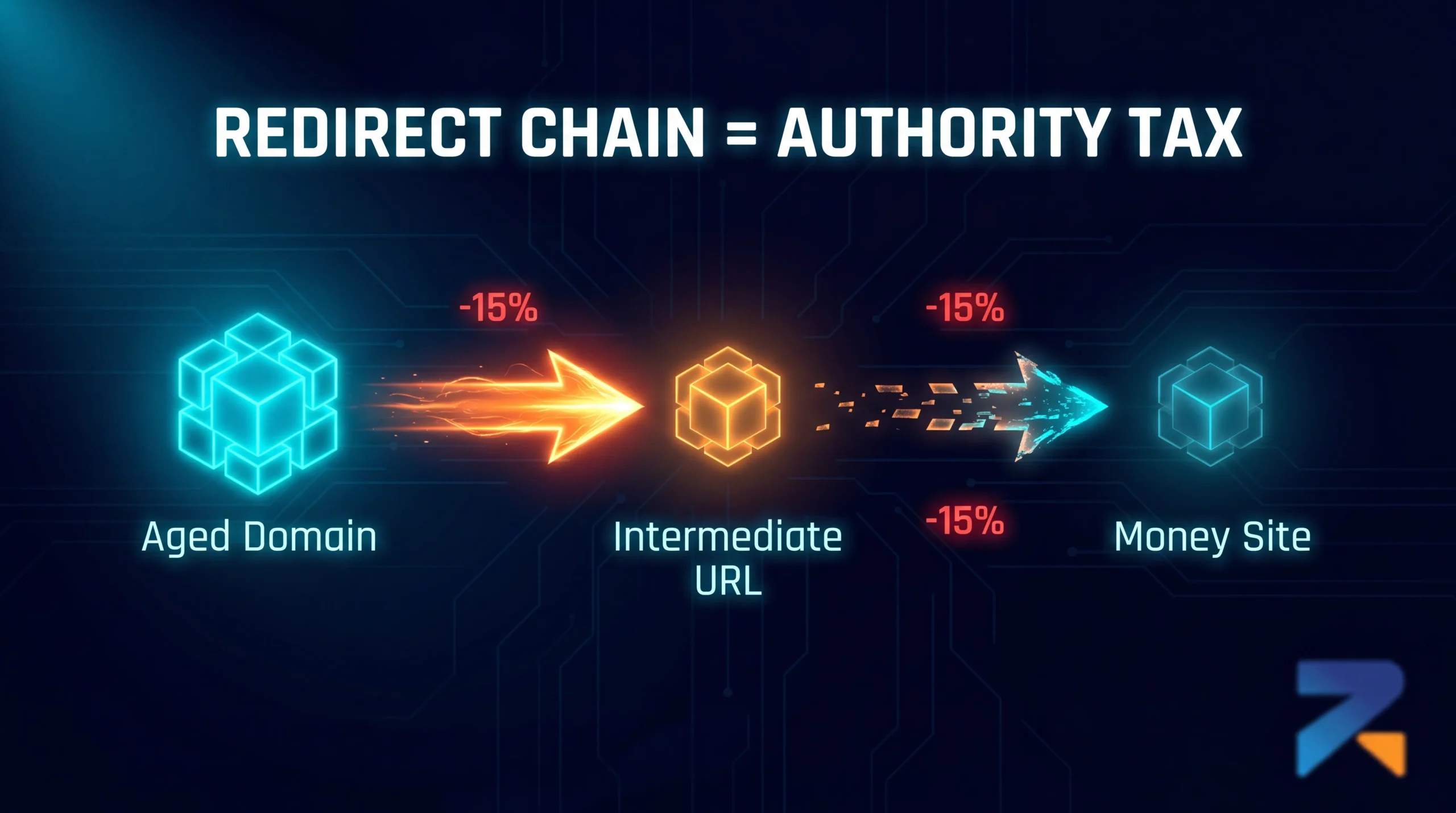
Every hop in a redirect chain costs you. The commonly observed estimate is 10–15% equity loss per additional redirect hop. So if your setup looks like this:
aged-domain.com → intermediate-domain.com → money-site.com
You’re not transferring the full authority of the aged domain. You’re transferring roughly 85–90% of it, at best. Add another hop and you’re down to 70–75% of the original signal by the time it reaches your money site.
In iGaming, operators who acquire multiple aged domains and route them through a consolidation layer before hitting the money site are quietly bleeding authority at every junction. Each of those domains cost real money. Each hop is a tax on that investment.
The practical takeaway: audit your redirect chains before and after every deployment. Make them as short as possible. Direct 301 from source to final destination wherever achievable. If you’re running a PBN and pointing nodes at your money site, every node should be a single-hop 301 — not a chain passing through an intermediate URL. The PBN setup guide covers this in more detail.
Practical Decision Framework
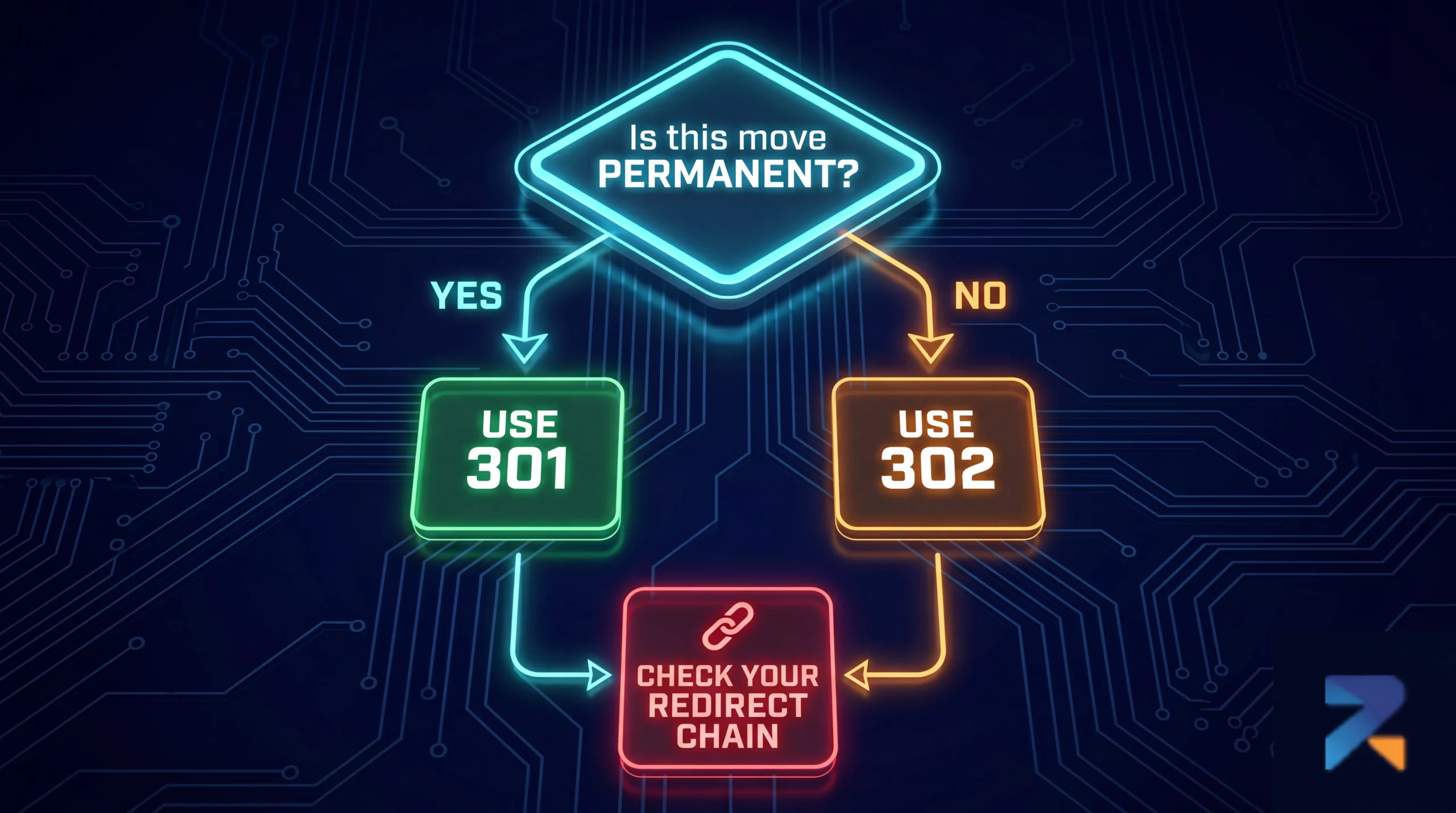
Before you configure any redirect on an aged domain, answer these three questions:
1. Is this move permanent? If yes, use a 301. No exceptions for iGaming authority transfer.
2. Does the original URL need to stay indexed? If yes — because you’re testing, complying with regulatory requirements, or running a temporary routing rule — use a 302. Understand that full authority consolidation will take longer.
3. How many hops does this redirect create? If more than one, restructure before deployment. Every intermediate URL in the chain is a tax on the authority you paid for.
The step-by-step technical setup for implementing a 301 correctly across Apache, Nginx, and cPanel is in the 301 redirect guide for iGaming aged domains. Once you know which redirect type fits your use case, that’s where the implementation detail lives.
And if you’re still in the domain selection phase — figuring out which aged domain is worth pointing at your money site in the first place — start with the aged domain fundamentals for iGaming SEO before spending anything.
The redirect type is a small decision with a disproportionate effect on results. Get it right once, and the domain does exactly what you paid for it to do. If you’re looking for aged domains that are already audited and ready to deploy, Rexusdomain keeps a curated inventory specifically for iGaming operators
Related Guides
Sources & Further Reading
Frequently Asked Questions
What is the difference between a 301 and 302 redirect for iGaming aged domains?
A 301 redirect is permanent and passes approximately 90-99% of link equity from the source URL to the destination. A 302 redirect is temporary and passes minimal or no link equity. For iGaming aged domain strategies, always use 301 redirects — a 302 from an aged domain to a money site provides no meaningful SEO benefit. Google will eventually follow repeated 302 redirects and may credit some equity, but the transfer is unreliable and should never be used intentionally for authority consolidation.
Does a 307 redirect pass link equity differently than a 301 for aged iGaming domains?
A 307 redirect (HTTP 1.1 temporary redirect) functions similarly to 302 — it does not pass reliable link equity. Google treats 307 as temporary and does not consistently credit the destination with the source PageRank. For aged domain to money site redirects, use only 301 permanent redirects configured at the server level via .htaccess (Apache) or server block configuration (Nginx). Meta-refresh and JavaScript redirects provide even less reliable equity transfer than 302 or 307.
How do redirect chains affect link equity from aged iGaming domains?
Each additional hop in a redirect chain dilutes link equity transfer. A direct 301 from aged-domain.com to money-site.com passes approximately 90-99% of equity. Adding one intermediate hop (aged-domain.com → intermediate.com → money-site.com) reduces transfer to approximately 80-90%. Three or more redirect hops can reduce transfer to 60-75%. For aged domain 301 strategies, eliminate all redirect chains — point directly to the canonical money site URL in a single hop.
When should I use a 410 Gone redirect instead of a 301 for aged iGaming domain URLs?
Use 410 Gone for aged iGaming domain URLs that have zero backlinks pointing to them and no value to preserve. A 410 tells Google the URL is permanently removed and should be dropped from the index without redirect equity transfer. Use 410 selectively on low-value orphan pages from the previous domain owner that you want to actively deindex. For all URLs with one or more referring domains, use 301 to preserve equity — a 410 destroys that backlink value permanently.
Can I use a JavaScript redirect from an aged iGaming domain if I cannot access server settings?
JavaScript redirects from aged iGaming domains are not recommended for link equity transfer. Google can follow JavaScript redirects but does not reliably pass PageRank through them. If server-level access is unavailable, contact the hosting provider to implement server-side 301s via .htaccess or Nginx configuration. Meta-refresh redirects with a 0-second delay are a fallback that Google partially follows but should only be used temporarily until proper server-level 301s are configured.
How do I verify my aged domain 301 redirects are passing equity correctly?
Verify 301 redirect equity transfer using three methods: (1) use httpstatus.io or a browser developer tool to confirm the response code is exactly 301 (not 302 or 200); (2) monitor the money site DR in Ahrefs monthly for 90 days post-redirect for measurable authority increase; (3) check Google Search Console Coverage report to confirm the aged domain URLs are dropping from the index as redirected, with the money site URLs gaining impressions for keywords the aged domain previously ranked for.