
Most iGaming operators don’t have a link building strategy. They have a link buying habit.
They mix PBNs, guest posts, 301 redirects, and comment links into the same campaign without a clear reason why each one is there. The result is a backlink profile that looks chaotic to Google because it is. Some months rankings jump. Then a core update hits and everything drops. They blame the algorithm. The real problem was never the update. It was that no one thought through which link type belongs where, and why.
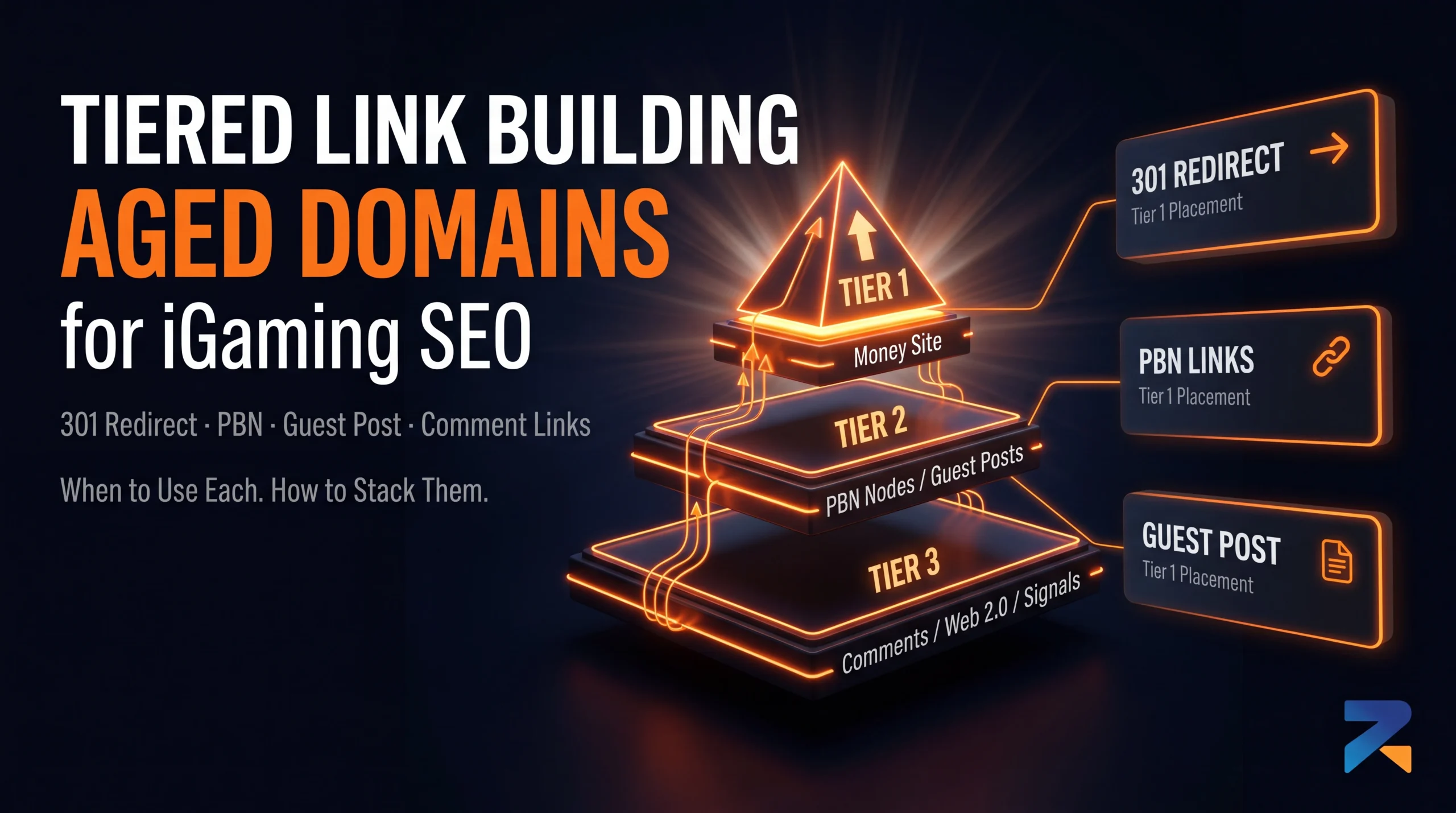
Tiered link building isn’t a black hat tactic. It’s a structural decision. You build links in layers each layer serving a specific function so the signal reaching your money site is clean, credible, and hard to reverse-engineer. When you add aged domains to that structure, each tier gets significantly more leverage. But only if you assign each domain type to the right job.
Here’s the decision framework operators who’ve done this at scale actually use.
What Tiered Link Building Actually Means in iGaming
Three tiers. That’s it.
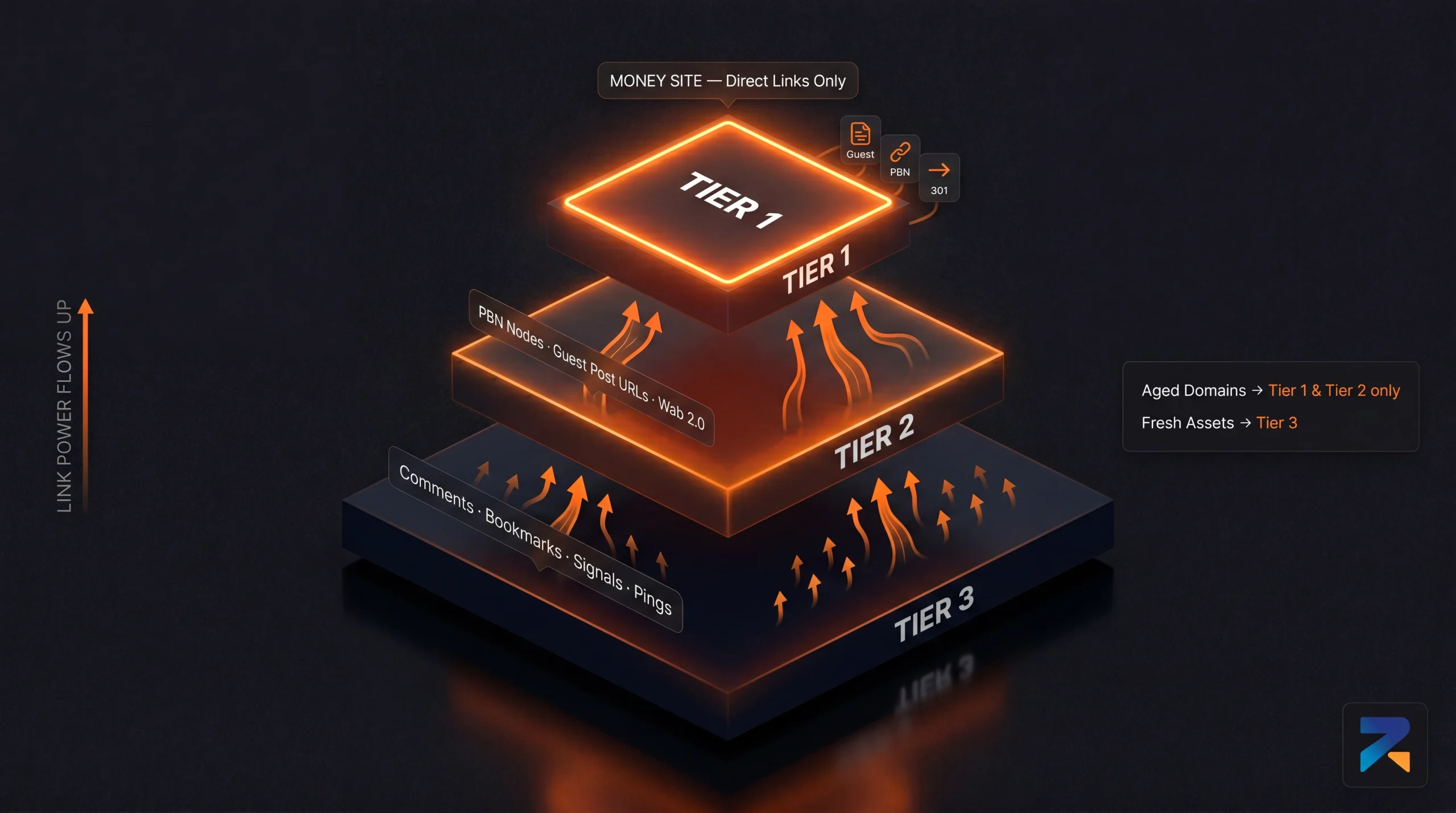
Tier 1 direct links to your money site. These are the only links Google sees pointing at your site. Quality, relevance, and anchor diversity here matter most. Every bad Tier 1 link is a direct signal Google reads about your site.
Tier 2 links pointing to your Tier 1 properties. Not to your money site. To the guest post pages, PBN posts, or niche edit sources that link to you. This amplifies the authority of those Tier 1 links without touching your money site directly.
Tier 3 volume links pointing to Tier 2 properties. The most aggressive, least selective layer. Here you’re buying bulk signals to get Tier 2 pages crawled, indexed, and treated as live content by Google.
The reason this structure works in iGaming is exactly why it needs to be done carefully. iGaming sites carry YMYL scrutiny. Google’s quality evaluators pay close attention to gambling content. An unnatural link profile at Tier 1 is immediately visible. But if you push power through a properly constructed Tier 2, the signal reaching your money site looks organic because the Tier 1 sources look like genuinely authoritative pages.
Where Aged Domains Belong in Each Tier
Aged domains don’t belong everywhere. That’s the first thing to understand.
Their value is domain-level authority years of crawl history, accumulated link equity, and established topical identity. That’s a premium signal. Burning it on Tier 3 bulk link volume is like using a DR60 domain to host comment spam. The asset doesn’t match the job.
In practice, aged domains operate best at Tier 1 (as PBN nodes, niche edit hosts, or 301 redirect sources) and selectively at Tier 2 (as the backbone of your PBN network pointing to Tier 1 guest post pages). Tier 3 is where fresh domains, web 2.0 properties, and disposable assets do the work.
Understand that distinction before reading the rest of this.
When to Use a 301 Redirect
A 301 redirect from an aged domain is the most powerful single move in iGaming SEO when used correctly. You’re pointing the entire link equity of a domain with real history directly at your money site.
Use a 301 redirect when:
- The aged domain has 50+ referring domains from real sources
- Its historical content is topically adjacent to your iGaming niche (a sports news site redirecting to a sports betting platform, for example)
- The domain has no manual penalty history and clean Wayback Machine records
- You need to move the needle fast on a competitive keyword without waiting for content to build authority
Don’t use a 301 redirect when the domain has a mixed or irrelevant history. The redirect passes equity but it also passes context. If Google modeled that domain as a Finnish cooking blog for eight years, pointing it at your Thai casino site creates a topical mismatch that undermines the very authority you paid for.
The other mistake: using a 301 redirect and then trying to layer PBN links on top. Once a domain is redirected, it no longer exists as a standalone entity. You can’t build anchor diversity through a redirected domain. The anchor text of the incoming links to that domain carries over you inherit whatever profile was there before, not what you build after. If you need anchor control, don’t redirect. Build a live site instead.
Read the full breakdown of when 301 redirect passes link equity before executing this.
When to Use PBN Backlinks
PBN links belong at Tier 1, on aged domains with real authority, used specifically for exact match and partial match anchor text control.
Here’s why. Guest posts on real editorial sites give you limited anchor flexibility editors change your text, house style overrides your request, or the site simply won’t publish “best online casino Thailand” as a clickable link. PBNs give you full control. You write the post, you set the anchor, you control the placement.
That control is the reason PBNs still work in iGaming when deployed correctly. And it’s also the reason they get people penalized when deployed recklessly.
Use PBN backlinks when:
- You need exact match anchor text on a competitive keyword (“online casino Malaysia”, “slot gacor”, “live casino Thailand”)
- You want to test how Google responds to a specific anchor without exposing your money site to editorial risk
- You’re building anchor diversity across a multi-domain setup and need fill-in anchors to balance brand-heavy guest post profiles
The rule in iGaming: keep exact match anchors below 8% of your total Tier 1 profile. Some operators push to 10-12% and hold rankings for a while until a core update recalibrates. We’ve seen this kill rankings on otherwise solid DR45+ sites. The domain strength delays the penalty. It doesn’t prevent it.
PBN nodes should always sit on aged domains with at least 3 years of clean history. A PBN built on fresh dropped domains registered last month is visible to Google’s link graph analysis. The age signal on the PBN domain itself matters.
More on running a responsible PBN setup for iGaming here.
When to Use Guest Post Backlinks
Guest posts are your primary authority and trust signal at Tier 1. They’re also the only Tier 1 link type that actively supports E-E-A-T because they appear on real editorial sites that Google already trusts.
Use guest post backlinks when:
- You need brand anchors (“RoyalCasino”, “BetKing Thailand”) or natural anchors (“this platform”, “click here”)
- You’re targeting markets where Google quality raters actively review gambling content (most Tier 1 GEOs: UK, Sweden, Germany, Japan)
- You want co-citation signals being mentioned alongside legitimate gambling brands in the same editorial context
- You’re building long-term authority rather than short-term rank manipulation
The common mistake: putting exact match anchor text in guest posts. Editors at real sites flag it as obviously paid. Even when they accept it, the surrounding content often lacks topical relevance which dilutes the signal. Guest posts should carry your brand and partial match anchors. Leave exact match to PBNs.
One more thing. Guest posts from aged domain sites blogs that have been running for 5+ years with a real editorial history hit significantly harder than posts on freshly launched “guest post farms”. The hosting domain’s history matters as much as the link itself.
Compare the risk-reward of guest posts against PBNs side-by-side here.
When to Use Comment Backlinks
Comment links belong at Tier 3 only. Not Tier 1. Not Tier 2 directly touching Tier 1 sources. Tier 3.
Most comment links are nofollow by default. That means they pass no direct link equity to wherever they point. What they do pass is a crawl signal Google follows the link, lands on the page, and re-crawls it. For Tier 2 PBN posts that need indexing and activity signals, this matters.
Use comment backlinks to:
- Get Tier 2 PBN posts indexed faster after they go live
- Add apparent activity signals to web 2.0 properties you’re using at Tier 2
- Create a natural-looking link pattern around Tier 2 assets (real pages get linked to from comments; it’s a recognizable organic pattern)
What you never do is use comment links pointing directly at your money site. It’s an instant footprint. Bulk comment links targeting a casino domain in iGaming are one of the clearest manual review triggers in the niche. Google’s spam team has seen this pattern thousands of times.
When to Use Niche Edits
Niche edits also called link insertions are links added to existing, already-indexed content on real sites. Not new articles. Existing pages that already rank and have backlinks of their own.
This makes them more powerful than guest posts in one specific way: the page already has authority baked in. You’re not waiting for a new post to accumulate signals. The equity is already there.
Use niche edits when:
- You want Tier 1 power similar to a PBN but from a real editorial domain
- The existing page is topically relevant to your target keyword
- You need a link that looks indistinguishable from an organic mention
The risk with niche edits in iGaming: quality control. Many brokers selling “niche edits” are actually selling injections into hacked or compromised sites. Always verify the Wayback Machine history and traffic data before accepting a niche edit placement. A link from a site that lost 90% of its traffic six months ago isn’t worth what you’re paying.
The Full Decision Map
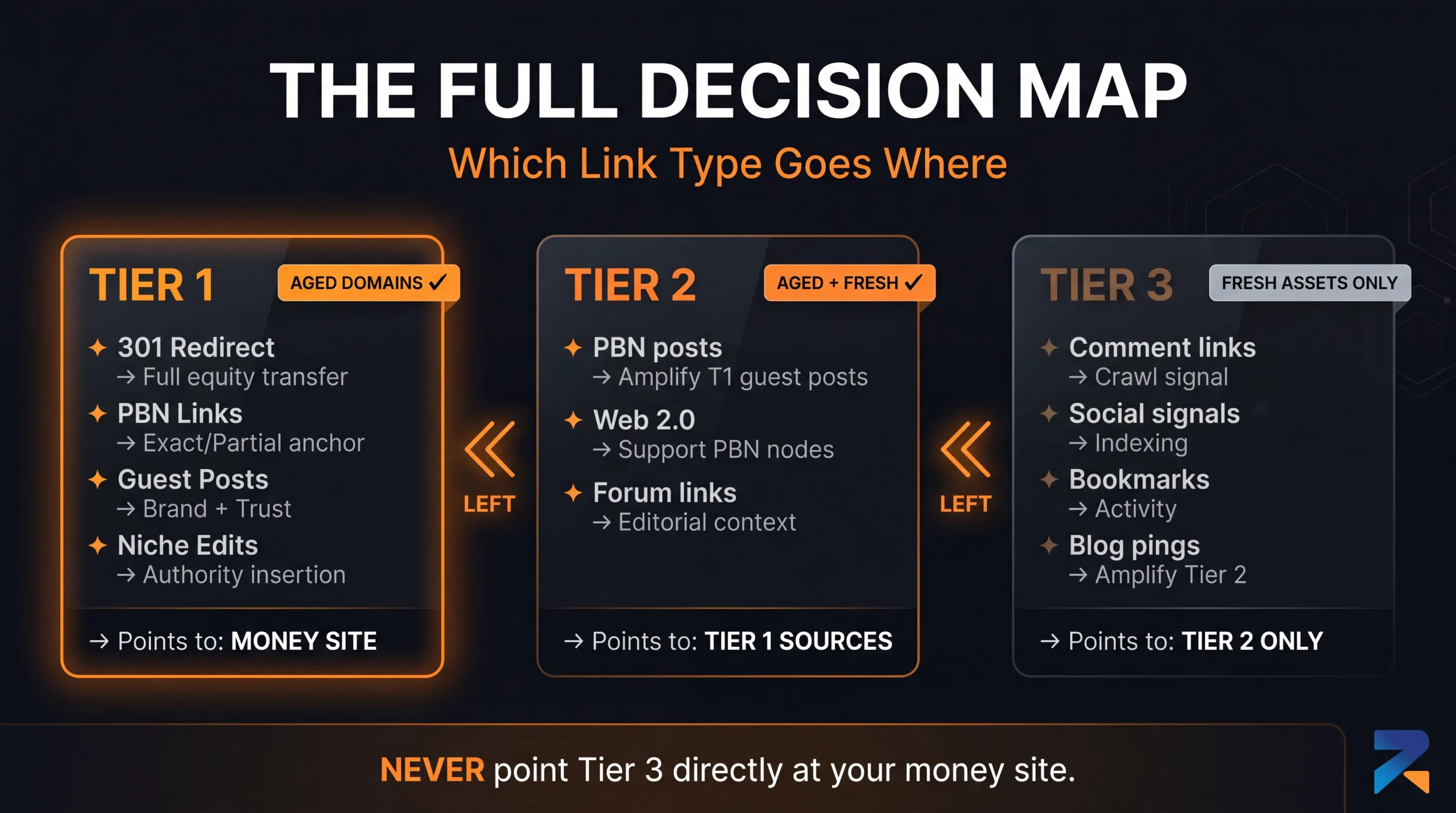
Here’s how the full structure looks when you put it together for an iGaming money site:
Tier 1 Direct to money site:
- 301 redirect from aged domain → full equity transfer, no anchor control after redirect
- PBN on aged domain → exact match and partial match anchors
- Guest post on real editorial site → brand anchors, partial match, E-E-A-T
- Niche edit on real indexed page → topical authority, natural-looking insertion
Tier 2 Pointing to Tier 1 sources:
- PBN links to guest post URLs to amplify their authority
- Web 2.0 properties linking to PBN posts
- Forum contextual links to guest post pages (not to money site)
Tier 3 Amplifying Tier 2:
- Comment links, social signals, blog pings, bookmarks
- All pointing to Tier 2 properties never to Tier 1 sources, never to money site
What Most Operators Get Wrong
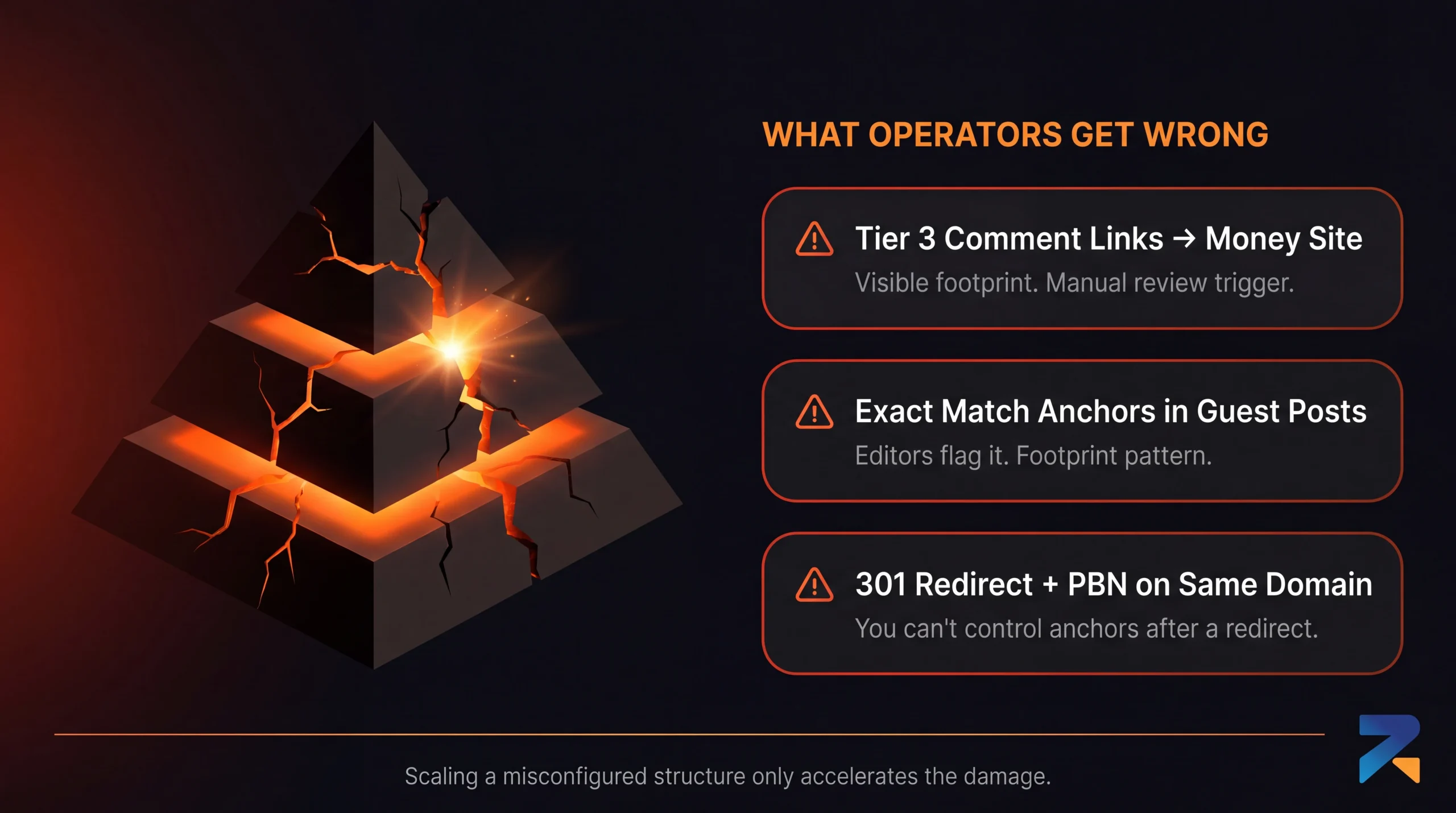
They collapse the tiers. They run Tier 3 comment blasts pointing directly at guest post pages that already link to their money site, which creates a visible footprint of low-quality links two hops from the money site. Google doesn’t stop at one hop when evaluating link patterns.
They also confuse the job of each link type. PBNs for anchor control. Guest posts for authority and trust. 301 redirects for equity consolidation. Niche edits for topical insertion. Comment links for indexing and amplification only. When operators treat all of these as interchangeable just “more links” the profile stops making structural sense.
The operators who maintain stable rankings through core updates are the ones who’ve built this structure deliberately. Every link in their profile has a reason for existing at the tier it sits in.
That’s not a coincidence. It’s architecture.
If you’re still building your first aged domain network and haven’t validated your anchor text ratios or run a full backlink audit, do that before scaling this structure. Scaling a misconfigured setup just accelerates the damage.
When you’re ready to source the aged domains that sit at the foundation of this structure Rexusdomain carries pre-vetted iGaming-relevant domains with verified clean histories. The kind that belong at Tier 1, not Tier 3.
Related Guides
Sources & Further Reading
Frequently Asked Questions
What is tiered link building and how does it apply to iGaming sites on aged domains?
Tiered link building is a strategy where links are built not just to the money site (Tier 1) but also to the pages that link to the money site (Tier 2), amplifying the total PageRank delivered. For iGaming sites on aged domains, Tier 1 links come from quality aged PBN domains and editorial placements. Tier 2 links amplify those Tier 1 sources via guest posts, forum mentions, and social bookmarks. The aged domain money site never directly receives low-quality Tier 2 links.
What should Tier 1, Tier 2, and Tier 3 links look like for an iGaming aged domain strategy?
Tier 1 (direct to money site): aged domain PBN links with TF 15 plus, editorial guest posts on DR 30 plus gambling or finance sites, and niche-relevant directory citations. Tier 2 (links to Tier 1 sources): guest posts on DR 20-30 sites, profile links, social bookmarks, blog comments on relevant forums. Tier 3 (links to Tier 2): social signals, web 2.0 properties, ping submissions. Quality decreases with each tier — Tier 3 links would not be acceptable pointing directly to an iGaming money site.
How many Tier 2 links should each Tier 1 link receive to maximise PageRank amplification?
Each Tier 1 link page should receive 5-20 Tier 2 links to produce meaningful PageRank amplification. Links from aged PBN posts with fewer than 5 incoming Tier 2 links receive minimal amplification benefit. Links with 15-20 Tier 2 links from relevant sources see the greatest proportional authority increase. Avoid exceeding 50 Tier 2 links per Tier 1 source — the marginal amplification diminishes rapidly above 30 links and creates detectable link velocity spikes on the Tier 1 source pages.
Does tiered link building increase the risk of Google penalty for iGaming sites?
Tiered link building reduces penalty risk for iGaming money sites when implemented correctly — low-quality links are never applied directly to the money site URL. The risk shifts to Tier 1 and Tier 2 sources: if a Tier 1 PBN domain is detected and deindexed, the money site loses that link equity but faces no direct penalty. Aged domains used as Tier 1 sources provide more deindexation resilience than fresh domains due to their established crawl histories and legitimate link profiles.
Can aged domain 301 redirects function effectively as Tier 1 in a tiered link strategy?
Yes. Aged domain 301 redirects are one of the cleanest Tier 1 link sources for iGaming tiered strategies because the equity transfer is direct and the aged domain legitimate history provides natural link context. Apply Tier 2 links to the aged domain itself rather than to the redirect destination — amplifying the incoming authority at the redirect source before it passes through to the money site produces the highest effective PageRank delivery at the Tier 1 layer.
What metrics should I track to evaluate whether my tiered link building is working for iGaming?
Track three metrics to evaluate tiered link effectiveness: (1) Ahrefs Domain Rating of the money site — should increase 2-5 points per quarter with consistent Tier 1 additions; (2) target keyword position movement — measure positions for 20-30 target terms monthly using Ahrefs or SEMrush position tracking; (3) organic traffic via Google Search Console — weekly impressions and clicks for target keyword clusters. Tier 2 additions produce delayed effects visible 6-12 weeks after implementation as the amplified Tier 1 authority propagates to the money site.