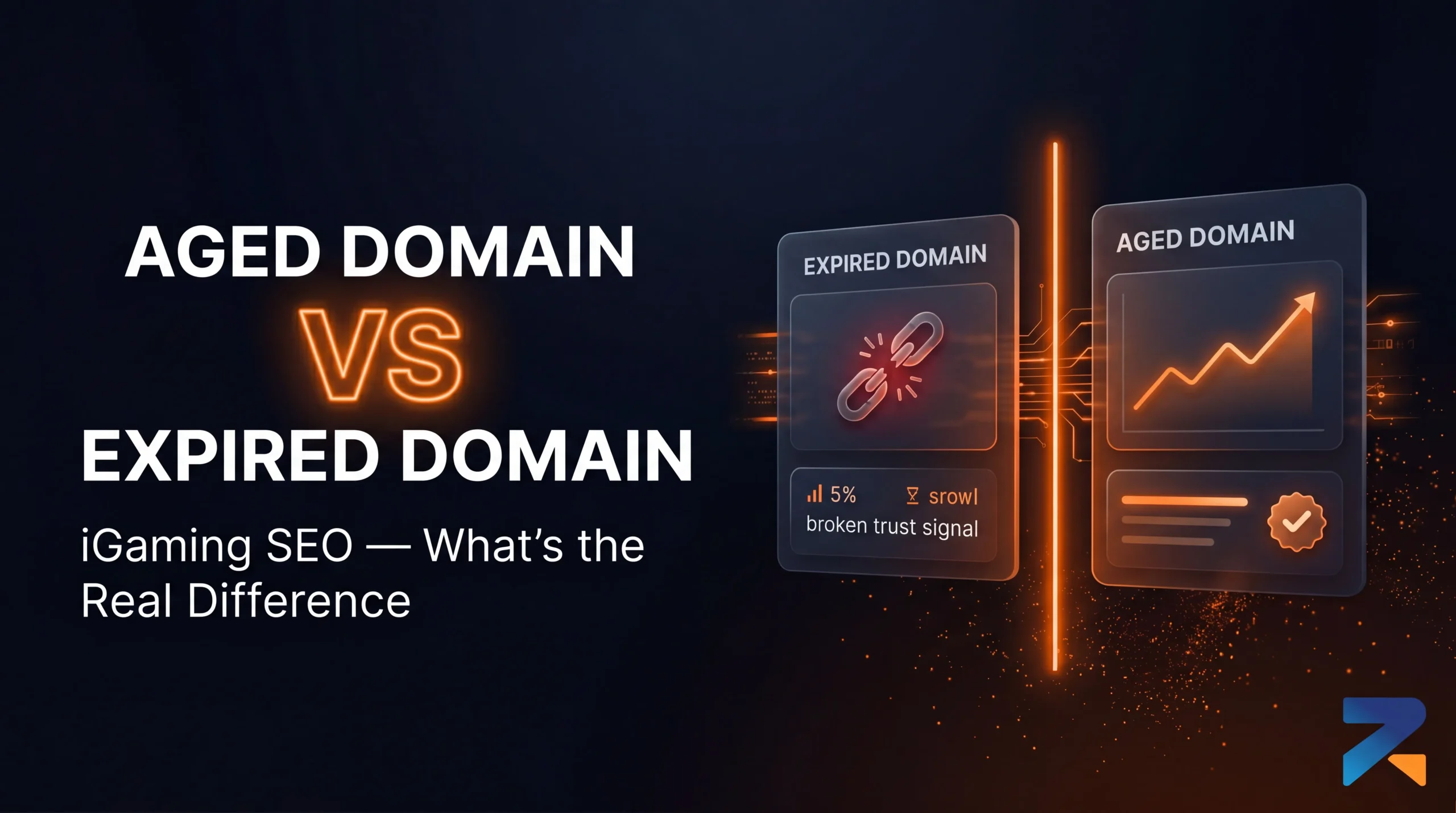

Most people in iGaming use “aged domain” and “expired domain” like they mean the same thing. They don’t.
Buying an expired domain thinking you’re getting an aged domain is one of the most expensive mistakes you can make in this niche — and it happens constantly. The difference isn’t just semantic. It determines whether you’re acquiring a real SEO asset or a domain-shaped liability with inflated metrics and zero trust signal left inside it.
Here’s what actually separates the two, and why it matters specifically in iGaming where Google scrutinizes every link signal harder than in any other vertical.
What Is an Expired Domain?
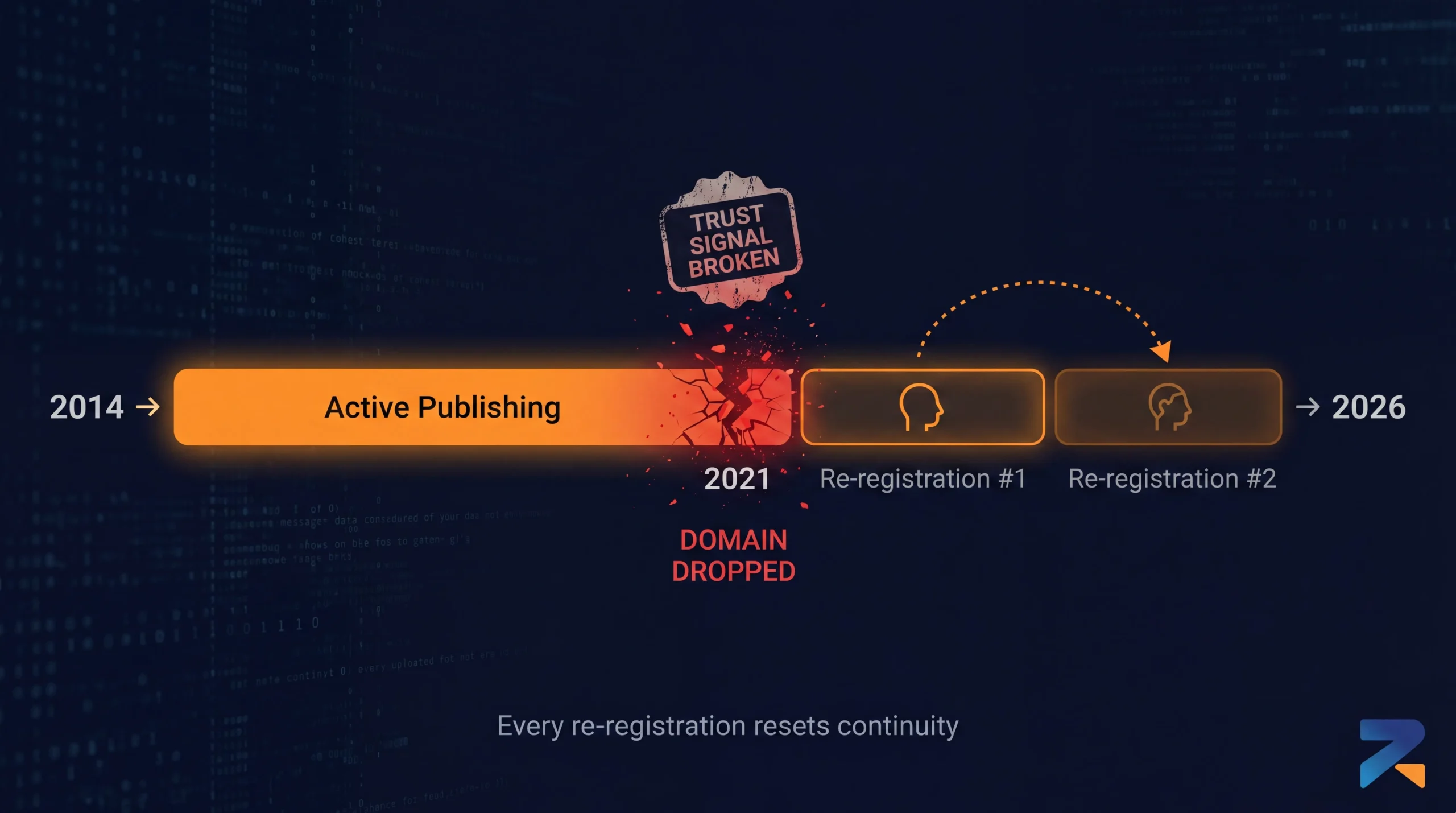
An expired domain is any domain whose registration was not renewed by the original owner. That’s it. The owner stopped paying. The registrar waited out the grace period. The domain dropped.
What happens next is the problem. Once a domain enters the deletion cycle — pending delete, then caught by drop catchers — it gets picked up by whoever bids first. This could be a legitimate SEO buyer. It could also be a content farm operator, a link broker running hundreds of PBN nodes, or someone who cycles the domain through multiple owners in 18 months to juice the metrics before reselling.
An expired domain has lapsed continuity. It may have had a solid 8-year history as a sports media publication. But the moment it expired and went through three re-registrations with different operators, that continuity is broken. Google can see ownership gaps. Google can see content flips. And in the YMYL-heavy territory of iGaming, that broken continuity is a serious red flag.
Not all expired domains are bad. But the expiration event itself is a point of vulnerability. What matters is what happened during and after it.
What Is an Aged Domain?
An aged domain has been continuously held — and in most good definitions, continuously active — over a meaningful period of time. Age alone doesn’t make a domain valuable. A domain registered in 2005 that sat parked on a GoDaddy landing page for 19 years has aged in calendar terms but has no trust accumulation worth talking about.
What you’re actually buying with a properly aged domain is compounded trust signals: years of organic backlinks pointing to real content, a consistent niche identity Google has indexed repeatedly, and zero gaps in the registration chain that would cause a trust reset. If you want the full picture of what makes an aged domain valuable for iGaming, the breakdown starts with these signals — not the registration date.
In iGaming, the sweet spot is domains that were operated as genuine editorial properties — news sites, sports portals, finance publications, tech review sites — for a minimum of 5 years, with clean backlinks from editorial sources, and then became available through a single ownership transition.
That single-transition point is important. The moment a domain passes through multiple re-registrations, it’s no longer genuinely aged in the SEO sense — even if the registration date shows 2008.
The Core Differences That Actually Matter for iGaming SEO
Trust Accumulation vs. Trust History
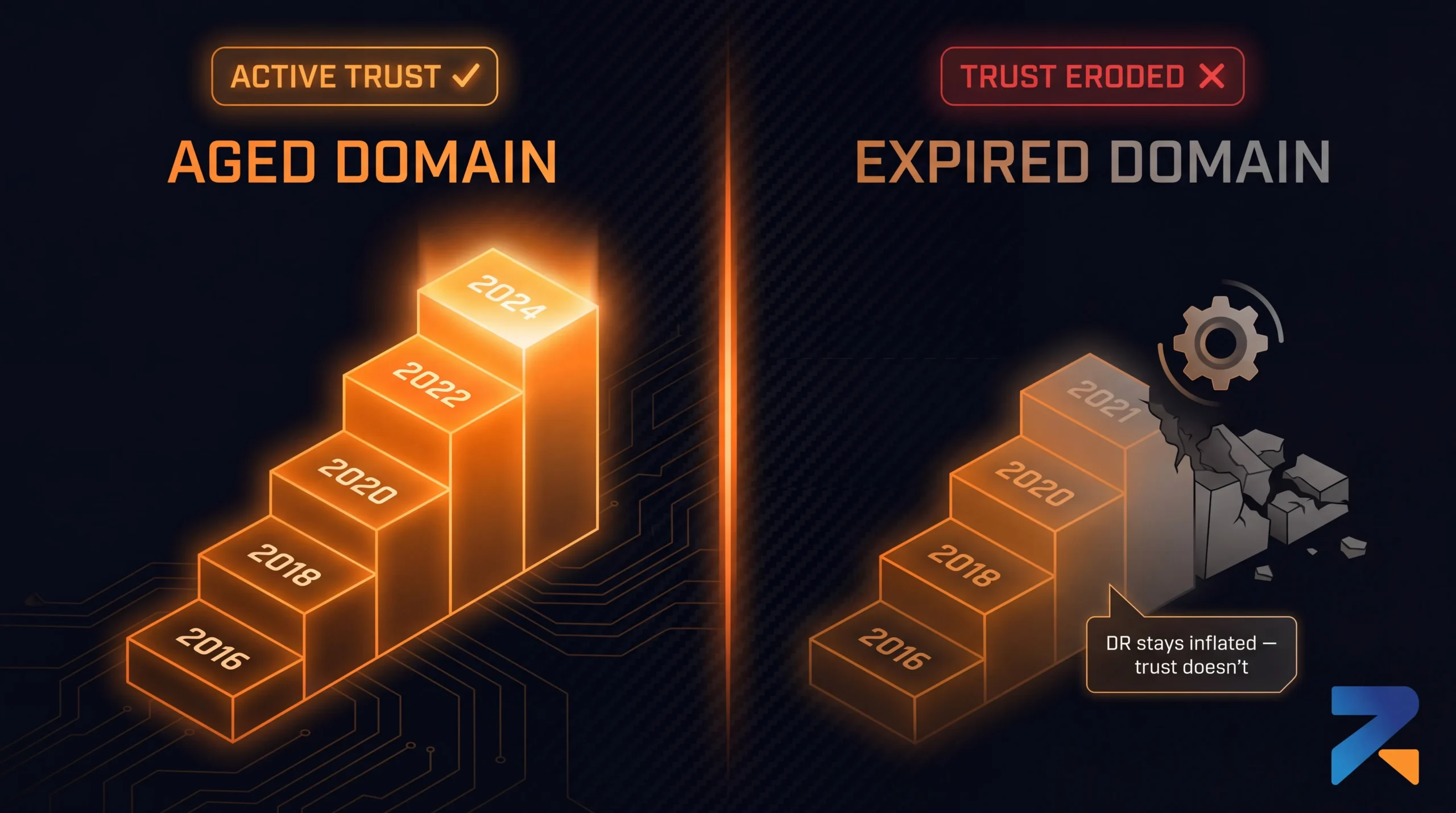
An aged domain has active, compounding trust. Each year of legitimate publishing added signals Google used to build a model of the domain’s authority and relevance. That model persists even after the original site goes offline — but only if the domain wasn’t re-registered, spun through a PBN, or pointed at unrelated content in between.
An expired domain has historical trust — which may or may not still be intact. The trust that existed at expiration doesn’t automatically survive the drop. Content farms understand this, which is why they buy high-DR expired domains, spin up thin content, and resell them at 3x markup. The DR metric stays inflated for months after the domain’s real trust signal has eroded.
This is why DR alone will get you burned in iGaming. We’ve seen operators pay $800 for a DR 42 expired domain that dropped six months earlier, pointed it at a casino affiliate site, got zero ranking movement for four months, and then got hit with a manual action for unnatural links. The domain’s backlink profile looked fine on paper. The content history didn’t.
Ownership Continuity
Most aged domain marketplaces source inventory through one of two routes: private owner negotiation or controlled acquisition at expiration. The best aged domains come from the first route — a single owner who ran the domain actively for years, stopped needing it, and listed it for sale directly.
Expired domains almost always come from the second route. The original owner didn’t intend to sell. The drop happened. Someone picked it up. That someone may have used it, misused it, or flipped it again before it ended up in the marketplace you’re browsing.
For iGaming specifically, ownership chain matters because Google can correlate the content history in Wayback Machine with the backlink acquisition pattern over time. A domain that ran as a legitimate travel blog for 7 years, expired, got picked up by a generic web 2.0 content farm for 18 months, then expired again and landed in a domain marketplace — that domain carries the content farm period in its history. It’s not clean, no matter what the current DR says.
Backlink Profile Integrity
On a properly aged domain, the backlinks accumulated naturally while the original site was live. They point to real content that existed. Referring domains include genuine editorial sources — news publications, community sites, industry directories — and the anchor text distribution looks natural because it was never optimized.
On an expired domain that’s been re-used, you often find layered link activity. Clean original links from the first owner’s era, then a burst of low-quality links acquired by whoever picked it up at expiration, then possibly a disavow attempt from the next owner, then more links added during re-sale prep. In Ahrefs or Majestic, this shows up as unnatural spikes in referring domain growth that don’t align with any real publishing activity.
Run the timeline check. Pull the referring domain acquisition graph in Ahrefs. If you see a flat line of organic growth followed by a sudden spike at any point, cross-reference that spike date against the Wayback Machine. If the spike happened when the domain was either expired or running thin content, those links were bought. Don’t use that domain for a money site or a PBN node you care about.
Price vs. Value Ratio
Expired domains tend to be cheaper at point of acquisition — you can pick them up at auction for $50–$400 depending on the backlink profile. That price reflects the uncertainty. You’re buying what’s there on the surface without any guarantee of what the content history looks like at Google’s end.
Genuinely aged domains from curated marketplaces that pre-screen inventory cost more — typically $300 to $2,000+ depending on DR, niche relevance, and link quality. That premium pays for the verification work that went in before the domain was listed: content history review, backlink audit, penalty check, blacklist screening.
In iGaming, where a good aged domain used as a 301 source can accelerate ranking velocity by 60–90 days compared to a fresh domain, that $800–$1,200 price differential is irrelevant against the revenue timeline. Pay for a verified asset or run the full audit yourself. There’s no middle ground that works.
How to Tell What You’re Actually Getting
Before you buy any domain marketed as “aged,” run this check. If you want the complete step-by-step process, the full guide on how to run the full audit process before you buy covers every metric in detail. The steps below focus specifically on catching the expired-domain-disguised-as-aged scenario.
Step 1 — Wayback Machine ownership continuity audit. Pull snapshots across the full domain history. Look for content gaps longer than 12 months. Note niche shifts. Look for any period where the domain shows a parking page, link farm, or thin content site. A domain that went dark for 14 months in 2021 before being relisted is an expired domain in disguise.
Step 2 — WHOIS history. Use tools like DomainIQ or WhoisXML to pull the full registration history. If you see more than two owners in the past 10 years, treat the domain as expired-class, not aged-class — regardless of what the seller calls it.
Step 3 — Referring domain acquisition timeline. In Ahrefs, pull the referring domains graph. Organic, gradual growth that mirrors the original site’s publishing activity is the green flag. Spikes at non-publishing periods are the red flag. A domain that went from 40 referring domains to 190 in a three-month window during a period when the Wayback Machine shows nothing but a parking page — that’s manufactured authority.
Step 4 — Manual penalty and spam footprint check. You can’t access Search Console pre-purchase, but you can look for heavy exact-match anchor text clusters, groups of backlinks from the same IP range, or link patterns that match known link networks. Cross-check the domain against Google’s spam report archives if the backlink volume looks suspicious relative to the domain’s publishing history.
Step 5 — Live index check. Do a site: search for the domain. Indexed pages that match the original content history suggest Google still respects the domain. A domain with zero indexed pages, a DR of 38, and a strong-looking backlink profile is not aged — it’s an expired domain with inflated third-party metrics and a trust signal that already degraded.
The Labels Don’t Mean Anything Without the Audit
Here’s the thing about the marketplace: there’s no industry-wide definition of “aged domain” that every seller uses consistently. Some platforms list any domain older than 3 years as “aged.” Others include expired domains that have already been through one re-registration cycle. A few do the full audit work before listing.
The label is marketing. The audit is reality.
When you’re buying for iGaming — whether for a money site, a 301 redirect source, or a PBN node — you need to evaluate every domain as if it might be an expired domain with a cleaned-up surface. Run the five steps above every time. No exceptions based on price, seller reputation, or how good the metrics look in the listing.
Most operators who’ve been burned by a bad domain weren’t careless. They just trusted a label that nobody actually enforces.
The Practical Rule
If someone is selling you an “aged domain” and can’t tell you the full ownership chain, walk away. A real aged domain has a traceable story. You should be able to follow that story from registration to present in Wayback Machine, confirm it in WHOIS history, and see it reflected in a clean, gradual backlink acquisition curve.
Expired domains aren’t automatically worthless. Some are excellent assets. But you need to audit them as expired domains — with full awareness that the trust continuity may be broken — not assume they carry the same SEO value as a properly aged asset.
In iGaming, you don’t have the luxury of testing this. The sandbox period on a compromised domain costs you months of ranking time and potentially triggers manual scrutiny that follows your money site long after you’ve moved on.
If you want domains that have already been through the full audit process — ownership history verified, backlink profile reviewed, content history clean — Rexusdomain’s inventory is pre-screened specifically for iGaming use. No guesswork at checkout.
Related Guides
Sources & Further Reading
Frequently Asked Questions
What is the difference between an aged domain and an expired domain?
An aged domain is any domain registered for a significant period (typically 5+ years) regardless of whether it is currently active. An expired domain specifically refers to a domain whose registration has lapsed and entered the deletion or pending-delete phase. Not all expired domains are aged — a 2-year-old domain that expired is simply expired, not meaningfully aged. For iGaming SEO, the age, authority, and content history matter more than the registration status.
Is an aged domain more valuable than an expired domain for iGaming SEO?
Both terms describe different attributes of the same potential acquisition target. A domain can be both aged and expired. What matters for iGaming SEO is the combination of age (8+ years preferred), authority (DR 25+, TF 15+), content history (legitimate iGaming or adjacent content), and availability (expired, for sale, or acquired via auction). Domain age alone adds value only when accompanied by a genuine historical backlink profile.
How old does a domain need to be to count as an aged domain?
The iGaming SEO industry generally considers 5+ years as the minimum threshold for a meaningfully aged domain, with 8-12 years as the sweet spot. Domains registered before 2015 have historical link profiles that predate major Google Penguin and Panda updates, providing additional validation of link quality. Domains older than 15 years with unbroken content history command premium pricing but provide the strongest authority signals.
Can I buy an aged domain that is still registered by someone else?
Yes. Aged domains currently registered by their owners can be purchased through direct outreach, broker services like Sedo or Afternic, or via GoDaddy Auctions if the owner has listed it for sale. Direct outreach to the current registrant (via WHOIS if not privacy-protected) is the most cost-effective approach for acquiring in-use aged domains, though success rates are typically under 10%.
What makes an aged domain expire instead of renewing?
Domains expire when registrants fail to renew before the expiration date. Common reasons include: the registrant abandoned the project, the email on file is no longer active (missing renewal notices), auto-renew failed due to expired payment card, or the domain was strategically allowed to lapse. For iGaming domain buyers, domains abandoned due to Google penalties are a risk — verify through Wayback Machine gaps and Google Search Console history.
Are aged domain metrics different from expired domain metrics?
No — the SEO metrics (DR, TF, referring domains) apply identically whether a domain is currently registered or expired. The key difference is timing: metrics from an expired domain that has been deleted and re-registered by a third party are typically reset to zero within 6-12 months as Google drops the historical link credit. Acquiring before deletion — via backorder or auction — preserves the full metric value.