
Most operators skip the restoration phase entirely. They buy the domain, verify the metrics, and immediately slap their casino affiliate template on it. WordPress installed, theme activated, 30 iGaming pages live done.
Then they wait. And wait. And wonder why the domain that was supposed to skip the sandbox is behaving like a fresh registration.
Here’s what happened: they broke the historical content signal. Google came back to a domain it recognized, found nothing resembling what used to be there, and treated the whole thing as a reset. The authority didn’t disappear overnight but the transition was so abrupt that Google had no reason to associate the new content with the domain’s existing trust. That’s not a sandbox. That’s a self-inflicted penalty.
Content restoration isn’t about nostalgia. It’s about signaling continuity to a crawler that has years of expectations about what this domain is supposed to look like.
Why Content Continuity Matters More Than Metrics
Every tool will show you DR, DA, TF, backlink counts. None of them show you how Google perceives the domain’s content identity. And that identity matters especially in a niche as scrutinized as iGaming.
When Googlebot revisits a domain it’s been crawling for six years and finds zero pages that relate to what was previously there, it doesn’t automatically carry over the trust. It re-evaluates. That re-evaluation takes time you don’t have in a competitive market, and it often produces volatility that looks like a penalty from the outside.
We’ve seen operators with DR 40+ domains still stuck on page 5 eight weeks post-launch. Backlinks were real. History was clean. The only difference was zero content bridge between the domain’s past and its iGaming future.
The operators who avoid this problem do one thing first: they restore before they redirect.
Step 1 — Reconstruct the Content Map from Wayback Machine
Before you write a single word of new content, you need to know what this domain used to publish. Not just the niche the actual URL structure, the category logic, the specific pages that were earning links.
Go to archive.org. Pull the full crawl history. Don’t just look at the homepage snapshots. Dig into the inner pages the ones that have backlinks pointing at them specifically. If an article about “online payment security” at /blog/payment-security/ has 12 dofollow links from finance sites, that URL slot still has equity potential even if the content is gone.
Map out:
- Every URL that received at least one external backlink
- The original content category breakdown
- The most recent active period before the domain went dark or dropped
- Any sharp topic shifts in the archive (a domain that was a travel blog for 4 years and then pivoted to crypto for 6 months is sending mixed signals)
This isn’t vetting you already did that. This is forensic content mapping, and it’s the blueprint for your restoration phase. The Wayback Machine guide covers how to read the archive correctly if you haven’t done that already.
Step 2 — Decide: Restore, Redirect, or Bridge
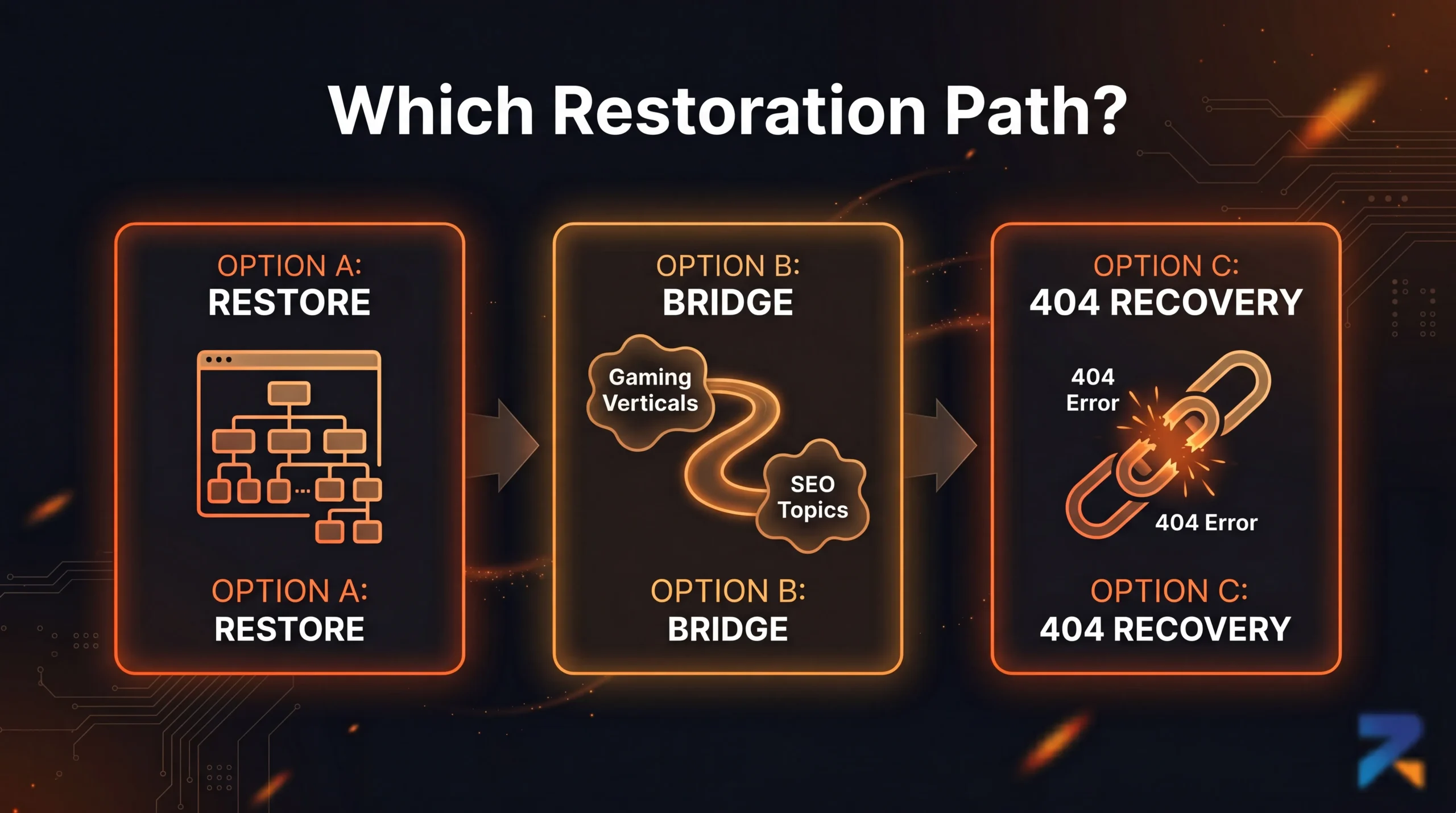
Once you have the content map, you have three realistic options. Which one you choose depends on how related the domain’s original niche is to iGaming.
Option A: Direct Restoration
The domain was in a related niche finance, payments, entertainment, technology. The backlink profile is topically adjacent. In this case, restore 60–80% of the original URL structure with updated, legitimately useful content before introducing any iGaming-specific pages.
Don’t copy the old content from the Wayback snapshot verbatim. Rewrite it. Give Google fresh content on familiar URLs. The signal you’re sending is: this domain is back, it’s active, and it’s continuing in the same direction. Give it 3–4 weeks of crawl activity before introducing iGaming content.
Option B: Niche Bridge
The domain was in a completely unrelated niche local services, food, travel. Direct restoration would mean publishing content that has nothing to do with what you’re building. In this case, you build a topical bridge.
Identify overlapping themes. Gambling adjacent topics include finance, entertainment, sports, gaming, and mobile technology. Publish 8–12 articles in those bridge categories first. You’re not pretending to be a travel blog. You’re using legitimate content areas to demonstrate topical evolution rather than a hard reset.
This approach is slower. Expect 6–8 weeks of bridge content activity before moving into core iGaming pages. But it’s a fraction of the time you’d spend in sandbox with a fresh domain.
Option C: Strategic 404 Recovery
Some operators skip the restore entirely and focus on recovering the highest-value orphan URLs. If a specific page at /reviews/best-slots/ has 40 links pointing at it and the original content was gone before you bought the domain, you can publish iGaming content at that exact URL path and capture the link equity directly.
This works cleanly when the historical URL aligns well with where you’re taking the site. It doesn’t work if you’re forcing a topical mismatch a URL that used to hold a recipe blog post isn’t going to smoothly carry a “best online casino bonuses” page to the top of the SERP without significant time and authority.
Step 3 — Rebuild Content in the Right Order
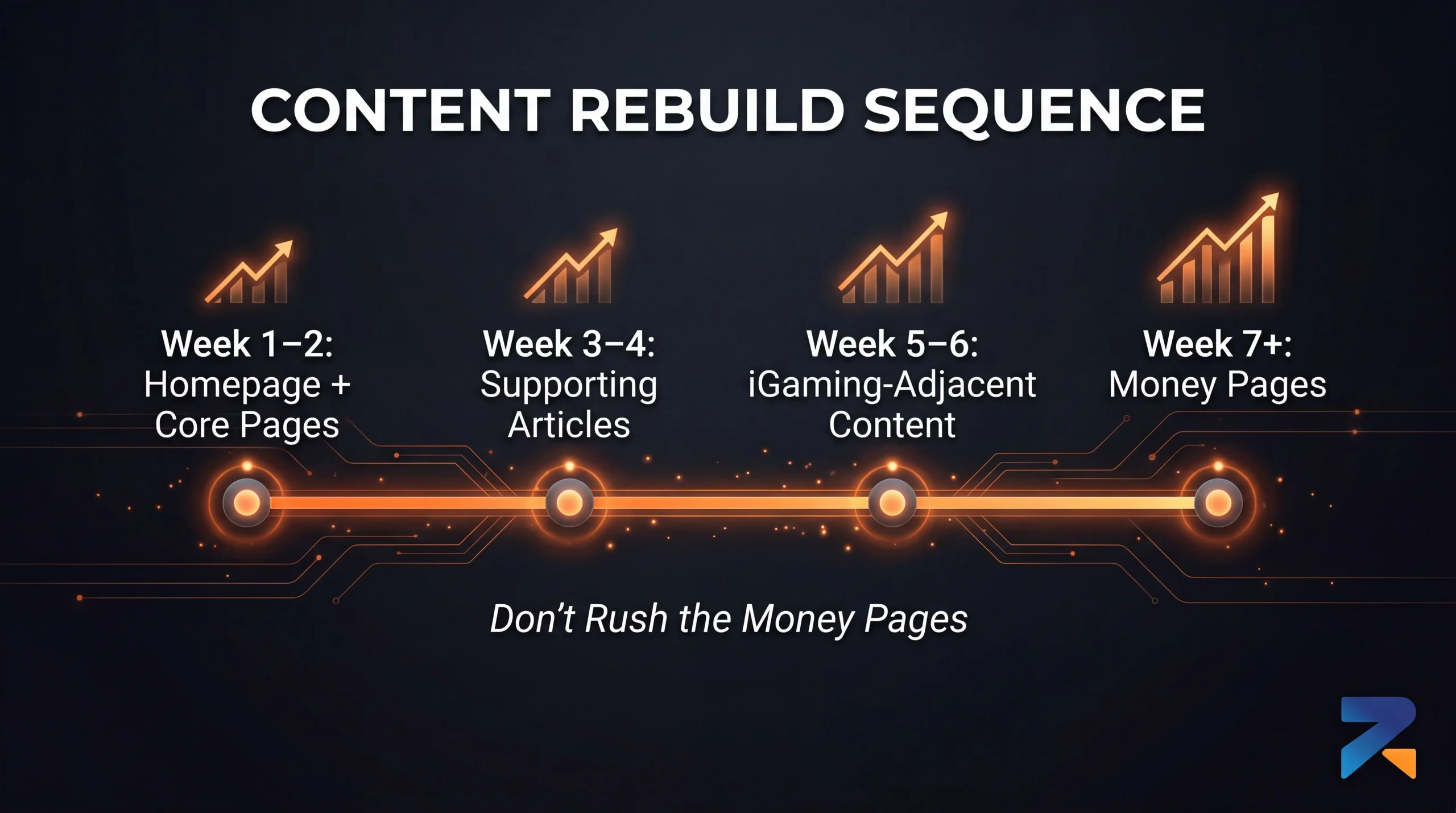
Order matters. Most operators publish everything at once. Don’t.
Google’s re-crawl of a domain that’s been dormant follows a pattern: it starts shallow (homepage, a few top-level pages), then goes deeper over time as crawl budget confidence builds. If you publish 80 pages on day one, most of them won’t get meaningfully evaluated for weeks. Worse, a large content drop with no engagement signals looks manufactured.
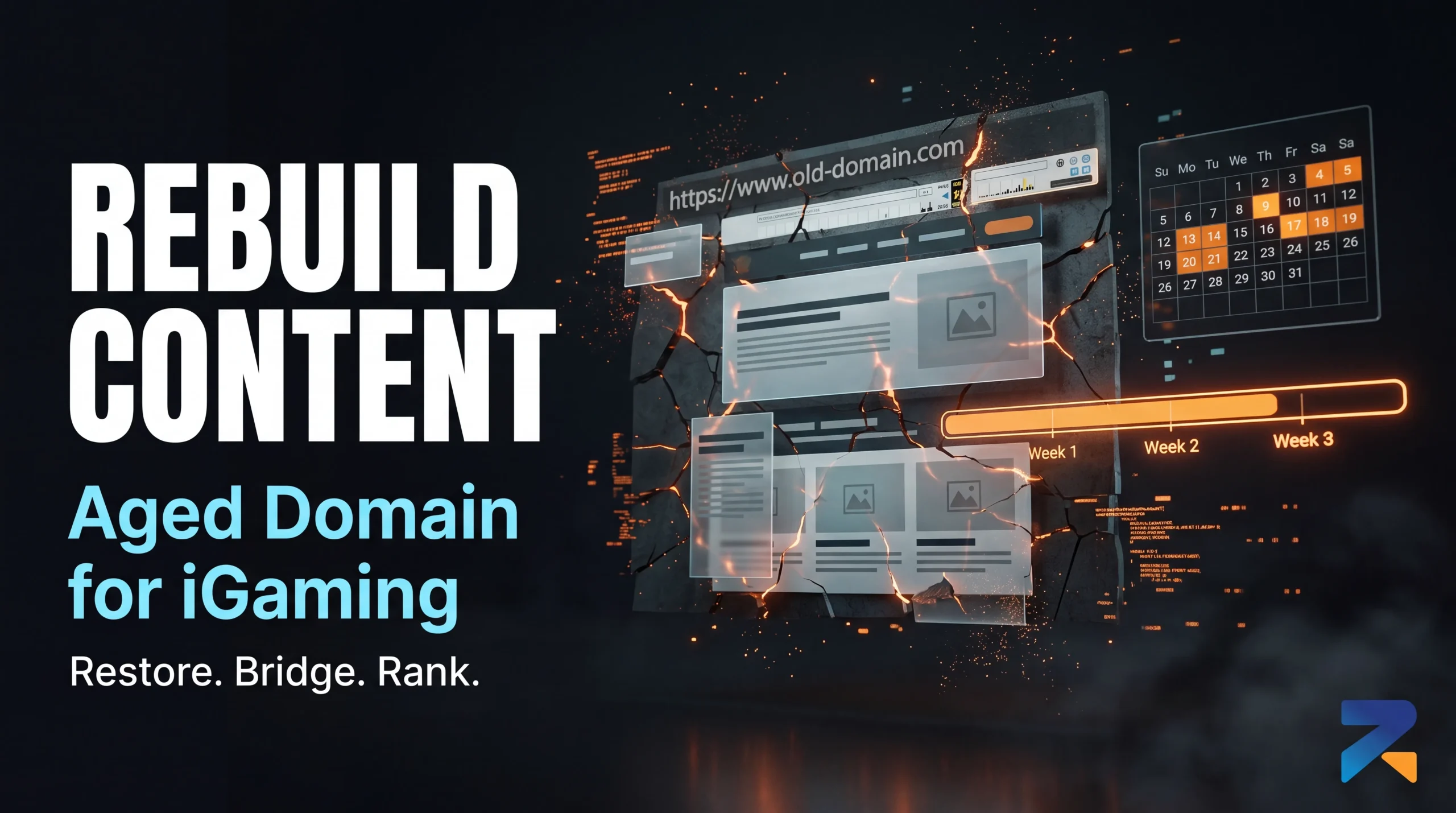
Week 1–2: Homepage and 3–5 core category pages only. These should reflect either the original niche (if restoring) or the bridge topics (if pivoting). Submit sitemap with only these URLs. Let Googlebot in.
Week 3–4: 8–12 supporting articles. Mix informational and navigational content. No commercial iGaming pages yet. Build the topical scaffold first.
Week 5–6: Introduce your first iGaming-adjacent content. Casino payment guides, sports betting explainers, responsible gambling topics content that has real value and slots naturally into what you’ve been building.
Week 7 onward: Core money pages. Review pages, comparison pages, bonus pages. By now the domain has fresh crawl activity across multiple content categories. Your commercial iGaming content is entering an environment Google has already re-evaluated and accepted.
This timeline isn’t theoretical. Operators who follow a staged rollout consistently see commercial pages index within 10–14 days of publishing. Those who go straight to the money pages on day one often wait 30–60 days just for indexation if it happens at all.
Step 4 — Preserve the URL Architecture Where It Counts
Here’s the part most people get completely wrong.
If the original domain had backlinks pointing to specific inner pages, you need to either restore content at those exact URLs or 301 redirect those paths to the most relevant iGaming page on your new site. Letting those URLs return a 404 is leaving link equity on the floor.
Run your backlink export from Ahrefs or Majestic. Filter by linked page (not just root domain). For every URL with 2+ external links, make a decision: restore, redirect to a relevant page, or 301 to homepage as a last resort.
Never let high-value linked pages 404 permanently. That’s not just wasted equity it’s a crawl signal that the domain is abandoning its historical footprint, which is exactly what you’re trying to avoid.
The redirect types guide has the technical breakdown of which redirect to use in which situation. The short version for this context: 301 from old paths to the most topically relevant new page you have. Don’t 301 everything to the homepage.
Step 5 — Monitor Indexation Before You Scale
Don’t build out 50 pages and then check. Build in batches and track what’s happening between each batch.
After each publishing wave, check:
- Which pages have been crawled (Google Search Console coverage report)
- Which pages are indexed (site: operator in Google)
- Which pages are excluded and why (soft 404, duplicate, discovered but not indexed)
“Discovered currently not indexed” is the warning you want to catch early. If a large portion of your new content is sitting in that bucket after 2–3 weeks, it’s a signal that crawl budget is constrained or that Google is skeptical of the content quality. In that case, stop publishing more and fix what you have. More content published on a domain Google is already skeptical of doesn’t help.
For a full breakdown of what indexation behavior to expect and what each status means, the aged domain indexation guide covers this in detail.
The Mistake That Kills More Aged Domain Investments Than Anything Else
Impatience.
Not buying a bad domain. Not choosing the wrong niche. Not building the wrong content. Impatience.
The restoration phase feels like dead time. You’re publishing content that’s not directly earning anything. You’re waiting weeks before your commercial pages go live. It feels like you’re delaying the ROI on a domain you paid good money for.
But operators who cut this phase short who go straight to money pages, skip the bridge, ignore the URL architecture are the ones who come back six months later asking why their DR 45 domain isn’t ranking and their indexation is broken and their investment isn’t performing.
The restoration phase is not optional. It’s the mechanism by which the domain’s historical authority actually transfers to what you’re building.
Do it properly the first time. The commercial pages will come. And when they do, they’ll rank faster than anything you’ve built on a fresh domain because the foundation under them is real.
If you need a domain with clean history, verified metrics, and a genuine content record worth restoring, Rexusdomain is where operators who know what they’re doing go first.
Related Guides
Sources & Further Reading
Frequently Asked Questions
How should I rebuild content on an aged domain before launching an iGaming site?
Rebuild content in alignment with the domain history found in Wayback Machine archives. If the domain previously served iGaming content, rebuild with similar topical categories — casino reviews, game guides, responsible gambling information. Publish 10-20 pages before any promotional activity. Avoid immediately launching aggressive affiliate content; Google evaluates new content on aged domains against the established topical footprint from the domain history.
How many pages should I publish when rebuilding an aged domain for iGaming?
Publish a minimum of 10-15 topically relevant pages before any link building or affiliate integration. Prioritise: home page, about page, 3-5 core category pages (casino games, sports betting, promotions), 5-10 informational articles matching the previous content history, and a contact page. This foundation establishes E-E-A-T signals and gives Google enough context to evaluate topical authority before algorithmic ranking decisions.
Should the new iGaming content match the aged domain previous topic?
Yes, ideally. A domain previously hosting gambling news or casino reviews should rebuild with similar content to leverage topical Trust Flow signals from existing backlinks. Complete topic pivots — from finance to iGaming, for example — are possible but require 6-12 months for topical authority to re-establish. Within-niche transitions (poker to casino) are faster. Maintain 60-70% topical overlap with previous content themes for the fastest authority transfer.
What technical setup is required before publishing content on an aged domain?
Before publishing: (1) clear all old redirects and ensure clean URL structure; (2) submit an XML sitemap to Google Search Console immediately after first content publication; (3) set canonical tags on all pages; (4) configure robots.txt to allow all Google crawlers; (5) verify no residual 301 redirects pointing to the old content; (6) check for legacy DNS settings that may route traffic incorrectly; (7) configure HTTPS with a valid SSL certificate.
How long after content rebuild does an aged domain start ranking for iGaming keywords?
With high-quality content on a DR 30+ aged domain with a clean history, initial rankings for informational iGaming keywords typically appear within 4-8 weeks. Competitive transactional terms (best online casino, sports betting offers) require 3-6 months of consistent content and link building. Aged domains with strong topical Trust Flow in gambling categories rank faster than off-topic domains regardless of raw DR or DA scores.
Should I use the original domain URLs when rebuilding iGaming content on an aged domain?
Use original URLs where practical if they align with your new iGaming site structure. Original URLs that received backlinks retain higher equity than newly created URLs — Google attributes backlink value to the specific URL, not just the domain. For URLs with no backlinks, create your ideal URL structure. Redirect all old high-traffic URLs to their nearest equivalent in the new content architecture using 301 redirects.