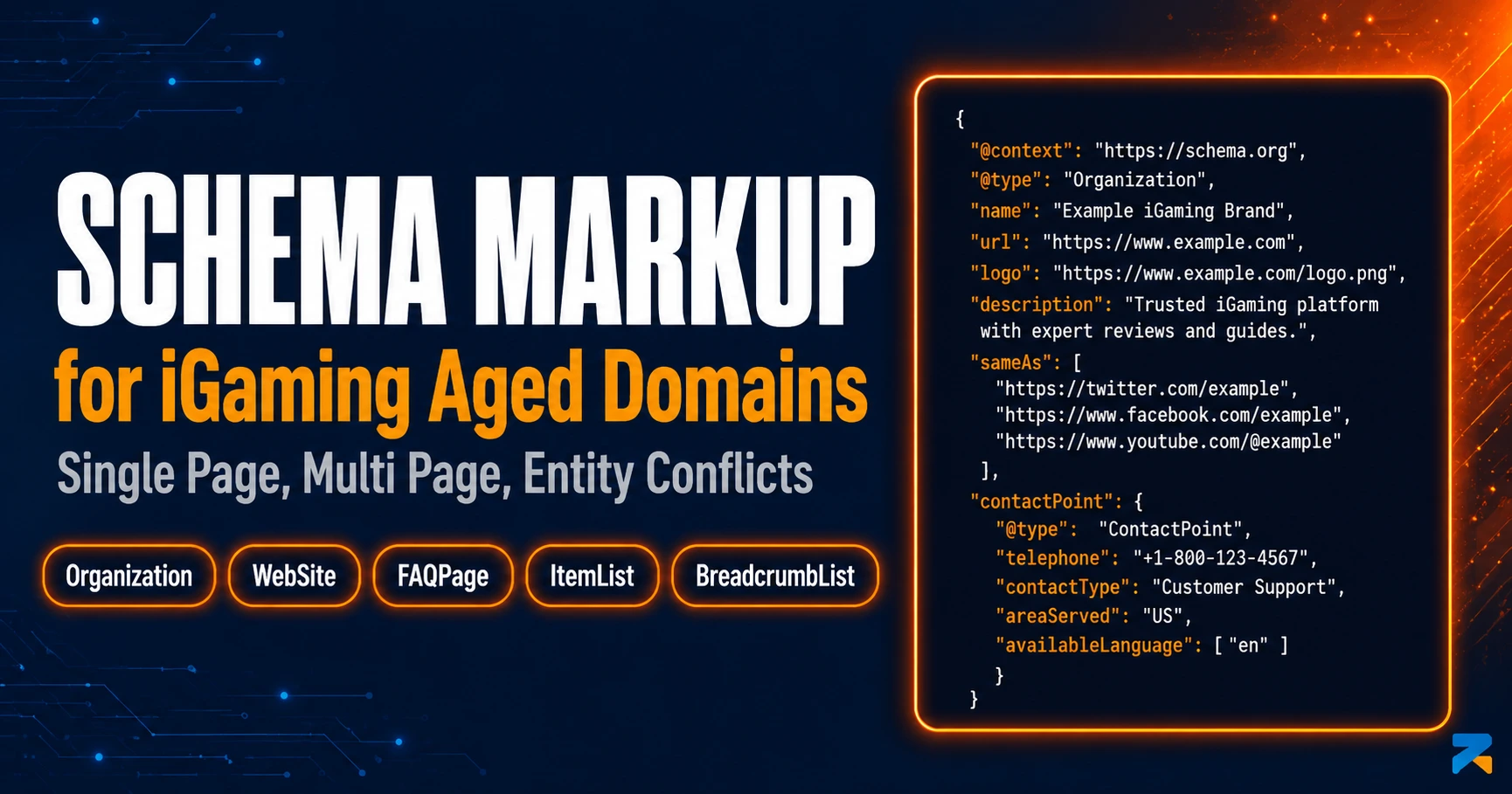

Schema markup behaves differently on an aged domain than on a new one: because Google already has years of crawl history and an existing entity model for that domain, the structured data you add either reinforces what Google already believes about the site, or creates a conflict with it. For iGaming operators, the practical decision is between a single-page schema setup (simpler, faster to launch) and a multi-page structure (granular Article/Product-level markup, better suited to larger content libraries) — this guide breaks down when each approach makes sense.
If you’ve ever wondered why iGaming sites that clone layouts from major retail or tech brands seem to rank faster than sites built from scratch part of the answer is in the schema. Not just the visual trust. Not just the UX familiarity. The actual structured data pattern that legitimate brands have been feeding Google for years, embedded in the HTML those operators are borrowing.
The problem is most SEO specialists stop at that observation. They don’t go one step further and ask: what does that actually mean for sites I’m building myself on aged domains?
Here’s the thing. When you build on an aged domain, Google already has an entity model for that domain. It has crawl history, content patterns, topical signals, and structural data it’s been processing for years. The schema you install on day one doesn’t land on a blank slate. It lands on top of everything Google already knows about that domain. That distinction changes everything about how you approach schema for iGaming.
Get it right and your schema amplifies existing trust signals. Get it wrong and you’re creating entity conflicts that quietly suppress rankings for months without showing up as a manual action. Most operators never connect those drops to their structured data. They blame the algorithm. They buy more links. The schema problem sits there untouched.
Why Schema Hits Different on an Aged Domain
A fresh domain has no entity history Schema you install there is the first signal Google receives about what kind of entity this site represents. It’s formative. For better or worse, Google builds its initial understanding from what you give it.
An aged domain is different. Google has visited it hundreds or thousands of times. It has indexed content, understood topical scope, parsed link patterns, and formed a working model of what this domain is. That model doesn’t reset the moment you acquire the domain and redirect it to iGaming content.
This is the part operators miss and it’s the same logic behind the brand template strategy operators use across Southeast Asia. They assume buying a domain wipes the slate. It doesn’t. The authority carries forward, yes that’s why you bought it. But so does the entity model. And if the schema you install in week one contradicts that model in ways that look abrupt and unnatural, Google registers that as noise, not signal.
A domain that spent six years as a sports media publication has an established entity type in Google’s knowledge graph something adjacent to NewsMediaOrganization or a topical sports content entity. The moment you reclassify it overnight as a gambling operation using aggressive schema, you’ve created a mismatch. The authority is still there, but now there’s friction between what Google knew and what you’re claiming.
The play is to let schema guide the entity transition gradually, not announce a hard pivot. That means choosing schema types that bridge the gap, starting with neutral entity types like Organization and WebSite before layering in gambling-adjacent markup.
Single-Page iGaming Money Site Schema Stack
Single-page money sites in iGaming are a specific beast. One URL, everything on that page, CTA pointing directly to the platform. No blog, no subpages, no internal link structure. The schema options are narrower, which means you need to make every choice count.
The Non-Negotiables
WebSite schema is the first thing you install and the one most people skip. It tells Google the canonical identity of the site its name, URL, and optionally a SearchAction that enables the sitelinks search box. For single-page sites the SearchAction isn’t relevant, but the name and url properties are critical because they anchor your entity identity in Google’s knowledge graph. This is how Google knows what to call you.
WebPage schema comes next. Declare the page type, name, description, and the date modified. Keep the dateModified property updated when you make content changes this is a freshness signal that aged domain operators frequently ignore. An aged domain with stale schema dates tells Google the content hasn’t been touched, even if you updated it last week.
Organization schema is where most single-page iGaming sites leave serious E-E-A-T signal on the table. The sameAs property lets you connect your site entity to social profiles, directory listings, and third-party mentions. If your domain has a Facebook page, a Twitter presence, or is listed on any gambling review aggregator link them here. Google uses sameAs to cross-reference whether this entity exists beyond the domain itself. For iGaming specifically, where trust signals are under elevated scrutiny because of YMYL classification, sameAs is one of the highest-leverage moves available on a single page.
FAQPage Honest Assessment Post-2023
Google restricted FAQ rich results in September 2023. For most sites, FAQ schema no longer produces the expandable snippet in search results that made it so attractive before. If you’re installing FAQ schema purely for SERP real estate, the ROI dropped significantly.
That said, don’t remove it and don’t skip it. The reason is AI Overviews citation signals and how Google pulls structured Q&A content to answer user queries directly in search.. Google’s AI-generated summaries pull structured Q&A content to answer user queries, and FAQPage schema is one of the cleaner signals for parseable Q&A structure on a page. For iGaming sites that want to appear in AI Overview citations which is increasingly where top-of-funnel visibility is going FAQ schema still does real work. It’s just working differently than it did three years ago.
The trap with FAQ schema on single-page sites is using it to house generic questions nobody is actually asking. “What is online gambling?” is not a FAQ worth marking up. “Is [platform name] available in [country]?” or “What deposit methods does [platform] accept?” those are real questions with real search behavior behind them. Specificity is what makes FAQ schema useful in the AI parsing context.
AggregateRating The Grey Area
Self-serving AggregateRating markup where you’re rating your own site or platform without third-party data backing it is Google’s least favorite thing in iGaming structured data. They know what it looks like. A 4.9/5 stars from 2,847 reviews on a single-page site with no visible review mechanism is exactly the kind of schema manipulation Google’s manual review team looks for in this niche.
The version that works without the same risk: aggregate from verifiable third-party mentions. If your platform is listed on review aggregators, forum threads, or affiliate directories with quantifiable sentiment, you can reference that data. The key is traceability. If Google’s quality rater can’t follow a logical path to where those ratings came from, the markup creates more risk than value.
For most single-page money sites on aged domains, skip AggregateRating entirely unless you have a defensible source. The other schema types do more work with less exposure.
SoftwareApplication The Most Underused Schema in iGaming
Here’s the one most SEO specialists haven’t tried yet. If your single-page site’s CTA points to a web-based casino or gaming platform, you can legitimately use SoftwareApplication schema to describe that platform. Set applicationCategory to GameApplication, include the operatingSystem (web-based), and add offers to describe the sign-up incentive or deposit structure.
This works because Google’s schema spec for SoftwareApplication was designed to describe apps and platforms, not just downloadable software. A browser-based casino is technically a web application. The schema is technically valid.
The entity conflict risk is real though. If your aged domain has no prior history of covering software, apps, or technology, installing SoftwareApplication schema is a topical mismatch on top of an already-sensitive domain transition. Use this on domains that have tech or software in their previous topical footprint. Skip it on domains that came from journalism, health, or education niches. The mismatch signal isn’t worth the structured data benefit.
Multi-Page iGaming Site Schema Stack
Multi-page sites full money sites, affiliate content operations, review-heavy platforms have more real estate to work with and correspondingly more places to get schema wrong. The principle here is that every page type gets its own schema layer, and those layers need to be consistent with each other and with the domain’s entity declaration at the homepage level.
Homepage vs Inner Pages Different Schema for Every Layer
Your homepage carries the site-level entity declarations: WebSite, Organization, and if applicable FAQPage. These establish who you are at the domain level. Everything that follows should reinforce that identity, not contradict it.
Review pages get Review and AggregateRating schema, and this is where multi-page sites have an actual advantage. If you have dedicated pages where user-generated or editorially-sourced reviews live, AggregateRating has context. It’s not self-serving if the page it lives on is genuinely a review resource. Bonus and promo pages support Offer schema, which can surface promotion details directly in certain SERP formats. Guide and how-to content supports HowTo schema. Article and blog content gets Article or BlogPosting with proper datePublished and author markup the author entity being particularly important for E-E-A-T in the post-2024 algorithm landscape.
BreadcrumbList The Structural Signal Everyone Ignores
BreadcrumbList schema is one of the most undervalued pieces of structured data in iGaming SEO. Most operators think of it as a cosmetic thing the little navigation trail that shows up in SERP snippets. It’s not. It’s a site architecture signal.
Google uses breadcrumb markup to understand the hierarchical relationship between your pages. On a multi-page iGaming site, that hierarchy tells Google which content is parent-level, which is subsidiary, and how your topical structure is organized. For aged domains specifically, consistent BreadcrumbList implementation across all pages reinforces the topical taxonomy you’re trying to establish and for a domain that’s transitioning from a previous niche to iGaming, that topical taxonomy signal accelerates Google’s re-categorization of the domain’s entity model.
Install BreadcrumbList on every non-homepage URL. Keep the hierarchy consistent with your actual URL structure. This is also one of the few schema types that directly supports crawl budget management on aged domains something worth thinking about on domains with large legacy content footprints that you’re rebuilding around iGaming content.
ItemList for Casino Comparison and Ranking Pages
If you run comparison pages, top-10 casino lists, or ranked recommendation pages, ItemList schema with ListItem markup is what turns those pages into structured data assets that Google can parse cleanly.
The common mistake here is using ListItem to point to anchor links within the same page rather than to separate URLs. If every item in your list points to #casino-1, #casino-2, and so on, you’re creating a list of fragments, not a list of entities. Google can’t assign meaningful PageRank or topical signals to page anchors the same way it can to distinct URLs. If your comparison content is significant enough to mark up with ItemList, it’s significant enough to deserve dedicated review subpages that the ListItem entries can point to properly.
SiteNavigationElement The Schema Almost Nobody Uses
SiteNavigationElement is the structured data equivalent of your main navigation menu. You’re telling Google explicitly which sections of your site you consider the most important, in what order, and how they relate to each other.
For multi-page iGaming sites this matters more than most people realize. Your navigation communicates topical priority. If your main nav lists “Casino Reviews”, “Slot Games”, “Live Dealer”, and “Bonuses” that tells Google the topical scope of the site at the entity level. Adding SiteNavigationElement schema to those nav items makes that signal machine-readable rather than just implicit.
On aged domains where you’re actively reshaping the topical identity toward iGaming, SiteNavigationElement is one of the faster ways to communicate the new entity scope without relying entirely on content volume to do the work.
Schema Conflicts to Avoid on Aged Domains
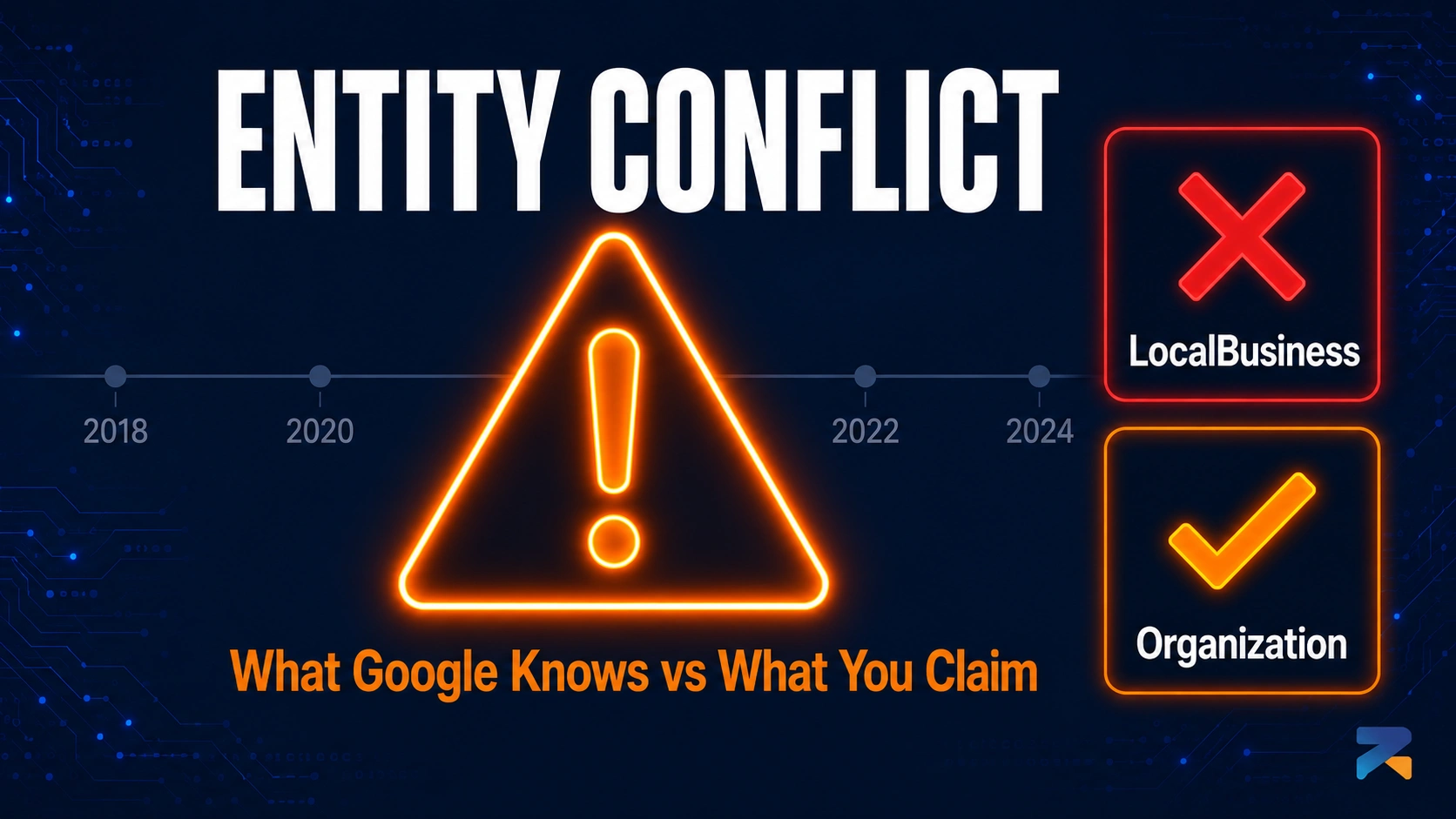
The most dangerous schema mistakes in iGaming aren’t about missing markup. They’re about installing the wrong markup for the domain’s entity history which is why auditing the entity history before deployment should always come before you touch a single schema block.
LocalBusiness schema on an iGaming operation without a verifiable physical address is one of the most common and most risky moves in this niche. Operators install it because it looks like a trust signal. Google’s quality review team looks for exactly this mismatch an anonymous WHOIS registration, hosting on a generic CDN, and a LocalBusiness schema claiming a local service entity. These signals contradict each other. In iGaming, which Google treats as YMYL, those contradictions invite manual review.
Domain-to-schema niche mismatch is the other major conflict. A domain that spent five years as an educational resource should not have gambling entity schema installed on day one. Start with generic Organization and WebSite markup. Build out the iGaming-specific content and schema types progressively over the first sixty to ninety days. Let the entity transition happen over multiple crawl cycles, not in a single deployment.
Avoid installing Casino entity type from schema.org’s full type hierarchy immediately on recently acquired aged domains. Yes, Casino is a valid schema.org type under EntertainmentBusiness. But for domains where Google’s existing entity model is not gambling-adjacent, that declaration is an aggressive pivot that creates signal confusion rather than clarity.
How to Implement and Validate
JSON-LD is the only format worth using for iGaming sites on aged domains. Microdata requires embedding markup directly in HTML elements, which creates maintenance overhead and increases the risk of conflicts when templates or CMS themes update. JSON-LD sits in the page <head> as a standalone script block, independent of the HTML structure, and is easier to update, audit, and debug.
Always validate before deployment. Google’s Rich Results Test is the primary tool it shows which schema types are valid and eligible for rich result display in the context of a specific URL. Schema Markup Validator at validator.schema.org is the secondary check for syntactic correctness independent of rich result eligibility.
Check existing schema inheritance on domains you’ve acquired. Some aged domains have schema markup installed by previous owners that is still being served. Before you deploy your own schema, audit what’s already there using a site crawl tool or by checking page source directly. Conflicting schema blocks on the same page one declaring the domain as a NewsMediaOrganization and one declaring it as an Organization running casino offers create exactly the kind of entity confusion that delays Google’s re-assessment of the domain under its new ownership.
The Practical Stack
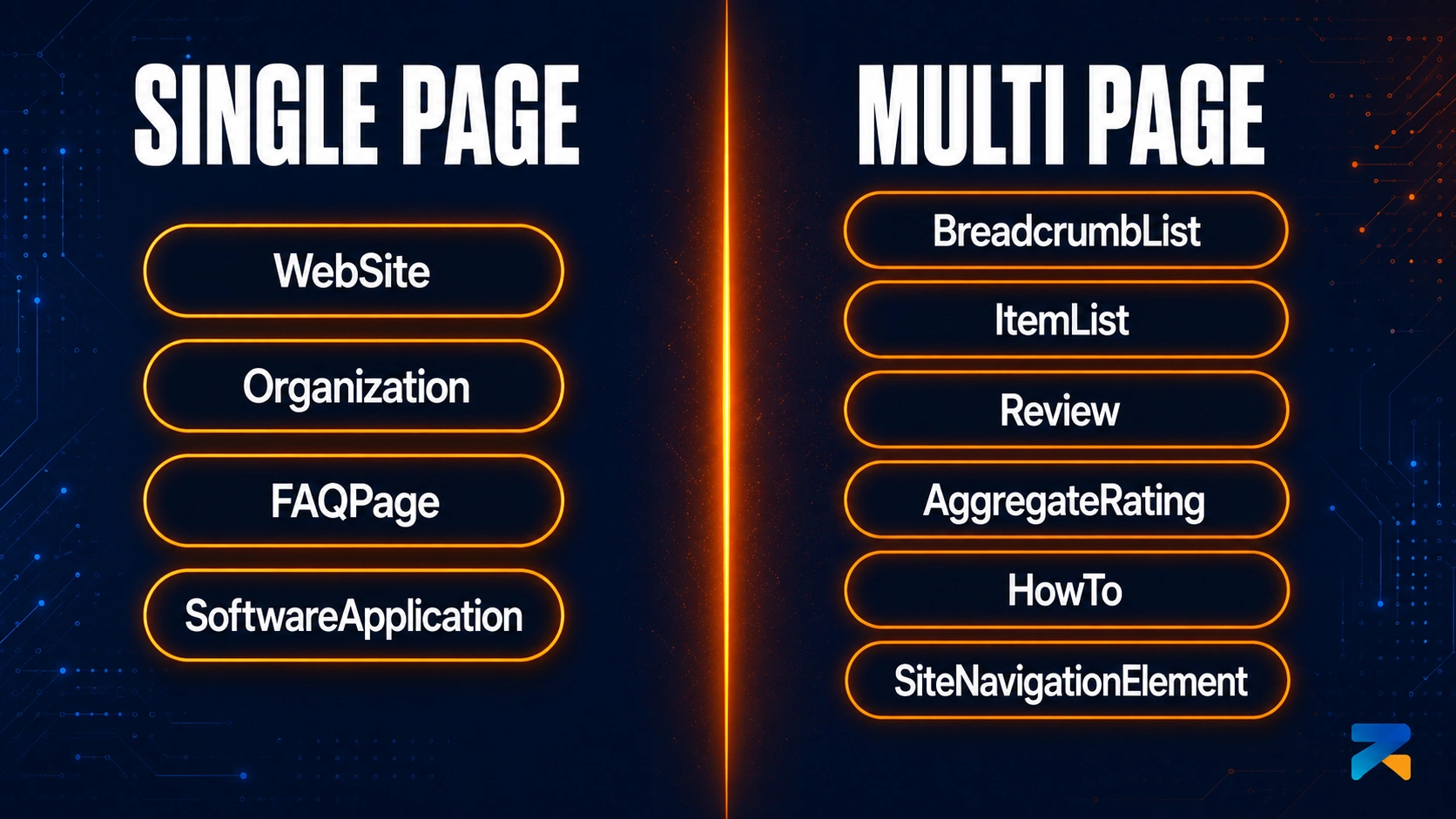
For single-page money sites: WebSite + Organization with sameAs + WebPage + FAQPage with specific questions. Add SoftwareApplication only if the domain history supports it. Skip LocalBusiness and self-serving AggregateRating.
For multi-page sites: start from the homepage entity declarations and work outward. WebSite + Organization at root. BreadcrumbList on every page. Review pages get Review + AggregateRating. Comparison pages get ItemList. Content pages get Article or HowTo. Navigation gets SiteNavigationElement. Layer in iGaming-specific entity types progressively don’t deploy the full gambling schema stack in week one on a domain with a non-gambling crawl history.
Schema markup is not a ranking shortcut. On aged domains in iGaming, it’s an entity clarification tool. Used correctly, it accelerates Google’s understanding of what the domain has become. Used incorrectly, it creates persistent friction that no amount of link building will overcome.
If you’re starting with domain selection and want the foundation to be right before you even get to schema the quality of the aged domain itself is where that starts. Rexusdomain sources aged domains specifically vetted for iGaming use, which means the entity history problem is already filtered before you make the purchase.
References
- Google Search Central. (2023). FAQ, HowTo, and Q&A rich results policy update. Retrieved from https://developers.google.com/search/blog/2023/08/howto-faq-changes
- Schema.org. (2024). Full type hierarchy Casino, SoftwareApplication, Organization. Retrieved from https://schema.org/docs/full.html
- Google Search Central. (2024). Structured data general guidelines. Retrieved from https://developers.google.com/search/docs/appearance/structured-data/sd-policies
\n\n
Related Guides
Sources & Further Reading