
Does Google Reset a Domain’s Trust When Ownership Changes?
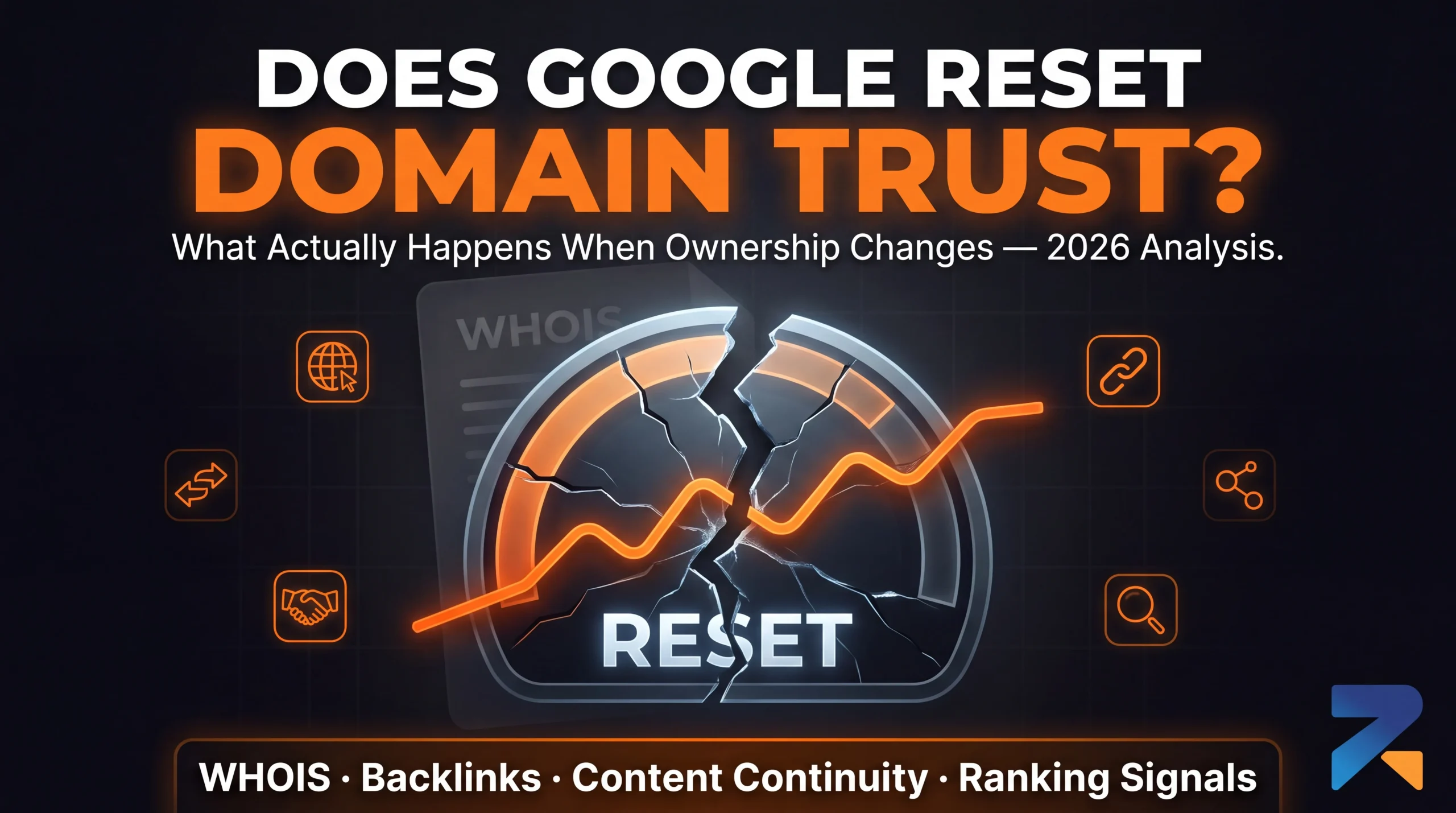
Google has never confirmed a hard “trust reset” tied to a domain ownership or WHOIS change, and the evidence from tracked case studies leans toward continuity rather than a reset but ownership changes can still trigger a re-evaluation that behaves like one if the new content, backlink profile, or usage pattern shifts sharply from the domain’s prior history.
Last updated: August 2026.
The Question Behind the Question
“Does buying an aged domain reset its authority?” is really two separate questions that get conflated. One is technical: does a WHOIS/registrant change itself trigger an algorithmic reset? The other is behavioral: does what a new owner typically *does* with a domain (change its content, niche, and hosting all at once) look enough like a fresh site to Google that it gets treated like one? The available evidence points to the second explanation far more than the first.
What Google Has Actually Said
Google’s public guidance has never described WHOIS or registrant changes as a ranking signal. John Mueller has addressed domain-history questions in Search Central hangouts multiple times, generally describing evaluation as ongoing and content-driven rather than tied to a single ownership event. There’s no equivalent of the “sandbox” period Google acknowledges for genuinely new domains being described for domain *transfers* specifically the sandbox effect, where it’s discussed at all, is associated with newly registered domains with no history, not domains that already have one.
What Case Studies and Observed Behavior Suggest
Domain buyers and SEO practitioners who track post-purchase performance report a wide range of outcomes, and the pattern that emerges isn’t “transfer causes reset” it’s “how much changes at once causes disruption.” A few consistent observations:
- Domains that keep similar content and backlink trajectory after a change of ownership tend to hold rankings with minimal disruption, sometimes within days.
- Domains that pivot hard new niche, wholesale content replacement, and a nameserver/hosting change all at once see much more ranking volatility, which looks like a reset but is more consistent with Google re-crawling and re-evaluating genuinely new signals.
- Domains with a gap in active content (parked, or dropped and re-registered with a gap) show more volatility than domains transferred while still actively maintained, since a content gap is itself a signal independent of ownership.
This pattern is consistent with Google’s ranking systems evaluating current signals continuously rather than storing an “ownership” flag that gets checked on transfer.
Why the Confusion Persists
Two things happen at the same time when someone buys an aged domain, and it’s easy to attribute the outcome to the wrong one: the WHOIS/registrant change (ownership), and a burst of content, structural, and backlink changes as the new owner starts using the domain (usage). When rankings shift after a purchase, it’s rarely possible to isolate which of these caused it without a controlled comparison and most public “case studies” are a single domain with no control, which is why anecdotal evidence on this topic is so mixed.
What This Means in Practice
If ranking continuity matters to you, the ownership change itself is not the primary variable to manage how much and how fast you change the domain’s content, structure, and hosting after acquiring it is. Domains that transfer cleanly and are eased into new content over weeks rather than replaced overnight are the ones that tend to hold their existing signals best, independent of who technically owns the WHOIS record.
Frequently Asked Questions
Does changing a domain’s WHOIS registrant hurt SEO?
There’s no confirmed direct penalty tied to a WHOIS registrant change itself. Ranking volatility that follows a domain purchase is more consistently explained by simultaneous content, backlink, or hosting changes than by the ownership change alone.
Is there a “sandbox” period for domain transfers like there is for new domains?
Google’s acknowledged sandbox effect is associated with newly registered domains that have no prior history, not with the transfer of a domain that already has an established history. A domain transfer is not the same event as a new registration.
How long should I wait before changing content on a newly acquired aged domain?
There’s no fixed number confirmed by Google, but practitioners who track outcomes generally favor easing changes in over several weeks rather than replacing everything on day one, since that isolates whether any ranking movement is a normal fluctuation or a response to the specific change made.
Does a gap between when a domain expired and when it was re-registered matter?
Anecdotally, yes a longer gap with the domain dropped or parked appears to correlate with more post-acquisition volatility than a domain that was transferred while still actively maintained, though this is closer to a content-continuity effect than a fixed rule.
Related Guides
Sources & Further Reading