
You bought the aged domain. DR 38, 190 referring domains, seven years of legitimate history. You’re expecting to skip the sandbox, rank fast, and let the authority do the work.
Then a core update hits. Rankings drop. You blame the algorithm.
Here’s what actually happened. The domain had real authority. What it didn’t have was any reason for Google to trust the people running it. Those are two different things and in iGaming, confusing them is one of the most expensive mistakes you can make.
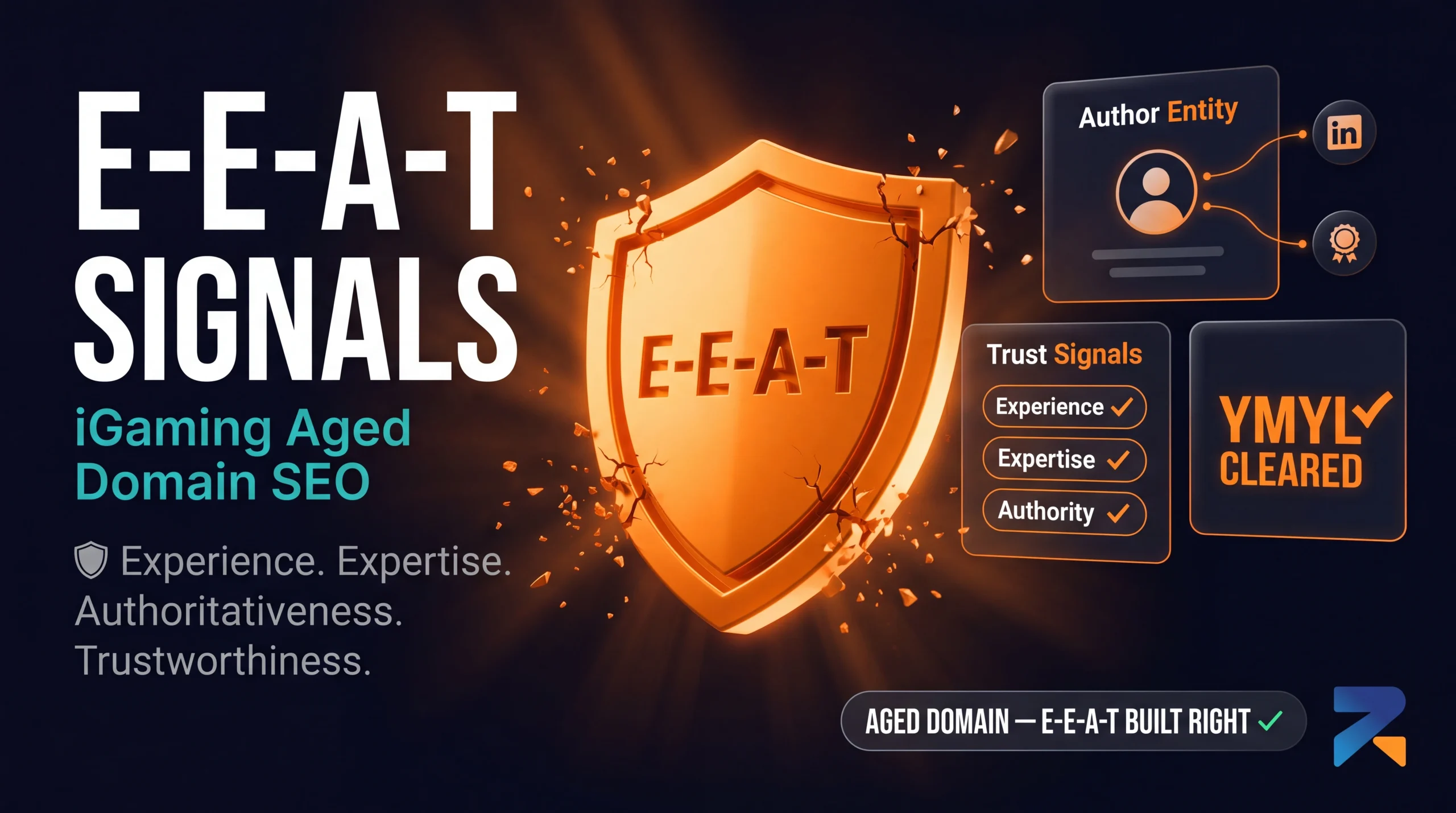
E-E-A-T: Experience, Expertise, Authoritativeness, Trustworthiness. DR is not E-E-A-T. Referring domains are not E-E-A-T. Backlinks tell Google the domain is real. E-E-A-T tells Google the site is run by someone accountable for what they publish. In iGaming a YMYL niche with human quality raters who manually review gambling sites you need both. One without the other will hold you for a while and then drop you when Google’s quality systems catch up.
The other thing most operators miss: E-E-A-T on an aged domain isn’t the same as E-E-A-T on a fresh one. The aged domain already has context. Google has a model of what it was. The trust signals you build now land on top of that history which is an advantage if you use it right, and a liability if you ignore it.
Why E-E-A-T Behaves Differently When the Domain Has a History
Fresh domain, blank slate. Whatever you publish is the first signal Google gets. Everything is formative.
Aged domain? Google’s been crawling it for years. It has indexed content, tracked topic evolution, parsed the link patterns, and formed a working model of what kind of entity this site is. That model doesn’t disappear the moment you take over.
This is the same logic behind why content silo structure matters so much on aged domains the domain’s topical identity is already formed, and you’re either working with it or against it. E-E-A-T works the same way. If the previous site had editorial credibility named authors, press mentions, clear organizational identity some of that reputation residue carries. If the previous site was anonymous spam with no accountable voice, you’re starting with a trust deficit that the backlinks alone won’t fix.
The problem is that most operators never check which one they inherited. They look at DR and click buy.
And then there’s the YMYL dimension. iGaming is explicitly flagged in Google’s Quality Rater Guidelines as a content category requiring heightened scrutiny. Real people review gambling sites and assess whether the organization running it can be held accountable for its recommendations. A domain with strong authority metrics and zero visible organizational identity looks suspicious in that context. Not neutral. Suspicious. The authority signals make it look like someone trying to exploit trust they didn’t earn.
The E-E-A-T Signals That Actually Matter in This Niche
Not all E-E-A-T signals are equal. In iGaming specifically, four things move the needle.
First-hand experience in the copy itself. Post-2022, Google is measurably better at distinguishing content written by someone who has used a casino platform from content assembled from the platform’s own promotional material. The difference shows in specifics: actual withdrawal processing times documented with dates, KYC verification steps by jurisdiction, specific bonus terms with wagering requirements and game restrictions, negative observations about platform limitations. Generic praise doesn’t pass the experience test. Specific, verifiable detail does.
Author entities that exist outside your own site. A name on a byline means nothing if Google can’t find that person anywhere else. The author needs to be a real entity LinkedIn profile, industry forum mentions, external citations, contributions to other publications. In iGaming, author credentials need to be relevant: compliance background, platform review history, regulatory knowledge. “10 years in digital marketing” is invisible. “Covered Malta MGA licensing requirements since 2019 and has reviewed 150+ casino withdrawal processes” is an entity Google can validate.
Organizational accountability. Who runs this? Who do readers contact if a recommendation is wrong? In regulated gambling markets, this isn’t just an E-E-A-T question it’s increasingly a legal one. Company name, contact mechanism, and disclosure of commercial relationships are the minimum. The more traceable the organizational identity, the more Trustworthiness signals you’re sending.
External reputation you didn’t create yourself. Google’s QRG explicitly tells raters to look for independent evidence of a site’s reputation review aggregator mentions, industry press, editorially placed backlinks. Your aged domain’s referring domain profile already contributes here. That’s the one E-E-A-T signal the domain brings with it. The others author, organization, experience you build from zero.
Single-Page iGaming Sites: E-E-A-T With Almost No Room to Work
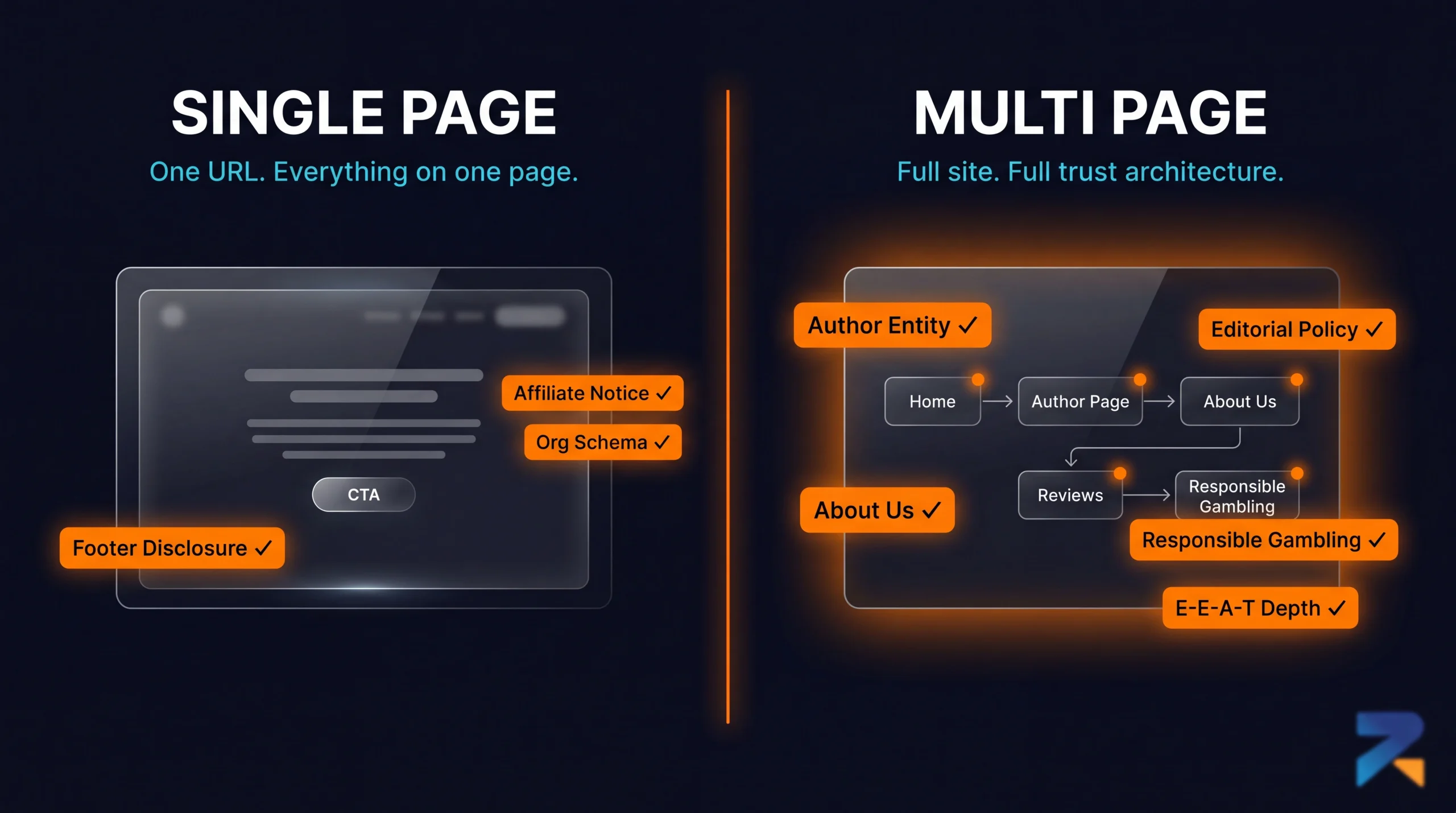
Single-page money sites are everywhere in Southeast Asian iGaming markets. One URL. All conversion content on a single page. CTA pointing directly to the platform. No blog, no author pages, no editorial depth.
This creates a specific problem. You have almost no surface area for the trust signals Google expects on a YMYL page. On a fresh domain with a brand new site, that’s survivable because the domain is new and the authority bar is lower anyway. On an aged domain, it creates a mismatch that quality reviewers notice: strong domain authority, zero organizational accountability. The two signals contradict each other and in a niche with manual review, someone is eventually going to look.
The operators who handle single-page E-E-A-T correctly make every available surface work.
The footer is doing more than you think. Most operators treat it as a legal formality privacy policy, terms, done. That’s leaving signal on the table. A single-page iGaming site footer should have: responsible gambling statement with a link to a real organization like GamCare or BeGambleAware, affiliate or operator disclosure, and at minimum a verifiable organizational name and a contact mechanism that actually responds. This is where quality raters check first when they land on a page with no other accountability markers. If the footer is empty or formulaic, the site fails the accountability check before the content is even evaluated.
Affiliate disclosure near the top of the page, not buried. Most operators hide this in the footer or skip it entirely. Don’t. A clear disclosure something like “we earn a referral fee if you sign up through our links” at the top of the page is an Experience and Trustworthiness signal. It tells Google the site has a real, specific commercial relationship with the products it covers, and the person running it is honest enough to say so. Sites that hide or omit this consistently take more damage in core update cycles than those that include it. That’s not a coincidence.
On-page copy has to carry the experience layer. Without author pages or multi-page depth, the content itself is your only E-E-A-T asset. Specific platform details, named game providers, documented bonus structures with their actual restrictions, and yes honest negative observations. A single-page site that praises everything reads as promotional to quality reviewers. One critical, specific observation about a platform’s withdrawal verification requirement does more for credibility than three paragraphs of praise.
Social presence as entity corroboration. For single-page operators, an active social profile that matches the site’s brand name gives Google an external reference point for the entity. It doesn’t need to be elaborate. A Facebook page or Telegram channel with regular updates that confirms the site exists beyond the domain level is enough to shift the entity signal from “anonymous site” to “real organization.” Pair this with Organization schema using the sameAs property to connect both. It’s one of the highest-leverage moves available when you’re working with a single URL.
One thing to watch on aged domain single-page sites: if the domain has a history in an unrelated niche and the single page is the first thing Google sees when it re-crawls, the entity mismatch is at its most visible. A domain that was a travel blog for five years now hosting a single page in thin English about “best slot bonus Malaysia 2026” that combination doesn’t get the benefit of the domain’s authority. It gets scrutinized because of it.
Multi-Page iGaming Sites: More Surface, More Places to Get It Wrong
Multi-page sites full affiliate operations, casino review platforms, comprehensive money sites have real E-E-A-T infrastructure to work with. The risk is that more pages means more inconsistency. And Google’s quality systems are specifically looking for the gap between a strong domain-level authority signal and weak page-level trust signals. That gap is where rankings go unstable.
Author Pages That Actually Build an Entity
An author page is not a bio paragraph. It’s an entity declaration. It has one job: give Google enough cross-referenceable information to validate this person exists as a real expert in this specific field.
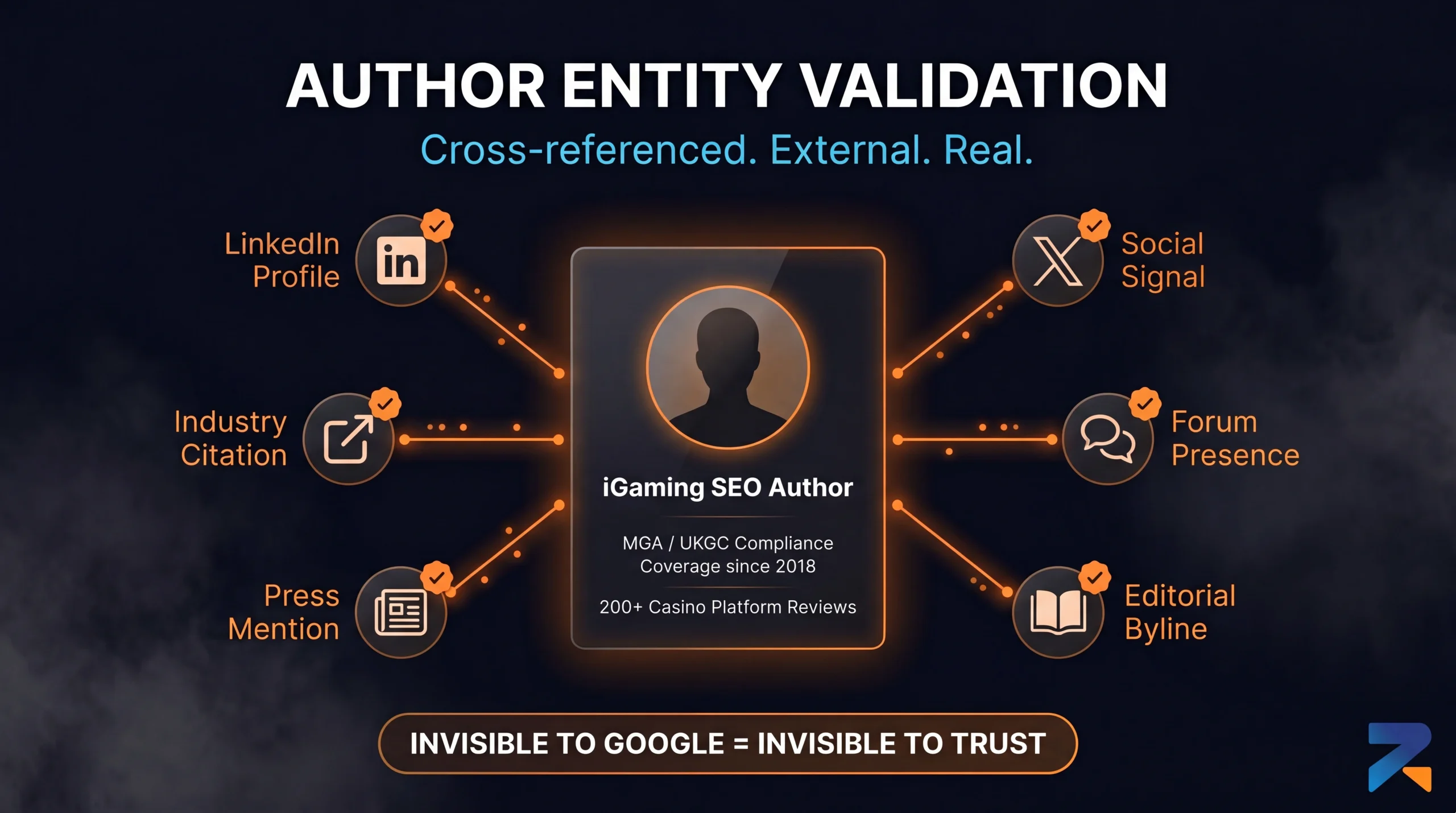
What doesn’t work: “Jane is a content writer with 8 years of experience covering the gaming industry.” That sentence says nothing verifiable.
What works: “Jane has covered online casino licensing compliance across the MGA, UKGC, and Philippine PAGCOR since 2018. Her reviews have been cited in [publication name]. She maintains a LinkedIn profile at [URL] and contributes to [relevant industry forum].” Now Google has cross-reference points. It can check. That’s what entity validation looks like.
In iGaming, the credential focus has to be gambling-specific. Platform review methodology, regulatory knowledge by jurisdiction, payment method research, responsible gambling expertise. Generic content marketing credentials don’t generate trust in a YMYL niche. Reviewers know the difference and so does the algorithm.
Every author on a multi-page iGaming site needs a page that does this work. Not a placeholder. A real profile with external corroboration.
About Us and Editorial Policy: The Pages Quality Raters Check Before Anything Else
When a quality rater lands on an iGaming site to evaluate it, they look for the About Us page before they evaluate content. This is documented behavior in Google’s QRG training they’re specifically instructed to assess who owns and runs YMYL sites and what processes govern their recommendations.
An About Us for an iGaming site on an aged domain needs to cover: who runs the operation, what qualifies them to review gambling platforms, and how readers can reach them with a mechanism that actually responds. It doesn’t need to be long. It needs to be honest and specific. “A team of passionate gambling enthusiasts” is not honest and specific. A named founder with verifiable background and a real contact email is.
Editorial policy is where most operators leave serious E-E-A-T gains uncaptured. A page documenting how reviews are conducted minimum testing period per platform, what disqualifies a casino from recommendation, how bonus terms are verified, how withdrawal speeds are documented is something content farms can’t fake at scale. If you have a genuine review process, write it down publicly. It’s one of the most defensible E-E-A-T assets a multi-page site can have.
Responsible Gambling Pages That Do Real Work
Most responsible gambling pages in iGaming are four sentences, a generic warning, and a link to Gamcare. Quality raters know what a checkbox responsible gambling page looks like. It doesn’t help.
The version that actually contributes to Trustworthiness is built as a genuine resource: self-exclusion options by jurisdiction with instructions for how to access them, deposit limit mechanics explained for the specific markets the site covers, problem gambling identification guidance that’s accurate and current, links to regional counseling services not just the same three international organizations on every site.
For aged domains specifically, this page has a secondary function. If the domain is transitioning from a non-gambling niche finance, sports media, general entertainment responsible gambling content is one of the cleanest topical bridges available. It has genuine information value, it’s clearly relevant to the new iGaming direction, and it doesn’t force a hard topical pivot that looks manufactured. Google can follow the logic of a domain moving toward gambling content via player protection topics much more easily than a domain that jumps straight to “top 10 casino bonuses” with no connective tissue.
Review Content That Passes the Experience Test
Multi-page review sites live and die on the first E in E-E-A-T. Experience.
After the 2022 helpful content updates and everything that followed, Google got significantly better at identifying review content that was written by someone who never used the product. In iGaming, the tell is almost always the same: the review covers everything the casino’s marketing page covers and nothing it doesn’t. No negative observations. No platform-specific friction points. No real data about withdrawal processing.
The reviews that perform and keep performing through updates have specifics that can only come from someone who actually tested the platform. Exact timeframes for document verification. Which payment methods have deposit fees that the casino doesn’t advertise clearly. Which game categories are excluded from welcome bonus wagering. Customer support response time tested at different hours. These are not things you can write by reading the casino’s own site. They require someone doing the work.
Operators who’ve built this kind of review content on aged domains with DR 30+ in Southeast Asian markets have seen commercial pages outperform fresh domain equivalents by 40 to 60 positions consistently. The domain’s authority amplifies what genuine experience signals are already saying. That’s the combination Google is looking for, and in iGaming it’s rare enough to be a real differentiator.
The Sequencing Mistake That Costs You the Most
Here’s where most operators get the timing completely wrong.
They treat E-E-A-T as something to build after the commercial pages are live. First get the money pages ranking, then worry about about pages and author profiles. That logic is backwards and it costs real money.
Google’s first re-evaluation of a newly built-on aged domain includes a quality signal pass. The pages it evaluates earliest are the ones it has the most historical context for usually the homepage and top-level category pages. If those pages carry strong E-E-A-T signals, they’re evaluated favorably and the commercial pages below them inherit that credibility. If they don’t, the domain’s authority gives you a temporary lift that doesn’t hold.
Before any money page goes live, these need to exist: About Us with real organizational information, at least one author profile with external links, a responsible gambling page with jurisdiction-relevant resources, an affiliate disclosure, and a working contact mechanism. These aren’t additions. They’re the infrastructure the commercial content needs underneath it to be defensible.
The operators who skip this and launch money pages first are the same ones who report strong initial rankings and then a cliff at the next core update. The domain’s authority gets them visibility. The missing trust layer costs them durability. Every single time.
Before any of this, the domain itself needs to be clean. Auditing the domain’s full history including manual penalty checks, backlink toxicity, and entity history is what makes the E-E-A-T layer buildable. There’s no trust infrastructure that fixes a domain Google already has a negative model of.
Aged domain authority gets you in the room. E-E-A-T is what keeps you there.
If you’re sourcing domains that have the kind of history that makes trust signal construction actually viable, Rexusdomain pre-vets every domain in its inventory for iGaming deployment so the foundation is solid before you build a single page on top of it.
Related Guides
Sources & Further Reading
Frequently Asked Questions
What E-E-A-T signals matter most for an iGaming site on an aged domain?
For iGaming E-E-A-T: (1) named authors with gambling industry credentials and verifiable online presence; (2) transparent editorial methodology pages; (3) responsible gambling certifications and operator license disclosure; (4) original research, odds data, or first-hand casino testing; (5) About Us page with verifiable company registration. The aged domain provides authority infrastructure, but E-E-A-T signals must be built on top through genuine expertise demonstration.
Does an aged domain automatically have strong E-E-A-T signals?
No. An aged domain provides historical authority and Trust Flow from previous legitimate operation, but E-E-A-T is evaluated on current content, author credentials, and entity signals — not domain age. A newly rebuilt site on an aged domain must establish its own E-E-A-T through fresh expert content, transparent authorship, and verifiable expertise. Domain age compresses the timeline but does not substitute for genuine expertise demonstration.
Should I build E-E-A-T on a single page or across multiple pages on an aged iGaming domain?
Multi-page E-E-A-T architecture consistently outperforms single-page approaches for iGaming SEO. Distribute signals across: an About page with entity and team information, individual author bio pages with credentials, a methodology page explaining review processes, terms and conditions, and a privacy policy. Google Quality Raters use these pages as entity verification checkpoints — sparse E-E-A-T on a single page flags sites for lower trustworthiness assessments.
How do I establish author E-E-A-T for an iGaming site with no existing contributors?
Build author E-E-A-T from the ground up: create detailed author profiles with real LinkedIn profiles, Twitter presence, and cross-references in gambling industry publications. Commission articles under named authors who publish elsewhere in the gambling media space. Use gambling industry professionals with verifiable backgrounds for core review content. Generic author names with no offsite footprint are a clear E-E-A-T red flag for iGaming sites.
What is the role of trust signals in iGaming E-E-A-T?
Trust signals in iGaming E-E-A-T include: regulatory license numbers displayed in footer (UKGC, MGA, AGCO), responsible gambling certification badges (GamCare, BeGambleAware, YGAM), verified operator affiliations, transparent contact information with a verifiable business address, and SSL/HTTPS implementation. These signals are evaluated by both Google Quality Raters and AI systems when assessing whether an iGaming site qualifies as a trustworthy information source.
How does aged domain authority interact with E-E-A-T for iGaming rankings?
Aged domain authority and E-E-A-T are complementary signals that work together. Aged domain authority provides link equity and topical Trust Flow that reduce the authority threshold needed to compete. Strong E-E-A-T provides the content quality and entity trust signals that convert authority into rankings. Sites with strong aged domain authority but weak E-E-A-T plateau at mid-page-one positions; those combining both reach and sustain top-3 rankings in competitive iGaming SERPs.