


You bought an aged domain. DR 35, solid backlink profile, five years of clean history. You install WordPress, dump 40 pages of casino content across five different categories, and wait for the authority to kick in.
Six weeks later, nothing is moving.
The domain isn’t broken. The backlinks are real. The problem is that you handed Google a topically incoherent site and expected it to figure out what you’re trying to rank. It won’t. In iGaming a YMYL niche where Google applies more scrutiny per crawl than almost anywhere else topical chaos doesn’t just slow you down. It actively dilutes the authority the domain spent years building.
Content silos fix this. Not because siloing is some secret SEO technique, but because it gives Google a coherent signal about what the domain actually covers and in a niche this competitive, coherence compounds faster than domain authority alone.
What a Content Silo Actually Does on an Aged Domain
A content silo is a structured grouping of pages around a specific topic, where all the content within that group reinforces each other through internal linking and topical relevance. On a fresh domain, it’s a way to build topical authority from scratch. On an aged domain, it does something different and more powerful.
An aged domain already has Google’s attention. It gets crawled regularly, its backlinks are recognized, and its trust signals are established. When you add a silo structure on top of that, you’re not just organizing content you’re directing Google’s understanding of what this domain is now an authority on. That’s a fundamentally different dynamic than building authority from zero.
Here’s the thing. An aged domain’s authority isn’t distributed evenly across all topics. It’s concentrated. If the domain spent six years as a sports news site, Google’s topical model for it leans heavily toward sports. A well-designed silo that leads with sports betting and builds outward from there into casino, poker, or slots will activate that pre-existing topical alignment much faster than a silo that ignores the domain’s history entirely.
The Niche Mismatch Problem You Need to Solve First
Most operators skip a critical step before building any content structure: they don’t read the domain’s topical footprint before deciding which silo to build.
This matters because the domain’s history isn’t just a backlink story. It’s a topical story. Google’s models understand, at a fairly granular level, what topics a domain has historically covered. When you pivot a domain to iGaming content, you’re asking Google to update that topical model. The question is how long that takes and a good silo strategy can dramatically compress that timeline.
If the domain was a finance publication, building a silo around “online casino payment methods” or “crypto casino bonuses” creates a plausible topical bridge. Finance → payments → crypto casinos is a logical content sequence that Google can follow. If the domain was a cooking blog and you open with a “best online slots Philippines 2026” page with no logical connective tissue, the topical model mismatch is severe and recovery takes much longer.
Reading the Domain’s Topical Footprint Before You Build
Pull the Wayback Machine data before you plan a single URL. Look at:
- Which content categories had the most pages and internal link depth
- Which topics generated the highest number of external links (these are the domain’s topical authority clusters)
- How the content has evolved over time a domain that covered finance, then pivoted to tech news, then went dark, has a fragmented topical model that needs a more conservative silo build
Once you understand what Google thinks this domain is about, you can build a silo that either aligns with or logically extends from that topical model. Alignment is faster. Logical extension still works, but builds more slowly.
If you haven’t done a proper content history audit yet, start with the Wayback Machine guide for aged domain iGaming the forensic content mapping process covered there is the same starting point for building a silo that actually activates the domain’s authority instead of fighting against it.
The Three Silo Models Operators Use in iGaming
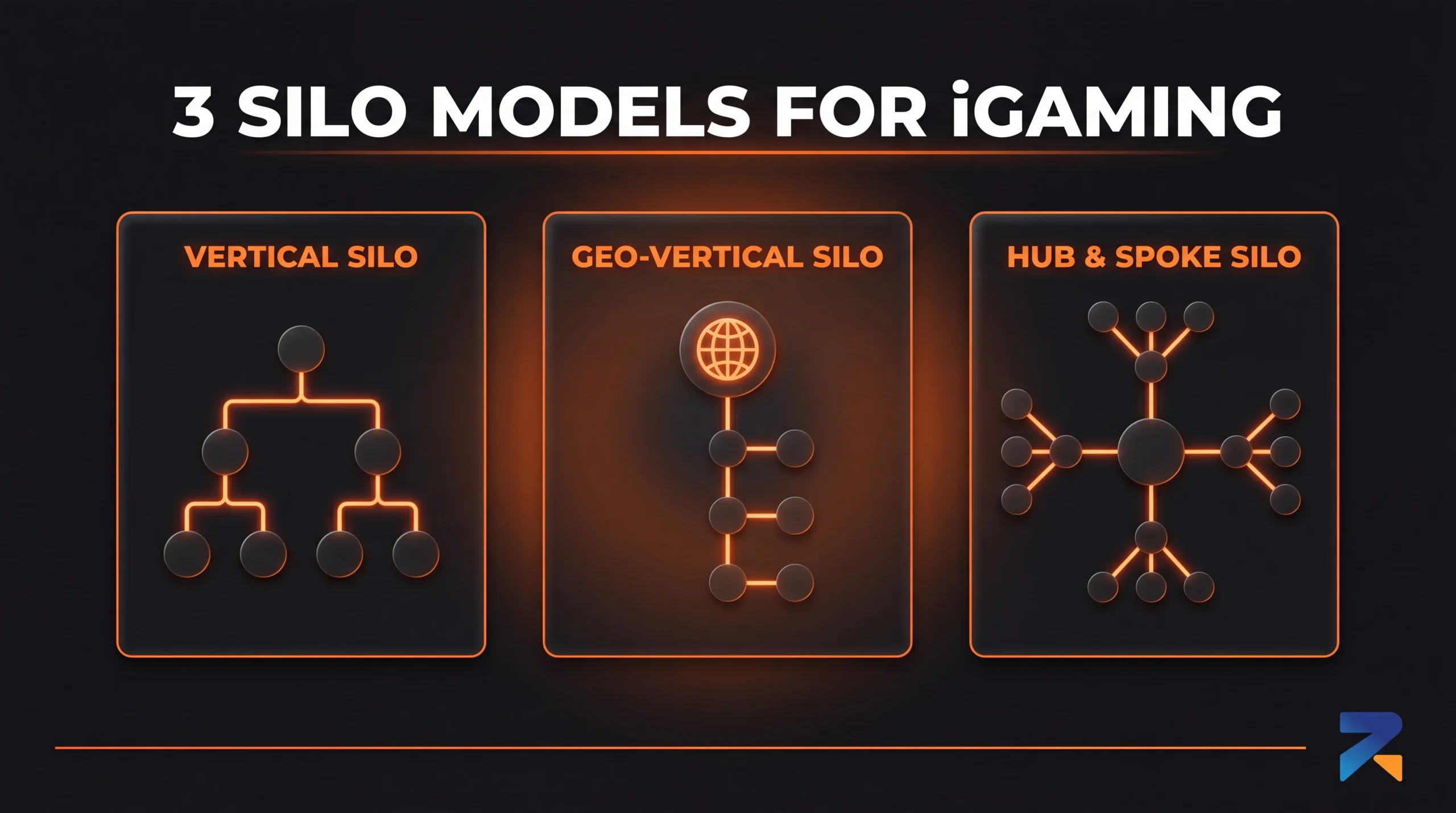
Not every iGaming site needs the same structure. The right silo model depends on what the domain was, what you’re trying to rank, and how many resources you have for content production. There are three primary models operators run in this niche.
Vertical Silo (One Game Type, Deep)
This is the most common setup for operators targeting a specific vertical usually slots, casino reviews, or sports betting with a single aged domain. You pick one primary topic and build downward with escalating specificity.
Example structure:
- Root: /casino/ (pillar page broad casino overview)
- /casino/slots/ (category page slots as a sub-vertical)
- /casino/slots/high-rtp-slots/ (cluster page specific attribute)
- /casino/slots/high-rtp-slots-philippines/ (GEO-specific money page)
Every page in this hierarchy links to the pages above and below it. The pillar page links to category pages. Category pages link to cluster pages. Cluster pages link to the money pages. Money pages link back up the chain.
This model works best when the domain’s authority is strong enough to rank one vertical fast and you want to consolidate that authority into a small set of money pages rather than spreading it thin. Operators who’ve run this on DR 30+ sports domains targeting Southeast Asian casino markets have seen first-page movement in under 60 days because the silo isn’t just organizing content, it’s channeling the domain’s authority like a funnel.
GEO-Vertical Silo (One Market, One Game Type)
This model adds a geographic layer to the vertical structure. Instead of building broadly around “slots,” you go narrow: slots in a specific market, at a specific player intent level.
Example structure:
- Root: /ph/ or /thailand/ (GEO hub)
- /ph/casino/ (market-specific category)
- /ph/casino/slots/ (market + vertical)
- /ph/casino/slots/no-deposit-bonus/ (money page with commercial intent)
The GEO-vertical model performs exceptionally well for operators running aged domains in Southeast Asian markets, where search behavior is highly localized and even modest DR domains can dominate market-specific queries that bigger international operators haven’t fully saturated.
One thing to get right: the GEO hub has to actually exist and have content. Operators who create the /ph/ directory and immediately jump to deep money pages without building the hub layer out are creating orphaned clusters. Google crawls them, can’t contextualize them within the site’s topical structure, and the pages underperform despite the domain’s authority.
Hub-and-Spoke Silo (Multi-Product Sites)
This is the most complex model and the one that’s most frequently built wrong. Hub-and-spoke is for operators running multiple iGaming products say, sports betting, casino, and live dealer on a single aged domain, usually because the domain’s authority is strong enough to support a multi-product money site.
The hub page is a broad iGaming overview. Each “spoke” is a product-specific silo built identically to the vertical silo model above. The hub links to each spoke’s pillar. The spokes do not cross-link to each other without passing through the hub first.
Most operators get this wrong because they build the spokes and forget the hub or they build the hub as a generic homepage that’s too thin to hold the silos together. In iGaming, a hub page that’s genuinely useful and well-linked is what tells Google that this domain is the authoritative center of all these topics, not just a site that happens to cover them.
How to Build the First Silo Layer Without Breaking Trust Signals
The sequence matters as much as the structure. Operators who try to build an entire silo simultaneously publishing 40 pages in the first two weeks are sending a content velocity signal that doesn’t match the domain’s historical behavior. A domain that was a travel blog for five years and suddenly produces 40 casino pages in 14 days is a red flag, even if each individual page is high quality.
Build the first silo layer in three phases:
Phase 1 (Weeks 1–3): Publish the pillar page and the first two category pages. These should be genuinely comprehensive 2,000+ words for pillar, 1,200+ for category. Interlink them from day one. Let Googlebot discover and index them before adding more depth.
Phase 2 (Weeks 4–6): Add 4–6 cluster pages that sit under the category layer. Each cluster page addresses one specific sub-topic within the category. Link up to the category page and cross-link between cluster pages that share relevance.
Phase 3 (Weeks 7–10): Add money pages at the deepest layer. These are the pages targeting high-intent commercial keywords bonus comparisons, specific operator reviews, “best [X] in [GEO]” pages. By this point, the silo structure above them is indexed, linked, and sending topical signals down the chain.
This is not slow. It’s staged. The difference is that by the time your money pages go live, the domain’s topical authority for that silo has already been established and those money pages inherit it immediately instead of waiting for it to develop.
Where Operators Screw This Up

There are two mistakes that kill more iGaming content silos than anything else.
The first is orphaned money pages. An operator publishes a high-intent page “best online casino Malaysia 2026” directly off the root, with no pillar, no category, no cluster context. The page has no silo above it. Google crawls it, finds strong content and a strong domain, and still underweights it because there’s no topical context to anchor it. We’ve seen this kill rankings on domains where the authority should have been more than enough to rank.
The second mistake is silo contamination. This happens when operators mix content categories within a silo putting a “responsible gambling” page inside a slots silo, or adding a sports betting article inside a casino category. Every page in a silo should belong to that silo’s topical cluster. Pages that don’t belong should either sit at the root level or be excluded from internal linking within the silo.
The one thing that’s harder to recover from than a weak silo is a contaminated one. Topical dilution inside a silo takes months to clean up, and in iGaming, you don’t have months to waste.
Before you build any silo on an aged domain, also make sure the domain itself is clean. Auditing the aged domain for toxic backlinks and historical penalties is a prerequisite a silo built on top of a penalized domain doesn’t rescue the domain, it just adds more content to something that’s already fighting Google’s filters.
Practical Silo Checklist Before You Publish
Before any content goes live on your aged domain, run through this:
- Domain topical footprint mapped you know what Google thinks this domain covered historically
- Silo model chosen vertical, GEO-vertical, or hub-and-spoke, based on your domain authority and product scope
- Pillar page written and published first the rest of the silo doesn’t go live until the pillar is indexed
- Internal links planned before publishing every new page knows where it links to and where it receives links from
- No orphaned money pages every commercial-intent page sits within a silo structure, not floating off the root
- Content velocity matched to domain history you’re not flooding the domain with 50 pages before Google has re-evaluated the domain’s new topical direction
The aged domain you bought has real authority. A well-built silo is how you direct that authority at the pages that actually make you money instead of spreading it across a disorganized site that ranks for nothing and converts even less.
If you’re sourcing aged domains with the kind of topical history that makes content silo strategies genuinely viable in competitive iGaming markets, Rexusdomain filters for exactly that domains with clean histories, real link profiles, and the right topical footprints for iGaming deployment.
Related Guides
Sources & Further Reading
Frequently Asked Questions
What is a content silo and why is it important for iGaming sites on aged domains?
A content silo is a structured group of topically related pages — casino reviews, sports betting guides, poker strategy — organised with a pillar page at the top and cluster articles beneath it, interconnected by contextual internal links. For iGaming sites on aged domains, silos amplify the existing Topical Trust Flow by concentrating link equity within each gambling sub-niche rather than diluting it across unrelated content. A well-siloed aged domain site typically reaches page-one positions 3-6 months faster than flat-architecture equivalents.
How many content silos should an iGaming site on an aged domain have?
A focused iGaming site should have 3-5 primary content silos aligned with main gambling categories: casino reviews, sports betting, live casino, poker, and responsible gambling. Each silo requires a minimum of 1 pillar page and 8-15 cluster articles to achieve sufficient topical depth for page-one rankings in competitive markets. Silos beyond 5 primary categories dilute Topical Trust Flow across too many sub-niches for a site with under 12 months of authority build history.
How does content siloing interact with aged domain Topical Trust Flow?
Content siloing amplifies aged domain Topical Trust Flow by reinforcing the topical signals that existing backlinks established. An aged domain with iGaming Topical Trust Flow of 20 increases effective TF within a well-siloed casino reviews category by an estimated 25-40% compared to equivalent content in a flat-architecture site. Each new cluster article within the silo adds a topical relevance signal that compounds with the aged domain foundation, accelerating the trust accumulation rate for that sub-category.
Should iGaming content silos be separate subdirectories or separate pages at the root?
Separate subdirectories for each silo (domain.com/casino-reviews/, domain.com/sports-betting/) outperform flat root-level page structures for iGaming on aged domains. Subdirectory silos create clear URL hierarchy signals that communicate topical organisation to Google. The subdirectory receives internal PageRank from the root domain, distributes it through the silo, and establishes a crawl pathway that ensures cluster articles index faster. Root-level page structures lack this hierarchy signal and produce weaker topical relevance outcomes.
What is the ideal pillar page length for an iGaming content silo on an aged domain?
Pillar pages for iGaming content silos should be 3,000-5,000 words covering the full breadth of the silo topic. A casino reviews pillar page covers evaluation criteria, the top 10-15 reviewed casinos, regulatory considerations, game type breakdowns, and bonus comparison methodology. Shorter pillar pages under 2,000 words lack the topical coverage depth required to rank for competitive iGaming head terms in Tier 1 markets. Cluster articles beneath the pillar should be 1,500-2,500 words each, covering specific sub-topics exhaustively.
How do I plan a content silo for an aged domain that previously covered multiple unrelated topics?
Audit the aged domain Wayback Machine history and Ahrefs Topical Trust Flow categories to identify which historical topics generated the strongest authority signals. Build your iGaming content silos in topical alignment with those legacy categories where possible. If the aged domain had finance and gambling content, create casino reviews and sports betting silos that bridge naturally from the financial decision-making context. Avoid complete topic pivots — transitional content that bridges the legacy topic and iGaming content activates authority transfer faster than cold-start publishing in a completely unrelated niche.