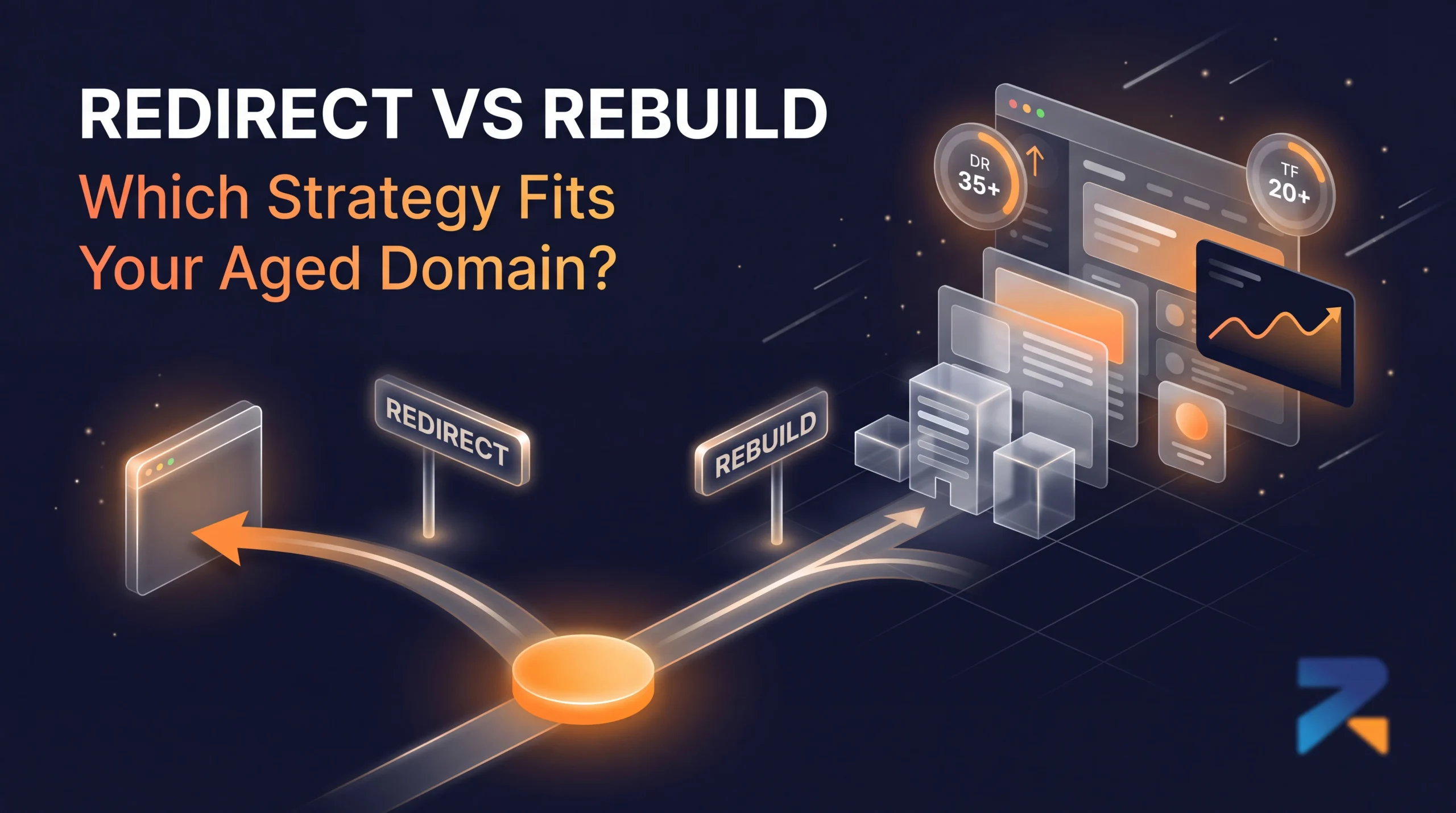

Redirect vs. Rebuild: Which Strategy Fits Your Aged Domain?
Redirecting an aged domain sends its accumulated authority to an existing site, while rebuilding creates new content directly on the domain to inherit that authority in place — redirecting is faster and lower-effort, while rebuilding generally preserves more long-term value and is less likely to trigger the scrutiny a sudden mass-redirect pattern can attract.
Last updated: August 2026.
What Each Approach Actually Does
A 301 redirect passes the aged domain’s link equity to a destination URL, consolidating authority onto a site you’re already running. Rebuilding means publishing new content directly on the aged domain itself, aiming to inherit its indexation history, topical relevance, and backlink profile in place rather than transferring that value elsewhere.
When Redirecting Makes Sense
- You already have an established money site and want to consolidate authority from multiple domains into one property rather than maintaining several separately.
- Speed matters more than long-term domain-level value — a redirect is live almost immediately, while rebuilding a domain’s own content and reputation takes months.
- The aged domain’s content history isn’t a strong topical match for what you want to build, making a standalone rebuild less efficient than redirecting the value elsewhere.
When Rebuilding Makes Sense
- The domain’s prior content and backlinks are topically relevant to what you plan to publish, meaning in-place content can inherit more of that relevance than a redirect target would.
- You want a standalone asset with its own resale or long-term value, rather than folding it permanently into another property.
- You’re managing multiple aged domains and want to avoid the pattern-recognition risk of redirecting several domains to the same destination in a short window.
The Risk Profile Is Different, Not Just the Effort Level
Redirect chains and mass-redirect patterns (many domains pointing to one destination in a short period) are a more visible, more easily detected pattern than a domain being rebuilt with its own standalone content. This doesn’t mean redirecting is inherently against guidelines — legitimate consolidations happen constantly — but it does mean the strategy carries a different kind of scrutiny than a slower, content-based rebuild.
A Middle Path: Redirect With a Delay
Some practitioners rebuild a domain with genuine content first, let it stabilize and reindex under its own identity, and only redirect later if consolidation becomes the goal. This avoids an immediate mass-redirect signal while still preserving the option to consolidate authority down the line.
Frequently Asked Questions
Is redirecting an aged domain better than rebuilding it?
Neither is universally better — it depends on your goal. Redirecting is faster and consolidates authority into an existing site; rebuilding takes longer but preserves the domain as a standalone asset and can better inherit topical relevance in place.
Is redirecting multiple aged domains to one site risky?
It can draw more scrutiny than individual standalone rebuilds, since mass-redirect patterns are a more visible and detectable signal than domains being rebuilt independently with their own content.
Can I rebuild a domain first and redirect it later?
Yes. Some practitioners build genuine standalone content first, let the domain stabilize under its own identity, then redirect later if consolidation becomes the goal — this avoids an immediate mass-redirect pattern.
Does the domain’s prior content topic affect which strategy is better?
Yes. A domain with content and backlinks closely matching your target topic generally benefits more from a rebuild, since in-place content can inherit more of that topical relevance than sending the value elsewhere via redirect.
Related Guides
Sources & Further Reading