
Link velocity—the exact rate at which a website accumulates backlinks over time—has long been debated as a potential ranking signal. But the conversation gets complicated when you apply it to aged domains. These are properties with deep historical link patterns that often sat completely dormant for months, or even years, before changing hands.
the-greenmarket.comthe-greenmarket.com
DA28
PA23
DR14
$ 100View details
lakewoodrvpark.comlakewoodrvpark.com
DA16
PA26
DR1
$ 80View details
lamalqueridamurcia.comlamalqueridamurcia.comE-commerce
DA5
PA18
DR0
$ 100View details
bernikerdecoratorsny.combernikerdecoratorsny.comShop
DA6
PA18
DR6
$ 25View details
gabrielecollalto.comgabrielecollalto.comEntertainment
DA9
PA25
DR1
$ 25View details
alikuscugokbilim.comalikuscugokbilim.comEducation
DA12
PA18
DR0
$ 25View details
If you recently acquired an expired property, you inherit its entire historical backlink curve. Understanding how search engines interpret the sudden reactivation of that curve is the difference between capturing top-tier rankings and triggering an algorithmic penalty.
Here is a breakdown of what Google actually looks for, why sudden backlink spikes can trip spam filters, and how to safely navigate link building on a reactivated domain.
The Unique Link Graph of an Aged Domain
When you build a site on a brand-new domain, search engines expect a slow, natural trickle of backlinks. Aged domains play by different rules.
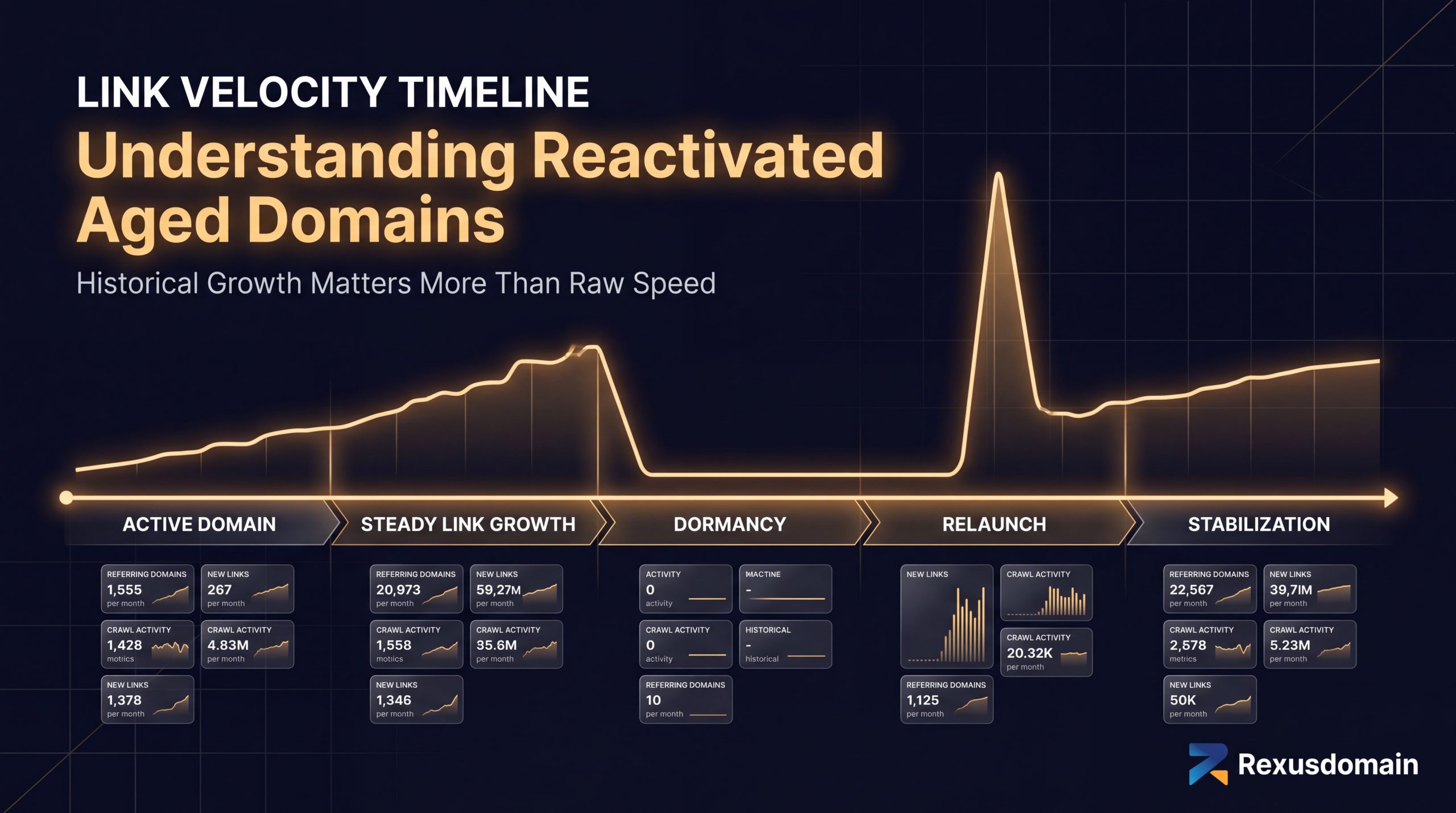
A seasoned domain might have earned links steadily for eight straight years, experienced zero link growth for an 18-month dormant phase, and then suddenly hit a massive spike when you push a new content strategy live.
To Google’s spam detection systems (like SpamBrain), context is everything. A domain that hasn’t seen a single new referring domain since 2023 suddenly acquiring 50 high-DR links in a single week doesn’t look like viral success. It looks exactly like paid link building or a Private Blog Network (PBN) setup. But does this specific pattern result in a hard penalty, or is it just an anomaly trigger?
Google’s Stance: Spam Trigger vs. Ranking Factor
Google representatives have stated multiple times that link velocity, on its own, is not a direct ranking factor. You don’t automatically rank higher simply because you build links faster than a competitor.
However, unnatural link velocity operates as a core anomaly detector. Sudden, inexplicable spikes in backlink acquisition—especially on properties that have been inactive—flag the domain for deeper algorithmic evaluation or manual review. It acts as a tripwire.
The Reality in the SERPs: Mixed Evidence and Volatility
Field data from SEO practitioners tells a nuanced story about how this actually plays out in the wild:
-
The Baseline Advantage: Aged domains with a gradual, established historical link profile routinely outrank newly built websites that possess the exact same current link count. This suggests that the age and stability of the existing link graph provide a buffer. Link velocity isn’t a hard blocker if the foundation is solid.
-
The Reactivation Sandbox: Many site builders report severe ranking volatility when they reactivate an aged domain with an aggressive, sudden link push. The site might dance in and out of the index or stall at the bottom of page two.
-
The Stabilization Period: This volatility isn’t necessarily a permanent penalty. In most observed cases, if the links are contextually relevant and not overt spam, the domain stabilizes and regains traction after a 4-to-8 week algorithmic evaluation period.
SEO Best Practices: How to Safely Build Links on Aged Domains
To leverage the power of an aged domain without poking the algorithmic bear, your off-page strategy needs to look organic. Here is how to handle link velocity properly after a domain acquisition:
-
Analyze the Historical Growth Rate: Before building a single link, look at the domain’s historical curve in Ahrefs or Majestic. Did it historically gain 2 links a month, or 20? Your baseline should mirror its most active historical period.
-
Drip-Feed the Reactivation: Do not blast the site with links in month one. The safest approach is to grow links gradually. Start with brand mentions, citations, and foundational profile links to signal that the business has simply changed hands or relaunched.
-
Match or Slightly Exceed: Once the domain is crawling and indexing normally, begin your outreach. Aim to match or only slightly exceed the domain’s historical link acquisition rate.
-
Prioritize Relevance Over Volume: A reactivated domain is highly sensitive to topical relevance. Five highly relevant contextual links placed over a month will perform drastically better—and look much safer—than 50 random guest posts.
Ultimately, link velocity on an aged domain is about managing risk. By respecting the domain’s historical link rhythm and easing it back into active growth, you avoid the anomaly filters and let the true authority of the aged domain do the heavy lifting.