
Every operator has been there. You’re evaluating an aged domain, and the first thing you check is DR, DA, or TF. The number looks solid, so you move forward. The domain lands. And then nothing happens or worse, rankings tank after a month.
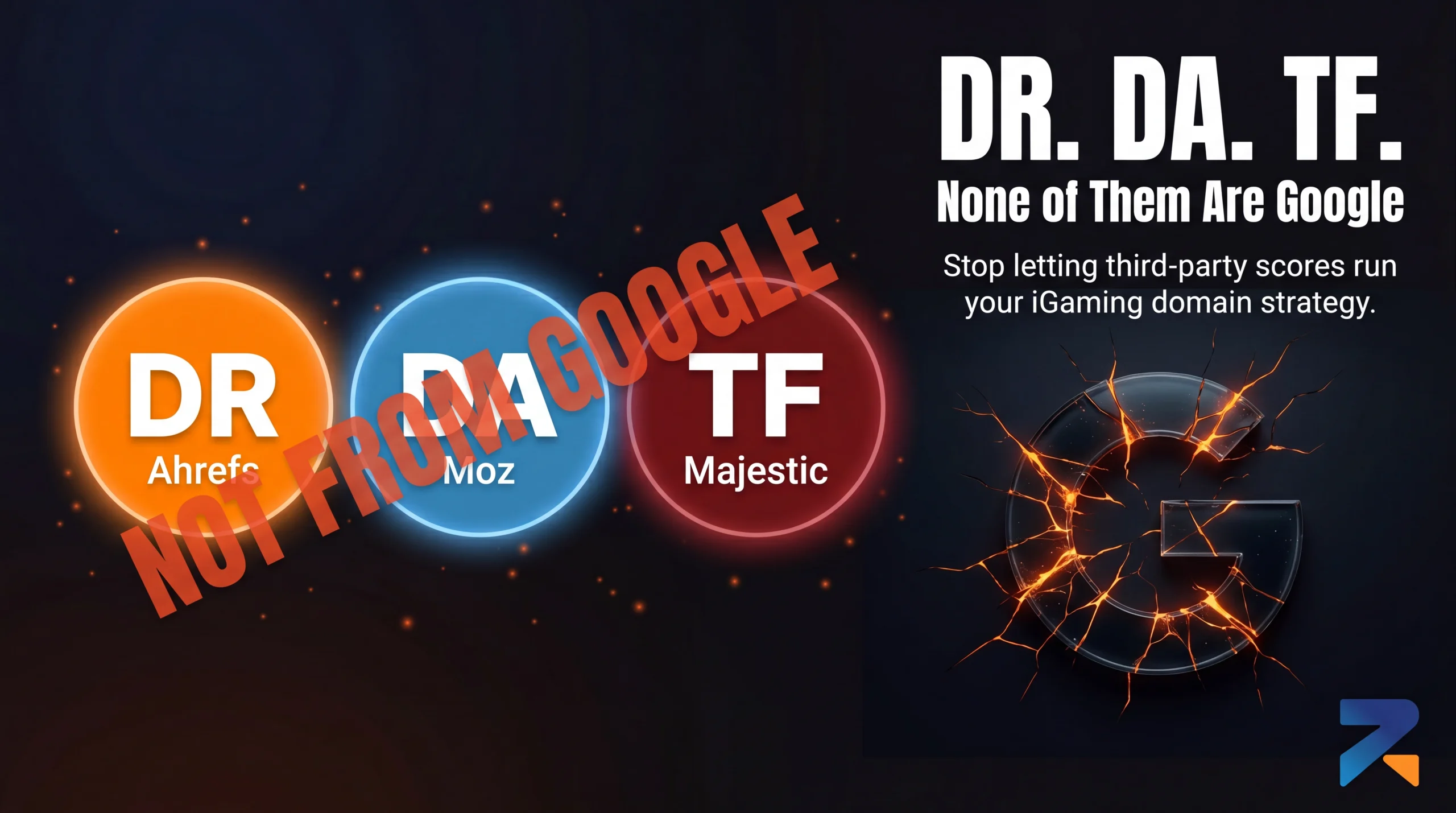
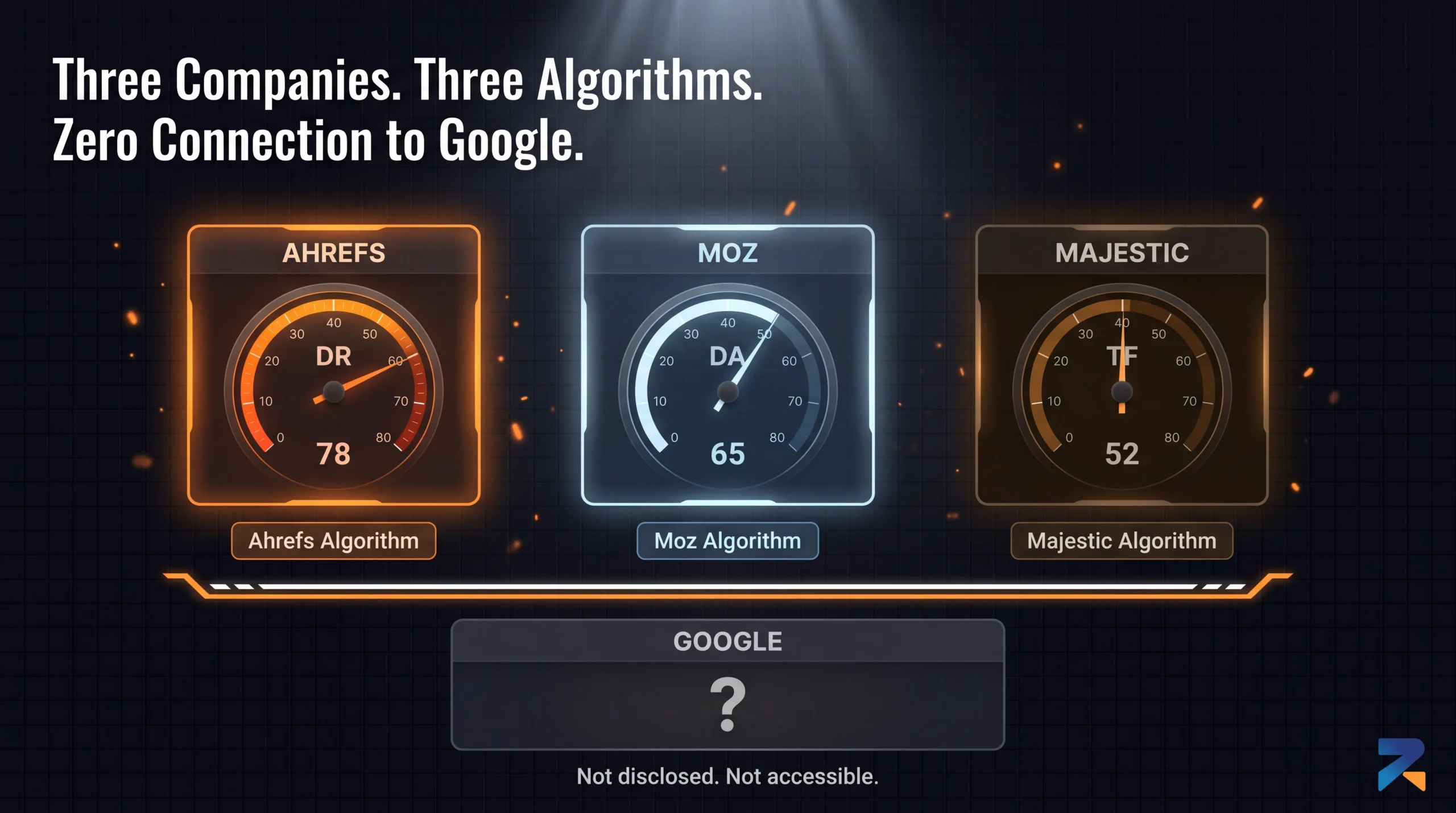
Here’s the thing nobody says out loud: DR, DA, and TF are not Google metrics. They were never Google metrics. They were created by three private companies Ahrefs, Moz, and Majestic to sell their own tools. Google has no idea what your domain’s DR is. It doesn’t factor into a single ranking decision.
That doesn’t make these metrics completely useless. But using them as the primary filter when buying aged domains for iGaming? That’s a mistake operators make constantly and it’s costing them real money.
This article breaks down what DR, DA, and TF actually measure, why they’re unreliable as standalone signals in iGaming, and what to look at instead when you’re vetting a domain.
What These Metrics Actually Are
Let’s get this straight before anything else.
Domain Rating (DR) is Ahrefs’ proprietary score, 0 to 100, that measures the relative strength of a domain’s backlink profile based on data crawled by Ahrefs’ own bot. It’s logarithmic, which means the jump from DR 50 to DR 60 is far harder than DR 20 to DR 30.
Domain Authority (DA) is Moz’s equivalent also 0 to 100, also logarithmic, also based on Moz’s own index of the web. It was originally designed to predict how well a domain would rank in Google. Emphasis on “predict.” It’s a guess.
Trust Flow (TF) is Majestic’s metric, measuring the quality of links pointing to a domain based on proximity to what Majestic considers “trusted seed sites” a manually curated list they built themselves. Citation Flow (CF) measures volume. TF measures “quality.” Both are Majestic’s interpretation, not Google’s.
Three different companies. Three different crawlers. Three different algorithms. Three different definitions of “quality.”
None of them have API access to Google’s ranking systems. None of them know what Google knows.
Why Google Doesn’t Use Any of Them
Google ran a public toolbar PageRank score for years a green bar in the browser that showed a domain’s relative authority on a 0–10 scale. They deprecated it in 2013 and removed it entirely by 2016.
Since then, Google’s internal authority signals whatever they are have been completely opaque. The company has explicitly said they don’t share PageRank data publicly anymore. John Mueller has said on multiple occasions that domain authority as a concept doesn’t align with how Google evaluates sites.
What Google actually evaluates is far more nuanced: the relevance of individual linking pages to the content being linked, the historical trust signals of the linking domain, whether the link pattern looks natural or manufactured, and increasingly, the overall quality and helpfulness of the destination site itself.
None of that gets distilled into a single number. That’s precisely why the DR/DA/TF proxies exist they fill a gap that Google deliberately left open.
Why This Matters More in iGaming Than Any Other Niche
In most niches, an inflated DR is annoying but not catastrophic. You overpay slightly for a domain and move on.
In iGaming, inflated metrics directly affect how much you spend, how you structure your network, and ultimately whether your strategy works at all. Aged domains with DR 40+ routinely sell for $300 to $1,500+ in marketplace auctions. If that DR is manufactured and in iGaming, this is far more common than people admit you’ve just bought an expensive liability.
Here’s how DR gets gamed in this niche specifically:
Link exchanges between operators. A group of iGaming affiliate site owners agrees to cross-link. Ahrefs crawls the links, each site’s DR bumps up. The links carry near-zero real authority because they’re self-referential within a contaminated ecosystem. DR goes up. Google sees a pattern.
Niche edit farms. Sellers buy niche edit placements on aged gambling or sports sites, temporarily inflating DR before listing the domain for sale. Once the domain changes hands, some of those placements get removed or the linking sites lose their own authority. DR drops post-purchase.
Majestic TF manipulation via seed adjacency. TF is calculated based on how close your backlink sources are to Majestic’s “trusted seeds” which include major media, government, and educational sites. A spammer who gets one link from a .edu that Majestic trusts can have surprisingly high TF despite a garbage overall profile.
We’ve seen operators pay a premium for DR 45 domains that, after a proper backlink audit, have 60% of their referring domains flagged as spam or dead. The DR looked great. The actual link profile was unusable.
What These Metrics Are Good For (and Where They Stop)
To be fair: DR, DA, and TF aren’t worthless. They’re useful as a first filter a way to quickly eliminate obvious junk from a list of 50 domains before you go deeper.
If a domain has DR 8 and you’re looking for genuine authority, you can skip it without spending 20 minutes on a full audit. That’s a legitimate use case.
The problem is when operators stop there. When DR 40 becomes a proxy for “this domain is good.” When a high TF score becomes a justification for not checking whether the link profile aligns with what you need for an iGaming money site.
Think of it like this: DR tells you how many votes a domain has received. It doesn’t tell you who voted, whether those voters were legitimate, or whether those votes are in any way relevant to gambling, sports betting, or casino content.
In iGaming, that relevance question matters enormously.
What to Actually Look At When Buying an Aged Domain
If DR/DA/TF are the wrong primary signals, here’s what you should be digging into instead.
Organic Traffic History
This one is underused and arguably the most important signal available.
A domain that consistently appeared in Google search results and drove organic traffic is a domain Google trusted enough to rank. That trust is real it’s built into how Google’s systems have historically evaluated the domain.
Pull the domain through Ahrefs’ Site Explorer and look at the organic traffic graph going back as far as the data allows. You want a domain that had sustained traffic over multiple years, not spikes from link schemes. If traffic dropped sharply at specific dates, check what Google updates rolled out at those times. A domain that tanked during a Helpful Content Update carries very different signals than one that recovered through multiple algorithm cycles.
Referring Domain Diversity and Composition
The number of referring domains matters less than what those domains are.
Look at the actual sites linking to the domain. Are they recognizable, legitimate sites in adjacent niches? Are they gambling review sites with real content? Are they general news or content sites that covered gambling topics organically? Or are they a wall of sidebar widgets, footer links, and foreign-language directories?
In iGaming specifically, look for domains where at least a portion of the backlink profile comes from real editorial content reviews, news coverage, event listings rather than 100% from link insertion networks.
Link Profile Relevance to Gambling/Betting
This is the niche relevance question. A DR 50 domain that built its authority as a tech news site is not the same asset as a DR 35 domain that spent five years as a sports news portal with regular coverage of major sporting events.
For iGaming money sites, a domain with existing topical relevance to gambling, sports, finance, or entertainment transfers more contextual authority than a generic high-DR domain from an unrelated niche. Google’s systems increasingly evaluate topical authority at the domain level, not just page-level relevance.
Spam Score and Toxic Pattern Checks
Run the domain through Moz’s Spam Score alongside a manual Ahrefs check for nofollow ratios, link velocity anomalies, and bulk link sources. Any domain with more than 20–25% of its backlinks from sites that are themselves flagged as spammy is a risk, regardless of what the headline DR looks like.
Check the Wayback Machine for content history. What was the site about at peak authority? Who was it serving? Was content consistently published over years, or was there a 3-year gap where the domain just sat dormant? Dormancy periods are a yellow flag.
Traffic Trend Post-Sale
One signal most operators don’t check: does the domain you’re evaluating still have any residual organic traffic right now? A domain with current traffic even 50–100 organic visits per month is still active in Google’s index. That’s meaningful. It means Google is still serving it for some queries. An entirely dead domain with zero traffic, no matter how high its DR, is starting from more of a cold state than operators typically assume.
A Practical Vetting Framework That Doesn’t Start With DR
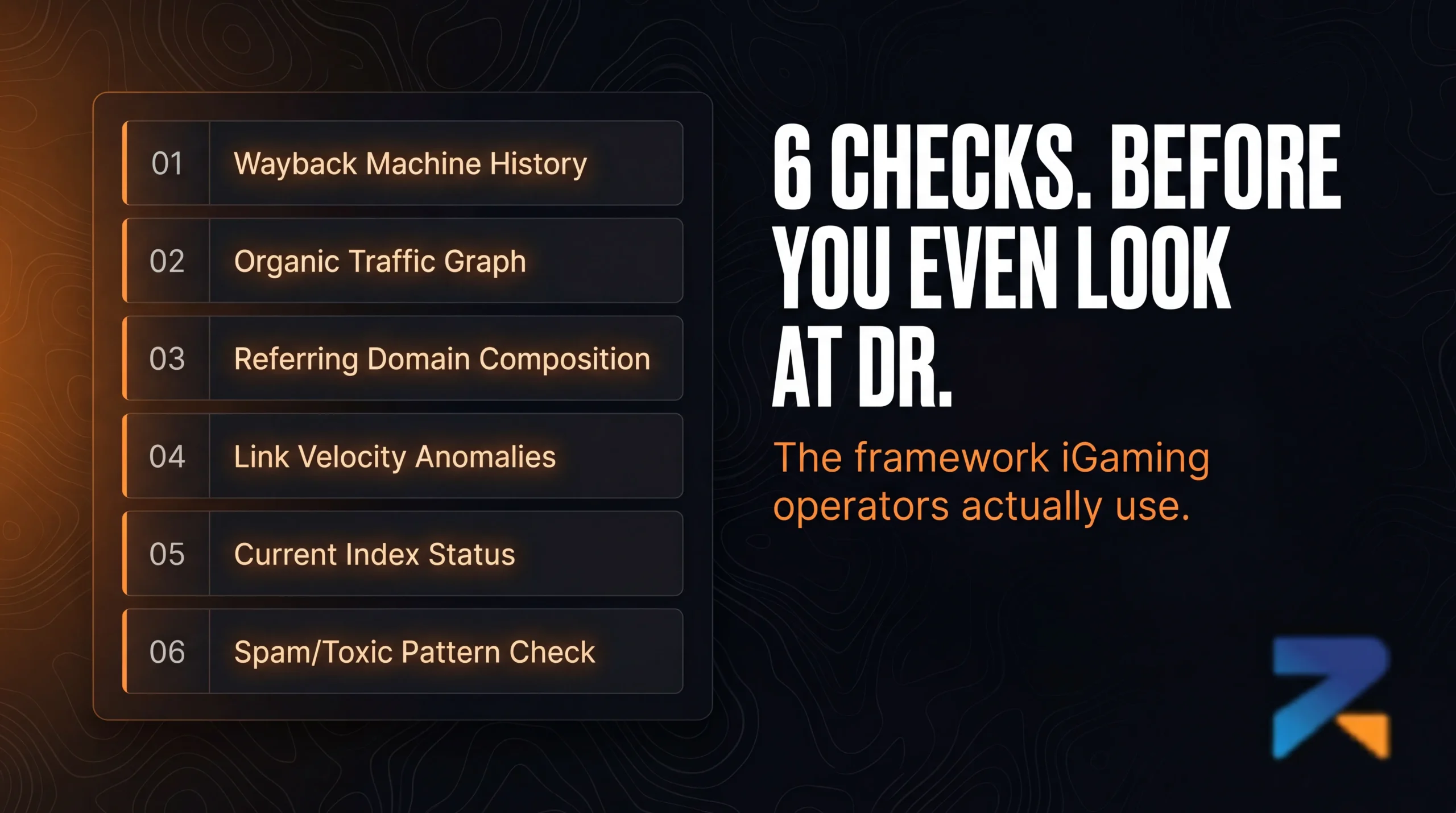
When evaluating aged domains for iGaming, run this sequence before you even look at DR/DA/TF:
- Wayback Machine check first What was the site’s content history? Was there gambling relevance at any point?
- Ahrefs organic traffic graph Did this domain have real search visibility over multiple years? Did it survive major algorithm updates?
- Referring domain composition Open the top 20–30 referring domains manually. Are they real sites? Are they live?
- Link velocity anomalies Did the domain pick up 500 links in a 3-month window and then nothing? That’s a scheme footprint.
- Current index status Is the domain still indexed? Does it have any live traffic?
- Spam/toxic pattern check Moz Spam Score + Ahrefs filtered view for nofollow-heavy or foreign-language patterns.
After all of that, look at DR/DA/TF as a sanity check not as the decision. A domain that passes the first six steps with DR 30 is a better buy than a DR 55 that fails two of them.
The Real Risk of Metric Dependency in iGaming
Most domain sellers know that iGaming operators use DR as their primary filter. That knowledge shapes how domains get prepared for market. It’s not always malicious sometimes it’s just the inevitable result of operators creating demand for a number that can be influenced.
When your acquisition process centers on a metric that sellers can move, you’re not vetting domains you’re vetting how well a seller has optimized for your checklist.
The operators getting real results from aged domains in iGaming are the ones doing forensic-level due diligence before purchase. They’re looking at things Ahrefs and Moz can’t measure: the quality of individual link sources, the content credibility of the domain’s history, the topical alignment with their target pages.
That takes more time than filtering by DR 40+. It also produces entirely different outcomes.
If you’re buying aged domains for iGaming and want to skip the guesswork, Rexusdomain’s inventory is vetted beyond headline metrics every domain has been audited for backlink profile quality, traffic history, and niche relevance before it’s listed. You can explore available aged domains or learn more about how to audit an aged domain properly before your next acquisition.
Related Guides
- Best Aged Domain Marketplace for iGaming SEO (2026)
- Best aged domain marketplaces 2026 — top 7 platforms ranked
- How to Build a PBN for iGaming SEO Using Aged Domains
- Where to Buy Aged & Expired Domains in 2026: The Complete Buyer’s Guide
- Aged Domain Sellers You Can Trust: How to Vet a Premium Marketplace
Sources & Further Reading
Frequently Asked Questions
What is the difference between DR, DA, and Trust Flow for aged domains?
Domain Rating (DR) is Ahrefs link strength score. Domain Authority (DA) is Moz equivalent. Trust Flow (TF) is Majestic quality-weighted metric, measuring how trustworthy a domain links are based on proximity to known trusted seed sites. For iGaming SEO, TF is often the most reliable predictor of actual ranking power.
Is Domain Authority still a useful metric in 2026?
DA is useful for relative comparison between domains, but it has serious limitations. Moz index is smaller than Ahrefs, and DA can be inflated by spammy links. For iGaming domain buying decisions, DR (Ahrefs) and TF (Majestic) are more reliable signals. Use DA only as a quick reference, never as your sole evaluation criterion.
Can a domain have high DR but low Trust Flow?
Yes, and this is a major red flag. High DR with low TF indicates a large number of referring domains of poor quality — often link farms, spam directories, or PBN networks. In iGaming SEO, a domain with DR40/TF8 is far less valuable and more risky than a domain with DR25/TF22. TF is the quality filter.
What DR and TF should I target for a PBN domain?
Minimum viable thresholds for a PBN domain: DR20+ (Ahrefs), TF15+ (Majestic), Spam Score under 5% (Moz), 30+ unique referring domains. For premium iGaming PBN nodes targeting competitive casino and sports betting keywords, aim for DR30+, TF20+, and topical TF in gambling or entertainment categories.
Do Google rankings actually correlate with DR, DA, or TF?
There is correlation but not causation. Studies by Ahrefs and SEMrush consistently show DR correlates with first-page rankings, but high-DR domains with thin content or spam history do not rank. Trust Flow correlates more strongly with quality outcomes in niche verticals like iGaming. All third-party metrics are proxies — what matters to Google is the actual quality and relevance of linking pages.
Should I prioritise referring domains or DR when buying an aged domain?
Referring domain count is often more predictive than DR alone. A domain with 200 unique referring domains at DR15 will frequently outperform a domain with 20 referring domains at DR35 — Google PageRank algorithm rewards breadth of linking sources. Aim for 50+ referring domains minimum, and verify those domains are real sites, not link farms.