
You found a domain that looks solid on paper. DR 38, referring domains from real sites, history going back to 2014, nothing obviously toxic in the backlink profile. Only problem it’s been parked for 20 months. The seller swears it’s fine. You’re not sure.
That uncertainty is worth taking seriously.
The question operators keep asking is whether link equity actually decays when a domain goes dark, and if it does, over what timeframe. It sounds like a simple question. The answer is more complicated than most people want it to be, because the honest version requires separating three different things that are happening simultaneously and moving at different speeds.
Most guides flatten this into “yes it decays” or “no the links stay” and leave you with the wrong mental model either way.
What’s Actually Happening When a Domain Sits Idle
First, let’s kill the most common misconception: Google doesn’t flip a switch the moment your domain stops serving content. There’s no penalty clock that starts ticking the day the site goes offline. That’s not how this works.
What actually happens is slower, more mechanical, and in some ways more damaging precisely because it’s invisible.
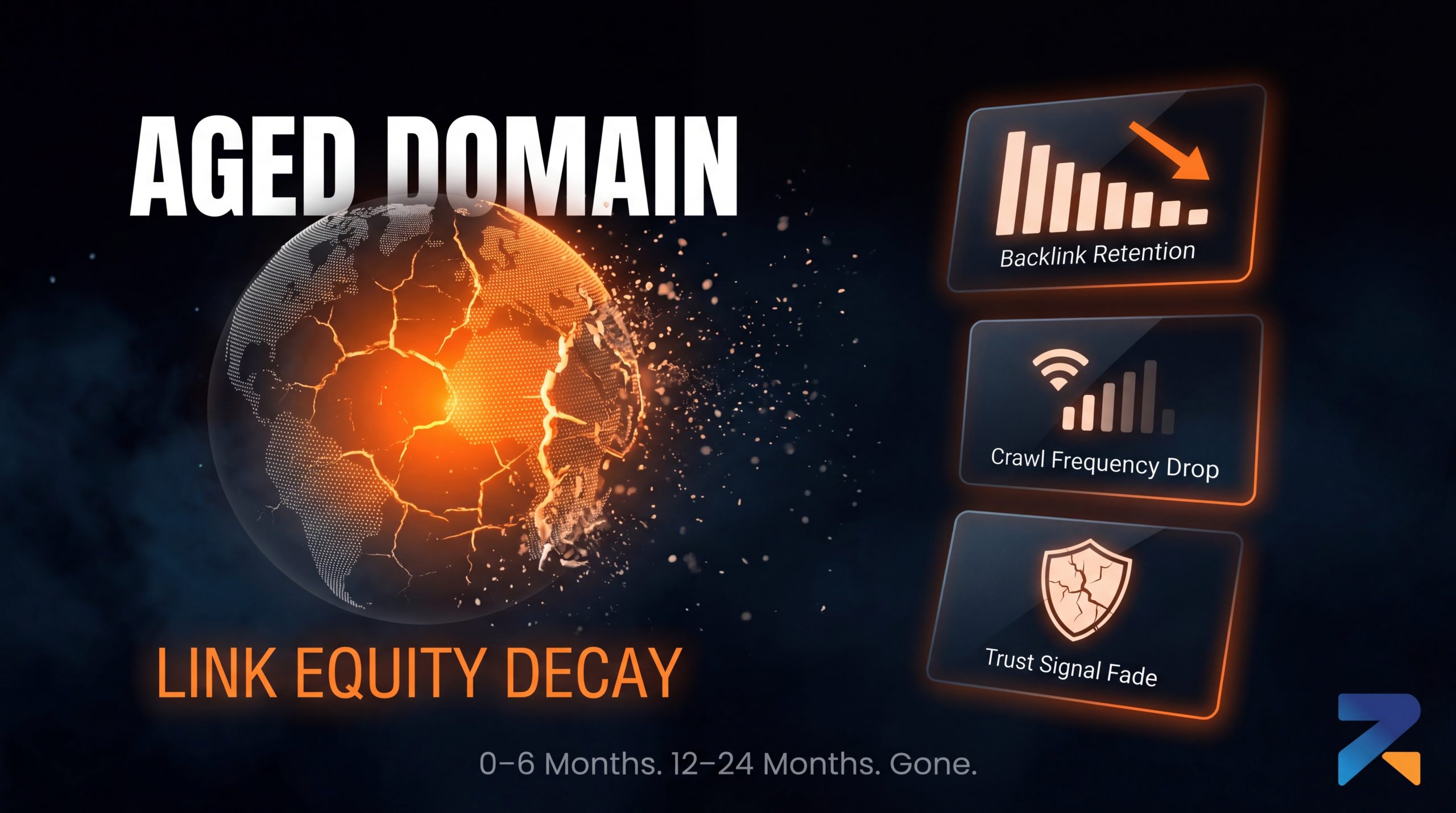
Backlinks die quietly. The pages linking to your domain don’t last forever. Publishers update old content, restructure URLs, delete articles that stopped performing, migrate to new platforms. Every time one of those pages disappears, the link it was carrying disappears with it. No algorithm needed just attrition. In markets where content gets refreshed aggressively, this alone can strip out 10–15% of your live referring pages within a year. That’s not a penalty. It’s just time doing what time does.
Googlebot stops showing up. Crawl budget allocation isn’t static. Google pays more attention to domains that give it reasons to come back new content, inbound signals, traffic activity. A domain that’s been parked showing the same blank page for 14 months? Googlebot visits less. The cached data gets stale. And when you eventually put something live on that domain, you’re not recovering from a standing start you’re recovering from a lower crawl priority than the domain’s age would normally earn you. That gap closes, but it takes longer than most operators expect.
Trust signals soften. This is the one people argue about the most, and I’ll be straight with you: the effect is real, but it’s slow. Google’s confidence in a domain is partly built on behavioral consistency over time. A domain that’s been active for eight years, regularly serving content, accumulating links organically that has a kind of momentum. Going dark doesn’t erase that momentum immediately. But a two-year gap does weaken the recency signals that reinforce it. Old history still counts. Just not as much as recent history. Think of it like a credit file: seven years of clean payments matters, but if you went completely inactive for two of those years and only just came back, the recent picture doesn’t match the historical one.
How Bad Is It, Actually Per Time Period
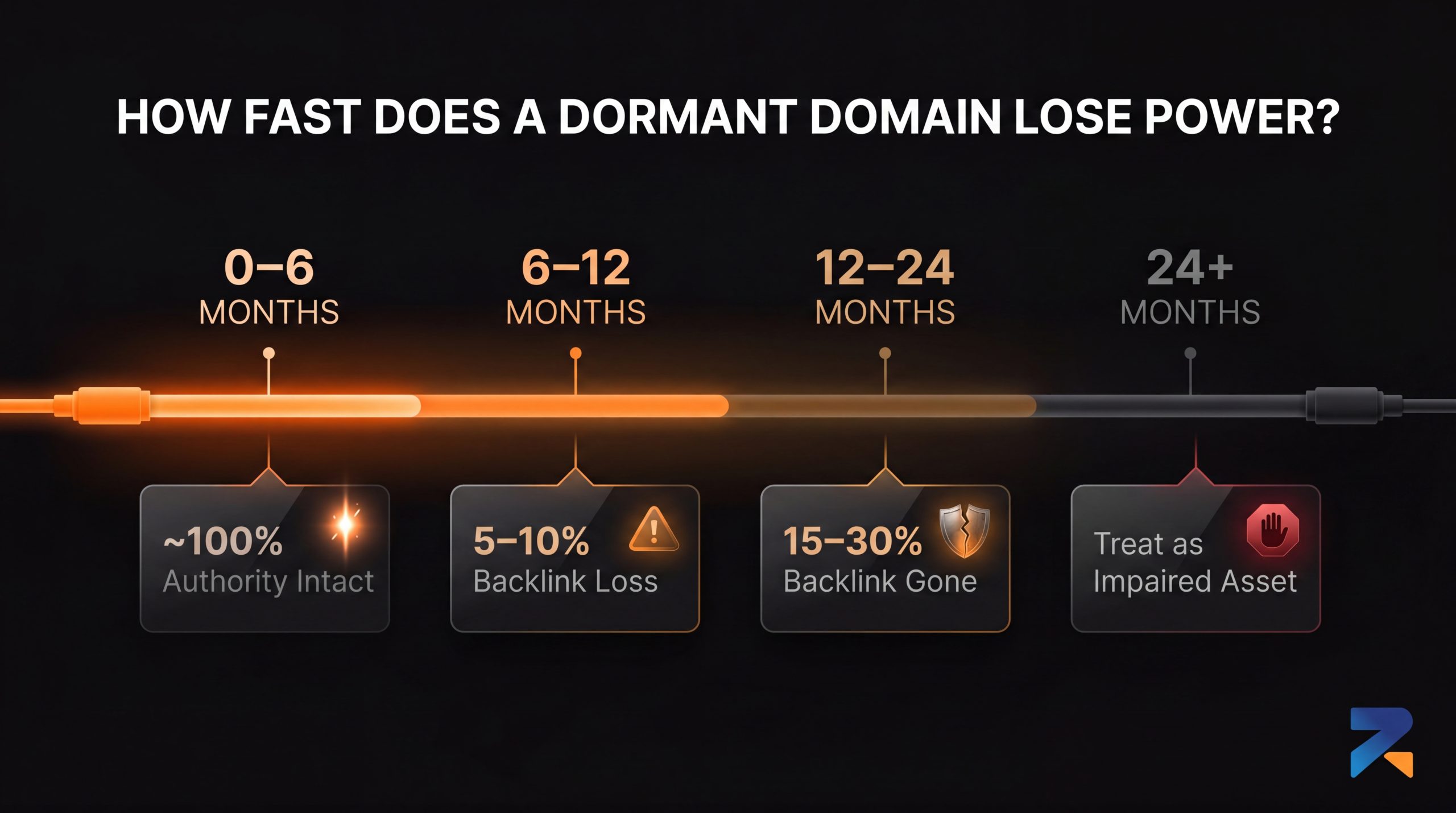
The gap between theory and what operators actually see playing out is worth talking through in specific terms.
Under six months: Basically nothing to worry about. The domain still has most of its signals intact, backlink attrition is minor, and crawl frequency recovers quickly once content goes up. Domains in this window activate close to their full potential. If you’re hunting dormant domains, this is the range you want.
Six to twelve months: The first meaningful cracks. Expect somewhere around 5–10% backlink loss from page-level deletions. Rankings that might have appeared in week five or six on a fresh activation now show up closer to week nine or ten. Still workable you’re not starting from nothing but the freshness premium is visibly gone and you’ll notice the difference if you’ve activated domains that were only dormant for a couple months.
Twelve to twenty-four months: This is where most operators get hurt. Backlink attrition is now real you could be looking at 15–30% of referring domains having updated or deleted the pages that were carrying your links. That’s not recoverable. The domain’s crawl allocation has settled into near-zero maintenance mode. And if the original content is completely gone, Google’s topical association with that domain has weakened. A finance domain that was active until early 2023 and has been blank since isn’t the same signal as a finance domain that was active last month. The history is still there, but the connection is fraying.
Over two years: Treat it with real skepticism before buying. Not a write-off operators are absolutely running campaigns on domains that sat dark for three or four years, some very profitably. But you’re buying something that needs more verification than its metrics suggest, and the timeline to performance is longer than with a recently active domain.
Some Things Don’t Come Back
Here’s what I mean by permanent: if 40 referring domains were linking to pages that no longer exist, those editorial links are gone. You publish fresh content, the domain is live again, great those links do not reappear. The site that linked to your old domain’s article about slot regulations in 2019 is not going to re-link just because you’re back online. That referring domain is lost from the profile permanently. You can build new links to compensate, but you are compensating, not restoring.
Index coverage is similar. Pages that were indexed while the domain was active can get quietly deindexed as Google repeatedly finds them returning 404s or blank parked pages. Getting re-indexed after reactivation takes time, and in iGaming, where you often need ranking signals fast, that lag costs you real opportunity in the exact window when you need momentum.
There’s also what I’d call a timeline gap problem. Google’s understanding of a domain’s authority is partly built on what the link acquisition pattern looks like over time. A domain that built links steadily for six years, went silent for two, and then suddenly has a new site and new links coming in that gap is visible. It doesn’t trigger a penalty in most cases, but it does mean the domain’s authority gets deployed from a weaker position than the DR suggests. DR 40 after 26 months of dormancy is not DR 40 from an active domain. Same dashboard number. Different real-world weight.
What You Need to Check Before You Buy
Ignore the historical metrics view. I mean that literally when Ahrefs or Majestic shows you referring domains, you’re looking at historical data, not live data. A referring domain that shows up in the count might be pointing to a page that 404’d eight months ago. The link is dead. The count is still there.
Go pull the top 25–30 referring pages manually. Open them. Confirm they’re live, indexed, and still carrying the link. If you find a third of them are pointing to dead pages or have been completely restructured, that domain’s actual profile is materially weaker than the tool is showing you. Price it accordingly.
On Wayback Machine and most people check this wrong don’t just confirm there’s a snapshot. Find the last date content was actively being updated. There’s a difference between a domain that had content through late 2023 and went dark in early 2024, versus one where the last real update was 2021. That date is when the decay clock started. That’s your baseline.
GSC access is rare but worth asking about. If the seller can pull historical Search Console data, impressions from the active period tell you whether the domain was actually ranking and drawing clicks or just passively accumulating backlinks without generating search traffic. Both look similar in Ahrefs. They do not behave the same way after reactivation.
One more thing that most operators completely skip: look for re-registration gaps in WHOIS history. If the domain lapsed and was re-registered even by the same person Google may treat it differently from a domain with uninterrupted registration. Tools like DomainIQ or WhoisFreaks surface this. Any ownership gap is worth investigating harder before you commit money to a purchase.
A Practical Way to Score It Before You Offer
When I’m looking at a dormant domain, I run through these five variables before making any price decision:
How long has it actually been dark? Under six months is low risk. Six to twelve is moderate factor in a 10–15% discount to what you’d pay for an active equivalent. Twelve to twenty-four months is where you want to verify live backlinks manually before anything else. Over two years, treat it as a partially impaired asset until proven otherwise.
What percentage of the top referring pages are still live? If 80% or more check out, you’re in decent shape. Below 60%, meaningful attrition has already happened and the profile is genuinely thinner than it looks.
Any re-registration events in WHOIS history? If yes, automatic deeper audit before proceeding.
When was the last Wayback snapshot showing real content activity? Under a year ago still warm. One to two years cooling. Over two years the recency signals are cold and recovery is going to take longer.
Does the domain’s historical niche line up with what you’re building? Off-niche history doesn’t disqualify a domain, but it means you’re rebuilding topical trust regardless of how clean everything else looks.
None of this makes a dormant domain a bad buy. It just means don’t pay active-domain prices for partial-domain value. And don’t expect a six-week ranking timeline on a domain that’s been offline since 2022.
When the Domain Actually Expires and Why It’s Not the End
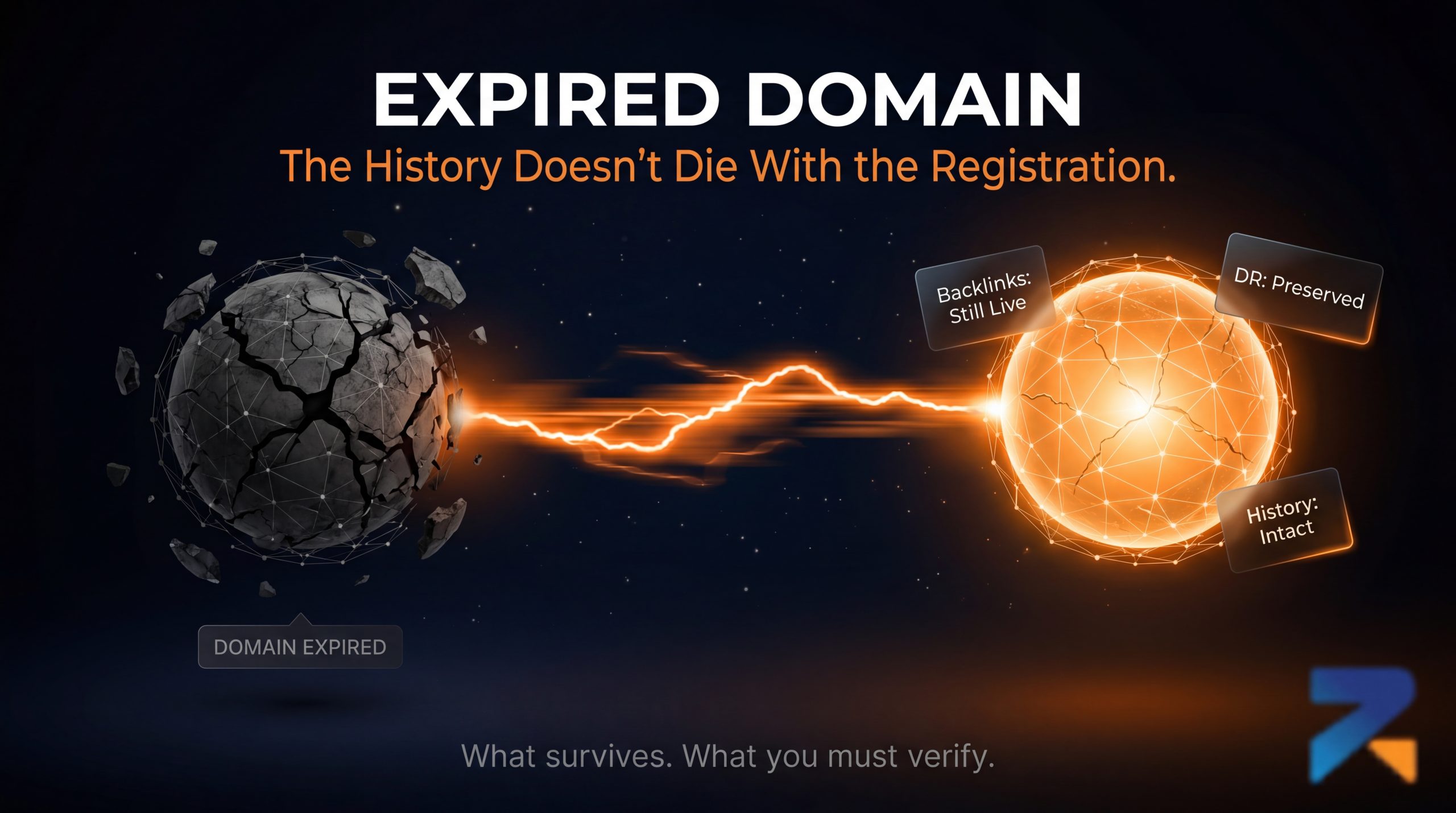
Now different scenario. The owner stops paying renewal fees entirely. The domain expires, burns through its grace period, hits redemption status, and eventually drops back into the open pool. Most people assume at this point the domain is dead, the SEO value is gone, and all that’s left is the name.
That’s wrong.
What expires is the registration. Not the backlink profile. Not the referring domains. Not the historical metrics. Not Google’s cached understanding of what that domain was.
When a domain drops, Ahrefs still shows every referring domain it had. Majestic still has the full trust flow history. The links that were pointing to it from live publisher sites many of them are still live, still pointing. The domain’s twelve years of editorial links from real sites didn’t dissolve just because the owner forgot to renew or couldn’t afford $15 for another year.
This is why expired domains get hunted so actively in iGaming. A domain that ranked for competitive gambling keywords for a decade, built up DR 42 from legitimate sources, and then got dropped whoever registers it next inherits that backlink profile. That’s a real asset. Operators in Southeast Asian markets and across Europe are running live iGaming campaigns right now on domains that were expired at the point of purchase.
The risk is different from a dormant domain, though. With a dormant domain, you mostly know what you’re getting the history is continuous, the ownership is traceable. With an expired domain, there’s a gap. Between the original owner dropping it and you picking it up, something might have happened. It might have been grabbed by a domainer who parked garbage affiliate pages on it for six months. It might have been used as a redirect target in a link scheme. It might have been quietly registered and burned by someone testing something they didn’t want associated with their main operation. None of that shows up cleanly in a DR number.
Understanding the actual distinction and what each type of domain brings is worth reading through in full if you haven’t already. There’s a detailed breakdown of aged vs expired domain differences for iGaming SEO that covers what to look for in each type.
What Makes an Expired Domain Actually Worth Buying
Check the drop cycle was clean. Pull WHOIS history. What you want to see is: last renewal → expiry → standard redemption period → deletion → your registration. No activity in between. If something was registered during that gap even briefly that’s a problem that needs investigating before you spend money.
Prioritize domains where the bulk of the links point to the root, not internal pages. Page-level links to URLs that don’t exist anymore still carry less weight than links to the root domain. A domain where most referring domains linked to the homepage or root transfers its equity more cleanly across a new deployment.
Run Wayback checks on the grace period window specifically. This is the bit most people miss. Between when the original owner stopped updating and when the domain fully expired, there’s sometimes a window where squatters stuffed it with garbage content or link farm pages. That window is short sometimes only weeks but it’s enough to create a taint in the history. If you see anything in Wayback during that period other than a standard “this domain is for sale” parking page, go deeper before buying.
Stable niche history matters even in expired domains. A domain that ran as a legitimate travel review site its entire life carries different risk than one that changed hands three times and covered four different topics. Consistency across ownership cycles is a quality signal regardless of how the domain ended up available.
Don’t Do This on Day One
The most common mistake I see with expired domains: operators register it, get excited, and immediately set up a 301 redirect to their money site. Same day or within the first week.
Don’t.
The domain just came back from the dead. Google doesn’t know your intentions yet. Hammering a redirect the moment it resolves doesn’t transfer equity cleanly it raises flags about what you’re actually doing with this thing. You need to either rebuild content on it first and let Google re-establish a relationship with it as a live, functioning domain, or if you’re going to redirect, do it as part of a deliberate, properly timed strategy.
The redirect timing and setup guide for iGaming covers this in detail. The timing section applies directly to expired domains coming back online.
The short version: an expired domain that died cleanly, with verifiable drop history and a live referring domain profile, is a serious SEO asset. Not second-tier. Not a consolation prize for operators who couldn’t afford a properly aged domain. Some of the most effective iGaming deployments running today started with expired purchases. The question was never “is this useful?” The question is whether you can verify what happened between the last legitimate owner and you and whether the answer is clean.
If it is, you have something real. Price it for what it actually is, not what the dashboard number says, and deploy it with patience.
If you want to skip the research work entirely, every domain listed at Rexusdomain has been verified for registration continuity, live backlink retention, and content history before it’s listed. You’re not guessing.
Related Guides
Sources & Further Reading
Frequently Asked Questions
Does an aged domain lose link equity when it goes dormant or parked?
Link equity (PageRank) does not decay simply because a domain is dormant or parked. The backlinks pointing to the domain continue to exist and pass authority as long as those linking pages remain live. What decays is organic search presence — dormant domains lose rankings and indexed pages. The link equity itself remains transferable via 301 redirect or content rebuild for years after the domain goes inactive.
How long can an aged domain stay parked before losing SEO value?
A parked domain retains its backlink-based authority indefinitely as long as the linking pages remain live. However, links to specific URLs on the dormant domain decay as those URLs drop from Google index. The root domain equity remains. Research suggests domains parked for 3+ years lose 20-30% of referring domain count as linking sites naturally expire or remove links — but core authority from high-quality links persists far longer.
What happens to Trust Flow when an aged domain goes dormant?
Trust Flow is calculated from existing live backlinks and does not decay due to domain inactivity. Majestic recalculates TF based on current link graph data regardless of whether the domain is active. A domain parked for 5 years with TF25 will still show TF25 in Majestic if its high-quality linking domains remain active. Check both Fresh Index (current) and Historic Index (peak) TF to understand full historical authority.
Do Google index drops affect aged domain link equity for SEO?
When an aged domain loses its indexed pages, Google may discount some link equity signals as the site appears abandoned. However, incoming backlink authority remains separate from the domain indexation status. The practical impact is that rebuilding content on the domain and achieving re-indexation fully activates the stored link equity — most SEOs report 30-60 day ranking trajectories after publishing content on a quality re-activated aged domain.
Should I rebuild content on an aged domain before or after acquiring backlinks?
Always publish content before acquiring additional backlinks. Google evaluates link equity in the context of existing content — links to an empty or parked domain provide reduced benefit. Publish minimum viable content (5-10 pages relevant to the domain history), submit to Google Search Console, achieve initial indexation, then begin new link acquisition. This sequence activates stored equity and ensures new links evaluate against real content signals.
Is a 5-year-old parked domain worth buying for iGaming SEO?
A 5-year parked domain is worth evaluating but not automatically worth buying. Check Majestic Historic TF — if it was above 15 at peak with a relevant TopicalTrust Flow category, the core equity is likely recoverable. Verify Wayback Machine archives show legitimate pre-parking content. If original content was iGaming, finance, or entertainment relevant, a 5-year parked domain with TF15+ and 30+ referring domains is a viable acquisition at $200-$800.