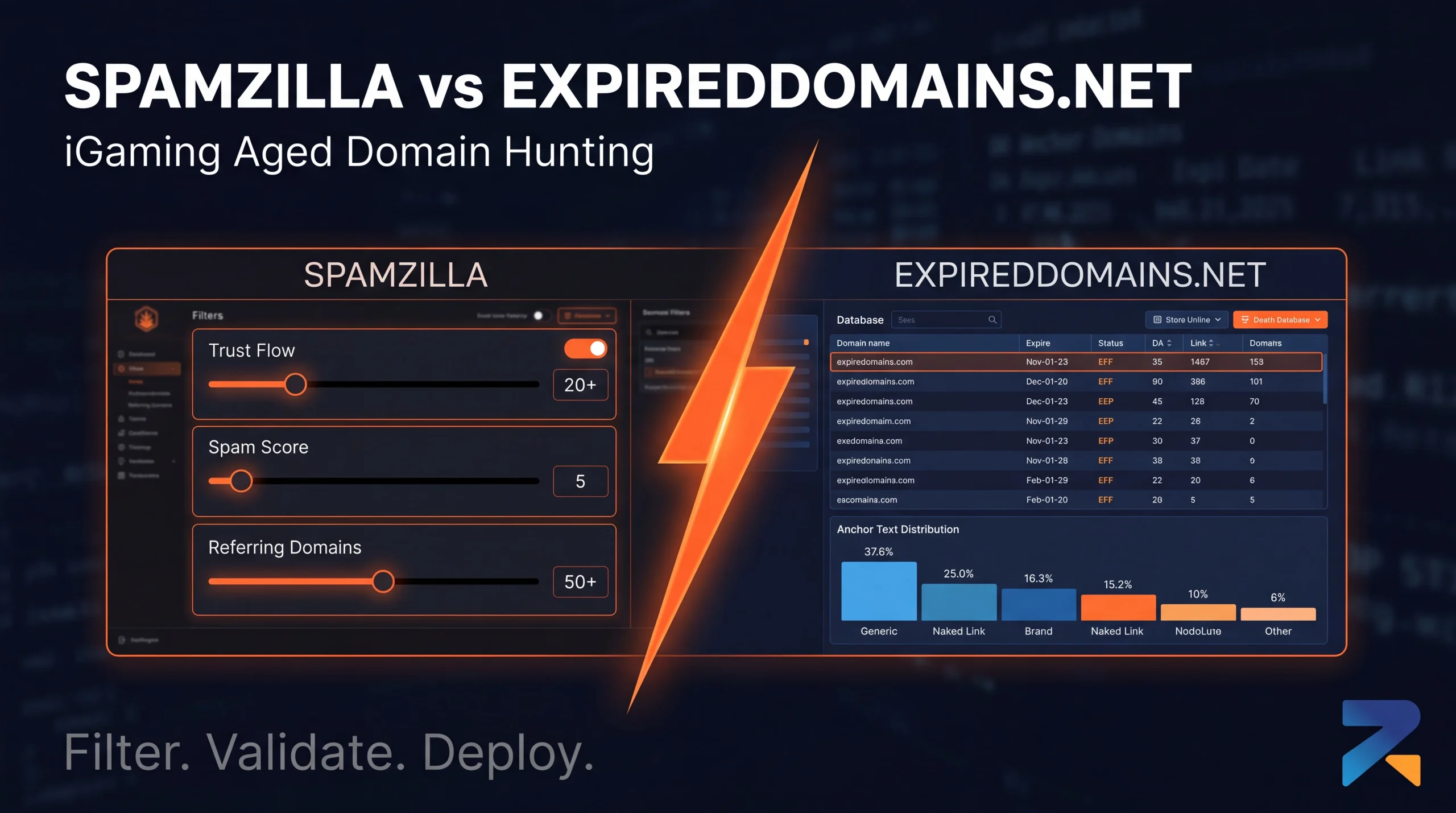

Most iGaming operators who start hunting aged domains themselves end up in one of two places: wasting 4 hours a day inside ExpiredDomains.net drowning in garbage, or paying for Spamzilla and wondering why the results still need a full manual audit.
Both tools have real value. Both tools also have specific failure points that nobody talks about until you’ve already burned a week filtering domains that look clean on the surface and fall apart the moment you open Wayback Machine.
This is not a “which one wins” article. It’s a breakdown of what each tool actually does in practice, where each one breaks down inside iGaming specifically, and the workflow that gets you from zero to a shortlist of viable domains in under 90 minutes instead of a full workday.
The difference between these tools matters more in iGaming than in almost any other niche. Gambling-adjacent expired domains have a higher base rate of spam history than any other vertical. Former pharmacy sites, adult directories, past casino affiliate spam farms all of them end up in the expired domain pool. Both tools pull from that same polluted ocean. The question is which one gives you better filters to avoid swallowing seawater.
What Each Tool Actually Does
Before comparing them, get clear on what they are.
Spamzilla
Spamzilla is a paid aggregator. It pulls expired and expiring domain data from multiple drop registrars GoDaddy, NameJet, Dropcatch, Snap, and others into a single interface with its own pre-built spam scoring layer on top. The spam score is calculated using a weighted combination of Majestic Trust Flow, Citation Flow, referring domain counts, and their own internal pattern recognition for known spam footprints.
The paid tier starts at around $77/month. There’s a free version with severe limitations it won’t show you anything useful for serious domain hunting.
What Spamzilla is: a filtered pipeline designed to surface domains that clear a basic quality threshold before you even open them.
ExpiredDomains.net
ExpiredDomains.net is a free (with optional premium) database that aggregates dropped and expiring domains across dozens of registrars. It doesn’t do spam scoring. What it does is give you access to a massive raw dataset sometimes 50,000+ new entries per day with a filter interface that lets you slice by DA, PA, PR (yes, PageRank still shows as a proxy metric), TLD, backlink counts, referring domain counts, and more.
The premium tier unlocks faster data refresh and more filter combinations. But the core value proposition is volume and raw filter flexibility, not pre-qualification.
What ExpiredDomains.net is: a firehose with adjustable nozzles. You still have to drink carefully.
The iGaming Filter Problem Most Operators Ignore
Here’s why both tools require more work in iGaming than in any other niche.
Expired domains don’t fall into the drop pool randomly. They fall because someone stopped paying for them. In iGaming, that usually means one of three scenarios: the casino affiliate site got penalized and abandoned, the operator pivoted to a different GEO, or the domain was bought specifically as a spam vehicle and the campaign ended.
All three scenarios produce domains with strong metrics on paper. An expired casino affiliate site with 200 referring domains and DR 28 looks like exactly what you want. Until you see that 80% of those referring domains are other expired casino affiliate sites from the same spam network, the content was thin AI-generated slot reviews across 400 pages, and Google already has a toxicity signal baked into that domain’s history.
Neither Spamzilla nor ExpiredDomains.net can catch all of this automatically. Their filters reduce the problem. They don’t eliminate it. That distinction is important before you build a workflow around either one.
Where Spamzilla Earns Its Price Tag in iGaming
For iGaming operators, Spamzilla’s real advantage isn’t the spam score itself. It’s the Majestic Trust Flow integration at the filter level.
TF is the metric that matters most in iGaming. A domain with TF 25 and CF 30 is worth five minutes of your time. A domain with TF 8 and CF 45 high citation, low trust is a domain where the referring domains are mostly garbage pointing at each other. That gap between TF and CF is one of the most reliable indicators of a manipulated link profile, and in iGaming you see it constantly.
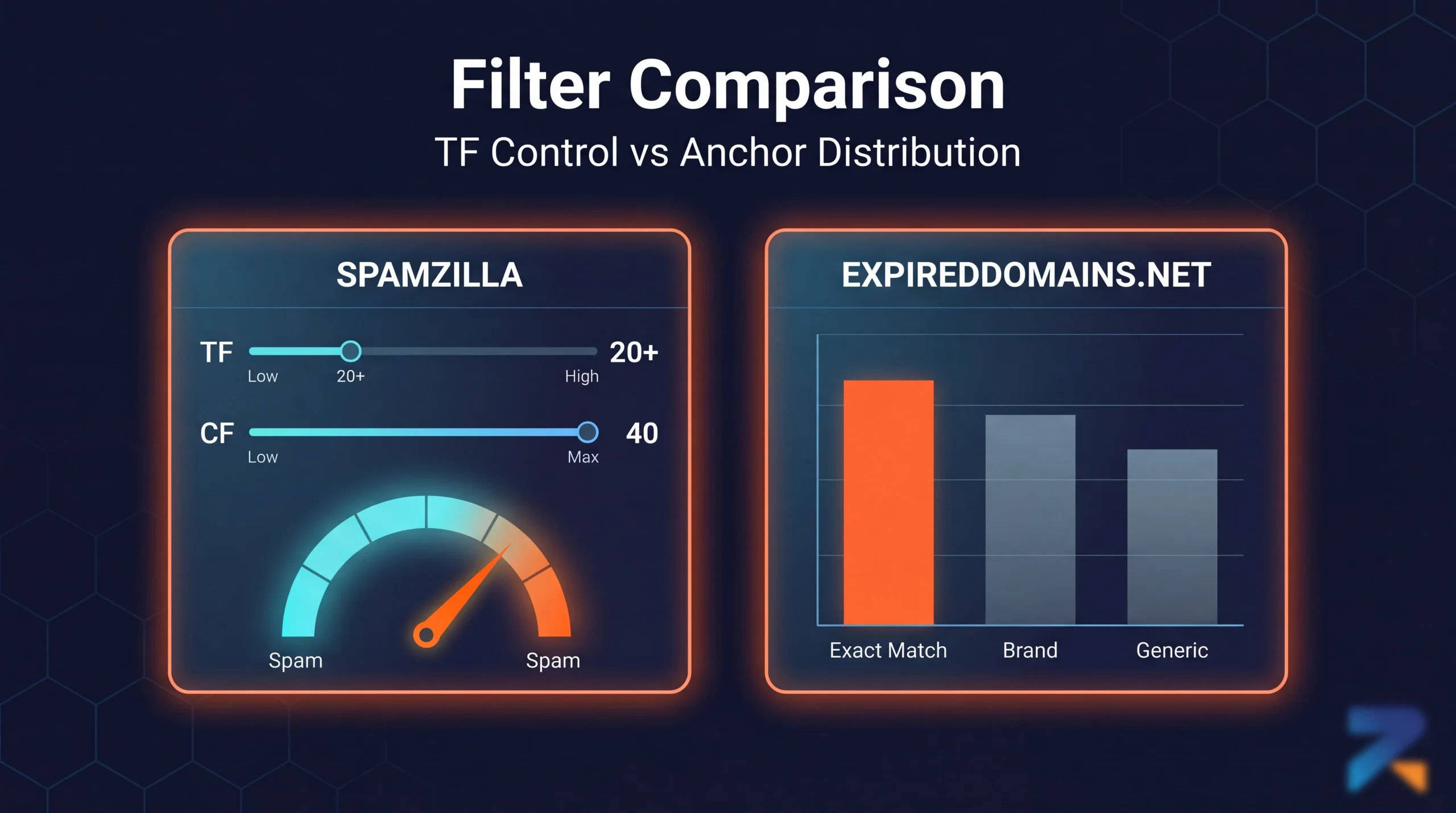
Spamzilla lets you set a minimum TF threshold before results even show up. On ExpiredDomains.net, you can filter by Moz DA but not by Majestic TF directly. That single difference eliminates a significant chunk of wasted evaluation time.
The other thing Spamzilla gets right: email alerts for specific criteria. If you’re looking for TF 20+, 50+ referring domains, .com or .net, not previously gambling-niche you set it once and the domains come to you. In iGaming markets where the best domains disappear within 24 hours of dropping, the alert system is a genuine competitive advantage.
The spam score itself is useful as a first triage signal, not a final decision. Treat it like a bouncer’s visual check at the door it catches obvious problems but it won’t catch the sophisticated stuff. A domain with a clean spam score can still have a Wayback history that kills its value for iGaming deployment.
Spamzilla also surfaces domains across the full drop cycle: pending delete (still in the drop queue), expiring (still owned, potentially available via backorder), and recently dropped. For iGaming operators who want to backorder before something hits public auction, that pipeline view matters.
What ExpiredDomains.net Does Better
Volume. And filter granularity on TLD and backlink patterns.
If you’re hunting for specific ccTLDs .id for Indonesia, .th for Thailand, .my for Malaysia, .ph for the Philippines ExpiredDomains.net gives you better coverage than Spamzilla. SEA iGaming markets run heavily on localized ccTLDs and Spamzilla’s coverage of obscure registrars for those extensions is inconsistent.
ExpiredDomains.net also shows you anchor text distribution in the backlink data. You can see what percentage of referring links use exact match anchors, branded anchors, or generic anchors before you do a full Ahrefs pull. An aged domain where 60% of the anchor text is “online casino” exact match is a problem regardless of its TF or DA. That anchor distribution view is a filter layer Spamzilla doesn’t offer at the same granularity.
The free tier also means there’s no barrier to building your initial filtering skills. If you’re learning to evaluate aged domains, ExpiredDomains.net is the tool you learn on. The volume of data teaches you pattern recognition faster than a paid tool with pre-filtered results.
For operators building a large PBN network and needing to source 15–20 domains per month at lower individual price points, the raw access to a high-volume pipeline matters. Spamzilla’s pre-filtering is optimized for finding quality. ExpiredDomains.net is better when you need quantity and are willing to do more manual QC.
Where Both Tools Break Down for iGaming
Spamzilla’s core limitation: the spam scoring doesn’t account for niche-specific context. A domain with TF 22, clean spam score, and 80 referring domains might score well in Spamzilla’s system while still being completely inappropriate for iGaming. A fashion blog turned abandoned e-commerce site has clean metrics but zero topical relevance to gambling. In iGaming, topical adjacency is a real factor in how cleanly authority transfers. Spamzilla doesn’t filter for this.
ExpiredDomains.net’s core limitation: the volume creates a false sense of optionality. Operators who use it without strict pre-set criteria spend hours evaluating domains one by one and end up with decision fatigue. The tool is only as good as the filters you enter before you start searching. Without knowing exactly what you’re looking for minimum TF, minimum referring domains from unique C-class IPs, specific TLD, specific niche history you’ll spend three hours and shortlist five domains that all fail Wayback Machine.
Both tools also have a shared blind spot: they can’t tell you whether a domain’s referring domains are still live, indexed, and passing equity. A domain that had 150 referring domains in 2021 may have 60 of those links sitting on pages that are now themselves 404’d or de-indexed. Ahrefs or Majestic will show you this. Neither tool surfaces it automatically.
The 5 Filters That Actually Matter in iGaming
Whether you’re in Spamzilla or ExpiredDomains.net, these are the settings that get you to a viable shortlist. Everything else is noise.
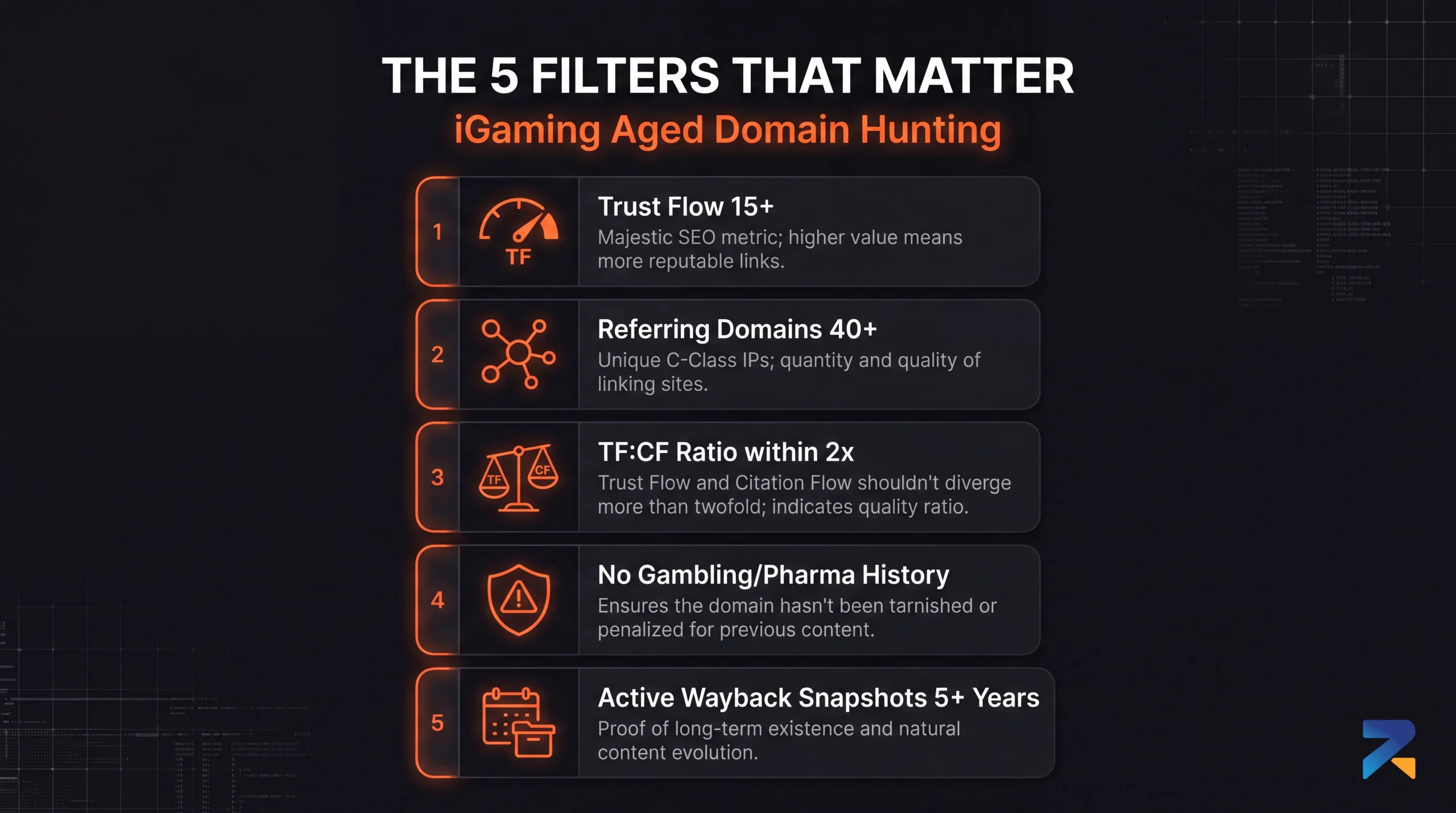
Trust Flow minimum: 15+ For money site foundation domains, raise this to 20. For PBN use, 12–15 is workable if referring domain count is strong.
Referring domains minimum: 40+ from unique C-class IPs. A domain with 300 backlinks from 12 domains is a liability. You want distribution.
TF:CF ratio within 2x If CF is more than twice TF, the link profile has a manipulation pattern. Skip it.
No gambling or pharma history as primary niche This is the filter neither tool does well automatically. You’re manually checking this in Wayback Machine after the initial filter runs. Build this into your workflow, not your tool settings.
Active history with consistent Wayback snapshots Domains that show 5+ years of consistent snapshots in Wayback Machine held real content for real users. Domains with gaps of 2+ years, or sparse snapshots, carried less real authority during those gaps regardless of what backlinks were built.
The Workflow That Actually Works
Don’t use these tools sequentially on the same domains. Use them for different sourcing jobs, then run the same validation process on whatever comes out of either.
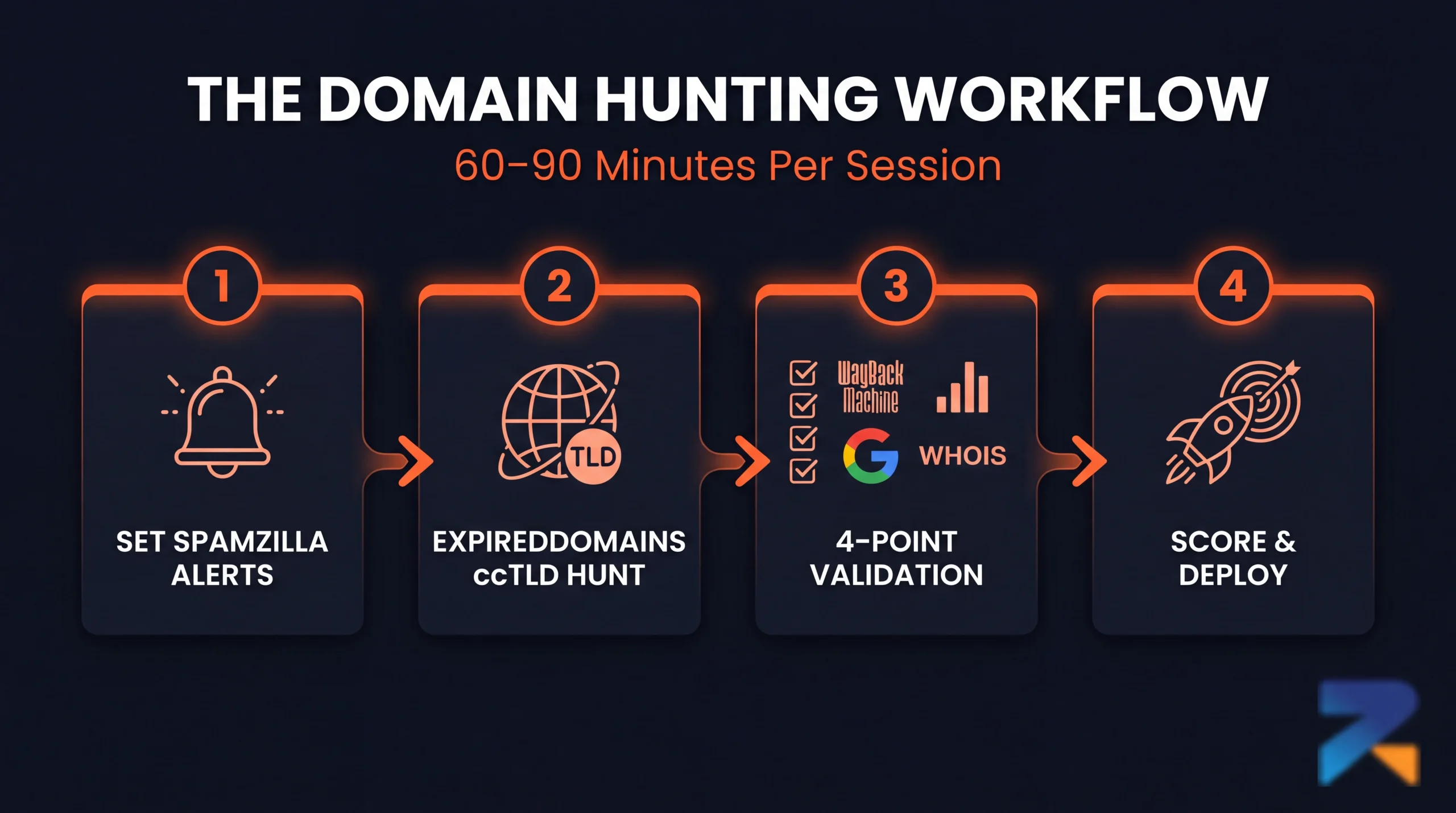
Step 1 Set Spamzilla alerts for your high-value criteria. TF 20+, CF under 40, referring domains 50+, .com or country-specific ccTLD, spam score below 5. Let this run passively. Check alerts daily. You’re looking for 3–5 domains per alert cycle that clear the initial threshold.
Step 2 Run ExpiredDomains.net once a week for ccTLD sourcing. Filter by your target GEO TLD, minimum DA 20, minimum 30 referring domains, not previously gambling niche (use the category filter). This surfaces SEA market options that Spamzilla misses.
Step 3 Every shortlisted domain from either tool goes through the same four-point validation. Wayback Machine for content history, Ahrefs for live referring domain quality and anchor distribution, Google Transparency Report for blacklist status, and a manual WHOIS check for ownership history. Skip any one of these and you’re taking a risk that has nothing to do with the tool and everything to do with the laziness of your QC process.
Step 4 Score what’s left. If a domain clears all four validation points, it earns a deeper look at niche relevance and redirect or rebuild suitability. Most operators stop at metrics. The operators who build stable ranking iGaming sites on aged domains take the extra 20 minutes to confirm the domain’s topical history actually supports the deployment they have in mind.
This workflow takes 60–90 minutes per session. It produces 1–3 genuinely viable candidates. That’s the realistic output. Anyone promising faster results is skipping validation steps that exist for a reason.
When to Use Both Together
The operators who’ve made this process genuinely efficient use Spamzilla as their quality filter and ExpiredDomains.net as their volume backup. Spamzilla for .com and major TLDs where the best domains move fast and pre-filtering saves hours. ExpiredDomains.net for ccTLD hunting in Southeast Asian markets where the database is deeper and the filter granularity on anchor data gives you an extra evaluation layer.
Neither tool replaces the manual audit. Both tools reduce the amount of garbage you have to manually audit. That’s the actual value proposition, and in iGaming where a bad domain purchase doesn’t just waste money but can actively poison a campaign reducing that garbage exposure is worth whatever subscription cost you’re paying.
Most operators start with one or the other. The ones who’ve been doing this for more than a year use both for different parts of the same sourcing job. That’s not a coincidence.
If you’re at the stage where evaluating and filtering dozens of aged domains is still taking a full workday, the alternative is buying from a marketplace that’s already done the validation work. Rexusdomain pre-audits every domain in its inventory against the same criteria this workflow produces TF, referring domain quality, Wayback history, blacklist status, and niche relevance so what you’re buying is already past the filter stage. Browse the available inventory at Rexusdomain and skip straight to deployment.
Related Guides
- Best aged domain marketplaces 2026 — top 7 platforms ranked
- Best Aged Domain Marketplace for iGaming SEO (2026)
- How to Build a PBN for iGaming SEO Using Aged Domains
- Where to Buy Aged & Expired Domains in 2026: The Complete Buyer’s Guide
- Aged Domain Sellers You Can Trust: How to Vet a Premium Marketplace
Sources & Further Reading
Frequently Asked Questions
What is Spamzilla and how is it different from ExpiredDomains.net?
Spamzilla is a paid research tool that aggregates expired domain data and filters aggressively for spam signals, including Moz Spam Score, manual penalty history, and anchor text patterns. ExpiredDomains.net is a free aggregator with broader inventory but fewer spam-filtering tools. Spamzilla saves time; ExpiredDomains.net requires more manual filtering.
Is ExpiredDomains.net free to use?
Yes, ExpiredDomains.net offers a free tier with access to large volumes of expiring and expired domains. Advanced filters — such as Moz metrics, Majestic TF, and country-specific filtering — require a premium subscription. Most serious domain buyers use the free tier for volume and paid tools for quality filtering.
Can I find iGaming-relevant expired domains on Spamzilla?
Yes. Spamzilla lets you filter by niche category, including gambling and entertainment. You can combine filters for Trust Flow, referring domains, spam score, and Wayback Machine age to surface iGaming-relevant expired domains that meet PBN or money-site standards.
What Moz Spam Score is acceptable for an aged domain?
A Moz Spam Score under 5% is the standard benchmark for domains suitable for PBN or money-site use. Scores between 5-15% warrant manual review of the backlink profile. Scores above 30% indicate heavy spam history and should generally be avoided for iGaming SEO applications.
How accurate is Spamzilla spam detection compared to manual Ahrefs audits?
Spamzilla uses algorithmic scoring that catches most common spam patterns — bulk directory links, foreign-language spam anchors, and PBN footprints. It does not replace a manual Ahrefs audit for high-value purchases. Treat Spamzilla as a fast pre-filter and Ahrefs as the final verification layer.
Which tool is better for bulk domain research: Spamzilla or ExpiredDomains.net?
For bulk filtering speed, Spamzilla wins — its spam scores and quality filters eliminate low-quality domains automatically. For sheer inventory volume at no cost, ExpiredDomains.net is unmatched. Most experienced PBN builders use ExpiredDomains.net for discovery and Spamzilla or Ahrefs for qualification.