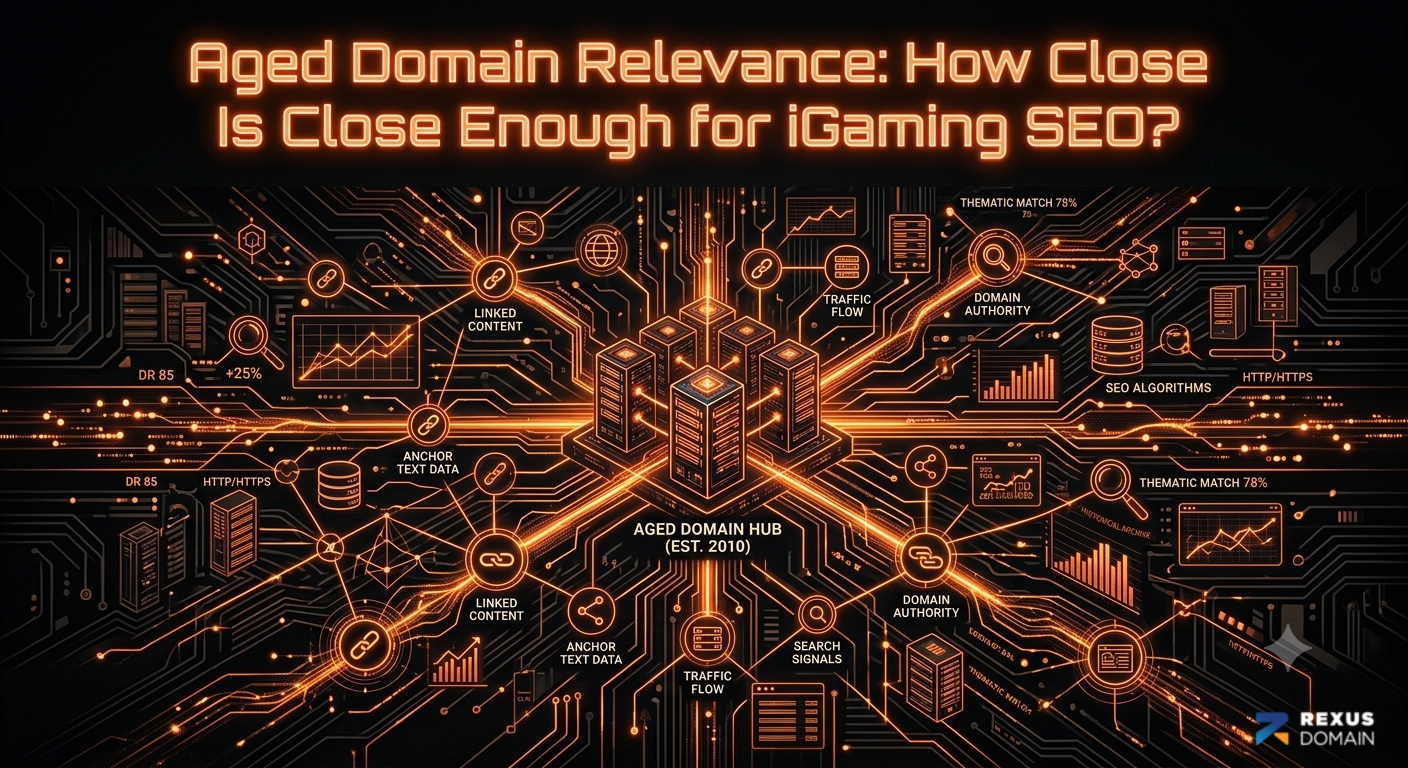

For iGaming SEO, topical relevance is as important as DR when evaluating an aged domain. Direct-niche matches — sports, gambling, and finance — transfer authority cleanly via 301 redirect or PBN. Adjacent niches can work with caveats. Unrelated niches dilute the transfer and extend Google’s re-verification window, which in a YMYL vertical like iGaming, costs you months.
You found an aged domain with DR 42, 220 referring domains, and a clean backlink profile. No manual actions. Wayback Machine shows legitimate content. The metrics check out. You buy it, deploy it as a Tier 1 PBN or redirect it at your money site, and wait.
Three months later, the needle barely moved.
The domain wasn’t fake. The metrics weren’t inflated. The problem was relevance — specifically, the gap between what Google understood that domain to be about and what you needed it to do. That gap is the variable most buyers discount when they evaluate an aged domain, and it is the variable that determines whether the authority you paid for actually transfers.
DR and referring-domain count tell you how strong a domain is. Topical relevance tells you how much of that strength reaches your iGaming site. The two are not the same question. Treating them as one is how you end up with a high-DR domain that produces low-impact results.
What “Topical Relevance” Actually Means for an Aged Domain
It is not the domain name. A domain called sportsnews.com is not automatically topically relevant to a sportsbook just because the word “sport” is in it.
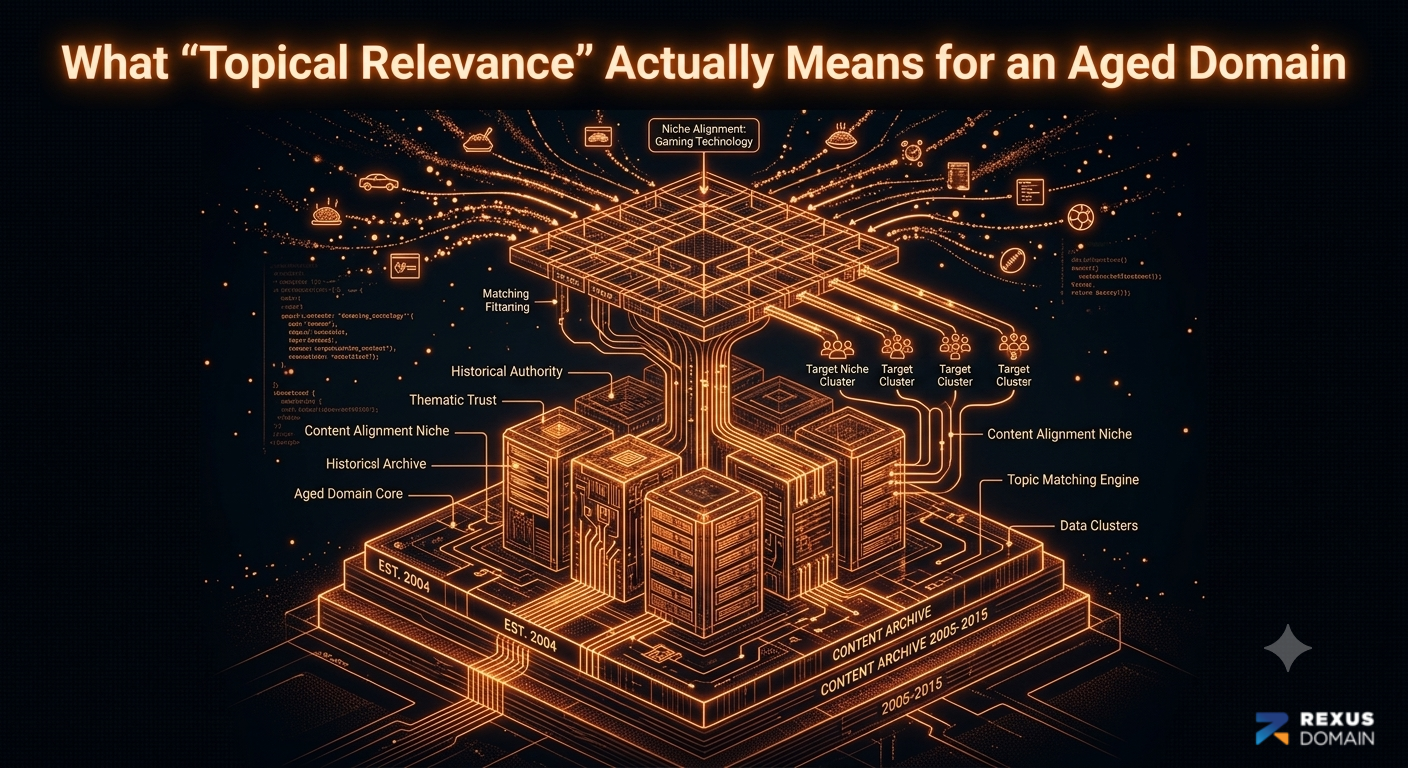
Topical relevance, from Google’s perspective, is the aggregate signal built from everything it has ever learned about a domain. That includes the content it crawled across the domain’s active life, the anchor text used by referring domains when they linked to it, the industries those referring domains themselves belong to, and the historical keyword positions the domain held. Together, these signals tell Google what the domain is about. Not what it was called. What it was actually used for.
Majestic’s Trust Flow categories give you a proxy view of how this classification works. A domain that spent six years as a sports statistics site will show TF categories concentrated in Sports, likely with some crossover into News and Media. A domain that spent the same six years as a personal finance blog will show TF categories in Finance, Banking, and Investment. Those categories are not cosmetic. They reflect how the backlink ecosystem treated the domain, which is the same signal Google has been accumulating.
When you deploy an aged domain into iGaming, Google does not reset that history. It carries it forward. The authority transfers — but the topical weighting on that authority transfers with it. A domain classified in Sports and Finance arrives at your casino site with signals that align. A domain classified in Food and Cooking arrives with signals that create friction. The authority is real. The direction it points is wrong.
For the full mechanics of how aged domain authority accumulates and transfers, the aged domains for iGaming SEO guide covers the foundational framework before you evaluate specific domains.
The Relevance Spectrum — From Perfect Match to Dead End
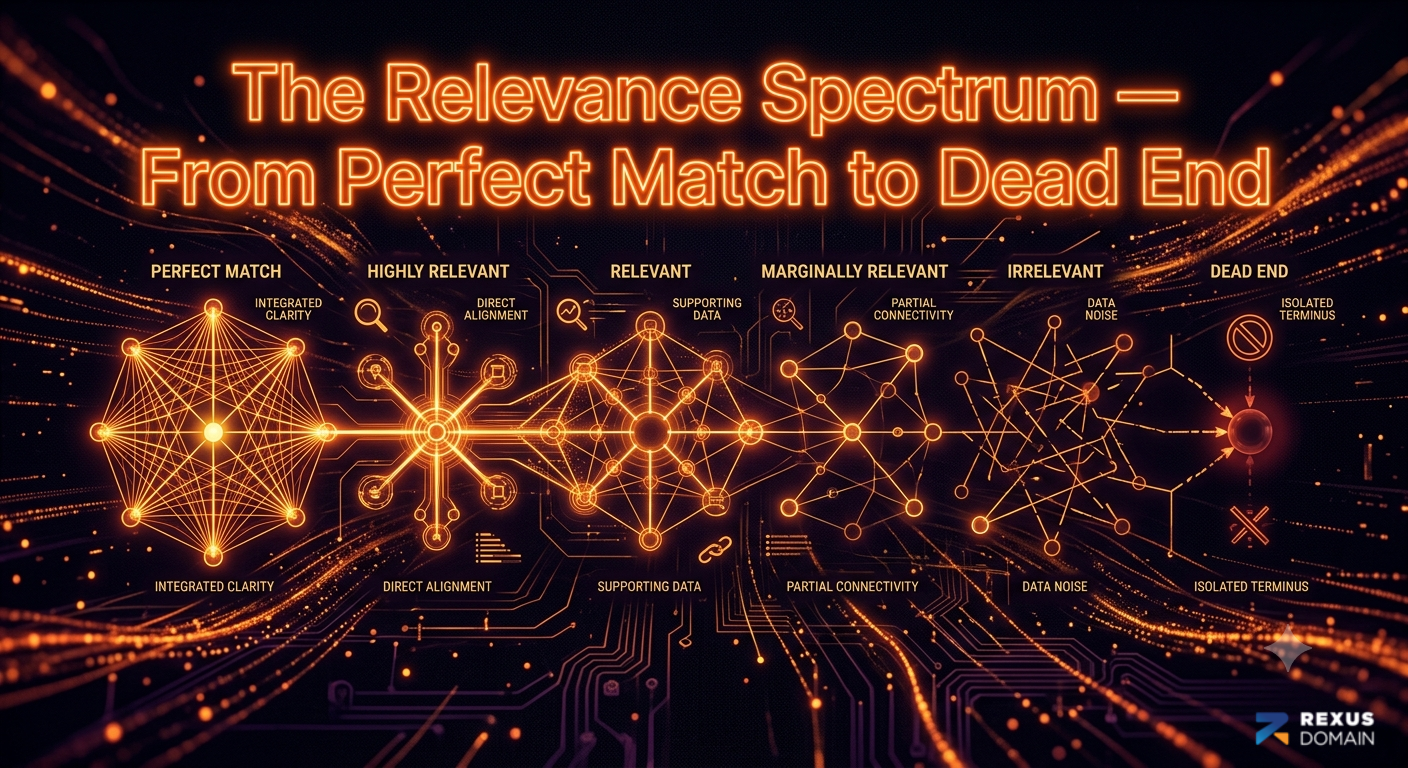
Not all topical mismatches are equal. The distance between a domain’s past niche and iGaming exists on a spectrum, and where a domain sits on that spectrum directly determines how much of its authority reaches your money site.
Tier 1 — Direct Niche Match
These are the domains that transfer cleanly. The topical signal is already pointing in the right direction.
Online gambling and casino content. A domain with a history of casino reviews, bonus comparisons, or slot content is the most direct match available. Google’s topical classification for that domain and your target site are effectively identical. Authority transfer via 301 redirect is close to full. Sandbox bypass on rebuild is strongest here.
Sports news, statistics, and odds. Sports domains are the natural adjacent niche for sportsbooks, but the best ones are closer than adjacent. A domain that spent years covering match statistics, fixture previews, or betting odds tips is already operating inside the YMYL overlap between sports and gambling. Referring domains from established sports media platforms carry the kind of editorial credibility that reinforces the authority transfer rather than diluting it.
Finance and fintech. Personal finance, investment comparison, and financial product review domains share a specific quality with iGaming content: they both require readers to make decisions involving real money. That overlap is not just topical — it is the specific axis Google uses to classify YMYL content. A finance comparison domain redirected to a casino odds comparison site produces clean authority transfer because the structural purpose of both sites is the same. Readers evaluating financial decisions and readers evaluating betting options are the same reader in different contexts.
Fantasy sports and esports. These overlap directly with sportsbook targeting, particularly in Southeast Asian and North American markets. A domain with a history of fantasy sports league coverage or esports tournament content is a direct feeder into sports betting affiliate content.
If you’re using a domain as a Tier 1 PBN pointed at a casino money site, these are the categories that perform. The PBN guide for iGaming on aged domains goes deeper on what to look for in Tier 1 domain selection.
Tier 2 — Adjacent Niches That Still Transfer Authority
These domains can work. They require more effort to close the topical gap and the transfer is not immediate or complete, but they are not write-offs.
Entertainment and media. A domain that covered movies, events, or celebrity content has some overlap with the entertainment positioning many casino brands use. The authority transfer is partial. You will need strong, consistent iGaming content built on top of it to shift Google’s topical read, and indexation will be slower than a Tier 1 match. This is workable as a Tier 1 PBN if the domain has genuinely strong DR and referring domain count — but expect the content to do more work than it would on a sports or finance domain.
General news with gambling coverage. A general news domain is weak on its own. But if its Wayback history shows consistent coverage of gambling legislation, regulated market news, or sports betting results, the topical signal is stronger than the “general news” label suggests. Check the content categories in Wayback carefully, not just the surface-level niche label.
Travel with casino or resort focus. Some travel domains have a natural overlap — destination content that heavily featured Las Vegas, Macau, or casino resort reviews sits closer to gambling content than a generic travel blog. The overlap is narrow. If the travel content was about hiking trails and budget hostels, the relevance drops to Tier 3. If it was about high-roller resort experiences and casino-hotel reviews, it is closer to a Tier 2 match.
For Tier 2 domains used as PBN links rather than 301 redirects, the topical gap matters less because the domain is one step removed from your money site. The tiered link building guide for iGaming breaks down where different topical matches fit in the tier structure.
Tier 3 — Unrelated Niches Where Authority Transfer Breaks Down
These are not bad domains. They are bad fits for iGaming deployment.
Cooking, food, and recipe sites. Health and fitness. Education and academic content. Automotive. Fashion and lifestyle. Home improvement. These domains may carry strong DR, legitimate referring domains, and clean histories. None of that is in question.
The problem is that every signal Google has accumulated about these domains points away from iGaming. The anchor text from linking sites uses food or wellness or automotive terminology. The referring domains are food bloggers, fitness publications, and car review sites. The historical keyword profile covered recipes and workout plans and car comparisons.
When you redirect that domain at a casino site or build a PBN node on top of it, Google has to reconcile a domain it understood as a food resource with a site that is now producing gambling content. In a low-scrutiny niche, that reconciliation happens eventually. In iGaming, where YMYL scrutiny means Google is already slower to extend trust, that reconciliation window extends further. The authority is real. The topical signal is pointing the wrong way. You spend months waiting for Google to update its classification while your competitors who started with relevant domains are already ranking.
The exception is Tier 2 or Tier 3 PBN use — these domains further down the link chain, pointed at your Tier 1 nodes rather than directly at your money site, carry less topical risk because the topical association attenuates across tiers.
How Google Reads Topical Signals on a Redirected or Rebuilt Domain
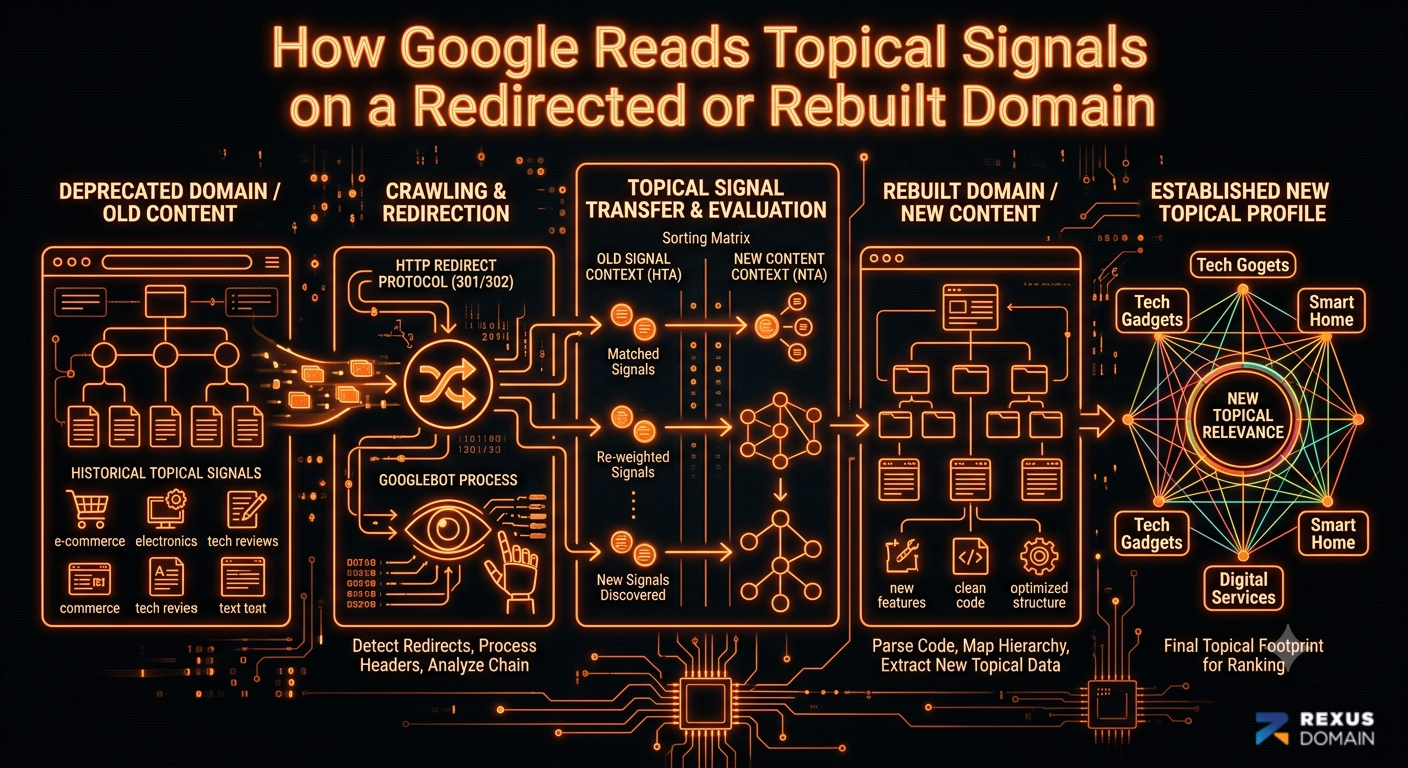
The 301 redirect is not a topical blank check.
When a 301 redirect transfers authority from an aged domain to your money site, Google does not strip the topical context and pass forward a clean, neutral block of authority. It passes the signal with its existing topical characteristics intact. A redirect from a sports domain to a sportsbook transfers authority colored by sports and gambling signals. A redirect from a cooking domain to a casino site transfers authority colored by food signals. The authority is not zero in the second case. But it is diluted by topical mismatch in ways that reduce its effective contribution to your rankings.
The mechanism behind this involves three overlapping signals. The first is backlink anchor text. Look at the anchor text across the referring domains of any aged domain in Ahrefs. The words other sites used when they linked to it reflect exactly how those sites characterized it. A sports domain will have anchors like “football stats,” “betting odds,” “match previews.” Those anchors reinforce the topical classification when the authority transfers. A cooking domain will have anchors like “best recipes,” “dinner ideas,” “healthy meals.” Those anchors conflict with the iGaming destination.
The second signal is the topical classification of linking domains themselves. Google does not just look at the link — it evaluates the source. A referring domain from ESPN carries a different topical signal than a referring domain from a food recipe blog, even if the DR values are identical. When a sports domain transfers its authority via 301, it brings with it a backlink graph populated with sports and media sites. That graph validates the transfer into sportsbook or casino content. When a cooking domain transfers its authority, the backlink graph is full of food and lifestyle sites, and that graph does not validate the iGaming destination.
The third signal is the domain’s crawl history. Google has indexed that domain’s content multiple times over years. It has a detailed record of what topics those pages covered, what entities appeared in the text, what the internal link structure connected. That record does not disappear when you rebuild the site. It informs how quickly Google re-classifies the domain once you publish new content, and how much it trusts that new classification given the depth of the previous one.
This is why operators with domains that sat in Tier 3 niches often see the same frustrating pattern: pages are crawled, content quality is fine, no technical issues, but indexation is slow and rankings are suppressed. The indexation issues guide for iGaming covers the diagnostic framework for exactly this scenario.
The YMYL dimension amplifies everything above. Google applies higher scrutiny to gambling content because it involves real financial decisions. In YMYL niches, the bar for trust is higher, the re-verification window is longer, and topical misalignment costs more time than it would in a non-YMYL niche. An irrelevant domain redirected to a casino site does not just transfer diluted authority — it transfers diluted authority into a niche that Google already evaluates carefully. The combination of those two factors is how a DR 40 domain ends up producing minimal ranking movement on a casino affiliate.
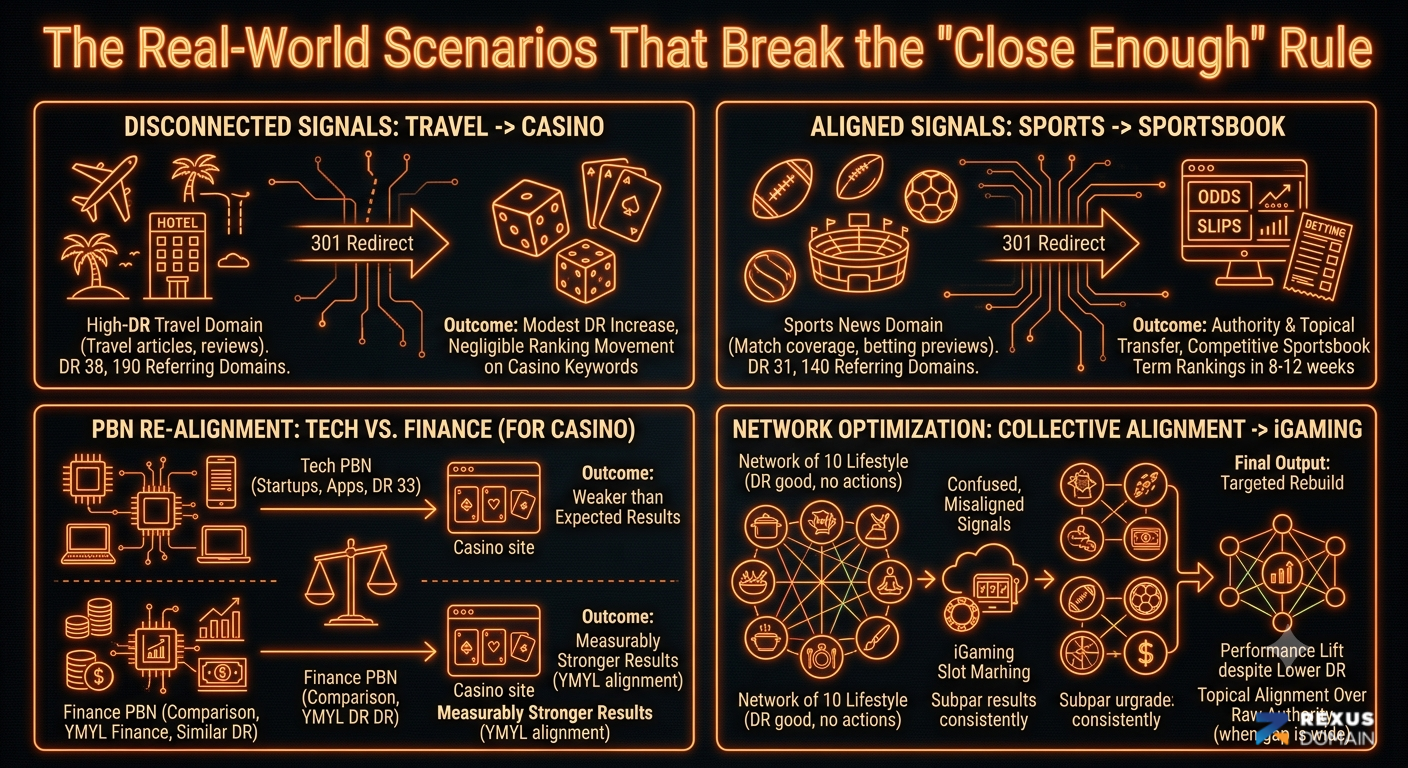
The Real-World Scenarios That Break the “Close Enough” Rule
Scenario 1: High-DR travel blog redirected to a casino site. The domain has DR 38, 190 referring domains, Wayback content confirms years of destination travel articles, hotel reviews, and itinerary guides. Topically, it is Tier 3. After the 301 redirect, the money site sees a modest increase in DR (expected — the referring domains are real). Ranking movement on competitive casino keywords is negligible over six months. The authority transferred. The topical signal did not help.
Scenario 2: Sports news domain redirected to a sportsbook affiliate. DR 31, 140 referring domains from sports media, Wayback content confirms match coverage and betting preview articles. Topically, it is Tier 1. After the 301, the money site begins ranking competitive sportsbook terms within 8 to 12 weeks. The authority and the topical signal aligned. Google had no reconciliation work to do.
Scenario 3: Technology news domain used as PBN Tier 1 for a casino affiliate. DR 33, clean history, legitimate content, but the entire site covered startup news and app reviews. The referring domains are technology publications. Built as a Tier 1 PBN node pointed at a casino money site, it produces weaker-than-expected results. Replacing it with a domain from a finance comparison site with similar DR produces measurably stronger results, because the finance domain’s topical signal aligns with YMYL financial decision-making, which is the axis that matters for casino content.
Scenario 4: PBN built across 10 lifestyle and food domains. Each domain individually looks fine — real DR, real referring domains, no manual actions. But every domain in the network came from cooking, wellness, and home improvement niches. As a collective, the network sends iGaming content a cloud of topically misaligned signals. The results are consistently below what the DR numbers would predict. Rebuilding four of the ten nodes with sports and finance domains lifts performance despite lower average DR across the network. Topical alignment outperforms raw authority when the alignment gap is wide enough.
How to Evaluate Relevance Before You Buy
This is a practical checklist. Run it on every domain before any purchase decision for iGaming use.
Wayback Machine content review. Go to web.archive.org, enter the domain, and pull snapshots from at least three separate time periods across its history. Look at the page content, the navigation categories, the site’s stated purpose. What topics appeared consistently? Was there a sudden niche shift at any point — a health blog that pivoted to gambling in its last year before expiring? Sudden shifts are a red flag. Consistent topical history across years is what you want. The Wayback Machine vetting guide for iGaming covers the exact checkpoints to look for.
Majestic TF category audit. Pull the domain in Majestic and check the Trust Flow topic categories. These categories reflect how the backlink ecosystem has classified the domain. A domain you want to use for a sportsbook should show Sports, Gambling, or Finance in the top categories. If the top categories are Food, Cooking, or Health, you have your answer on topical alignment.
Ahrefs anchor text profile. Pull the full anchor text report in Ahrefs and scan the top 20 to 30 anchors. What words do referring domains use when they link to this site? Anchors like “online casino,” “sports betting tips,” “football odds,” and “gambling bonuses” confirm topical alignment. Anchors like “easy chicken recipes,” “best hiking boots,” and “home renovation ideas” confirm topical conflict. The anchor text is the vocabulary of the backlink graph. It tells you exactly what the internet thinks this domain is about. For a deeper treatment of how anchor text signals affect iGaming authority, the anchor text strategy guide for iGaming covers the mechanics.
Referring domain industry analysis. Beyond the anchors, look at the actual sites linking in. Pull the top 30 to 50 referring domains in Ahrefs and check what industries they operate in. Sports publications, gambling review sites, finance blogs, betting news sites — these validate the topical signal. Food blogs, parenting sites, and home improvement portals do not. The quality of the topical alignment in the referring domain profile is as important as the anchor text itself.
Historical organic keyword profile. In Ahrefs, pull the organic keyword history for the domain. What did it rank for before it expired? If you see a consistent history of keywords like “best football betting sites,” “online casino bonuses UK,” or “sportsbook promotions,” the domain was already operating in or adjacent to iGaming territory. That history is baked into Google’s understanding of the domain and works in your favor. If the keyword history shows only food, travel, or technology content, you are starting the topical re-classification from zero.
Watch for late-stage niche shifts. Some domains are bought specifically to be dressed up before resale. The previous owner may have added a thin layer of gambling content in the final months before dropping the domain, trying to establish iGaming relevance without the genuine history behind it. Wayback Machine will reveal this. If the domain shows six years of food content followed by three months of casino pages before expiring, the gambling layer does not carry topical weight. The food history dominates. Any domain that passed a proper pre-purchase audit — like the full audit process covered in the aged domain audit guide for iGaming — should surface this pattern before you buy.
When Relevance Matters Less (and When It Is Non-Negotiable)
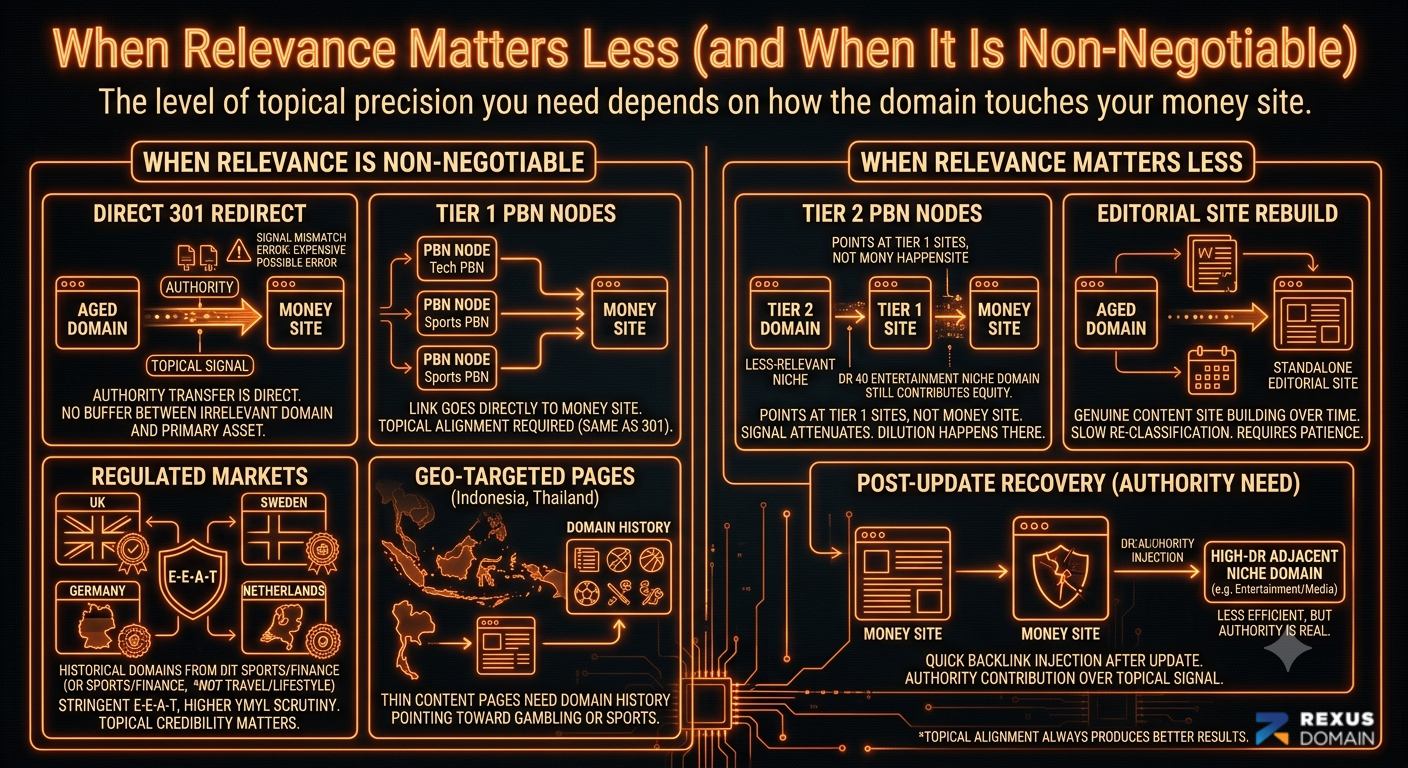
The level of topical precision you need depends on how the domain touches your money site.
When relevance is non-negotiable:
301 redirect directly to your money site. The authority transfer is direct. Every topical signal on the aged domain flows straight into your primary ranking asset. A mismatch here is the most expensive possible error, because you have no buffer between the irrelevant domain and the site that matters most.
Tier 1 PBN nodes pointed at your money site. Tier 1 means the link goes directly to your money site. The topical alignment requirement is the same as a 301 redirect for this reason.
Regulated markets — UK, Sweden, Germany, Netherlands. In licensed markets, E-E-A-T requirements are more stringent, Google’s YMYL scrutiny is applied at a higher threshold, and topical credibility matters more. A domain that helped a German sportsbook rank in .de SERPs needs to carry sports or finance topical signals from its history, not a travel or lifestyle background. The E-E-A-T framework for iGaming aged domains covers how these signals play out specifically in regulated market contexts.
Geo-targeted landing pages in competitive markets. A standalone landing page targeting “best online casino Indonesia” or “Thailand sports betting” on an aged domain needs that domain’s topical signal pointing toward gambling or sports, because the page itself is likely thin on surrounding editorial content. The domain’s history compensates for what the page cannot do alone.
When relevance matters less:
Tier 2 PBN nodes. Your Tier 2 domains point at your Tier 1 sites, not directly at your money site. The topical signal attenuates across that hop. A Tier 2 domain from a less-relevant niche pushes equity into your Tier 1 sources — the topical dilution happens there, not directly on your money site. A DR 40 domain from an entertainment niche used as a Tier 2 node still contributes real equity. It just cannot do Tier 1 work.
Domains being rebuilt as standalone editorial sites over time. If you are building a genuine content site on top of an aged domain, a slower topical re-classification is less damaging because you are establishing the new topical signal through months of consistent content rather than expecting an instant transfer. This requires patience and a content-first approach, but it is not a dead end.
Post-update recovery when the primary issue is authority, not topical alignment. If your money site lost rankings after a core update and you need to inject backlink authority quickly while your on-page work catches up, a high-DR domain from an adjacent niche used as a Tier 1 redirect can still help — the authority contribution is real even if it is not at full efficiency. That said, the recovery guide for iGaming sites after core updates makes clear that topical alignment on your recovery assets will always produce better results than topical mismatch, even when the need is urgent.
The Topical Fit Question Has a Specific Answer
Most guides treat topical relevance as a vague “nice to have.” That framing is wrong in iGaming.
Here is the specific answer to how close is close enough. For 301 redirects and Tier 1 PBN use in casino and sportsbook contexts, you need Tier 1 alignment — sports, gambling, finance, or directly adjacent niches with documented iGaming crossover in Wayback and anchor text. For Tier 2 PBN use or standalone rebuilds, Tier 2 alignment is workable with content that actively closes the topical gap. For anything else, the authority you are paying for is partially stranded in a topical category that Google cannot reconcile with your target niche.
The distinction between a domain that produces results and one that produces nothing often comes down to whether the topical signal history validates the deployment. Not the DR. Not the referring domain count. Whether the backlink graph, the anchor text, the Wayback content, and the TF categories all point in the direction you need them to point.
RexusDomain pre-screens every domain for niche relevance to iGaming, sports, and finance specifically. Every listing includes DR verified in Ahrefs, DA and PA verified in Moz, referring domain count and diversity, and a content history check — so you are working from a starting point where the topical alignment has already been screened rather than discovering the mismatch after purchase. Browse the current inventory if you are looking for aged domains with topical profiles that actually match what iGaming deployment requires.
Frequently Asked Questions
Does topical relevance affect how much authority a 301 redirect transfers to a casino or sportsbook site?
Yes. A 301 redirect carries the topical signals of the aged domain alongside its authority metrics. When the aged domain’s backlink anchor text, referring domain industries, and content history align with gambling or sports content, the authority transfer reinforces your money site’s topical positioning. When they conflict — for example, a food or fashion domain redirecting to a casino site — the authority is real but the topical signal creates friction that Google must resolve before rankings improve. In iGaming, that resolution window is longer than in non-YMYL niches.
What are the best past niches for an aged domain being used in iGaming SEO?
The highest-performing niches for iGaming deployment are online gambling and casino review sites (direct match), sports news and statistics sites, betting odds and fantasy sports platforms, and finance or fintech comparison sites. These niches share YMYL classification with gambling content, and their backlink graphs come from industries that Google associates with money-related decisions. Adjacent niches — entertainment media, general news with gambling coverage, and travel with casino resort focus — can work but require stronger content investment to close the topical gap.
Can a high DR domain from an unrelated niche still help an iGaming site rank?
It can contribute to authority, but not at the efficiency of a topically aligned domain. A DR 40 cooking domain redirected at a casino site will pass referring domain signals that push DR on your money site. The ranking contribution from that authority will be diluted because the topical signal is pointing the wrong way. For the same budget, a DR 30 sports or finance domain will typically produce better ranking results in competitive iGaming SERPs, because the authority arrives with topical context that validates the deployment.
How do I check topical relevance before buying an aged domain for iGaming use?
Check Wayback Machine for consistent content history across the domain’s active life. Pull Majestic Trust Flow categories to see how the backlink ecosystem classifies the domain. Analyze the top 30 to 50 anchor texts in Ahrefs for topical vocabulary. Review the industries of the top referring domains. Pull the historical organic keyword profile in Ahrefs to see what the domain actually ranked for. Any domain showing consistent sports, gambling, or finance signals across all five checks is a strong topical match for iGaming deployment.
Does topical relevance matter the same way for PBN Tier 2 domains as it does for Tier 1?
No. Tier 1 PBN domains point directly at your money site, so they carry the same topical alignment requirement as a 301 redirect. Tier 2 domains point at your Tier 1 nodes, not at your money site. The topical dilution from a less-relevant Tier 2 domain affects the Tier 1 node, not your primary ranking asset directly. Tier 2 domains from adjacent or moderately relevant niches can still contribute meaningful equity to your Tier 1 sources. The precision requirement scales with how directly the domain connects to your money site.
How long does topical re-classification take after you rebuild an aged domain in iGaming?
It depends on the gap between the domain’s past niche and your new iGaming content. A sports domain rebuilt as a sportsbook affiliate can re-classify within weeks because the topical shift is minimal. A cooking domain rebuilt as a casino review site may take three to six months of consistent iGaming content before Google’s classification of the domain aligns with the new use. In regulated YMYL markets like the UK or Germany, that re-classification window can be longer regardless of content quality, because Google applies additional scrutiny to trust signals in gambling verticals.
Related Guides
Sources & Further Reading
Frequently Asked Questions
How relevant does an aged domain need to be for iGaming SEO?
For iGaming 301 redirects targeting casino or betting money sites, high niche relevance (sports, finance, entertainment, gaming) is ideal but not always necessary. Domains with topically adjacent authority — former sports media, finance news, or lifestyle sites — reliably transfer equity to iGaming targets. Completely unrelated niches (pharma, automotive) show reduced topical signal transfer.
Can I use a finance or sports news aged domain for a casino SEO project?
Yes — finance, sports, and news-adjacent aged domains are the most commonly used and effective alternatives to directly gambling-relevant domains. Finance domains transfer well to betting sites (financial risk/odds overlap), sports domains transfer to sports betting, and entertainment domains work for general casino money sites. The key metric is content history quality, not the domain niche itself.
What domain content history is disqualifying for iGaming use?
Aged domains previously used for pharmaceutical spam, adult content, gambling-specific spam (thin affiliate pages), or doorway pages are disqualifying for iGaming deployment. These histories carry residual algorithmic distrust that survives ownership changes. Always use Wayback Machine to screen at least 5 years of content history before purchasing.
Does exact iGaming niche relevance matter more for PBN nodes or 301 redirects?
Niche relevance matters more for 301 redirects to money sites, where topical continuity helps Google confirm the redirect is legitimate and not manipulative. For PBN nodes linking to iGaming sites, niche relevance helps but is secondary to raw authority metrics (DR, TF, referring domain count) — a strong general-authority domain still passes valuable link equity.