
A Timeline of Google Algorithm Updates That Have Shaped Aged Domain SEO
Google’s algorithm updates haven’t targeted aged domains specifically, but several major updates from Penguin’s link-spam crackdown to the ongoing spam and core update cycle ave repeatedly changed what makes an aged domain valuable versus risky, and tracking that history helps explain why due-diligence standards keep shifting.
Last updated: August 2026.
Why This History Matters for Aged Domain Buyers
An aged domain’s value is a function of what search engines currently reward, not a fixed quantity. Updates that change how backlinks, content quality, or spam signals are evaluated directly change what “good” looks like in a due-diligence check. A domain vetted against 2015-era standards and never re-evaluated can be carrying risk that wasn’t visible when it was first acquired.
Key Updates and What They Changed
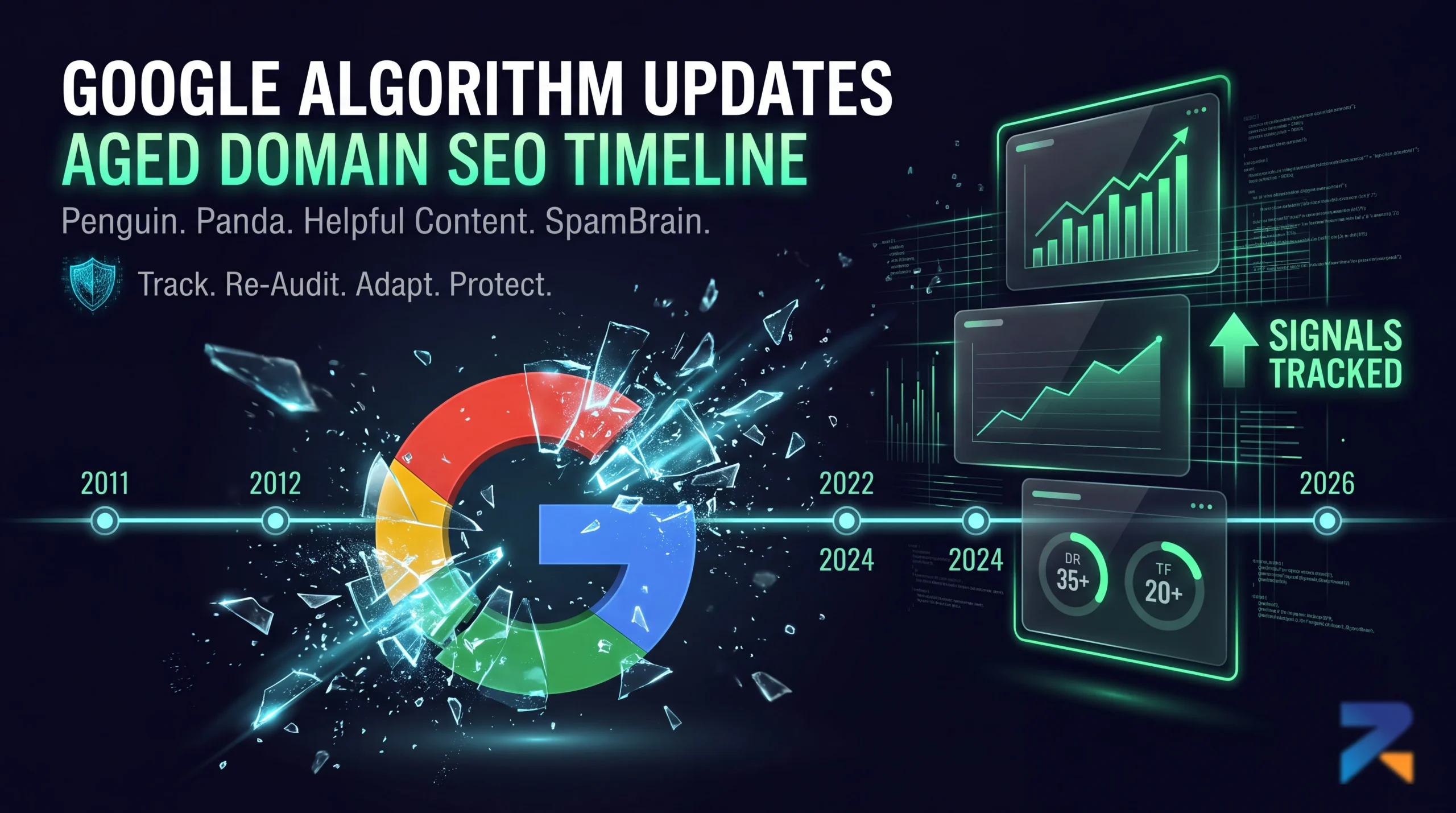
- Penguin (2012, later rolled into core algorithm in 2016) — targeted manipulative link schemes and keyword-stuffed anchor text. This is the update that made backlink profile quality, not just quantity, the central due-diligence concern it remains today.
- Panda (2011, later integrated into core) — targeted thin, low-quality, and duplicate content. Relevant to aged domains because a domain’s prior content quality (not just its links) started factoring into how much trust it retained.
- Helpful Content System (2022, merged into core ranking systems in 2024) — introduced a site-wide signal for content that seemed written primarily to rank rather than to help users. This raised the bar for what “rebuilding” a domain’s content needs to look like to avoid being flagged.
- SpamBrain (disclosed 2022) — Google’s AI-based spam detection system, which continuously evaluates link and content spam patterns rather than relying on periodic rule-based updates, making spam detection an ongoing process rather than a discrete event.
- Recurring core updates and spam updates (ongoing, several per year) — Google now ships broad core updates and targeted spam updates multiple times a year rather than the occasional named update of the early 2010s, meaning a domain’s standing can shift meaningfully between any two updates.
The Pattern Across All of These
Each major update shifted evaluation from something a domain could accumulate once (raw backlink count, keyword density, domain age itself) toward something that has to be continuously maintained (link quality, content usefulness, absence of spam patterns). This is the throughline for why domain age alone has never been a reliable proxy for quality the standards a domain was built against keep moving.
Practical Implication: Re-Audit, Don’t Just Audit Once
A backlink or content audit performed at acquisition reflects standards at that moment. Given how often core and spam updates ship, a periodic re-check not just a one-time due-diligence pass is a more realistic way to catch issues that a domain’s original evaluation wouldn’t have flagged.
Frequently Asked Questions
Has Google ever released an update specifically targeting aged or expired domains?
No confirmed update has targeted aged domains as a category specifically. Updates like Penguin, Panda, and the Helpful Content System changed the underlying signals (link quality, content quality) that determine whether any domain, aged or not, performs well.
How often does Google update its core ranking algorithm?
Google now ships multiple core updates and spam updates per year, a significant increase from the occasional named updates of the early 2010s, meaning evaluation standards shift more frequently than a one-time audit can account for.
Does the Helpful Content System still exist as a separate update?
It was merged into Google’s core ranking systems in March 2024, meaning it’s no longer a standalone signal but an integrated part of how core updates evaluate content quality.
Should I re-audit an aged domain I bought years ago?
Given how frequently ranking standards shift through core and spam updates, periodically re-checking a domain’s backlink profile and content quality is more reliable than relying on a due-diligence pass performed at the time of purchase.
Related Guides
Sources & Further Reading