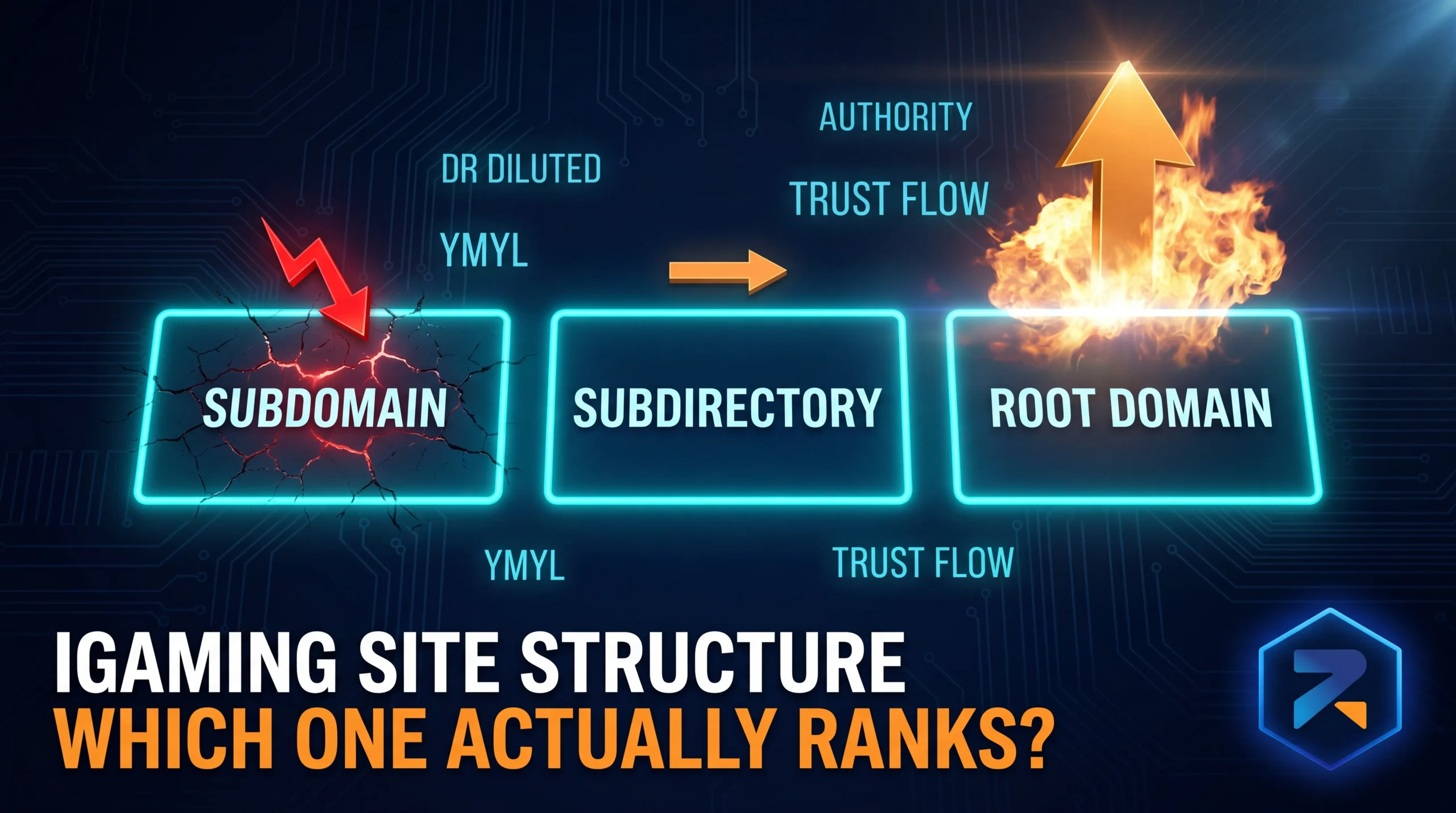

Every iGaming operator building a new ranking play hits the same fork eventually: subdomain, subdirectory, or standalone root domain. Most guides answer this with “it depends” and then spend 1,500 words describing what a subdomain is.
That’s not useful. You already know what a subdomain is. What you need to know is which structure survives a core update in a YMYL niche — and which one quietly burns your link budget while the metrics still look clean on paper.
The answer isn’t identical for every situation. But in iGaming, the cost of getting this wrong is higher than in almost any other vertical. You’re not just building authority, you’re building it in a niche where Google applies elevated scrutiny to every signal. A structural mistake doesn’t just slow you down. It can make six months of link building functionally worthless.
Here’s how each option actually performs.
Why Structure Hits Differently in iGaming
In generic SEO, the subdomain vs subdirectory debate is mostly academic. Differences are real but manageable. Most businesses can absorb a structural mistake without losing half a year of rankings.
iGaming doesn’t give you that cushion.
Google’s YMYL classification means every authority signal you’ve built is scrutinized more closely — including how you’ve structured the site receiving your links. Authority concentration matters more here than in lifestyle blogging or SaaS. Diluting signals across multiple domain entities, in a niche where each trust signal is already harder to earn, is a compounding error. Not a minor inefficiency.
The other factor is cost. Quality links in iGaming are expensive. Every structural choice you make determines how much of that investment actually reaches the pages you’re trying to rank. Waste 30% of your link equity on a bad structural decision and you’ve paid premium prices for discounted results.
Subdomain: The Option That Looks Flexible and Performs the Worst

igaming.yourdomain.com. betting.yourbrand.com. You see this structure constantly across iGaming properties — usually from operators who wanted to “keep things separate,” or who inherited a setup from a developer who didn’t specialize in SEO.
The core problem is this: Google treats subdomains as separate entities. Not completely isolated, but separate enough that a subdomain does not automatically inherit the authority your root domain has accumulated. If yourdomain.com has DR 55 with solid editorial backlinks, igaming.yourdomain.com starts closer to zero than to 55.
For iGaming, that’s a structural disaster. You’re competing in one of the hardest niches in search, on a domain entity that begins with a weakened authority position — while simultaneously diluting the signals pointing at your root.
The scenario where subdomain makes legitimate sense in iGaming is narrow. Multi-language or multi-GEO setups — uk.yourbrand.com, de.yourbrand.com — where you actually need separate crawl environments and are managing cross-domain internal linking deliberately. That’s the list. If you’re not operating in that context, subdomain is the wrong choice.
Most operators on subdomains aren’t there for strategic reasons. They’re there because it was easier to configure. That’s not a good enough reason when you’re competing for high-intent iGaming keywords in a Tier 1 GEO.
Subdirectory: The Right Call in One Specific Situation

yourdomain.com/igaming/. yourdomain.com/sports-betting/. Structurally, this is significantly better than subdomain. Pages in a subdirectory are part of the same domain entity. They inherit root authority. Links pointing at any page on the root can flow through internal linking to your iGaming section. This is how most legitimate editorial sites that add gambling content actually operate.
Subdirectory works well under one specific condition: your root domain already carries real authority that’s relevant — or at minimum adjacent — to iGaming content.
A sports media site that’s spent five years publishing match previews, team news, and betting analysis has accrued trust signals in a space directly adjacent to sports wagering. Adding a /sports-betting/ subdirectory to that domain leverages existing authority toward relevant commercial intent. The editorial history does genuine work.
Where subdirectory breaks down for iGaming is when operators try to reverse-engineer that logic. A fresh domain, or a domain with authority in a completely unrelated niche, doesn’t solve the problem by using subdirectory instead of subdomain. You’ve organized the structure correctly, but there’s no useful authority underneath it.
The other limitation is dependency. When your iGaming content lives as a subdirectory of a parent domain, you’re tied to that parent’s overall health. A core update that penalizes the root takes your iGaming section down with it. Operators running serious programs don’t want their rankings held hostage to decisions being made about a parent property they don’t fully control.
Root Domain: Why Aged Domains Win This Comparison in iGaming

A standalone root domain — specifically an aged domain with clean content history and verified backlink authority — is the dominant structure for competitive iGaming SEO. This isn’t a preference. It’s the outcome of how Google evaluates authority in YMYL verticals.
When you build on an aged root domain, every link pointing at that domain works for the same entity. The next decision: which extension to use because geo-targeting signals start at the TLD level: best TLD for iGaming aged domains. no inheritance dependency, no authority dilution across subdomains.. No authority dilution across subdomains. No dependency on a parent root’s health. No structural inheritance issues. The domain is a single, coherent SEO entity that Google has already been evaluating for years.
The authority the domain carries was earned before you bought it. That trust history is real. An aged domain that ran as a legitimate sports publication or finance site for six years carries a fundamentally different signal profile than any fresh domain you register today — regardless of what structure you deploy on top of it.
This is why the single landing page model is so effective in competitive iGaming markets. One aged root domain, one page, one target keyword. Every backlink the domain carries concentrated behind a single URL. No crawl budget spread across hundreds of pages that rank for nothing. No link equity bleeding into category archives and pagination. In Southeast Asian markets, operators running this model against heavily-funded full-site competitors win consistently — not because the page is better written, but because the authority concentration is structurally superior.
For operators building PBN nodes, the answer is always root domain. Always. A PBN subdirectory under a parent domain introduces footprint risk and eliminates the structural independence that makes a well-built node valuable in the first place. Every node is its own aged root domain. That’s not optional.
Which Structure for Which Scenario
Building a standalone iGaming money site targeting competitive keywords. Root domain on an aged domain with verified clean history. This is the default for a reason. One well-audited aged domain at DR 25–35 outperforms a fresh root or a subdirectory on a mediocre parent domain — not sometimes, consistently.
Adding an iGaming vertical to an existing media or news site with real editorial authority. Subdirectory. The existing domain’s trust signals are worth leveraging, as long as the topical relationship is genuine — sports, entertainment, or finance content that’s adjacent to gambling. Don’t force it if the niche gap is too wide.
Targeting multiple GEOs with local market keywords. Separate aged root domains per target GEO, not subdomains. A DR 30 aged domain built for a specific market will outperform a subdomain off a global root in local SERPs every time. Google’s geotargeting for ccTLD and geo-specific roots is more precise than its interpretation of subdomain geo-signals.
Building PBN nodes. Root domains, sourced from aged domains with clean histories. Non-negotiable.
Fresh operator with limited budget trying to rank fast. Root domain on an aged domain is still the answer. First meaningful movement typically comes 8–12 weeks post-deployment when the audit was clean and the build was correct. That’s faster than the 9–14 months a fresh domain needs in competitive iGaming SERPs.
The Mistake That Costs the Most
Treating this decision as reversible.
Migrating site structure after you’ve built a backlink profile and started accumulating ranking signals is painful. Switching from subdomain to subdirectory requires redirects, recrawl cycles, and weeks of ranking volatility. Moving from subdirectory to a standalone root domain is essentially rebuilding from scratch with a 301 redirect strategy — which can work, but it’s not the same as starting on the right structure from day one.
Make the structural decision before you point the first link. Before the first page goes live. Before anything is installed.
If you’re buying an aged domain to deploy as a money site or PBN node, audit it properly, confirm the history is clean, then build directly on the root. That’s the structure most serious iGaming operators have converged on — not because the alternatives don’t exist, but because they’ve run the tests and root domain wins.
The domains that make this model work are the ones with genuine content history, clean backlink profiles, and no penalty baggage. Browse verified aged domains at Rexusdomain and filter by DR, niche history, and TLD before you commit to any structure.
Related Guides
Sources & Further Reading
Frequently Asked Questions
Should I use a subdomain or subdirectory for multi-country iGaming SEO on an aged domain?
Subdirectories (domain.com/uk/, domain.com/au/) are superior to subdomains (uk.domain.com, au.domain.com) for multi-country iGaming SEO on aged domains. Subdirectories inherit the full aged domain link authority across all country sections. Subdomains are treated as separate entities by Google, splitting the aged domain authority and requiring independent link building for each geographic market. The subdirectory advantage is most significant for aged domains with DR 30 plus and strong historical backlink profiles.
Does Google treat a subdomain as a separate site from the root aged domain for iGaming SEO?
Google generally treats subdomains as separate sites with independent authority signals for SEO purposes, though it is context-dependent. For iGaming on aged domains, this means blog.casino-domain.com, uk.casino-domain.com, and casino-domain.com each build authority independently and cannot share backlink equity freely. Subdirectory structures avoid this fragmentation, consolidating all aged domain link equity into a single authority pool that benefits all country and category sections.
Can I add a blog subdirectory to an aged iGaming domain without diluting the existing authority?
Yes. Adding a /blog/ subdirectory to an aged iGaming domain does not dilute existing authority and can reinforce it by expanding topical relevance through fresh content. New blog content on aged domains achieves indexation 2-4 times faster than equivalent content on fresh domains due to elevated crawl budgets. The blog subdirectory benefits from the aged domain authority from day one, unlike a subdomain that must build its own authority from zero.
What is the best structure for an aged iGaming domain targeting casino, sports betting, and poker simultaneously?
Use a flat subdirectory silo structure: domain.com/casino/, domain.com/sports-betting/, domain.com/poker/ as separate category sections with shared root domain authority. Each silo should have a pillar page at the category root and cluster pages in subdirectories beneath it. This concentrates aged domain link equity at the root, distributes it efficiently across three distinct topical silos, and maintains clear topical separation that amplifies each section TF signal independently.
Should an iGaming site on an aged domain use www or non-www as the canonical URL?
Choose either www or non-www as the canonical version and redirect the other permanently via 301. The choice does not affect rankings. What matters is consistency — all internal links, hreflang annotations, sitemap entries, and Google Search Console property setup must reference the same canonical format. Mismatches between www and non-www canonicalisation cause link equity fragmentation on aged domains where some historical backlinks may have targeted the www version and others the non-www.
Can a subdomain PBN site pass link equity to an aged domain money site as effectively as a root domain?
Root domain PBN sites pass significantly more link equity than subdomain PBN sites. Google assigns independent authority metrics to subdomains — a link from blog.pbn-domain.com carries a fraction of the PageRank of a link from pbn-domain.com. For iGaming PBN construction using aged domains, always host PBN content at the root domain level (domain.com/post) rather than on subdomains. Subdomains are suitable for staging environments only.