
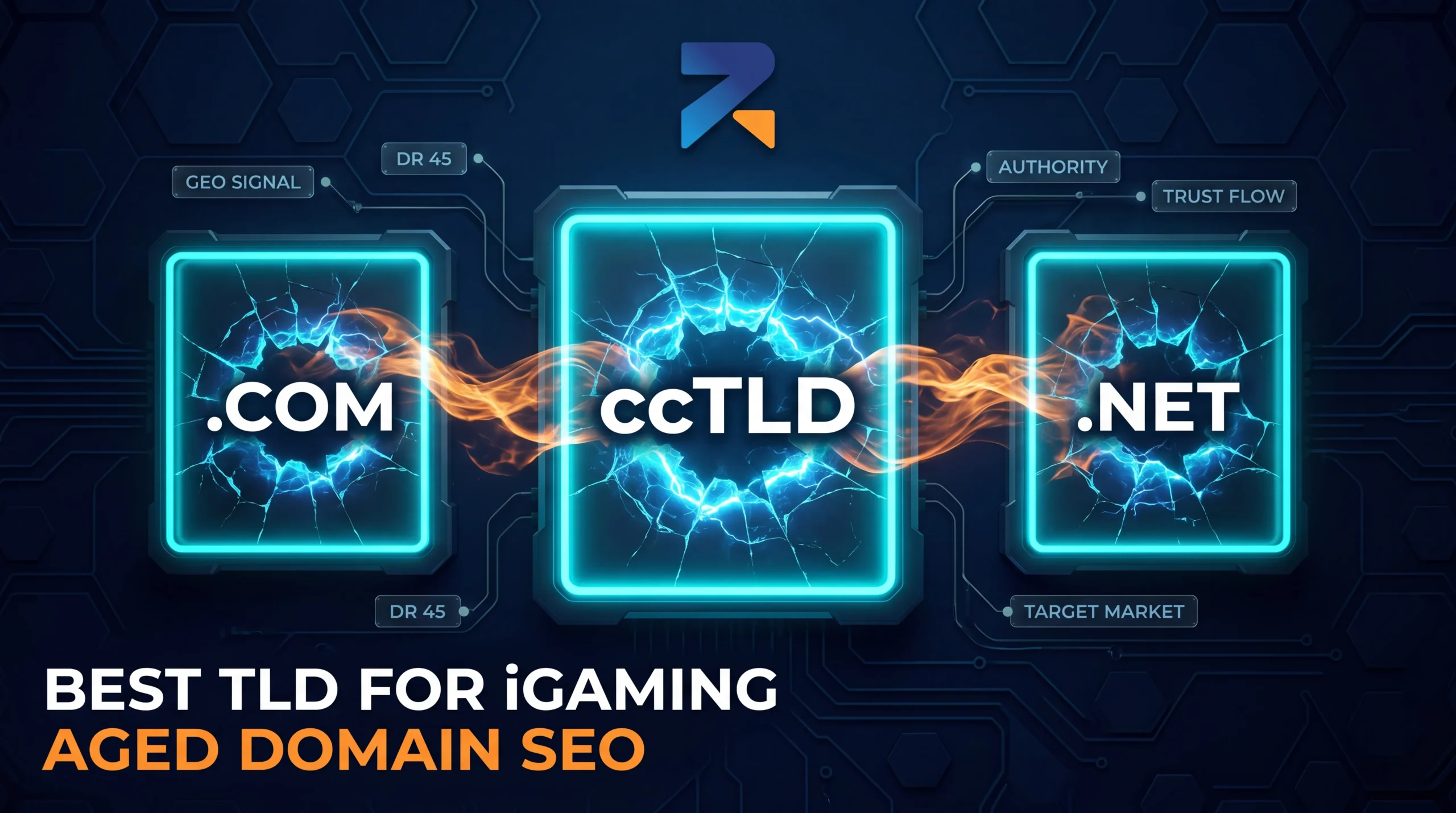

Most operators spend weeks evaluating DR, backlink profiles, and domain history before buying an aged domain. Then they pick the TLD in about thirty seconds.
That’s backwards.
The TLD decision isn’t cosmetic. In iGaming, it directly affects which SERPs you’re eligible to dominate, how Google treats your geo-targeting signals, and whether the authority on that domain even transfers the way you’re expecting. A 10-year-old aged domain with DR 45 can underperform a 6-year-old domain if the TLD is working against your target market.
Here’s what actually matters — and what most guides completely skip.
What TLD Actually Signals to Google
Let’s clear something up first. Google has officially said TLD alone is not a ranking factor. A .net doesn’t rank worse than a .com by default. A .id doesn’t automatically rank better in Indonesia than a .com targeting the same market.
But that’s the wrong way to frame it.
TLD is a geo-targeting signal, not a quality signal. And in iGaming — where you’re usually going after one specific market or a handful of regulated countries — geo-targeting signals matter enormously. They determine which version of Google’s index your site competes in, how Search Console interprets your target region, and how easily you can stack those signals with hreflang, hosting location, and backlink geography.
Get the TLD right and those signals reinforce each other. Get it wrong and you’re fighting your own infrastructure.
.com Aged Domains: The Default Everyone Reaches For
.com is the dominant choice in iGaming. Walk into any SEO forum targeting casino, betting, or slot keywords and roughly 80% of the domains in play will be .com. There are good reasons for that — and some serious traps people don’t see until it’s too late.
What .com does well:
A .com aged domain gives you universal targeting. There’s no geographic restriction baked into the TLD itself, which means you can point it at any market without the TLD fighting you. If you’re running a multi-market operation — say, targeting Indonesia and Canada and India from the same domain — .com is the only TLD that makes structural sense.
Authority also tends to be deeper on aged .com domains, simply because they’ve been around longer on average, accumulated more links, and have more reference-class data for Google to evaluate. When you’re buying an aged domain through a marketplace, the premium inventory is disproportionately .com.
Where .com creates problems:
In geo-specific iGaming markets, .com by itself gives Google no geo-targeting signal at all. You can compensate with Google Search Console geo-targeting settings, server location, hreflang tags, and localized backlink profiles — but you’re manually rebuilding what a ccTLD gives you automatically.
More importantly: in highly competitive local markets like Indonesia or Thailand, the operators who’ve locked in strong ccTLD aged domains have a structural advantage. They’re not just ranking on the same signals — they’re triggering a geo-filter that narrows the competitive field. A .com in that environment is competing against everyone globally who’s targeting the same keyword cluster.
That’s not a reason to avoid .com. It’s a reason to understand what you’re getting into.
ccTLD Aged Domains: The Underestimated Weapon in SEO Asia
This is where the real edge is in 2026, and most operators are still sleeping on it.
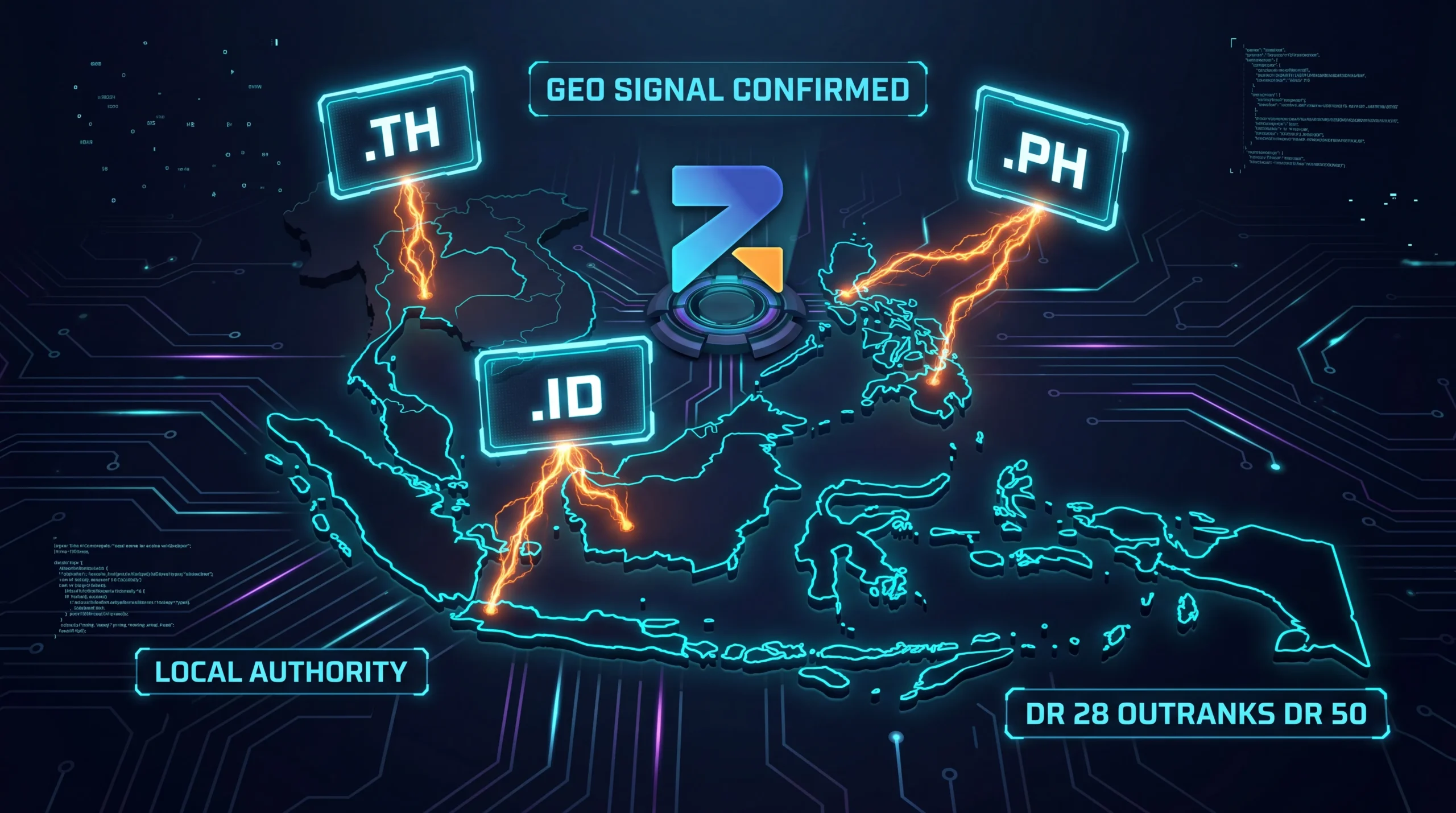
Country code TLDs — .id, .ph, .th, .uk, .au, .de — carry an explicit geo-signal that Google has no ambiguity about. When you use an aged .id domain to target “slot online” or “situs judi bola” in Indonesia, you’re not asking Google to infer your target market. You’re telling it directly, with the TLD as part of the signal stack.
In Southeast Asian iGaming markets specifically, this matters more than almost anywhere else in the world.
Indonesia (.id): The Indonesian market is one of the most aggressively competitive iGaming SERPs in existence. Operators running .id aged domains in combination with Indonesian IP hosting, Indonesian language content, and locally sourced backlinks have consistently outperformed .com equivalents with higher raw metrics. We’ve seen .id domains with DR 25–30 outrank .com domains with DR 50+ on the same keywords — not because of some TLD magic, but because the entire signal stack was aligned. The TLD was the anchor that made everything else click.
Philippines (.ph) and Thailand (.th): Similar story. Regulated or grey-market operators targeting these markets have increasingly moved toward ccTLD aged domains as the competition for .com inventory drives prices up and quality down. A clean aged .ph domain with 5+ years of history and a legitimate backlink profile from local Filipino news sites is worth more than a generic aged .com with DR 40 and backlinks from international directories.
One critical caveat: ccTLD aged domains are harder to find in good condition. The inventory is smaller, the quality range is wider, and the proportion of spammy or penalized domains is higher than in the .com market. You need to audit these more carefully — link profile, Wayback Machine history, manual penalty checks — not less carefully. The scarcity creates opportunity, but it also creates a lot of garbage options that look attractive on the surface.
.net, .org, and Other gTLDs: When They Work
Nobody’s primary iGaming strategy centers around .net or .org aged domains. That’s not how operators use them. But dismissing them entirely is a mistake.
.net aged domains have one legitimate use case in iGaming: PBN satellite sites and link building assets. If you’re building a network of supporting domains to push
authority toward your money site, .net domains with solid link profiles can serve that function — the same way any PBN domain for iGaming SEO
. They’re not ideal for money sites in competitive markets, but as PBN nodes pointing at a .com or ccTLD money site, they work fine.
Where .net falls apart is when operators try to use it as a primary money site in a competitive geo market. The lack of geo-targeting signal, combined with the association pattern that Google has built up around .net domains in iGaming (many of which have been used in aggressive link schemes historically), makes it a harder road than it needs to be.
.org is worse for iGaming money sites for a different reason: the implied editorial and non-commercial expectation of .org domains creates a trust mismatch. Google’s quality assessment systems have context about what kinds of sites typically sit on .org. A casino affiliate site on a .org aged domain is swimming against the current from day one.
For PBN purposes, both .net and .org aged domains work. For money sites, stick to .com or the appropriate ccTLD for your target market.
The Mistake That Kills the Authority Transfer
Here’s where operators lose money they’ll never get back.
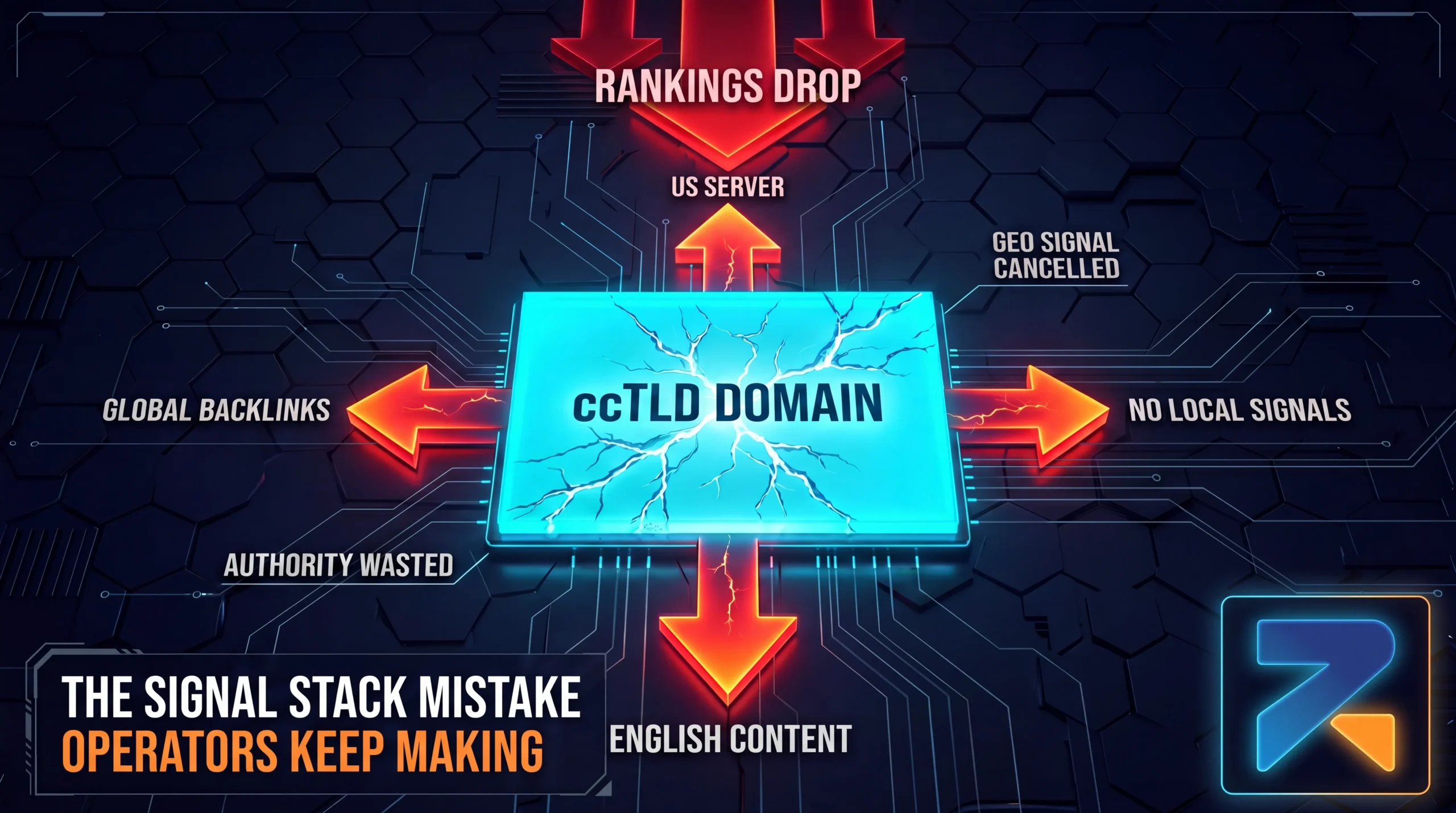
They buy a ccTLD aged domain — let’s say a .id with solid history — and then install a generic WordPress site in English, get it hosted on a US server, and point backlinks from international domains at it. Then they wonder why the geo-targeting signal isn’t working.
This is exactly the kind of deployment decision that needs to be locked in before you touch anything four money site deployment models for iGaming
ccTLD aged domains require a consistent signal stack. Indonesian domain means Indonesian-language content (or at least a clear Indonesian content layer), Indonesian or Southeast Asian hosting, local backlinks where possible, and GSC set to Indonesia. If any of those signals contradict each other, you’re not getting the full benefit of the ccTLD — you’re just paying more for a domain with a shorter extension.
This is less of an issue with .com because .com doesn’t carry geo-expectations. But the flip side is you then have to build all of those geo signals manually through other means.
Practical Framework: Which TLD Should You Actually Buy?
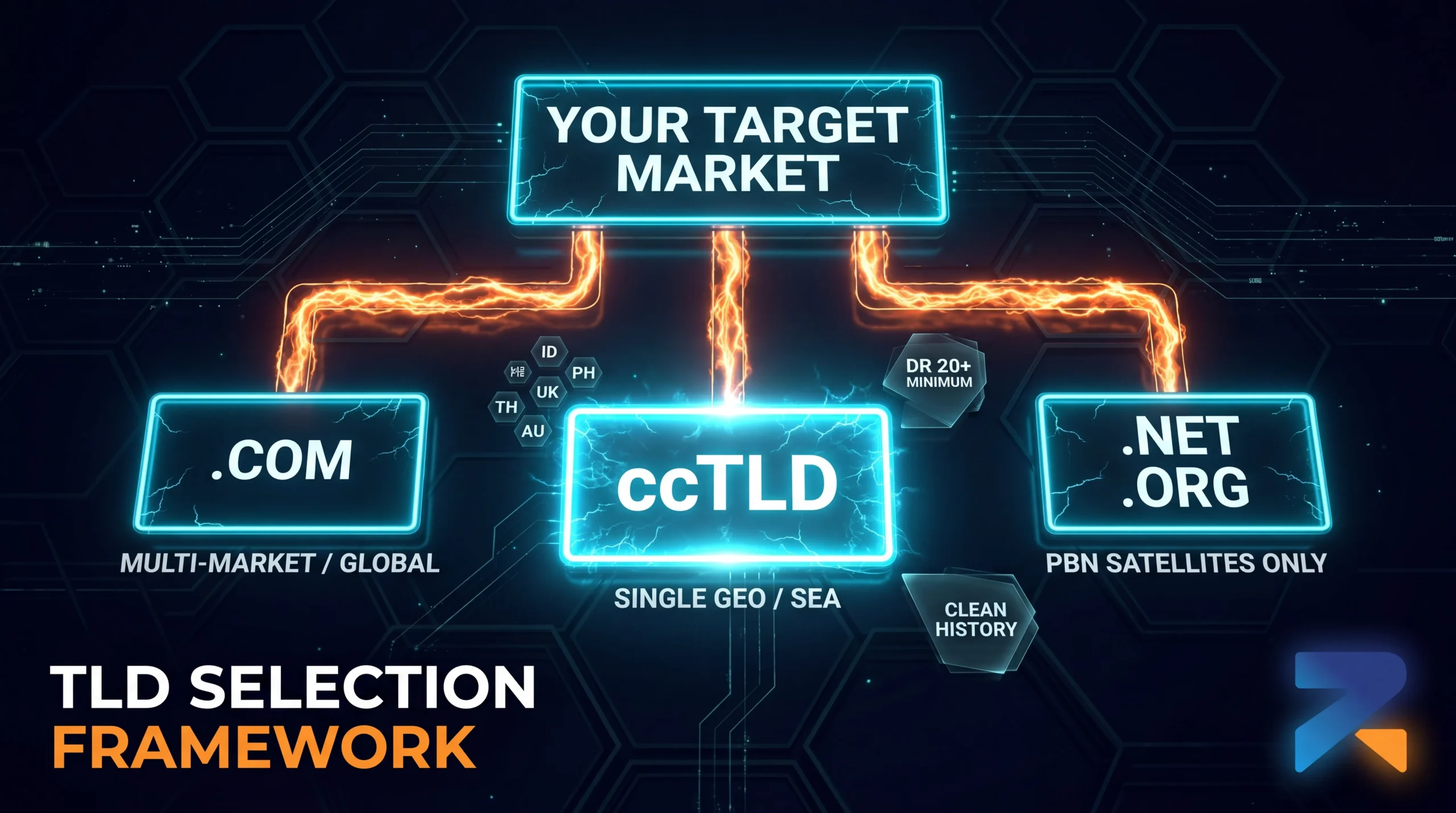
Subdomain vs subdirectory vs root domain for iGaming Stop thinking about this as a preference. Frame it as a market-matching decision.
Single market, Southeast Asia (ID, PH, TH, VN): Go ccTLD first. Look for aged .id, .ph, or .th domains with clean history, local backlink profiles, and 5+ years of age. If good ccTLD inventory isn’t available within your budget, a .com with deliberate geo-stack buildout is your fallback — not your first choice.
Multi-market or global affiliate operation: .com only. The versatility outweighs any geo-signal advantage you’d get from a single ccTLD, and trying to run a multi-market site on a ccTLD creates structural problems with geo-targeting that are painful to resolve.
UK or Australian markets: .co.uk and .com.au aged domains carry significant authority in those local SERPs, and the regulatory environment in both countries means local trust signals matter for iGaming. These ccTLDs are worth pursuing if you’re serious about those markets — but inventory is limited and prices reflect that.
PBN satellites: .com, .net, .org, whatever’s available with a clean profile and solid metrics. TLD matters less here because the domain is an authority conduit, not a money site. What matters is the backlink profile and history, not the extension.
Before You Buy: One More Check
TLD strategy only makes sense once you understand why aged domains are worth buying in the first place. If you haven’t read our core guide, start here: aged domain strategy for iGaming SEO. Whatever TLD you’re targeting, the audit process doesn’t change based on extension.. The Wayback Machine history check, the spam score review, the manual penalty verification in Search Console (post-transfer), the referring domain quality check — all of it applies regardless of whether you’re buying a .com, a .id, or anything else.
ccTLDs can hide low-quality history more easily than .com domains simply because there’s less tooling and less aggregated data available for auditors. Ahrefs and Majestic have less comprehensive crawl data for .id or .th domains than they do for .com. That means you need to be more thorough, not less.
Run the full audit process outlined in the iGaming aged domain audit checklist before you commit to anything. This applies double for ccTLD purchases where the historical data is thinner.
And If you’re buying from a marketplace, focus on platforms that specialize in iGaming-vetted inventory — here’s how the top aged domain marketplaces for iGaming. Generic domain auction sites will have ccTLD listings, but very few of those platforms have done the industry-specific filtering that matters for iGaming deployments. The difference between a vetted ccTLD and an unvetted one with similar surface metrics can be the difference between a domain that ranks in 6 weeks and one that never moves.
Rexusdomain filters specifically for iGaming-suitable aged domains across both .com and regional ccTLD inventory. If you want to see what’s available in your target market, browse the current listings here.
Related Guides
Sources & Further Reading
Frequently Asked Questions
What is the best TLD for an aged iGaming domain in 2026?
.com remains the strongest TLD for iGaming aged domains in 2026. It carries the highest trust signals, broadest international recognition, and deepest domain extension history. .net and .org are viable alternatives for domains with strong existing authority. Avoid acquiring aged ccTLDs (.co.uk, .de, .es) unless your iGaming site specifically targets that country, as ccTLDs carry geographic authority restrictions that limit international ranking potential.
Do .casino and .bet domains have SEO advantages for iGaming?
Newer niche TLDs like .casino, .bet, and .poker have no confirmed SEO advantage over .com for iGaming rankings. Google treats all TLDs equally in its algorithms. The practical disadvantage is that .casino and .bet domains have minimal history predating 2014 (when ICANN launched new gTLDs), so aged domain benefits are largely unavailable. Established .com domains with 10+ year histories consistently outperform new gTLD alternatives for competitive iGaming keywords.
Can a .net or .org aged domain outrank a .com fresh domain for iGaming keywords?
Yes. A .net or .org aged domain with TF 20+ and a clean link profile will typically outrank a fresh .com for competitive iGaming keywords within 3-6 months of content development. TLD is a minor factor in modern Google algorithms. Link authority, topical relevance, and content quality are primary ranking determinants. A 10-year .net with 200 quality referring domains will outperform a 2-year .com in most competitive iGaming SERPs.
Should I avoid ccTLD aged domains for iGaming SEO?
Only acquire ccTLD aged domains if they target your primary market. A .co.uk aged domain with gambling history is excellent for UK iGaming SEO but provides minimal authority benefit for .com or international strategies. Multi-market iGaming operations should build their primary authority on .com domains and use ccTLD aged domains as supplementary assets for individual country strategies where local search presence is a priority.
Are aged .info and .biz domains worth buying for iGaming PBNs?
.info and .biz aged domains are generally lower quality for iGaming PBN construction. These TLDs have historically been overrepresented in spam campaigns, and their Trust Flow profiles tend to be lower than equivalent .com domains of the same age. When building PBN networks for competitive iGaming keywords, prioritise .com (60-70% of network), .net (15-20%), and .org (10-15%). Include .info and .biz only if metrics (TF 15+, 30+ referring domains) strongly justify acquisition.
Does TLD affect topical Trust Flow for iGaming aged domains?
TLD does not directly affect topical Trust Flow calculations. Majestic Trust Flow is calculated from the quality and topical relevance of inbound links, regardless of TLD. A .net domain with links from authoritative gambling directories and media sites will have higher iGaming Trust Flow than a .com with links from unrelated industries. When evaluating aged domain TLDs, prioritise Trust Flow category match over TLD extension for iGaming SEO applications.