
You open Ahrefs, type the domain, see DR 42. Looks fine. You buy it for $400.
Six weeks later the 301 is live and the money site hasn’t moved. You go back and — for the first time — check Majestic. Trust Flow 9, Citation Flow 51. The whole backlink profile is link farm garbage, the kind Ahrefs surfaced as referring domains without a single warning. Four hundred dollars and six weeks, gone.
That’s not unusual. That’s Tuesday in iGaming.
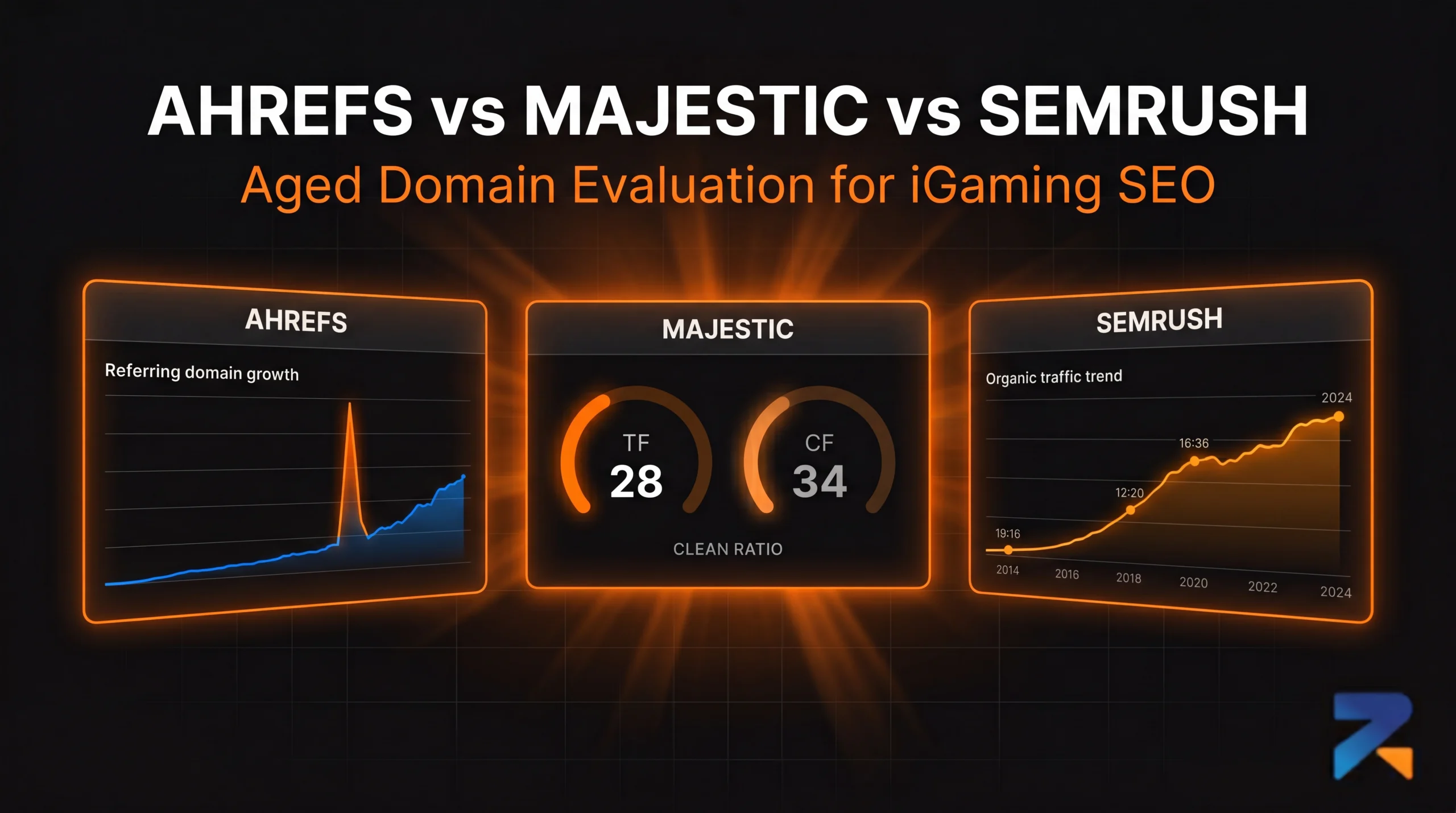
The problem isn’t Ahrefs. The problem is that Ahrefs, Majestic, and SEMrush don’t crawl the same internet. Different bots, different indexes, different ways of scoring what a link is actually worth. A domain that looks perfectly clean in one will fail hard in another. If you’ve built your entire evaluation around one tool, you’re missing things — and in this niche, what you miss will cost you.
This isn’t about which tool is the best. It’s about knowing what each one is actually built to catch, and running them in the right sequence so nothing gets through that shouldn’t.
None of Them See the Same Thing
Pull the same domain through all three tools and you’ll get three different referring domain counts. Not slightly different — wildly different. A domain we ran last month: 160 RDs in Ahrefs, 80 in Majestic Fresh, 230 in SEMrush. All three numbers are technically accurate for each tool’s own crawl. None of them is what Google sees.
Ahrefs runs one of the most aggressive crawlers going. Fast refresh, massive live index, good at catching new links. Majestic is slower but keeps two separate indexes — Fresh (last 90 days) and Historic, which goes back to 2006. SEMrush is a competitive intelligence platform first; backlink analysis is in the product, but it’s not what the company was built on.
Keep that in front of you during every evaluation. These are all third-party approximations. The gaps between them are real, and they matter when you’re putting hundreds or thousands into a domain.
Ahrefs: Fast, Good for Patterns, Not for Quality
Most operators open Ahrefs first and that’s fine. It’s the quickest tool to load, the interface is clean, and there are two specific things it genuinely does better than the other two.
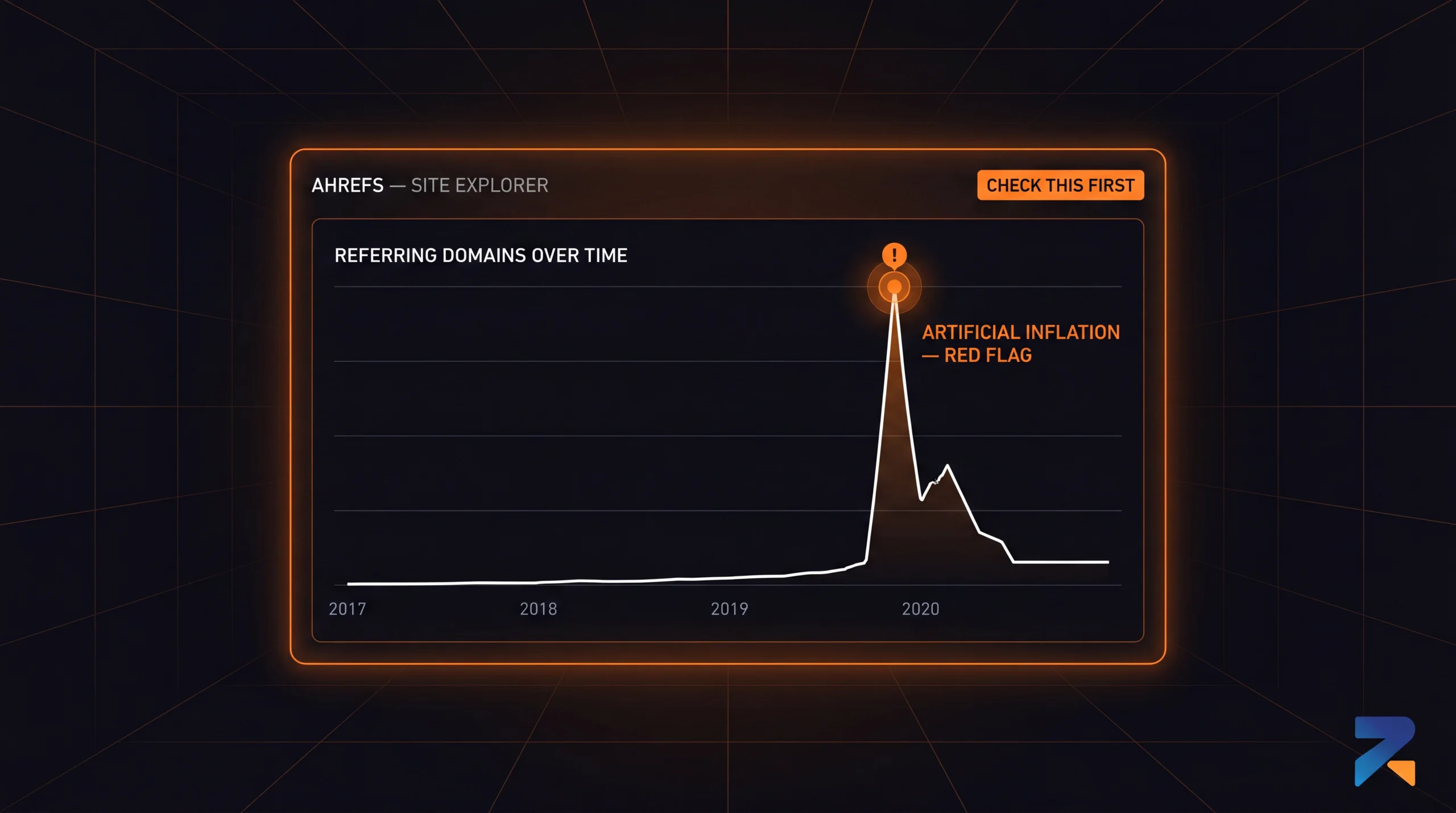
The referring domain growth graph is the first one. Open Site Explorer, pull the domain, and look at how that number moved over time. You want slow and steady — years of gradual growth, maybe some spikes when the site published something that got picked up. What you don’t want: a flatline for three years, then 600 new referring domains in under 60 days, then flatline again. That’s a metric inflation campaign, almost certainly run to pump the domain’s value before a sale. Ahrefs shows this more clearly than anything else.
The Anchors report is the other thing worth opening immediately. If you’re looking at a domain that was supposedly a news or sports site, and 55% of the anchor text is “online casino bonus”, “best slots real money”, “no deposit casino 2021” — someone already ran this domain through a link network. Doesn’t automatically kill the deal, but you need to know before the redirect goes live, not after.
Now, DR — Ahrefs’ main score — is useful for exactly one thing: talking to sellers. Everyone in the market speaks DR, so it’s a shared language. As an actual evaluation signal, don’t lean on it. A DR 35 with 25 referring domains from real editorial sites will do more for a money site than a DR 55 propped up by 300 links from network blogs. The number doesn’t show you that difference.
Spam detection is where Ahrefs falls apart. The tool shows you what’s linking. It doesn’t score how clean those links are. You can filter by the DR of linking domains, but that doesn’t help — a site can hit DR 70 and still be a link farm. Operators who’ve relied purely on Ahrefs DR and referring domain counts have a pile of non-performing domains to prove it. Ahrefs won’t catch what Majestic catches. That’s just reality.
Majestic: Ugly Interface, Best Spam Filter You Have
Run this second. Every domain that clears Ahrefs gets run through Majestic next. No skipping.
The interface looks abandoned. Honestly, it looks like it hasn’t been redesigned since 2012. Don’t let that put you off — the data inside is something neither Ahrefs nor SEMrush can replicate.
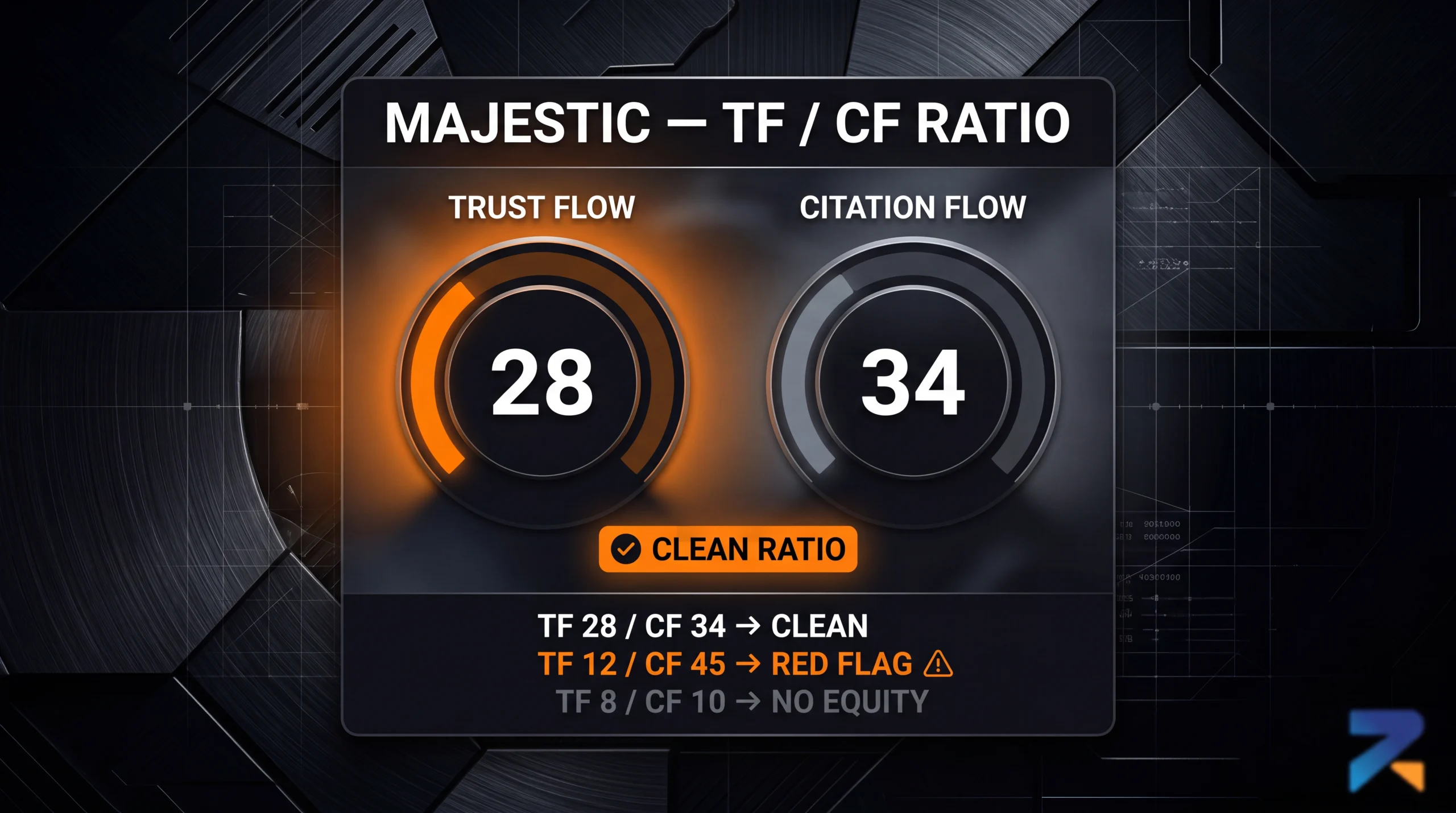
Trust Flow and Citation Flow are Majestic’s two core metrics. Trust Flow scores how many of the links pointing at a domain come from trusted sources. Citation Flow is just raw volume — how many links, period. The ratio between them is one of the fastest quality reads available.
TF 28, CF 34: clean. Links are coming from sites that earned their own authority legitimately, and the volume is proportionate to that trust.
TF 12, CF 45: walk away. Lots of links, not from anywhere real. That gap is the fingerprint of a domain built on networks, not on content.
TF 8, CF 10: this domain is just old. Nothing was built on it. You’d be paying for the age of the registration date and not much else.
Any domain where CF is more than 3x the TF — put it down. Don’t try to talk yourself into it, don’t factor in that the price seems reasonable. In iGaming, that ratio almost always means someone deliberately built cheap bulk links to inflate the domain before selling it.
Majestic’s Historic Index is the other thing that has no equivalent. They’ve been indexing links since 2006. The full history is queryable. This is how you verify whether a domain that claims to be 15 years old was actually active before 2018 — or just registered early and parked while the SEO equity slowly bled out. We’ve looked at domains claiming deep histories where the entire backlink profile started two years before listing. Majestic catches it in minutes.
Also check Topical Trust Flow before you close Majestic. It breaks down the topic categories of a domain’s link sources. If you’re buying a sports or news domain to redirect into a casino or sportsbook property, you want to see Sports, Recreation, or Entertainment in the top categories. If “Recreation > Gambling” is already sitting in there? That’s a real signal — the link profile already has contextual relevance to what you’re targeting.
One genuine weakness: refresh speed. Majestic’s crawler doesn’t move as fast as Ahrefs. If someone added 80 garbage links to a domain in the last three weeks, Majestic might not show it yet. Ahrefs will catch recent changes faster. For anything historical, Majestic is the better tool.
SEMrush: Not for Backlinks. For Traffic History.
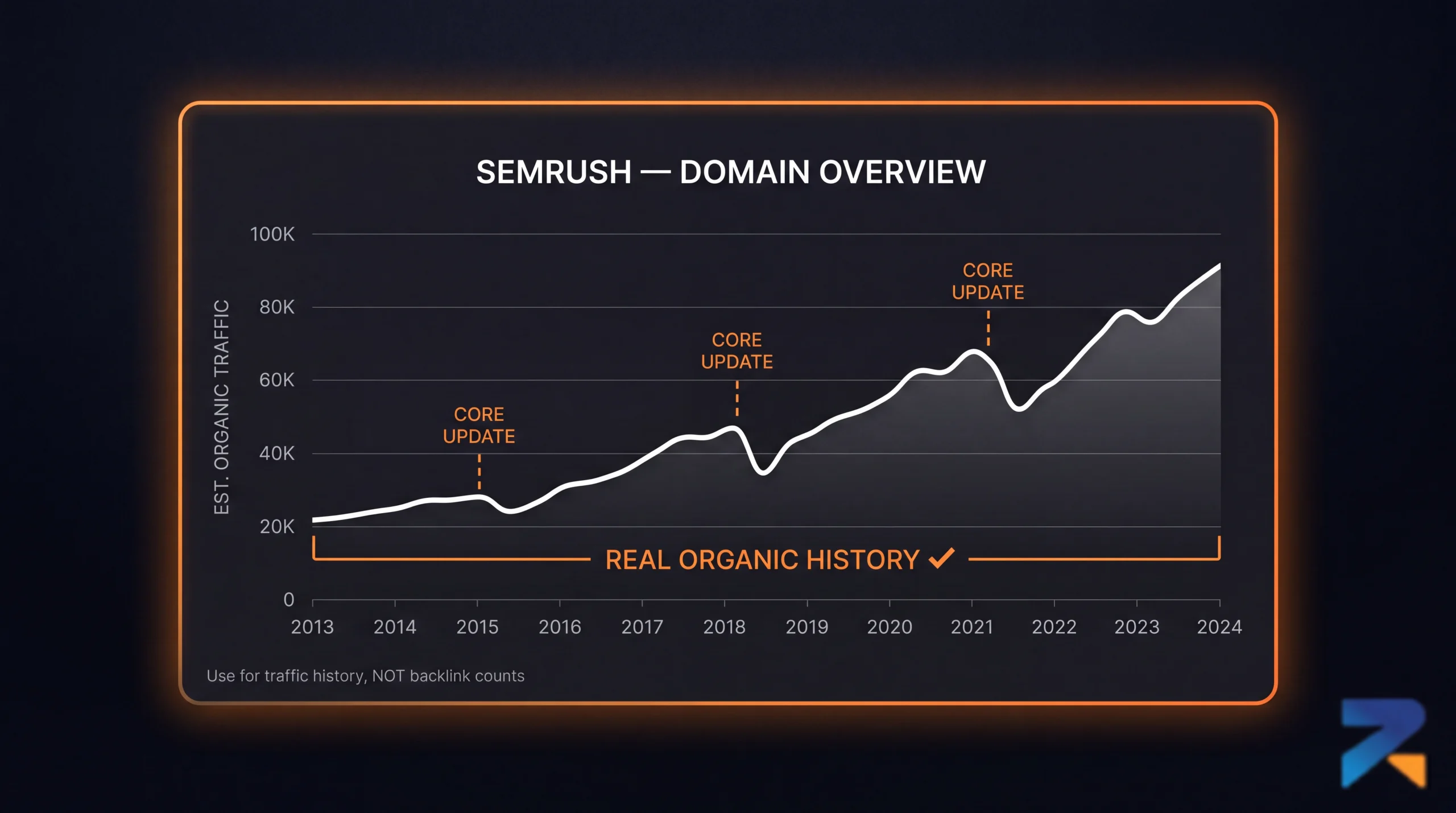
Most people use SEMrush for the backlink check. That’s a mistake. Their backlink index is smaller than Ahrefs, it misses a substantial portion of links on older domains, and the referring domain counts are routinely off on anything with a long history.
Stop using SEMrush for backlinks on aged domain evaluations. Use Ahrefs and Majestic for that.
What SEMrush actually brings to this process is organic traffic history — and nothing else in this list gives you that.
Pull any domain into Domain Overview in SEMrush and look at the organic traffic trend. A domain that had real search traffic over multiple years will show a line that moves the way a legitimate site moves: gradual climbs, visible drops during major Google updates, recoveries when the site was being actively managed. That pattern is meaningful. A domain that accumulated links but never actually ranked will show something flat, or nothing at all.
This matters because there’s a real difference between a domain that ranked and one that just has backlinks. The one that ranked has crawler visits, user interactions, and behavioral signals built into its history. That’s a different type of asset for a redirect or a PBN node — and you can only see it in SEMrush.
While you’re in there, pull the Organic Research tab and look at what the domain actually ranked for, going back as far as the data goes. If you’re buying this domain to redirect into a sportsbook, and it spent six years ranking for “Premier League match previews”, “NBA game predictions”, “football betting tips” — that’s clean topical alignment. If it ranked for kitchen renovation guides and parenting blogs, the relevance transfer gets thinner. Not impossible, but factor it into what you’re willing to pay.
SEMrush’s Backlink Audit has a toxicity score. It’s okay as a third opinion — if Ahrefs flagged a messy growth pattern, Majestic showed a blown-out TF/CF ratio, and SEMrush is now calling 40 links toxic, you have three sources pointing the same direction. That’s meaningful. Don’t use the toxicity score as your primary call. Use it as confirmation when the other tools already have doubts.
How to Actually Run This
Ahrefs goes first. Open the referring domain graph and look for any artificial spikes. Pull the Anchors report and scan for over-commercialized exact-match gambling terms that don’t fit the domain’s supposed history. Check DR but treat it as rough orientation, not a decision point. If anything in those checks looks off — the spike, the anchors, the pattern — the domain is out. Close the tab and move on.
If it clears Ahrefs, open Majestic. Pull TF and CF before you look at anything else. CF more than 3x TF means the domain fails right here, regardless of what Ahrefs said. If both numbers are very low, the domain never had real authority and that won’t change after you redirect it. If the ratio looks clean, run the Historic Index check to confirm the link-building activity has actual age behind it and wasn’t manufactured in the 18 months before listing. Check Topical Trust Flow for category relevance.
If it clears Majestic, run SEMrush. Look at traffic history — was there genuine organic traffic over multiple years, and did it move in ways that match how a legitimate site behaves through algorithm cycles? Pull the historical keyword data and check for topical relevance to your target niche. Run the Backlink Audit only if you want a secondary toxicity read on links already flagged by the first two tools.
Domain fails Ahrefs or Majestic — SEMrush doesn’t run. The domain is gone.
For anything above DR 50 with an asking price over $1,500, run all three tools in full and add a Wayback Machine content audit before committing to anything. At that price point you should also be manually clicking through a sample of the top referring domains — actually opening the sites, not just reading the metrics. A DR 72 domain in Ahrefs can still be a link farm. The metric won’t tell you. The actual site will.
Where This Goes Wrong
The three-tool process sounds obvious when it’s written out like this. In practice, most operators run one tool on ten domains and call it a day because they’re busy and the evaluation feels like overhead.
The problem is that bad domains don’t fail on day one. They fail after you’ve set up the site, published content, built links to the domain, and waited out the indexation window. By the time it’s clearly not working, the actual cost — in time and in the links you spent on it — is five to ten times the domain purchase price.
The other thing that kills operators: skipping Majestic because the interface is ugly. That’s genuinely the most common reason people miss the TF/CF problem. The tool looks outdated. It is outdated. The data inside it is not. There is no faster spam screen for aged domains, and the Historic Index has no equivalent in any other tool on this list.
And one more — treating SEMrush traffic estimates as real numbers. They’re modeled. A domain showing 4,000 estimated monthly visits in SEMrush might have had 1,000 real visits, or 9,000. The specific figure doesn’t matter. What matters is whether there was traffic at all, whether it grew and dropped in patterns consistent with real search performance, and whether the keyword profile lines up with what you’re trying to rank. Shape of the trend. Not the number.
This Takes Less Time Than Losing the Domain
Twenty minutes per domain. That’s the realistic time commitment if you know what you’re looking for and aren’t stopping to second-guess every metric. Most iGaming operators already have active subscriptions to at least two of these tools — this isn’t a budget question, it’s a habit question.
The domains that actually do something in iGaming are the ones that survive all three checks. They exist. You just have to be disciplined enough to discard everything that doesn’t make it through.
Run Ahrefs, Majestic, and SEMrush in sequence, then cross-check against the pre-purchase audit checklist before you pull the trigger on anything. That’s the process.
Every domain in the Rexusdomain inventory goes through this before it’s listed — backlink profile, TF/CF ratio, traffic history, content audit, all of it. If you’d rather start from a shortlist that’s already been through the checks, the catalog is here
Related Guides
- Best Aged Domain Marketplace for iGaming SEO (2026)
- Best aged domain marketplaces 2026 — top 7 platforms ranked
- How to Build a PBN for iGaming SEO Using Aged Domains
- Where to Buy Aged & Expired Domains in 2026: The Complete Buyer’s Guide
- Aged Domain Sellers You Can Trust: How to Vet a Premium Marketplace
Sources & Further Reading
Frequently Asked Questions
Which SEO tool is best for evaluating aged domains: Ahrefs, Majestic, or SEMrush?
Ahrefs is the most widely used for aged domain evaluation — its Domain Rating and backlink index are comprehensive and updated frequently. Majestic is essential for Trust Flow and Citation Flow data, which Ahrefs does not replicate. SEMrush is least useful for domain buying; its backlink index lags the others and organic traffic estimates are unreliable on dormant domains.
What is the difference between Domain Rating and Domain Authority?
Domain Rating (DR) is Ahrefs metric, based on the strength of a referring domain profile on a logarithmic scale of 0-100. Domain Authority (DA) is Moz equivalent. Both predict ranking potential but use different algorithms. Neither is a Google metric — they are third-party proxies for link equity, useful for comparison but not definitive.
Should I use Ahrefs or Majestic Trust Flow to vet a PBN domain?
Use both. Ahrefs DR and referring domain count give you link profile breadth and recency. Majestic Trust Flow reveals link quality and topical relevance — a domain with TF25 in the Gambling category is far more valuable for iGaming PBNs than TF25 in a general category. Cross-referencing both tools catches discrepancies that signal manipulation.
Can SEMrush be used to check aged domain history?
SEMrush has a Domain Overview and Backlink Analytics feature, but its historical backlink data is significantly less comprehensive than Ahrefs or Majestic on aged or dormant domains. For domain buying decisions, SEMrush is a supplementary check at best. Use Ahrefs or Majestic as your primary evaluation tools.
What backlink metrics matter most when buying an aged domain for iGaming?
Prioritise: (1) Referring domains — 50+ unique domains is the baseline for any meaningful link equity; (2) Trust Flow 15+ in a relevant topical category; (3) Anchor text distribution — less than 20% branded-keyword anchors suggests organic link acquisition; (4) Spam Score under 5%; (5) Wayback Machine history confirming legitimate content.
How often are Ahrefs and Majestic backlink indexes updated?
Ahrefs crawls the web continuously and updates its index live, with major domain metrics refreshing every 15-30 minutes for active domains. Majestic Fresh Index updates daily; its Historic Index covers links going back years. For aged domains being evaluated, check both indexes — some older link profiles appear only in Majestic Historic data.