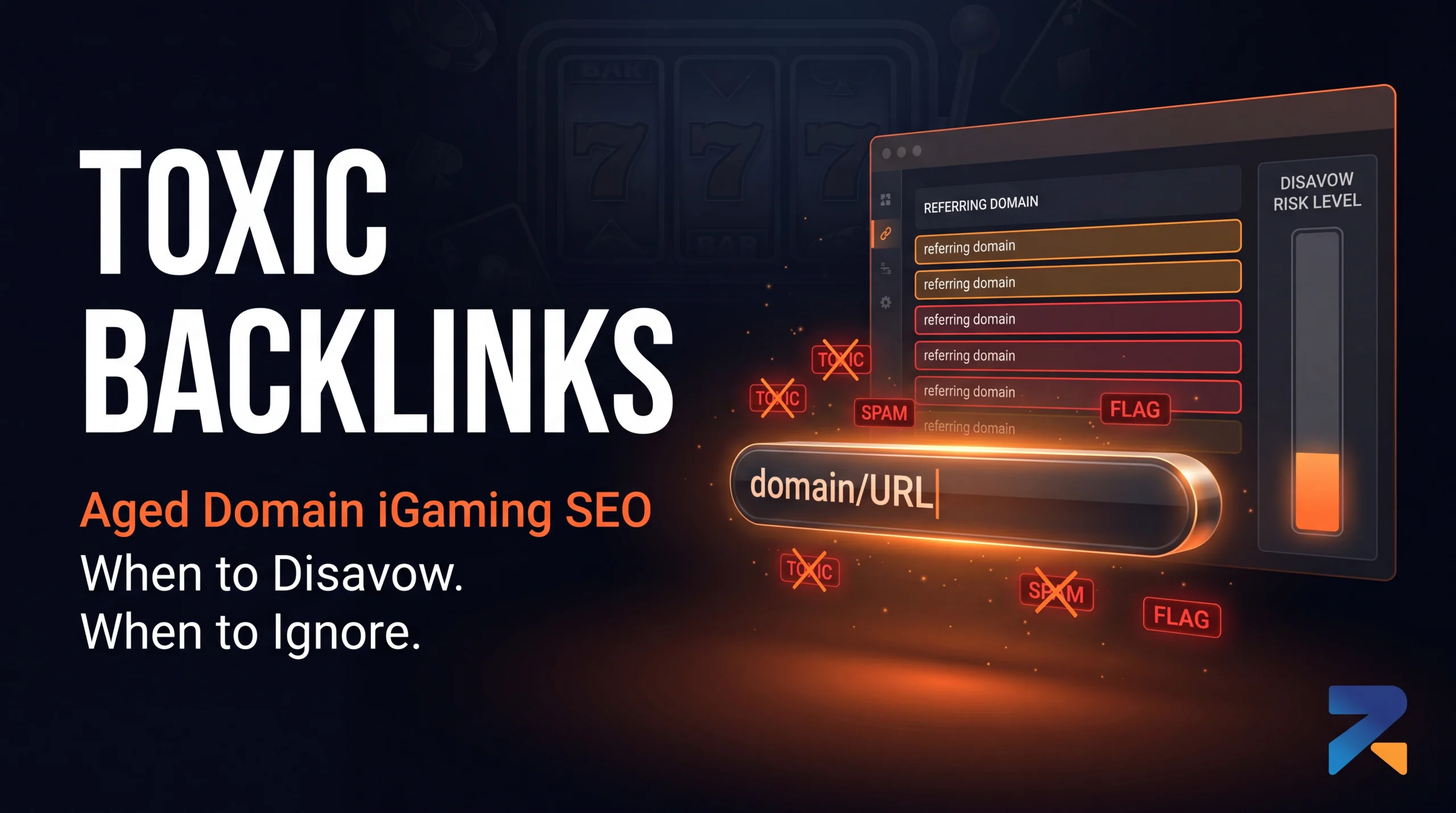

You bought the domain. DR 38, 180 referring domains, Wayback history looks fine. Two weeks after you point it somewhere, you run a proper backlink export and see 90 links flagged red in Ahrefs, a Moz spam score at 34%, and Semrush’s toxicity bar looking like a warning light.
So you open the Disavow Tool. You start pasting domains. You submit the file.
Rankings don’t come back. Some drop further. You spend three weeks wondering what else went wrong.
Here’s what went wrong: you disavowed links that weren’t hurting you. And in doing so, you pulled out equity the domain had been sitting on for years equity you literally paid for when you bought it. This is exactly what a proper pre-purchase audit is supposed to catch before you spend a dollar but even operators who did audit still make this mistake post-purchase. We’ve seen this kill aged domain campaigns that had real momentum. Not because the links were toxic. Because the operator assumed they were.
This is the most misunderstood decision in aged domain SEO and in iGaming it costs real money every single time it gets made wrong.
“Toxic” Is a Tool Label, Not a Google Signal
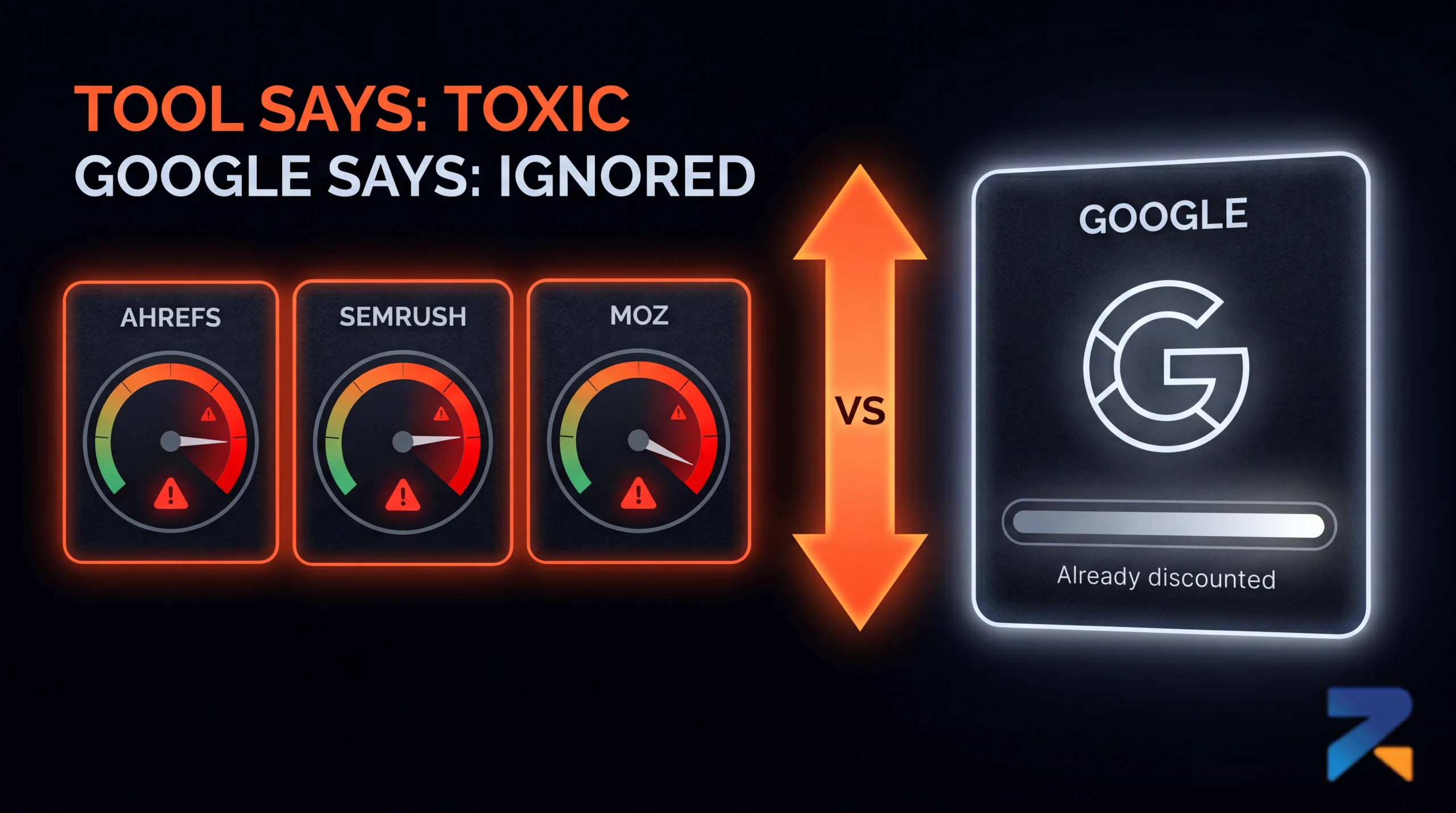
Every major backlink tool has its own toxicity scoring system. Ahrefs uses a combination of spam signals to flag “toxic” links. Semrush has its Authority Score and a dedicated Toxicity Score. Moz has Spam Score. None of them are Google. None of them have access to what Google’s algorithm actually weights.
What tools are doing is pattern matching. Low DR domain? Flag. High outbound links per page? Flag. Foreign language content pointing to English site? Flag. Link from a gambling directory circa 2011 with no traffic? Definitely flag.
The problem is that Google already knows about most of these patterns and has largely already decided to ignore them. The algorithm has been discounting low-quality link signals since 2012. A forum profile link from a Russian-language site with 700 outbound links from the same page isn’t passing anything to your domain. It’s also not dragging it down. It’s just sitting there, doing nothing, while a tool paints it red and makes you nervous.
In iGaming, aged domains almost always come with this stuff attached. Previous owners used gambling directories, ran affiliate profile pages, got listed on every casino comparison site that existed in 2009. That’s part of what makes the domain aged. Some of those sites are now dead, parked, or running spam content. Doesn’t mean the link equity they passed five years ago evaporated and it definitely doesn’t mean you need to disavow them now.
Three Types of Bad Links. Three Different Calls.
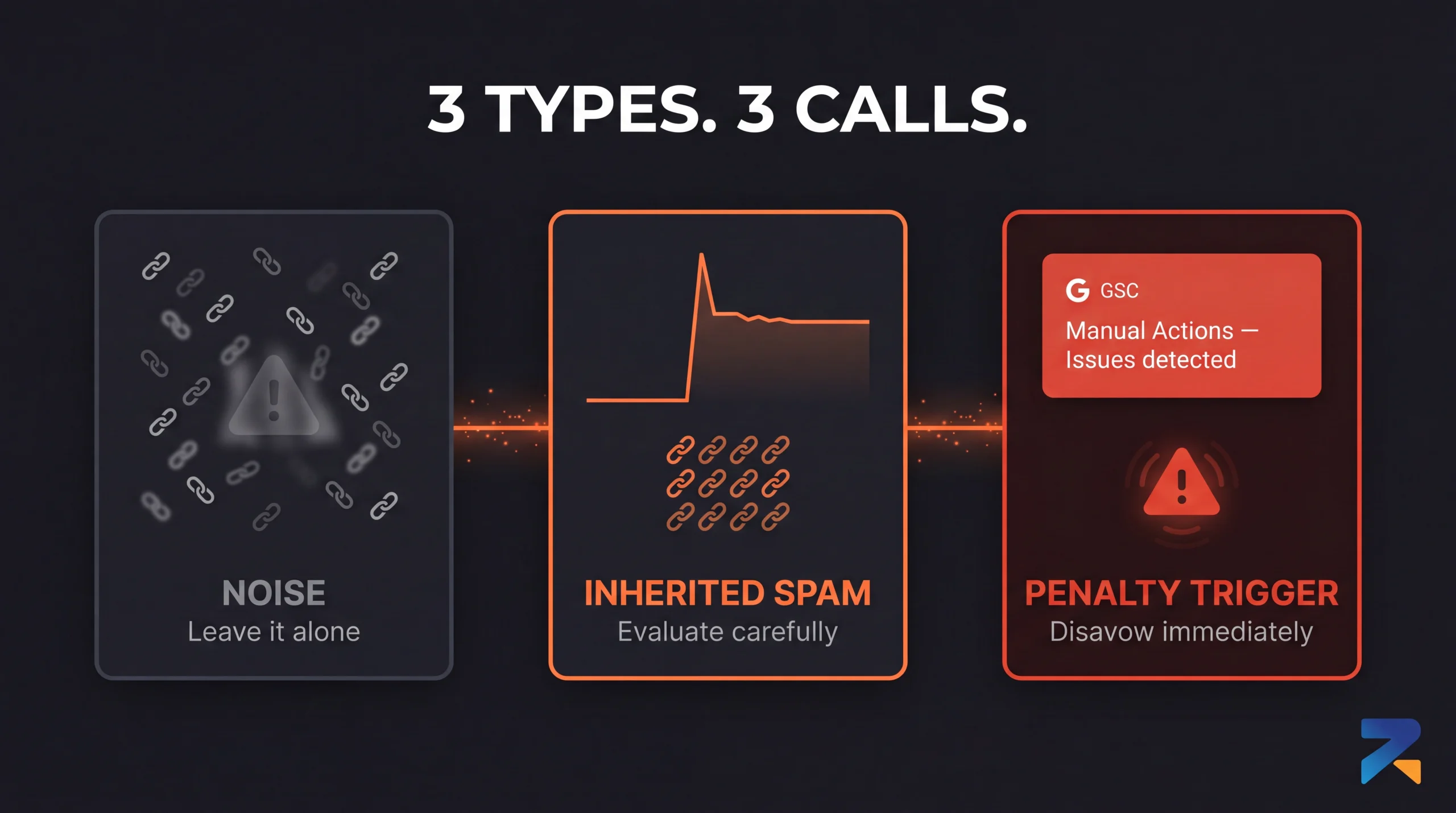
When you’re working through a backlink export on an aged domain, you’re not looking at one problem. You’re looking at at least three completely different situations that get lumped under the same label. The right tool matters here too how you pull a full backlink export in Ahrefs versus Majestic versus Semrush will give you different flagging thresholds, so knowing what each tool is actually measuring keeps you from reacting to phantom signals.
The first is noise. Old forum profiles, blog comment spam, low-DR directories, sidebar links from sites that haven’t been updated since 2016, random foreign-language pages that scraped content and linked back to everything. This is the bulk of what gets flagged probably 80% of the “toxic” count you’re looking at. These links have been sitting there for years. The domain ranked through them. They’re not being counted. They’re not dragging you down. Leave them alone.
The signal that something’s just noise: zero organic traffic on the referring page, 500+ outbound links from the same URL, anchor is your naked domain or brand name with no commercial keyword, and it’s been indexed since before 2020 with no visible impact on anything. That’s not a threat. That’s clutter.
The second is inherited spam. This is trickier. Some aged domains change hands mid-campaign the previous owner ran an aggressive link building scheme, it stopped working, they dropped the domain, you picked it up two years later. What you’re looking at in Ahrefs is a spike: 60–80 new referring domains appearing in the same 45-day window, all pointing to the same commercial pages, all with exact-match keyword anchors.
The question you need to answer before touching these isn’t “are they spam?” It’s: did the domain continue ranking after that spike? If traffic held or grew after the link burst, Google adjusted for it already. The spam cluster is effectively neutralized algorithmically, not in a disavow file. You start disavowing those domains now, you’re stripping out referring domain count for no gain.
If, on the other hand, the traffic dropped in that same window and never recovered, those links may still be in play. That’s when surgical disavowing makes sense domain-level only, on the clusters from that specific window, not everything around them.
The third is actual penalty material. Rare on a properly checked domain, but it exists. Manual action in GSC after you verify. Sitewide footer links from a large site blasting keyword-stuffed anchors across 1,000+ pages all pointing to one URL on your domain. Links from niches Google explicitly refuses to trust pharma spam, payday loan farms, adult networks making up more than 15% of your total referring domain count. These you disavow immediately, domain-level, and you document everything in case you ever need a reconsideration request.
The Disavow File Does Not Clean Your Profile
This is where a lot of operators get the tool wrong. They think of the disavow file the way they’d think about deleting bad photos from an album just remove the ones you don’t want and you’re left with a cleaner set.
That’s not what’s happening.
When you submit a disavow file, you’re asking Google to exclude those links from evaluation. Google eventually complies. But you’ve also just told Google’s systems exactly which links to look at including links that were being completely ignored before you pointed them out. And if a link you disavow was actually passing some equity, even quietly, that equity gets pulled. You can update the file later without those domains but recovery isn’t instant. You’ve created a gap.
The other thing nobody tells you: there’s a meaningful difference between “Google ignores this link” and “this link is hurting me.” Most flagged links fall in the first bucket. The disavow file only matters for the second bucket. Using it aggressively on the first bucket accomplishes nothing except shrinking your link profile.
One specific scenario we’ve seen this go wrong: a DR 14 blog in the sports betting space. Zero traffic in Semrush, flagged as medium toxicity in Ahrefs, looks like nothing. But it’s a real site, genuinely niche-relevant, been live since 2015, links to the aged domain from an editorial paragraph. That link is passing equity. Not much, but real. The operator disavows it because the tool flagged it. Three months later they’re paying for a guest post to replace the equity they killed for free.
How to Actually Make the Call
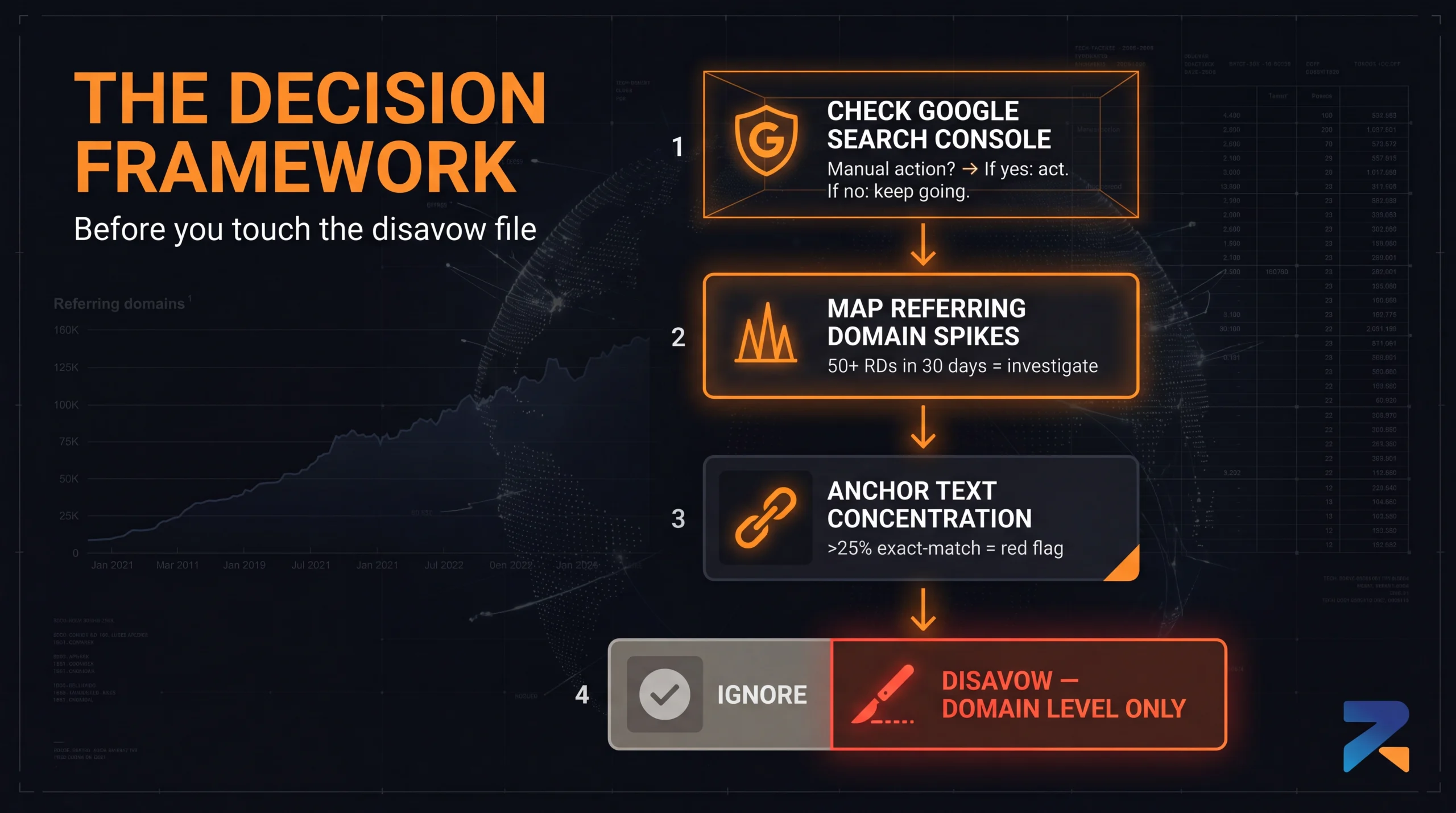
Stop at GSC before you do anything else. Verify the domain in GSC, open the manual actions tab, check. No manual action means the domain isn’t penalized. Everything you’re looking at in third-party tools is a model. Useful, but not authoritative.
After that, open Ahrefs and filter referring domains by first-seen date. You’re looking for spikes any period where the referring domain count went up by 50 or more in under 30 days is worth examining. Pull the anchor text from those referring domains. If the spike anchors are commercial keywords at scale “best casino bonus”, “slot online terpercaya”, that kind of thing and they’re from domains that share similar structures or were registered around the same time, you have a link network. That’s the thing to target. Not the whole profile.
Then export everything and look at anchor text concentration across your full referring domain set. In iGaming, anything above 25% exact-match commercial anchors across unique referring domains is worth acting on. Below that, you’re managing a profile that Google’s already seen, already evaluated, and already decided to work with. The anchor text audit guide covers how to do this properly same methodology applies here before you touch the disavow file.
Build the disavow file last, not first. Add only what the above process confirmed as active risk, domain-level entries only unless the problem is isolated to a single page on an otherwise clean site. The smaller the file, the less equity you’re voluntarily cutting.
If You Already Bought Without Running the Audit
It happens all the time. Domain goes live on GoDaddy Auctions, four hours left on the clock, the numbers look right and you pull the trigger. Two weeks later you’re in the backlink report wondering what you got yourself into.
Don’t touch the disavow file for at least 30 days after you take ownership.
Use that window to actually watch what happens. Are rankings moving at all? Is GSC showing impressions? Is there a manual action you missed? A lot of domains that look messy in tools rank just fine because Google’s been living with their backlink profile for years and has already priced in the noise.
If after 30 days you’re genuinely seeing impressions drop in GSC and there’s no on-site explanation, go back through the triage process above. Disavow only the spike clusters that show organized exact-match anchor patterns. Not the old forum profiles. Not the dead directories. Not the random scraper sites. Just the organized stuff.
Negative SEO Is the One Exception
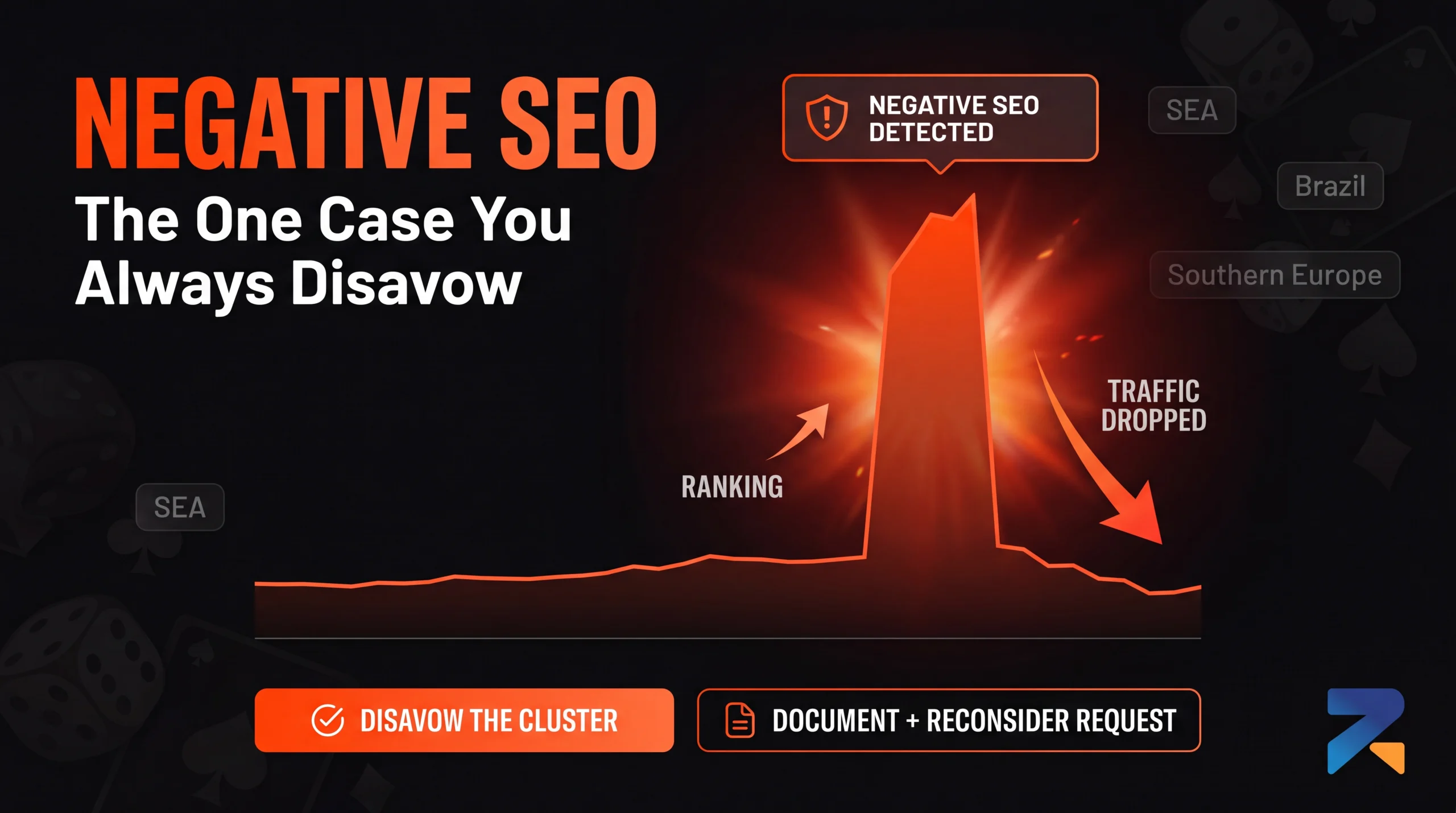
In iGaming and specifically in competitive GEOs like Southeast Asia, Brazil, and parts of Southern Europe negative SEO campaigns happen. Once you’re ranking for anything that converts, someone will try to knock you down. The method is usually a blast of thousands of links, often with spammy or foreign-language exact-match anchors, sometimes appearing across 500+ unique domains in a week.
The tell is the timeline. You were ranking, traffic drops suddenly, and the spike in Ahrefs corresponds exactly to that drop. That’s not inherited history. That’s active manipulation. Check the anchors on that spike if it’s your target keywords in a language you don’t publish in, pointing to your commercial pages, that’s the pattern.
In that scenario: disavow the entire cluster, submit immediately, document the referring domains and the timeline. You can also submit a reconsideration request explaining what you observed Google handles confirmed negative SEO cases differently from self-inflicted spam.
But don’t let the negative SEO scenario make you trigger-happy. Most of what you’re looking at on a regular aged domain purchase is not negative SEO. It’s just history.
What You’re Actually Protecting
An aged domain in iGaming is valuable precisely because of its link history the good stuff and the messy stuff that’s been sitting around long enough for Google to have already decided what to do with it. When you buy one and immediately start stripping links out, you’re not inheriting that authority. You’re diluting it.
The operators who get this right are precise and slow with the disavow file and aggressive with new link acquisition on top. The ones who get it wrong go the other direction heavy disavow, light new building and then wonder why the domain doesn’t perform like the metrics suggested it should.
Protect what you bought. Only cut what you can prove is actively pulling it down.
If you want aged domains that’ve already been vetted for clean link profiles before they hit the market, that’s exactly what Rexusdomain screens for before listing anything in inventory.
Related Guides
Sources & Further Reading
Frequently Asked Questions
Should I disavow toxic backlinks on an aged domain I just purchased?
Only disavow if the toxic links are actively triggering a manual penalty or causing clear algorithmic suppression. Google advises disavow files are rarely necessary — its systems ignore most low-quality links automatically. For acquired aged domains, audit the full link profile first, identify patterns of obviously manipulative links (link farms, foreign spam networks), then disavow conservatively. Over-disavowing legitimate aged links can destroy genuine authority.
What types of backlinks on aged iGaming domains should be disavowed?
Disavow: (1) links from known link farms with DR 0-5 appearing in bulk (50+); (2) links with exact-match anchor text from irrelevant foreign-language domains; (3) links from adult sites if the acquired domain is not adult content; (4) links from previously penalised domains in Google manual action databases; (5) large blocks of identical anchors from the same IP range. Never disavow individual links from legitimate low-DA sites.
How do I identify toxic backlinks on an acquired aged iGaming domain?
Export the full backlink profile from Ahrefs and Majestic. Red flags: referring domain DR 0-5 in bulk, anchor text in unrelated languages, identical anchor text patterns from multiple domains on the same IP subnet, links from known PBN networks appearing in bulk, and high-volume link acquisition spikes visible in the Ahrefs historical timeline. Cross-reference with Google Search Console’s links report post-acquisition for current active links.
What is the difference between toxic backlinks and low-quality backlinks?
Toxic backlinks are links from sites that actively signal spam, manipulation, or policy violations — link farms, deindexed domains, adult directories on non-adult sites, and identical-anchor bulk patterns. Low-quality backlinks are links from legitimate but low-authority sites (community forums, small blogs, local directories) that provide minimal ranking benefit but do not trigger penalties. Low-quality links rarely require disavow action.
Can toxic backlinks on an aged domain cause a manual penalty after transfer?
A pre-existing manual action does transfer with the domain — it attaches to the domain, not the owner. However, new manual penalties from existing toxic links are uncommon post-transfer unless you actively build similar links. Google evaluates the domain as a new business entity after transfer for most purposes. The exception is domains where Google has specifically flagged the site for link scheme participation — these require manual reconsideration requests.
How long after purchasing an aged domain should I wait to submit a disavow file?
Do not submit a disavow file immediately. First, publish content and achieve indexation. Monitor Google Search Console for 4-8 weeks to identify any manual action notifications or ranking suppression signals. If organic performance is below expectations for a high-metric domain, review the link profile for obvious manipulation patterns before disavowing. Premature disavow of aged links can permanently remove authority that took years to accumulate.