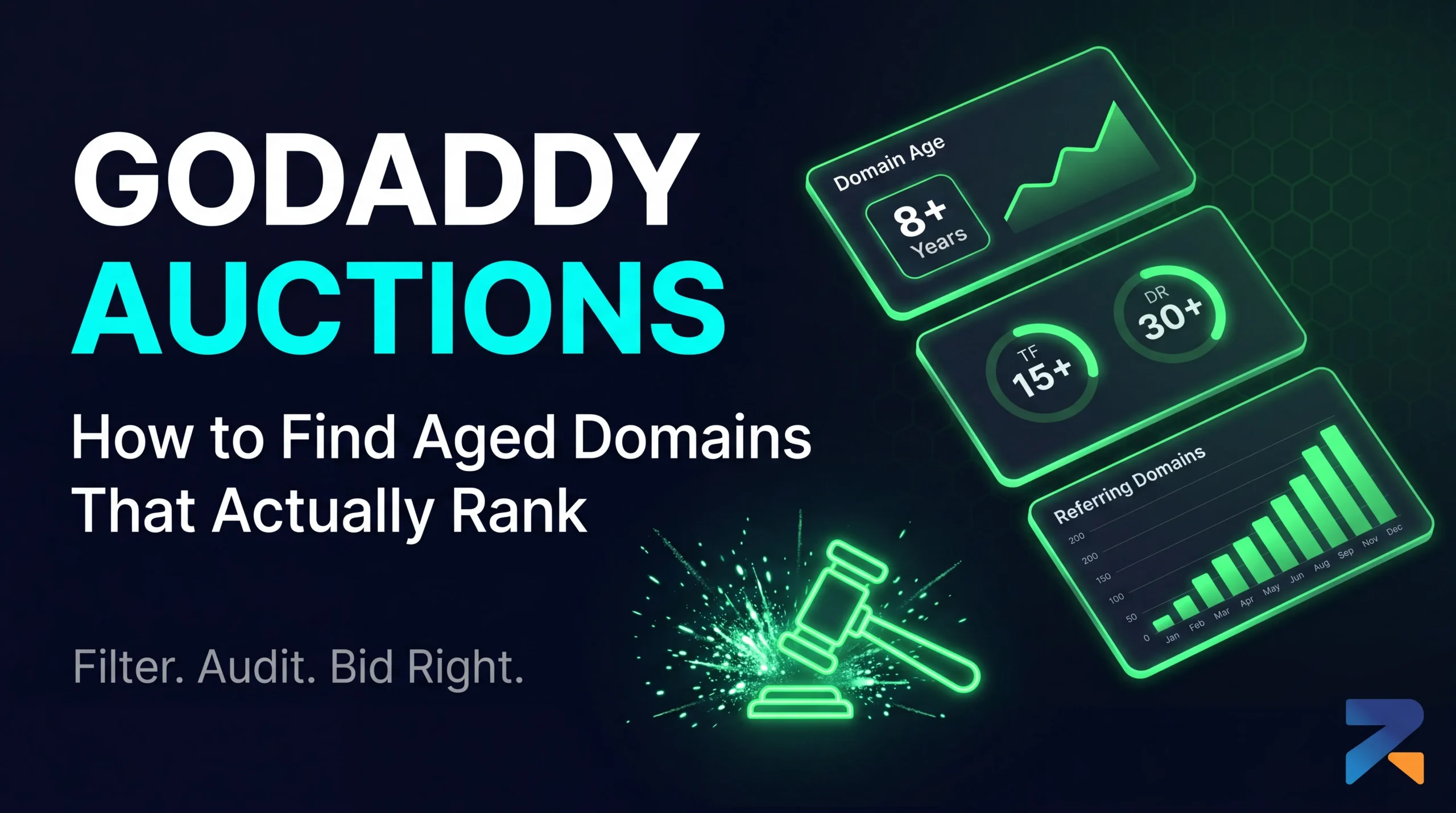

GoDaddy Auctions: How to Find Aged Domains That Actually Rank
Most people open GoDaddy Auctions, type a keyword, sort by price, and buy whatever looks decent. Three weeks later the domain doesn’t move anything. The metrics looked fine. The price felt right. But the domain was garbage — and they had no way to know because they didn’t know what to actually look for.
GoDaddy Auctions is one of the largest secondary domain marketplaces on the internet. Tens of thousands of domains cycle through it every day. Some of them are genuinely valuable aged assets with clean link histories, real traffic, and years of legitimate publishing. Most of them aren’t.
The platform doesn’t tell you which is which. That’s your job.
What GoDaddy Auctions Actually Is (and How It Works)
GoDaddy Auctions is a marketplace where domains change hands — through auctions, buy-now listings, and closeout sales. The majority of inventory comes from two sources: domains that the original registrant didn’t renew (expired domains that GoDaddy caught before full deletion), and domains that owners are actively selling.
The distinction matters. An expired domain that lapsed because the owner stopped paying is not the same as an aged domain someone acquired, developed for years, and is now selling intentionally. One has a content and traffic history that built up organically. The other might have been a parked page for half its registered life.
GoDaddy Auctions doesn’t separate these clearly. You’ll see both in the same search results, with similar metrics, at similar prices.
Here’s the thing — the platform’s job is to move inventory. Vetting the quality of individual domains is not their priority. It’s yours.
Setting Up Your Search Filters the Right Way
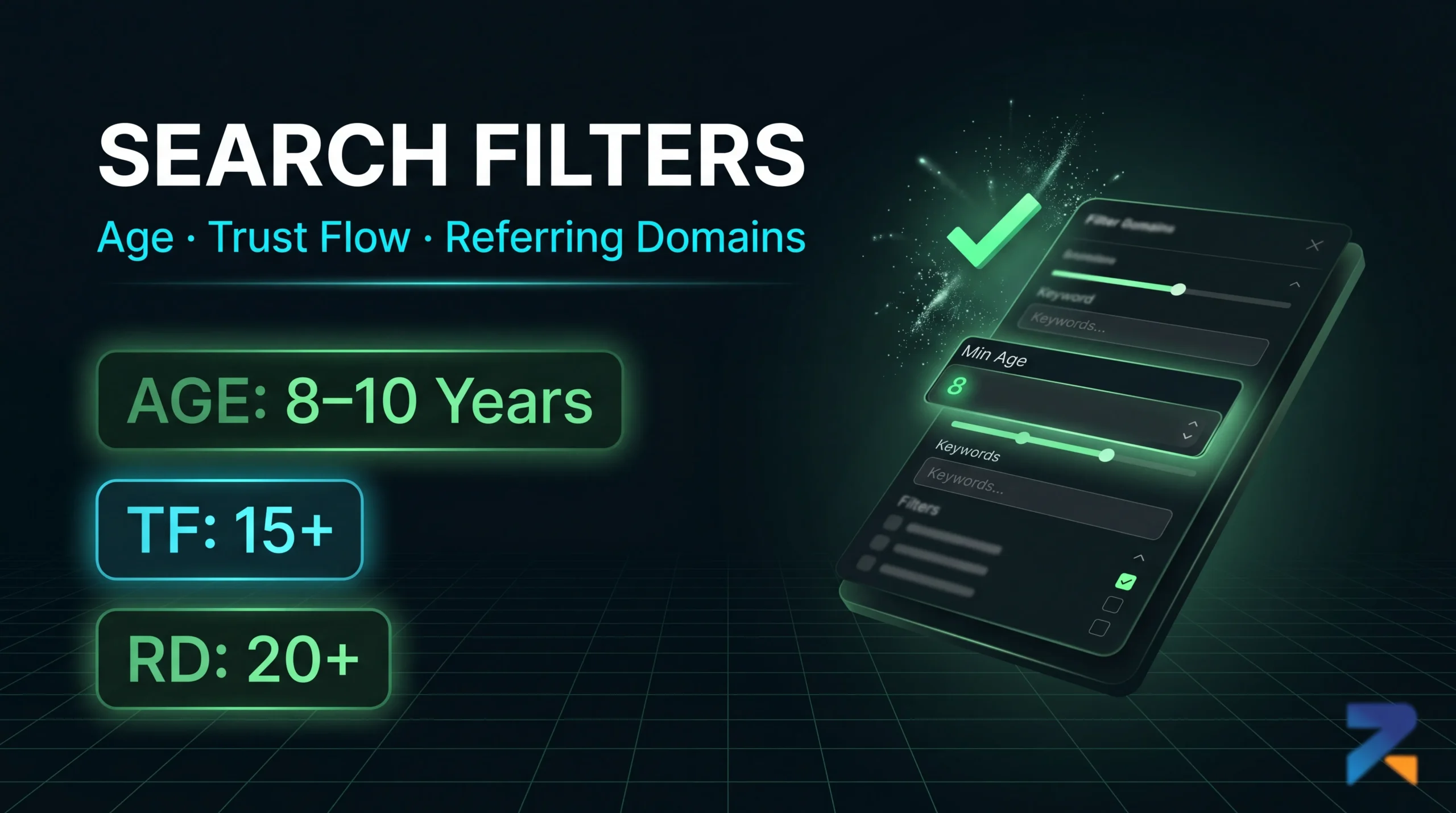
The default search view on GoDaddy Auctions is practically useless for finding quality aged domains. You need to use the advanced filters, and you need to know which ones actually matter.
Start here:
Age: Set minimum domain age to at least 8–10 years. A domain registered in 2015 and dropped in 2023 has had time to build legitimate history — but only if it was used. Age alone means nothing. Age combined with other signals means a lot.
Majestic Trust Flow (TF): Filter for TF 15 or above as a starting floor. Trust Flow is a rough proxy for link quality from the Majestic index. Not perfect, but useful for eliminating obvious junk quickly. Below TF 15 you’re wading through too much noise.
Number of Referring Domains: 20+ referring domains minimum. A domain with 8 referring domains pointing to it isn’t going to move rankings anywhere competitive.
Buy Now vs Auction: Auctions can surface better deals, but they also attract more competition and require faster decisions. Buy-now listings give you time to audit properly. For beginners, start with buy-now. You’ll make fewer rushed mistakes.
What you don’t need to obsess about at the filter stage:
- Exact match keywords in the domain name. EMD still gets overvalued by domain buyers. A domain’s backlink profile and content history matter far more than whether it contains “casino” or “poker” in the name.
- GoDaddy’s own valuation estimate. It’s an algorithmic number that factors in keyword popularity and comparable sales. It tells you nothing about the domain’s actual SEO value or link history quality.
The Metrics That Actually Predict Value
Once you’ve filtered the list down to a shortlist worth investigating, you need to pull real data — not just what GoDaddy shows you.
GoDaddy Auctions integrates basic Majestic metrics (TF, Citation Flow) and sometimes shows Estibot valuations. That’s not enough. Before you bid on anything, run it through:
- Ahrefs or Semrush — Pull the full referring domain count, DR, and organic traffic history. The traffic graph is what you want. A domain that had real organic traffic in 2017–2020 and then dropped to zero tells a different story than one that never had any.
- Archive.org (Wayback Machine) — Check what the domain actually published. Was it a real website with content? A content farm? A parked page? A link farm? This is non-negotiable. You cannot skip this step.
- Google “site:” search — Type
site:yourdomain.cominto Google. If the domain is completely deindexed with zero results, investigate why before bidding. Clean drops will usually still show some cached history or have a natural reason for absence.
The combination of Ahrefs traffic history + Wayback content check eliminates about 80% of the domains that look good on the surface but will perform poorly after acquisition. If you’re still getting clear on what makes an aged domain genuinely valuable, start there before you go any further.
How to Read the Backlink Profile on a GoDaddy Listing
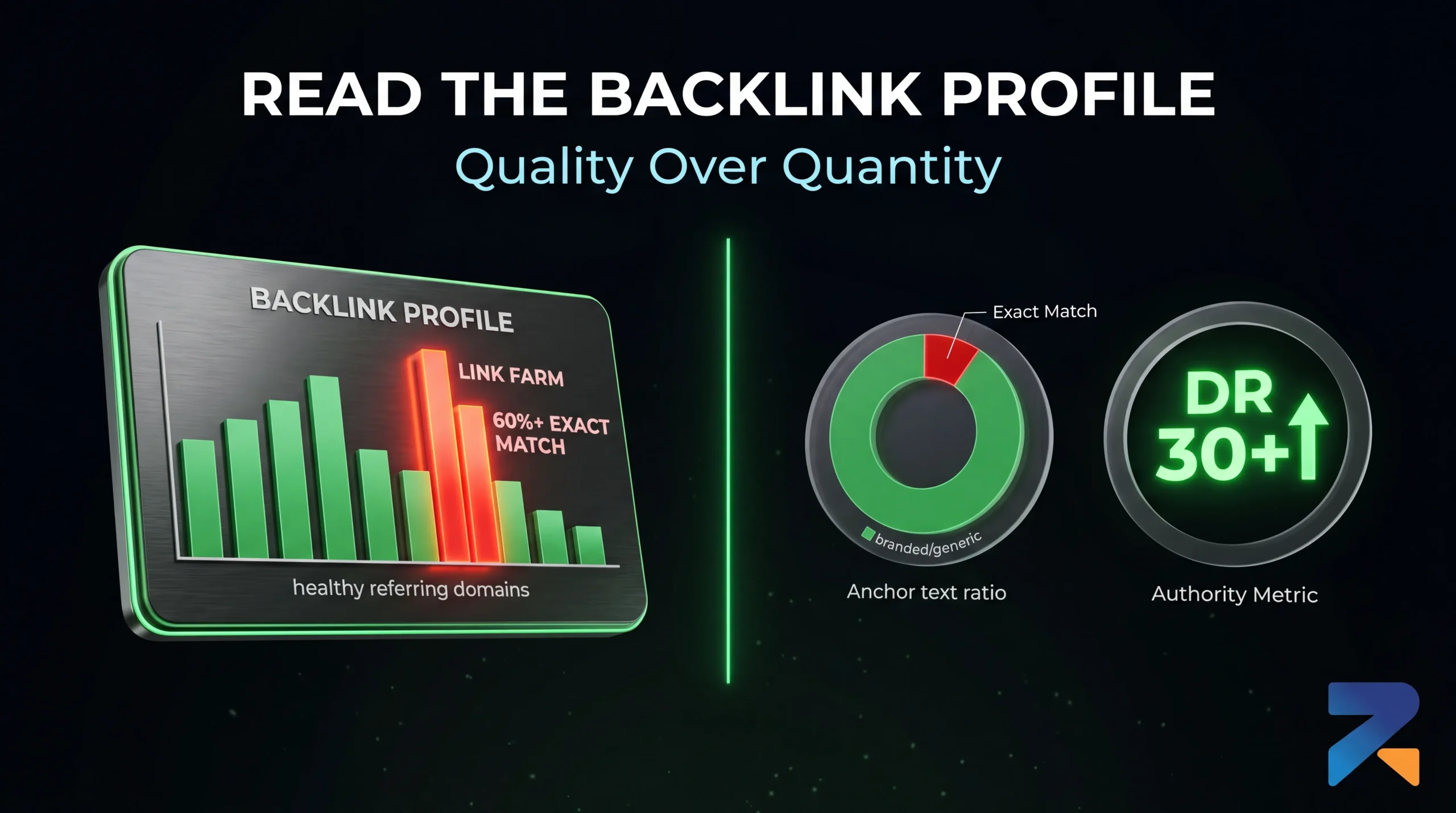
This is where most buyers get it wrong.
A domain with 200 referring domains sounds stronger than one with 40. It isn’t always. The question is where those 200 links came from and whether they’re still live.
What you’re looking for in a quality backlink profile:
- Topical diversity that’s not random. Links from sports sites, news publications, entertainment, finance — these cross-niche profiles often indicate a domain that was legitimately published and earned links naturally. Pure niche concentration can be fine, but it should make sense given the domain’s content history.
- DR 30+ referring domains in the mix. A profile built entirely from DR 5–10 sites is weak regardless of how many there are. You want some actual authority in the link graph.
- Links that have been live for years. Fresh backlinks on an old domain are a red flag. It suggests someone bought the domain previously and ran a link-building campaign on it before dropping it again. You inherit that pattern.
What to walk away from immediately:
- Referring domains that are all from the same IP range or hosting provider — classic link farm pattern.
- Anchors that are 60%+ exact-match commercial keywords. Unnatural anchor ratios are a manual action waiting to happen.
- A sudden spike of 100+ new referring domains in a short window followed by complete flatline. That’s a link scheme footprint.
The Auction Bidding Process: What Most Guides Don’t Tell You
GoDaddy Auctions has two types of listings worth knowing:
Standard Auctions: Run for a set period (typically 7 days). You bid, and if you’re the highest bidder at close, you win. There’s a proxy bidding system — similar to eBay — so you can set a max bid and let the system bid for you up to that limit.
Expiring Auctions (Closeouts): These are domains in the final stages of expiry. They often run for just a few days and can be extremely cheap. The risk is higher because you have less time to audit.
One thing that consistently trips up first-time buyers: auction sniping. GoDaddy automatically extends auctions if a bid is placed in the final minutes. Don’t panic-bid to “win” — decide your maximum value beforehand and don’t exceed it. Emotional bidding on domains is how you overpay for garbage.
Also: winning the auction is not completing the purchase. You still need to go through GoDaddy’s transfer process, which takes time. Budget 5–10 business days for the domain to land in your registrar account, depending on the TLD and transfer complexity.
When GoDaddy Auctions Makes Sense — and When It Doesn’t
GoDaddy Auctions is excellent for volume sourcing. If you have the time and know-how to audit 50 domains per week and are comfortable with a high rejection rate (most listings won’t pass proper vetting), the marketplace can yield strong assets at below-market prices. For a direct breakdown of how GoDaddy compares to curated marketplaces, that comparison is worth reading before you commit to any single sourcing channel.
It does not make sense if:
- You need a domain quickly and don’t have time for thorough auditing
- You’re in a high-sensitivity niche and can’t afford to deploy a domain that later surfaces a toxic history
- You don’t have access to Ahrefs, Semrush, or equivalent tools to properly evaluate the profile before bidding
The raw-marketplace model works for experienced operators who treat it as a sourcing pipeline with a heavy filter on the front end. For everyone else, the time-to-bad-decision ratio is too high.
The iGaming SEO Angle
If you’re sourcing aged domains specifically for iGaming use — whether for a money site, a PBN node, or a 301 redirect — GoDaddy Auctions adds an extra layer of risk that most SEO use cases don’t have.
iGaming is a restricted category on most ad networks, and Google has consistently applied tighter scrutiny to gambling-adjacent domains. A domain with any prior association with pharmacy spam, payday loans, or adult content is a liability for an iGaming deployment, even if the metrics look clean. That history sits in Google’s systems regardless of what Ahrefs shows you.
You also want to pay closer attention to geographic footprint of the backlink profile. A domain with 80% of its referring domains from tier-3 or geo-irrelevant markets won’t carry much weight in the regulated markets where iGaming traffic actually converts — UK, Canada, Australia, Nordics.
For iGaming specifically, GoDaddy Auctions is best used as a sourcing channel only when you have the full audit infrastructure in place. Buying based on quick metric checks alone in this niche is how you waste budget on domains that look fine but deploy to silence. Run the full audit process before you deploy — every single time.
If you want aged domains already vetted for iGaming use — with content history, backlink quality, and niche relevance already screened — that’s what Rexusdomain exists for. The audit work is done before the listing goes live.
Practical Checklist Before You Bid on Any GoDaddy Auction Listing
Run through this before placing any bid:
- Archive check — Pull 3+ years of Wayback Machine snapshots. Does the content look legitimate? Is there a clean history?
- Ahrefs/Semrush traffic graph — Was there real organic traffic? When did it drop, and why?
- Referring domain quality scan — Are the linking sites real publications? What’s the DR spread? Any obvious link farm patterns?
- Anchor text distribution — Check the ratio of exact-match commercial anchors vs branded/generic. Over 40% exact-match on a domain is a risk.
- Google site: check — Is the domain indexed? If not, is there an obvious reason?
- Spam score — Run it through Moz or an equivalent tool. High spam score doesn’t automatically disqualify, but above 30% warrants a full backlink review before proceeding.
- WHOIS history — How many times has this domain changed hands? Multiple ownership changes in 3–4 years is a yellow flag.
If a domain passes all seven points, it’s worth serious consideration. If it fails two or more, move on. There are thousands of listings. There’s no domain worth cutting corners for.
GoDaddy Auctions is a tool. Like any tool, the outcome depends entirely on how you use it. The platform gives you access. The auction gives you the domain. Neither one vets it for you.
Do the work before you bid, not after.
Related Guides
- Best aged domain marketplaces 2026 — top 7 platforms ranked
- Best Aged Domain Marketplace for iGaming SEO (2026)
- How to Build a PBN for iGaming SEO Using Aged Domains
- Where to Buy Aged & Expired Domains in 2026: The Complete Buyer’s Guide
- Aged Domain Sellers You Can Trust: How to Vet a Premium Marketplace
Sources & Further Reading
Frequently Asked Questions
How do I find aged domains on GoDaddy Auctions that have SEO value?
Use GoDaddy Auctions advanced filters: set minimum bids to filter out junk, sort by expiry date, and cross-reference each candidate in Ahrefs or Majestic. The auctions platform itself does not display DR or TF — you must check those manually. Focus on domains with 20+ Majestic referring domains and Trust Flow above 10 as a minimum threshold.
What is the difference between GoDaddy Auctions and GoDaddy Closeouts?
GoDaddy Auctions involves competitive bidding, often resulting in higher prices for desirable domains. Closeouts are domains that failed to sell at auction and are available at a fixed price, typically $10-$25. Closeouts can occasionally yield aged domains with real backlink profiles that were overlooked — worth checking daily for iGaming domain hunters on a budget.
Are GoDaddy Auctions domains pre-screened for spam history?
No. GoDaddy does not screen domains for spam history, manual penalties, or backlink quality before listing them at auction. Buyers are entirely responsible for due diligence. Always check Wayback Machine for content history and Ahrefs for backlink profiles before bidding. The presence of a high bid from others does not confirm SEO quality.
What is a competitive bidding strategy for GoDaddy Auctions?
Monitor domains 48-72 hours before expiry using watchlists. Most serious bidding happens in the final hours. Set a maximum bid in advance based on your domain valuation, not auction momentum. Avoid escalating bids simply because others are bidding — competitor interest does not confirm SEO value. Budget $200-$800 for mid-tier aged domains with genuine metrics.
How do GoDaddy Auctions compare to NameJet or Sedo for aged domain quality?
GoDaddy Auctions has higher volume but lower average quality than NameJet. NameJet benefits from registrar partnerships that surface premium drops before they reach GoDaddy. Sedo marketplace includes private listings from domain investors, which sometimes yields higher-quality aged domains. For iGaming SEO, check all three platforms rather than relying on any single source.
Can I backorder a specific domain on GoDaddy Auctions?
Yes. GoDaddy Auctions allows backorders on domains approaching expiry. Placing a backorder gives you priority in the drop-catch queue if the domain deletes. If multiple parties backorder the same domain, it goes to auction among backorder holders. For high-value iGaming targets, backorder on both GoDaddy and NameJet simultaneously to maximise your catch probability.