
A lot of people buy aged domains, build backlinks, and then wonder why their rankings dropped instead of climbed.
The domain wasn’t the problem. The anchor text was.
In iGaming — the most competitive niche in SEO by almost every measure — anchor text is the signal Google scrutinizes most carefully. Get it wrong and the authority you paid a premium for works against you. The stronger the domain, the louder its link patterns speak. And Google listens.
This piece covers how to actually structure anchor text from aged domains for iGaming: which types to use, what ratios hold up under scrutiny, how to spread anchors across a multi-domain setup, and the specific patterns that keep getting iGaming affiliates hit with manual actions despite having solid domain profiles.
Why Anchor Text From Aged Domains Hits Differently
If you already understand aged domain authority in iGaming you know that a domain with a clean history carries trust signals built over years of legitimate use. Google has crawled it hundreds of times. It knows the content, the link pattern, the traffic behavior, the topical history.
That’s exactly what makes anchor text more sensitive on aged domains, not less.
A domain Google already trusts gets more attention when its behavior changes. If an 8-year-old domain suddenly starts firing off dozens of links with anchors like “best online casino bonus 2026” pointing to the same page, the algorithm doesn’t need long to flag it. The same pattern from a fresh domain might fly under the radar for months. From an aged domain with a rich data history? The anomaly is easier to detect because there’s so much more baseline data to compare against.
The point is simple. Authority amplifies signals. Including the wrong ones.
The 6 Anchor Types You Need to Know Cold
Before you talk ratios, get the vocabulary right. This isn’t academic — every type plays a different role in how a link profile reads to Google.
Exact match uses your primary keyword verbatim. “Best online casino UK”, “slot sites with fast withdrawal”, “trusted sportsbook Indonesia”. Highest keyword signal, highest risk if overdone.
Partial match includes the keyword but not word-for-word. “Find a reliable online casino here” or “how to pick the right sportsbook”. Still carries keyword relevance, reads more naturally than exact.
Branded uses your brand name or domain. “Betway review”, “CasinoX bonus page”, “visit RexusDomain”. Google treats this as genuine referral behavior — people linking to a brand they actually know.
Naked URL drops the raw URL as the anchor. “https://aged-domain.com” or “aged-domain.com/free-spins”. Common in forums, roundups, and less polished editorial content. Looks human because it is how humans often link.
Generic uses no keyword at all. “Click here”, “read more”, “check the full list”. Zero keyword value but essential for making a profile look like it wasn’t assembled in a spreadsheet.
LSI and topical uses semantically related language without being an exact match. “RTP comparison by provider”, “wagering requirement explained”, “live dealer casino regulation Europe”. Underused by most iGaming SEOs, which is a mistake — this is where safe topical density gets built.
The Ratios That Actually Hold Up in iGaming
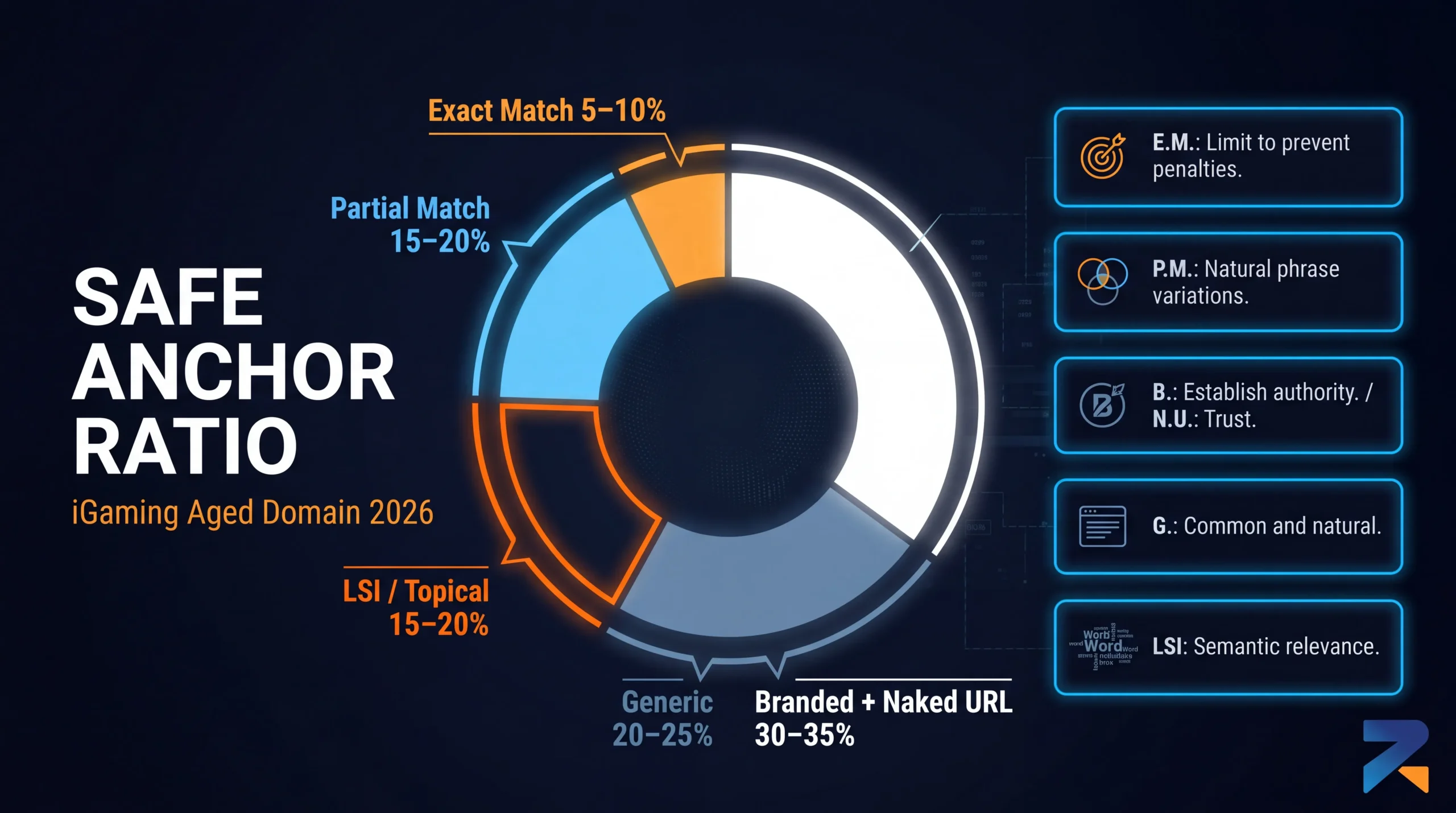
There’s no universal magic number. But across competitive iGaming affiliate markets, these ranges consistently produce profiles that rank without triggering manual reviews.
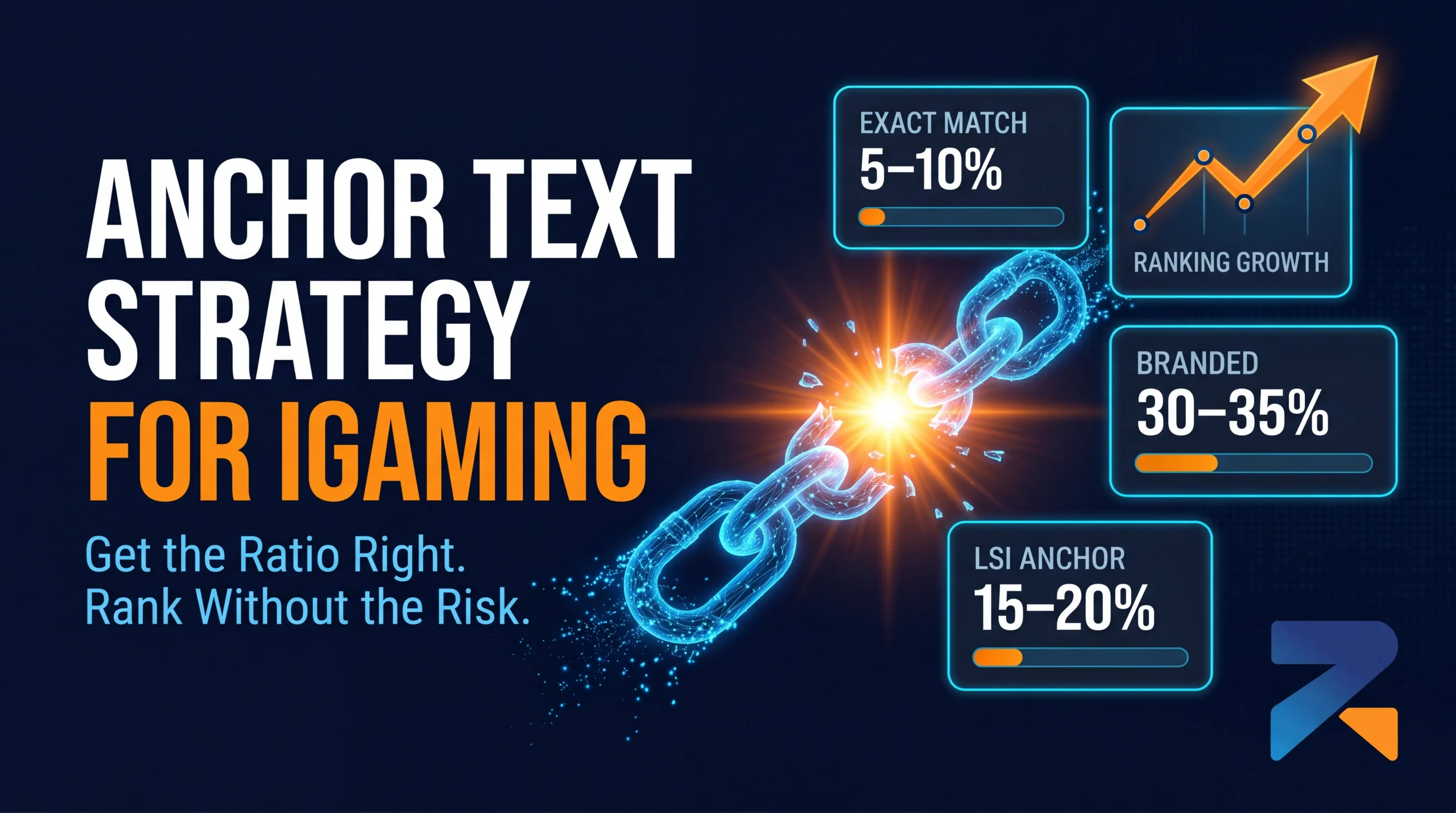
Exact match: 5–10% ceiling. iGaming target keywords are among the most monitored in search. Anything above 10% exact match from a single aged domain starts looking like a signal operation, not editorial linking.
Partial match: 15–20%. This is the working range. Enough topical signal to help with keyword relevance, spread enough to avoid pattern recognition.
Branded plus naked URL combined: 30–35%. This is the backbone of a healthy profile. A lot of people underweight branded anchors because they feel like wasted link equity. They’re not. Branded links are exactly what Google expects to see when a site is genuinely being referenced — operators, review sites, and affiliate directories all link by brand name because that’s how they write.
Generic: 20–25%. Don’t skip this. The non-keyword portion of a link profile is what makes the rest of it plausible.
LSI and topical: 15–20%. If you want to push harder without touching exact match percentages, put that aggression here. Topical anchors build semantic authority in a way that’s much harder for the algorithm to penalize because it doesn’t look like keyword targeting.
One thing worth being clear about: these ratios apply to the incoming link profile of your target page, not to the output of any single domain. If your money site homepage receives 300 backlinks from across your entire setup, it’s the distribution across all 300 anchors that Google evaluates. Not the 12 links from one specific aged domain in isolation.
How to Distribute Anchors Across Multiple Domains
If your strategy involves more than one aged domain — whether that’s for building a PBN for iGaming or simply diversifying link sources across tiers — each domain should contribute a different anchor type to the same target page.
Don’t duplicate identical anchors from multiple domains pointing to the same URL. That’s one of the clearest detectable patterns in competitive iGaming link audits. If three aged domains all send “best casino affiliate program” to the same landing page within the same month, that’s not a natural link profile. That’s a fingerprint.
A cleaner approach works like this. One domain sends an exact or partial match anchor to your primary target page. A second domain sends branded plus LSI anchors to a different page on the same site — a category page, a review, a pillar article. A third sends generic and naked URL anchors to another inner page entirely. From Google’s perspective, three different sources are referencing your site in three different ways for three different pages. That reads as organic because that’s what organic actually looks like.
Vary the target pages too. Not every link from an aged domain should point to your homepage. Mix in inner pages, geo-specific landing pages, and content hubs. A profile where every high-authority link lands on one URL is its own kind of red flag.
The Patterns That Keep Getting iGaming Sites Penalized

Anchor clustering. One page receives too many links with similar anchors in a short window anchor text audit for iGaming. Even if the source domains have strong DRs, velocity spikes like this register quickly. The algorithm doesn’t just look at what the anchors say — it looks at when they appeared and whether the rate makes sense.
Niche mismatch forced through. An aged domain with a history in travel or finance suddenly sends links with casino anchors to a gambling site. The mismatch between anchor text, the source domain’s topical history, and the destination page is read as an anomaly. Domain authority doesn’t paper over this — it actually makes it more visible because there’s more historical data for the algorithm to compare against.
Going aggressive in the first few months. The most expensive mistake in aged domain link building. The domain goes live, the owner pushes 15 exact match anchors to the money site in the first six weeks, and then wonders why there’s a manual review three months later. Build the profile gradually, especially in the early months when Google is re-evaluating how a newly active domain behaves.
Anchor text that doesn’t match surrounding content. A link from an article about poker strategy, with the anchor “no deposit slot bonus”, pointing to a slot landing page. The keyword alignment looks fine on paper. But Google reads the content around the anchor — the words before it, after it, the topic of the article itself. A mismatch between anchor and surrounding context is a signal that the link was placed, not earned.
Anchor Text in 2026 With AI Search in the Mix
One shift that hasn’t gotten enough attention: every core update since mid-2024 has continued moving Google’s relevance signals away from explicit keyword matching toward entity recognition and topical authority.
In practice, this means a link profile that builds topical density through varied semantic anchors is more durable than one built on exact match volume. If your iGaming site accumulates links with anchors that orbit your topic naturally — “how casino bonuses are calculated”, “difference between RNG and live dealer”, “sports betting odds explained” — Google reads that as an entity being discussed by multiple independent sources in context. That’s harder to manufacture, which is exactly why it holds up better over time.
Exact match anchors are still worth using. They haven’t become irrelevant. But in 2026, the iGaming sites that are compounding rankings through core updates are the ones treating LSI and topical anchor diversity as a primary strategy rather than a fallback when they’ve hit their exact match ceiling.
If you’re still looking for the right aged domains to run this through — clean history, verified metrics, ready to transfer — browse the inventory at Rexusdomain and filter by the DR and niche relevance you actually need.
Related Guides
- Best aged domain marketplaces 2026 — top 7 platforms ranked
- Best Aged Domain Marketplace for iGaming SEO (2026)
- Where to Buy Aged & Expired Domains in 2026: The Complete Buyer’s Guide
- Aged Domain Sellers You Can Trust: How to Vet a Premium Marketplace
- How to Buy Aged or Expired Domains: A Step-by-Step Guide
Sources & Further Reading
Frequently Asked Questions
What anchor text strategy should I use when building links to an aged iGaming domain?
Use a diversified anchor text profile: 40-50% branded or naked URL anchors, 20-30% generic anchors (click here, learn more, read more), 15-20% topical variations of your target keyword, and under 10% exact-match keyword anchors. For aged iGaming domains that already carry legacy anchor text, auditing the existing profile before new link building is essential to avoid over-optimisation.
What is the ideal exact-match anchor text percentage for iGaming domains?
For competitive iGaming keywords like online casino, sports betting, or poker, exact-match anchor text should not exceed 5-10% of your total anchor profile. Aged domains acquired via auction often carry legacy exact-match anchors from previous owners. If existing exact-match ratio exceeds 25%, prioritise branded and generic anchors in new link-building to dilute the profile before targeting competitive terms.
Should I use the same anchor text strategy on an aged domain as on a fresh domain?
No. An aged domain has an existing anchor text legacy that must be audited first. A fresh domain starts clean. On aged domains, build new anchors to complement — not duplicate — the existing profile. Exact-match heavy aged profiles need diversification with branded anchors. Aged domains with naturally diverse profiles can support more aggressive topical anchor text in new campaigns.
How do I identify over-optimised anchor text on an acquired aged iGaming domain?
Export the full anchor text report from Ahrefs (Anchors tab). Red flags include: single anchor text phrase above 20% of all anchors; exact-match casino or betting keywords above 10%; bulk identical anchors from link farms; or non-English anchors comprising more than 15% of the profile. Any of these patterns increases algorithmic penalty risk when reactivating the domain for iGaming use.
What anchors should I avoid when linking to an iGaming money site?
Avoid: (1) exact-match money keywords above 10% of total anchors; (2) duplicate anchor text in bulk (50+ identical anchors from different domains); (3) anchor text in languages unrelated to your target market; (4) anchor text referencing unrelated industries on the previous domain; (5) partial-match gambling terms stacked across multiple pages targeting the same SERP.
How often should I audit the anchor text profile of an iGaming site built on an aged domain?
Audit anchor text profiles quarterly at minimum, and immediately after any core algorithm update. Use Ahrefs Anchors export for current data and Majestic for historical comparison. Monitor anchor velocity — sudden spikes in exact-match anchors from new referring domains may indicate negative SEO attacks or automatic link spam that requires immediate disavow action.