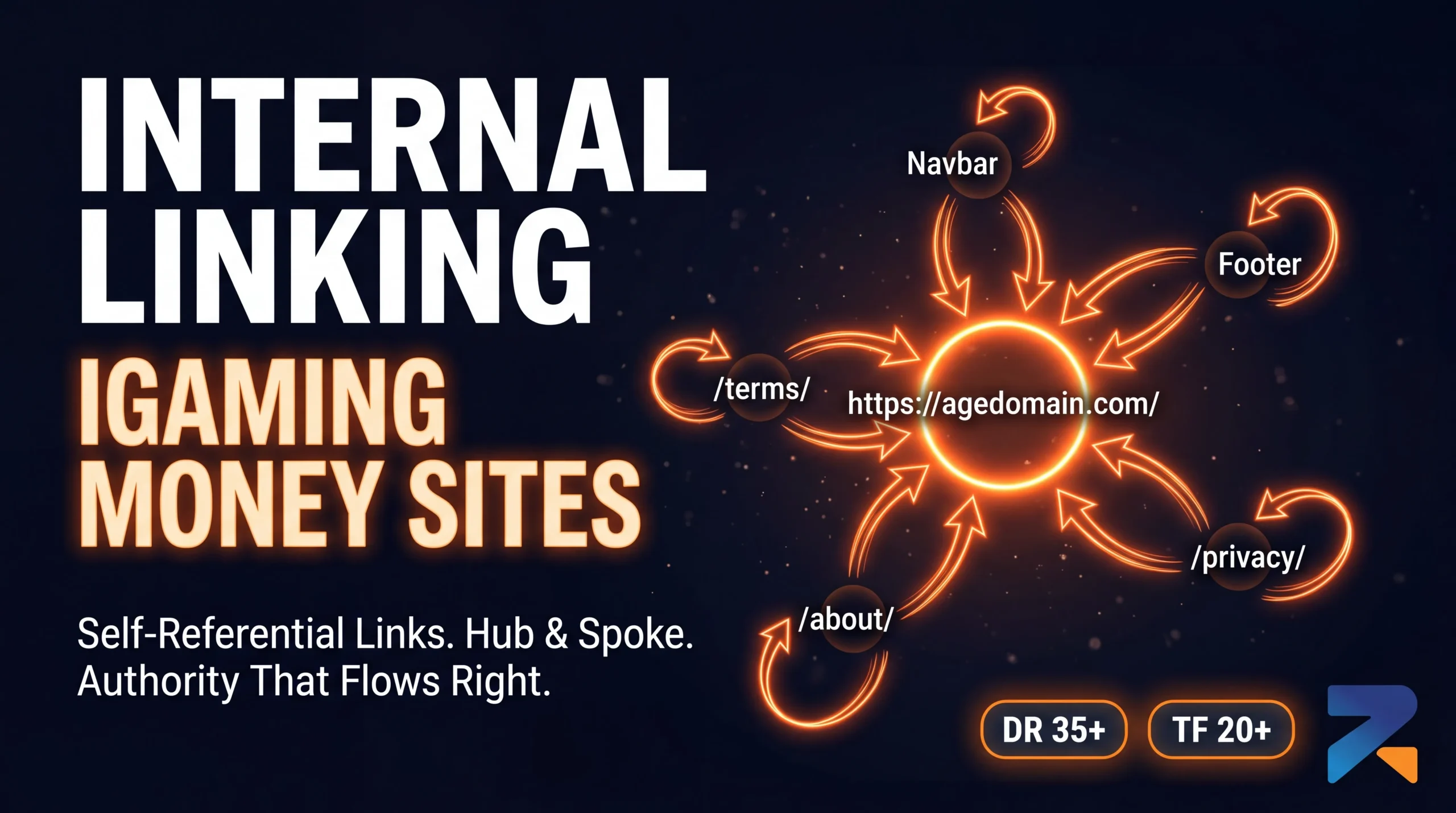

Internal linking is the most underestimated lever in iGaming SEO. Everyone obsesses over backlinks, aged domains, anchor text ratios — and then deploys a money site where the link structure is a complete mess. Or worse, a single-page setup where nobody thought about internal linking at all because “there’s only one page.”
Both situations cost rankings. The first bleeds authority. The second misses a deliberate signal amplification opportunity that competitors are already using.
This covers how internal linking actually works in iGaming money sites — from multi-page affiliate setups to single landing pages where the only internal link that matters points straight back to itself.
Why Internal Linking Hits Different in iGaming
In a standard niche site, internal linking is mostly about distributing PageRank from the homepage down to category and article pages. The logic is hierarchical: authority flows top-down.
iGaming doesn’t always work like that.
A lot of operators run flat structures. One page, all the authority, all the conversion. Or a money site with 5–10 pages max where the homepage IS the ranking page. In these setups, the conventional internal linking playbook — point everything to your deepest pages — doesn’t apply. You need a different framework.
What internal links do in iGaming specifically:
- Signal topical relevance to Google by connecting pages that share keyword context
- Concentrate authority on one target URL instead of spreading it thin
- Pass anchor text signals that reinforce what your target page should rank for
- Reduce crawl budget waste on thin or duplicate content
Every one of these matters more on an aged domain than a fresh one. You bought that domain because it carries authority built over years of legitimate use. Internal linking determines where that authority actually lands.
The Single-Page Money Site: Self-Referential Internal Linking
Here’s the scenario most guides ignore completely.
You’re running a single-page iGaming money site. The setup looks like this:
- Root domain:
https://agedomain.com/ - That URL is your money page — casino review, bonus landing, or geo-targeted ranking page
- No blog, no sub-pages, no categories
The standard internal linking advice doesn’t apply because there’s nothing else to link to. So most operators do nothing. They focus on backlinks and forget internal signals entirely.
That’s a mistake. Because the page can link to itself.
How Self-Referential Links Work
A self-referential internal link is exactly what it sounds like — a link inside https://agedomain.com/ that points back to https://agedomain.com/ with a keyword anchor text.
This isn’t accidental navigation. It’s a deliberate on-page signal. Google crawls the page, reads the anchor text on those links, and uses that information to reinforce what the URL should rank for.
Operators who’ve been running iGaming single-page setups for years do this consistently. Most people who are new to the setup don’t even realize it’s happening.
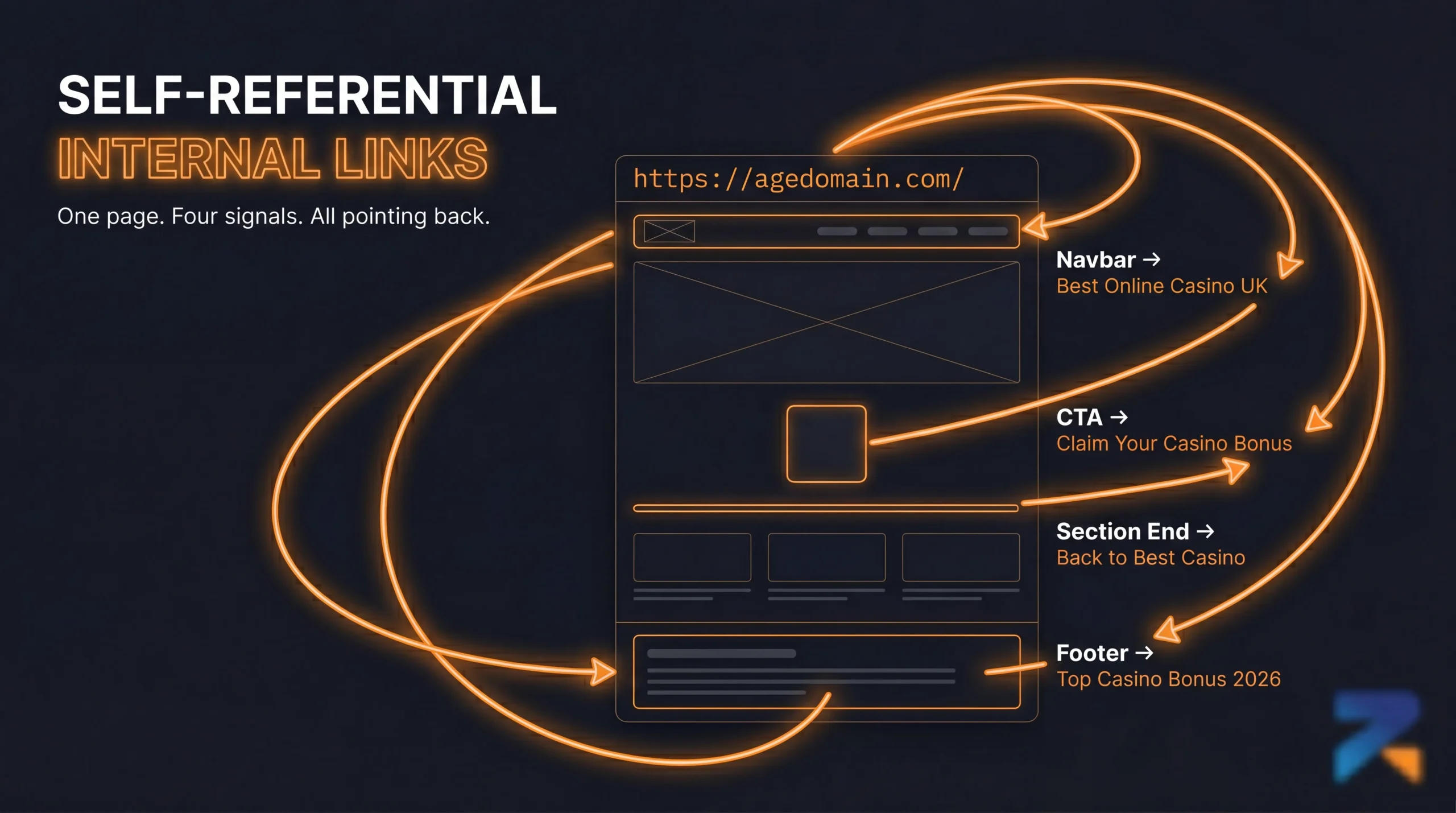
Here’s where these self-referential links typically live on a single-page money site:
Navigation bar The logo or site name in the navbar links to https://agedomain.com/ — standard practice. But the mistake is leaving the anchor as just the brand name or an image with no alt text. Use keyword anchor text here. “Best Online Casino” as the nav link pointing to the root URL is a clean self-referential signal right at the top of the page.
In-content CTA buttons Most single-page casino sites have multiple CTA buttons throughout the page — “Play Now,” “Claim Bonus,” “Get Started.” Those buttons are links. If any CTA is designed to scroll back to the top or link back to the homepage itself, that anchor text is a free keyword signal. Don’t waste it on “Click Here.”
Footer links The footer of https://agedomain.com/ almost always contains a link back to the homepage. Most operators use “Home” or the brand name. That’s a missed opportunity. Use your target keyword as the anchor. “Best Online Casino Bonus 2026” in the footer pointing to https://agedomain.com/ is a self-referential link Google picks up every time it crawls.
In-page section anchors If your single page uses jump navigation — “About Us,” “Games,” “Bonuses,” “FAQ” as section links — those are typically anchor links (#section). But you can add a separate “Back to top” or “Return to main” link at the bottom of each section that points to the full URL https://agedomain.com/ rather than just #top. Same destination, but Google reads the full URL link differently from a fragment anchor.
Real Example
Your money page is https://agedomain.com/ targeting “best online casino UK.”
On that same page:
Navbar:       [Best Online Casino UK]      → https://agedomain.com/

Footer:       [Top Casino Bonus UK 2026]   → https://agedomain.com/

Section end:  [Back to best online casino] → https://agedomain.com/

CTA button:   [Claim Your Casino Bonus]    → https://agedomain.com/
Four self-referential links. Four different anchor variants. All from within the same page, all pointing at the same URL. Google crawls https://agedomain.com/ and sees a page that is consistently signaling its own topical relevance through its own link structure.
That’s not over-optimization. That’s deliberate on-page architecture.
What Anchor Variants to Use
Don’t repeat the same anchor across every self-referential link. Vary them:
- Primary keyword exact match → one instance, usually the navbar
- Close variant or modifier → footer
- Generic + keyword blend → CTA or section link
- Brand name → logo alt text or one supporting link
Four links, four variants, zero external backlink budget spent.
Utility Pages: The Second Layer of Self-Referential Signals
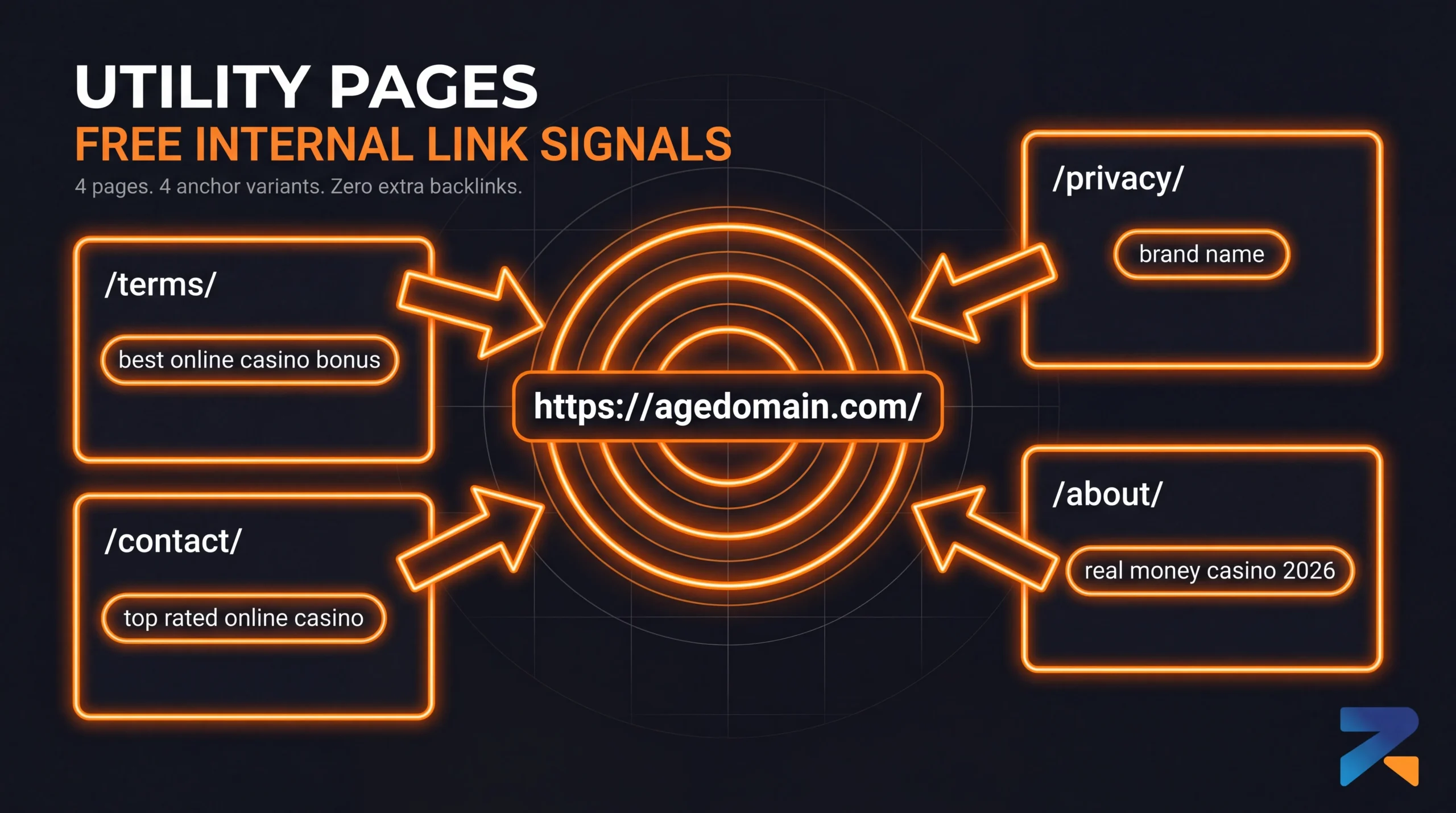
Beyond the money page itself, if you have any secondary pages — /terms/, /contact/, /about/, /privacy/ — every one of them should link back to https://agedomain.com/ with keyword anchor text.
Most operators treat utility pages as throwaway real estate. They’re not. They’re crawlable pages Google indexes, and every one of them is a free internal link opportunity pointing at your money URL.
Example setup:
/terms/footer → “best online casino bonus Canada”/contact/footer → “top rated online casino”/about/footer → “real money casino 2026”/privacy/footer → brand name or URL
Four pages, four different anchor variants, all pointing to https://agedomain.com/. Clean internal link profile, multiple keyword variations reinforced — zero additional backlinks required.
How Internal Links Flow on a Multi-Page iGaming Money Site
Once you have more than a handful of pages, the framework shifts. The goal isn’t to link everything to everything — it’s to create a deliberate authority funnel.
The Hub-and-Spoke Model
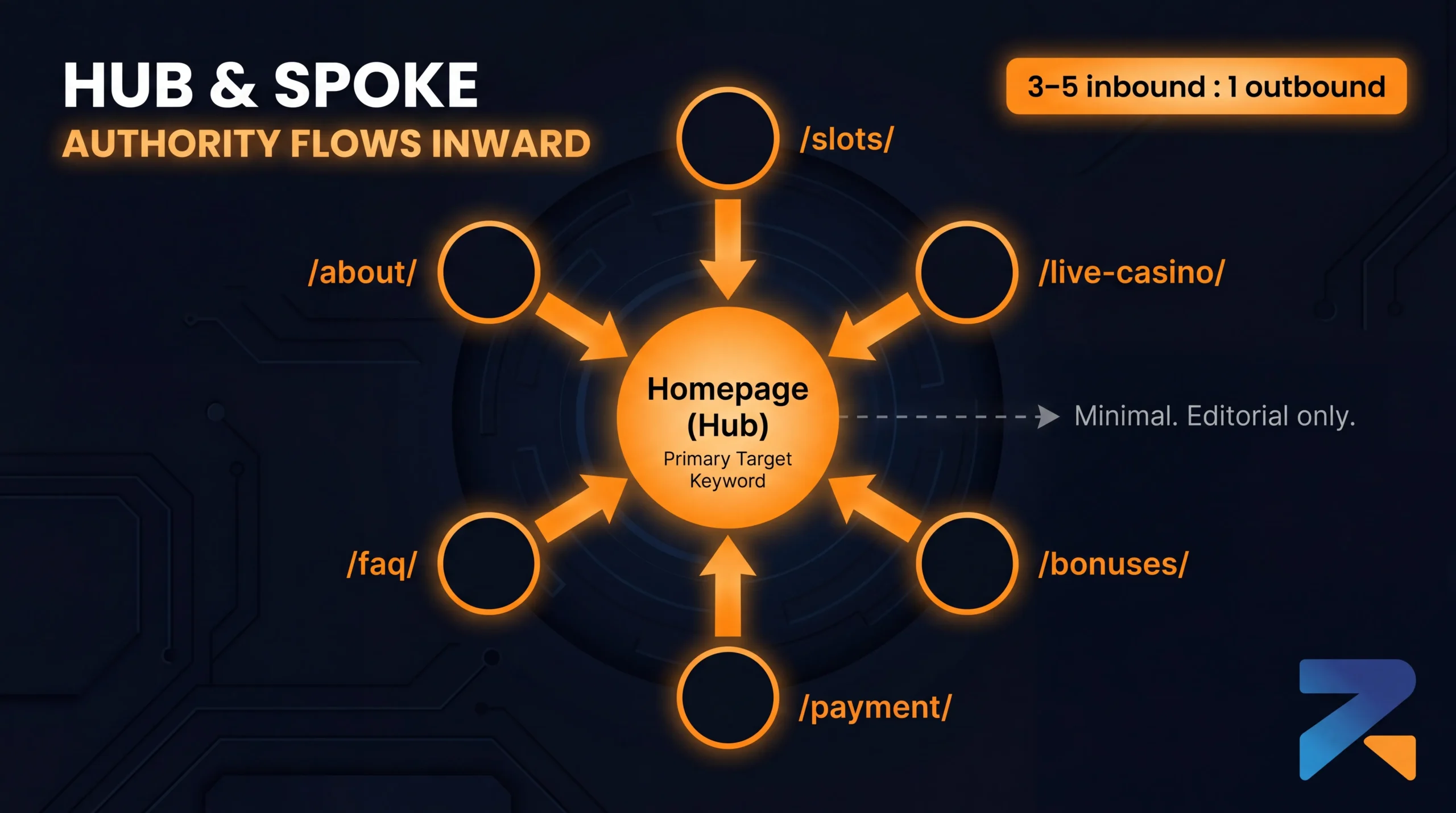
Before you decide on link structure, make sure you’ve already picked the right deployment model for your money site. The cleanest structure for iGaming money sites is hub-and-spoke. Your homepage or primary ranking page is the hub. Supporting pages are spokes. Links flow inward, not outward.
Hub page examples:
- Homepage targeting “best online casino UK”
- A dedicated bonus page targeting “welcome bonus casino 2026”
- A geo page targeting a specific market
Spoke pages examples:
- Game review pages (slots, live casino, poker)
- Payment method guides
- FAQ or how-to pages
Every spoke page links back to the hub with contextual anchor text. The hub links to spokes only when it makes sense editorially — not as a mechanical distribution exercise.
The ratio operators usually run: 3–5 spoke-to-hub links for every 1 hub-to-spoke link. You’re always pushing authority up, not bleeding it down.
Silo Structure for Broader iGaming Sites
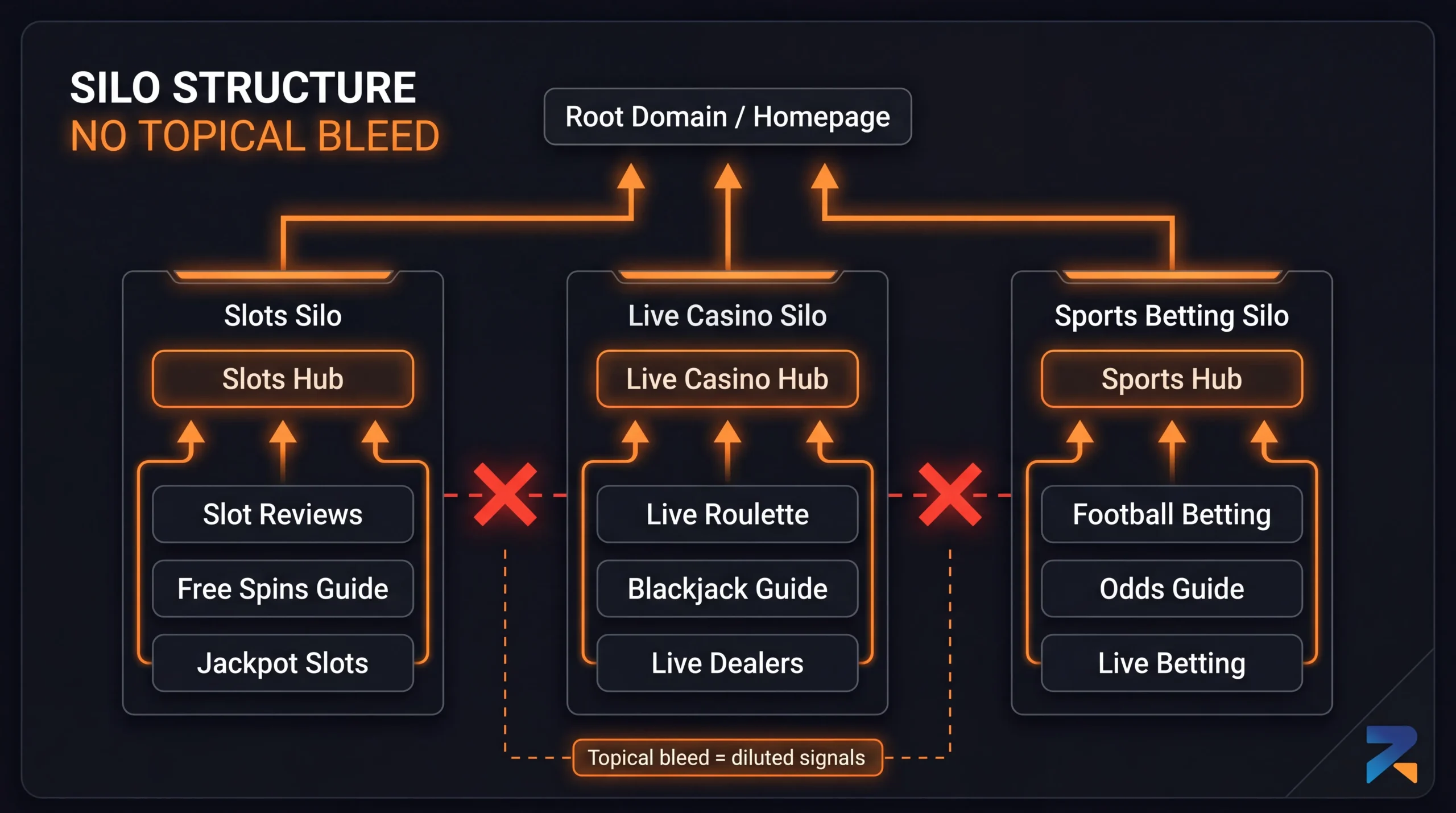
If you’re running a full affiliate site — multiple game categories, multiple geo targets — siloing prevents topical bleed.
A slot games silo should not freely link into a live casino silo. Keep related content in closed clusters, with each cluster pointing to its own category hub, and category hubs pointing to the root.
This matters because iGaming keyword clusters have very different topical profiles. “Online slots UK” and “live roulette UK” are related but not the same. Google’s internal topic modeling picks up cross-linking between unrelated clusters and it dilutes the topical signal.
Operators destroy good rankings doing exactly this — building a well-structured slots section, then haphazardly linking it to their sports betting pages because “it’s all gambling.” It’s not the same topic to Google.
Anchor Text in Internal Links: The Rules Are Different Here
For external backlinks, you manage anchor text ratios carefully — too many exact match anchors and you trigger over-optimization flags. For internal links, the calculus is different.
Internal links carry weaker individual signals than external links. That means you can use exact match anchor text more aggressively internally without the same penalty risk.
What that means in practice:
- Internal links to your target page: 60–70% exact match or close variants
- Remaining 30–40%: URL anchors, brand name, generic navigational text
This applies whether you’re working with self-referential links on a single-page setup or spoke-to-hub links on a multi-page site. The same logic holds.
Common Internal Linking Mistakes in iGaming
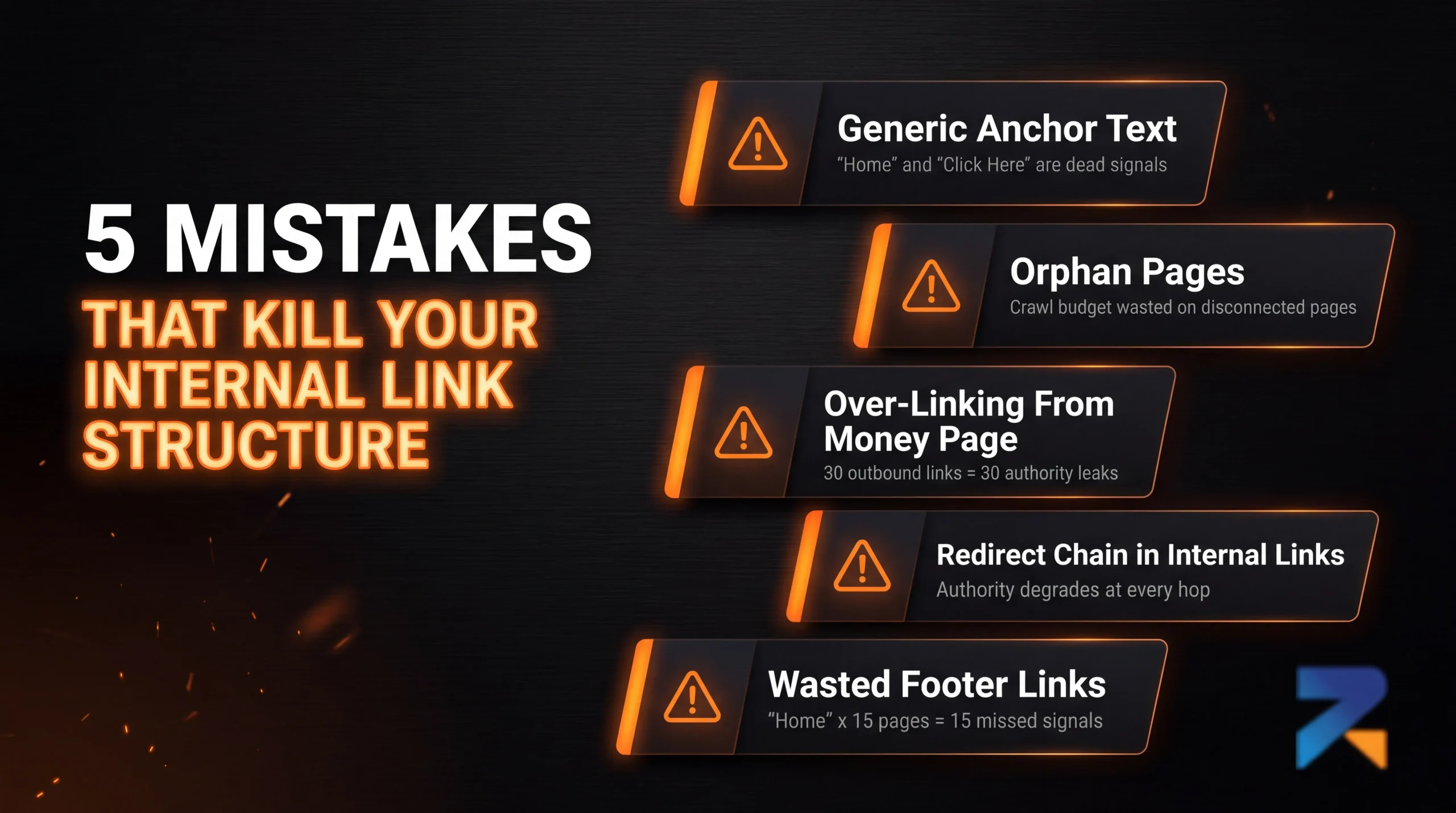
1. Self-referential links with generic anchors
The navbar links to the homepage with “Home.” The footer says “Back to top.” The logo has no alt text. All three are self-referential links with zero keyword signal. Every one of those is a wasted opportunity on a single-page money site. Fix the anchor text — that’s all it takes.
2. Orphan pages that eat crawl budget
Thin pages — placeholder FAQs, under-construction categories, payment guides with 150 words — that aren’t connected to anything are crawl waste. Either link them into your structure properly or noindex them. Leaving them unlinked doesn’t make them invisible. It just makes them useless while still consuming crawl resources.
3. Over-linking from the money page
Your homepage or primary ranking page should not have 30 outbound internal links. Every link you add is a potential authority leak. Keep outbound internal links from hub pages to under 10. Every click path away from your money page is a conversion and authority drain.
4. Not updating internal links after a redirect
If you’ve done a 301 from a supporting domain into your money site, and that redirected URL is still in your internal link map, you’re creating a redirect chain. Google follows it, but authority transmission degrades at each hop. Update those links to point directly to the live destination URL.
5. Wasting footer links on navigation
A sitewide footer link on a 15-page site pointing back to your homepage with exact match anchor text is 15 internal links with consistent anchor signals. Most operators use “Home.” That’s 15 wasted signals. Use your target keyword.
What a Clean Internal Link Map Looks Like
Single-page money site — self-referential setup:
https://agedomain.com/  ← Money page


  Within the page itself:

    Navbar      → [Best Online Casino UK]      → https://agedomain.com/

    Footer      → [Top Casino Bonus 2026]      → https://agedomain.com/

    Section end → [Back to best casino]        → https://agedomain.com/

    CTA         → [Claim Casino Bonus]         → https://agedomain.com/


  From utility pages:

    /terms/     → [best online casino bonus]   → https://agedomain.com/

    /privacy/   → [brand name]                 → https://agedomain.com/

    /contact/   → [top rated online casino]    → https://agedomain.com/

    /about/     → [real money casino 2026]     → https://agedomain.com/
Multi-page iGaming money site:
Homepage (hub — primary target keyword)

    ↑ from /slots/        → "best online casino games"

    ↑ from /live-casino/  → "top casino online"

    ↑ from /bonuses/      → "casino welcome bonus"

    ↑ from /payment/      → brand + URL

    ↓ to /slots/, /live-casino/, /bonuses/ (minimal, editorial only)
Practical Takeaway
Before you scale external backlinks, make sure your internal linking is already dialed in. Most operators do it the other way around and wonder why the links aren’t moving rankings.
If you’re running a single-page money site right now, do these four things this week:
- Check every link on the page that points to
https://yourdomain.com/— navbar, footer, CTAs, section links. Count them. Then check every anchor. If any say “Home,” “Click Here,” or nothing at all, fix them to keyword anchor variants. - Audit every utility page — terms, privacy, contact, about. Do they all link back to the homepage with keyword anchor text?
- Make sure no two pages use the exact same anchor pointing to the root URL. Vary them.
- If you don’t have a FAQ page, build one. Five questions, 100 words each, with one internal link per answer back to
https://yourdomain.com/using a different anchor variant each time.
Internal linking is one of the few things in iGaming SEO that’s entirely in your control and costs nothing to fix. Most operators sleep on it because it’s not as exciting as buying domains or building backlink packages. That’s exactly why getting it right is still a real competitive edge.
If you’re building this kind of setup on an aged domain — and want a domain with clean authority that this structure can actually amplify — Rexusdomain has a vetted inventory built specifically for iGaming operators.
Related Guides
Sources & Further Reading
Frequently Asked Questions
How should I structure internal linking on an iGaming money site built on an aged domain?
Build a hub-and-spoke internal link architecture: a central hub page (casino reviews or sports betting guide) links to all spoke pages (individual casino reviews, game guides, bonus pages). Each spoke links back to the hub and to 2-3 related spokes. This flat structure distributes PageRank efficiently and ensures link equity from aged domain authority flows to all key landing pages within 2-3 internal link steps from the homepage.
How many internal links should a page on an iGaming site have?
Target 5-15 contextual internal links per page for iGaming content, plus 3-8 navigation links in header and footer. Pages under 1,000 words should have 3-8 internal links; pages over 2,000 words support 10-20. Avoid excessive internal linking (50+ links per page) as it dilutes individual link equity and signals doorway page patterns. Quality of contextual anchor text matters more than link quantity for distributing authority.
What anchor text should I use for internal links on an iGaming site?
Use descriptive, keyword-varied anchor text for internal links on iGaming money sites. Include: (1) exact keyword anchors for 20-30% of links to priority pages; (2) partial-match variations for 30-40%; (3) descriptive branded anchors (read our casino review, see full bonus guide) for 30-40%. Avoid identical anchor text on multiple internal links pointing to the same page — varied anchors send stronger topical signals and avoid over-optimisation flags.
Should aged domain inherited authority affect my internal link priorities?
Yes. On a site rebuilt on an aged domain, prioritise passing authority from the pages inheriting the most aged link equity to your highest-value landing pages. Use Ahrefs to identify which legacy URLs had the most referring domains (if you maintained original URL structure). Create internal links from those high-authority inherited pages to your target keyword landing pages to flow authority directly to money pages rather than diluting it across less important content.
Does siloing content help iGaming sites built on aged domains?
Content siloing (grouping casino, sports betting, poker, and live dealer into distinct sections with cross-links limited within silos) reinforces topical Trust Flow on aged domains for iGaming. It tells Google each section has concentrated expertise rather than diluted authority across all gambling topics. For sites with aged domain authority in multiple gambling sub-niches, siloing amplifies existing topical TF rather than averaging it across the whole domain.
How often should I audit internal links on an iGaming money site?
Audit internal links quarterly and immediately after any structural changes (new category additions, URL consolidations, content pruning). Use Screaming Frog to crawl for broken internal links (404 targets), redirect chains (301 through 301), and orphan pages (no incoming internal links). Orphan pages on iGaming sites fail to receive authority from the aged domain foundation — identify and link them from relevant hub pages to activate latent equity.