
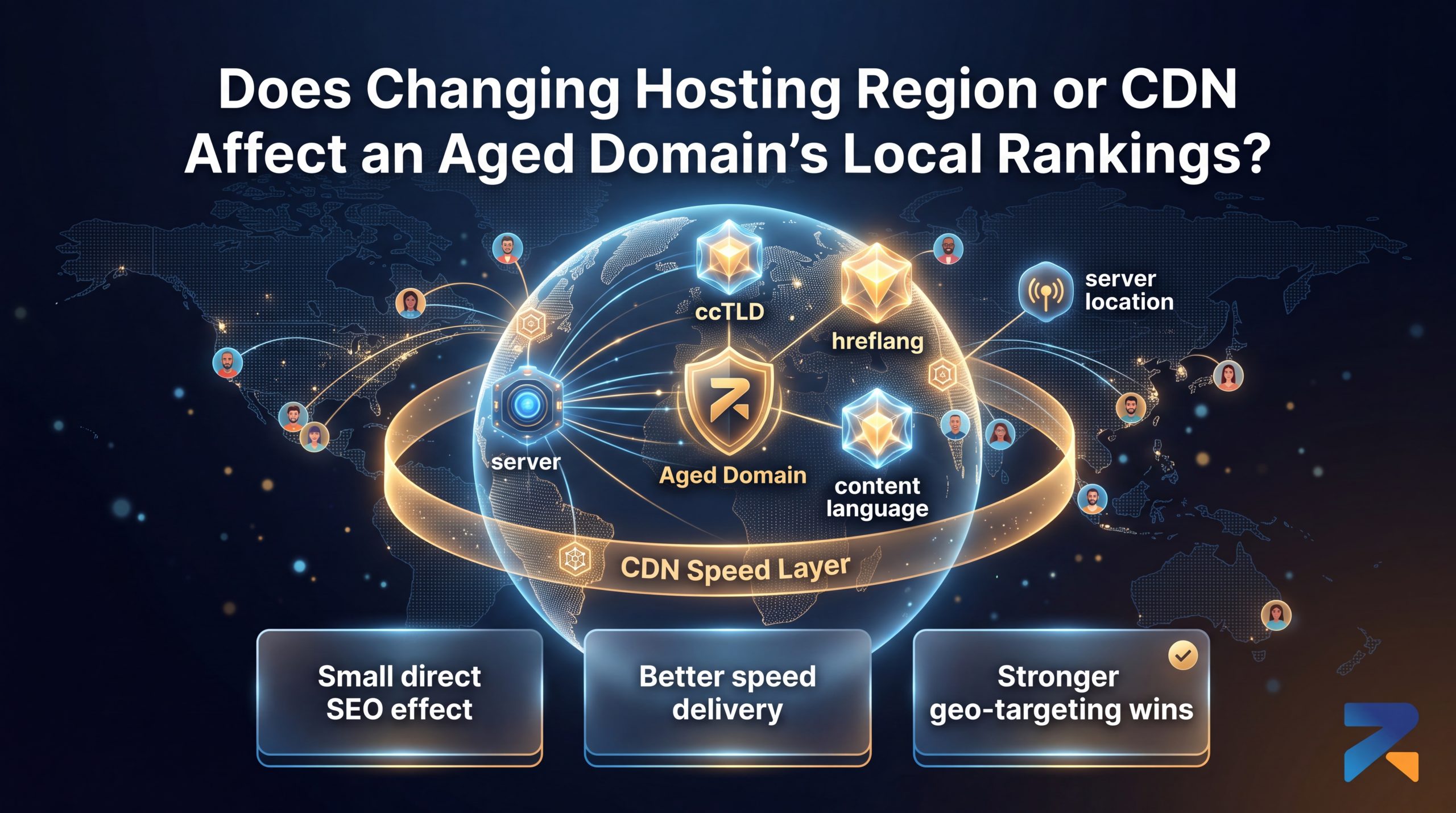

Does Changing Hosting Region or CDN Affect an Aged Domain’s Local Rankings?
Minimally for most sites — server location has a small effect on rankings that’s mostly neutralized once a CDN is involved, and Google relies far more heavily on the domain’s ccTLD, hreflang implementation, and content language or targeting signals than on where the origin server or CDN edge node physically sits.
Last updated: September 2026.
What Google Has Said About Server Location and Geo-Targeting
Google’s own documentation lists server location as one of several signals it can use to infer a site’s target country, but explicitly ranks it below stronger signals like a ccTLD, explicit geo-targeting configuration, and content language. In practice, once a site sits behind a CDN — which nearly every modern site does — the origin server’s physical location becomes even less relevant, since the CDN serves cached content from edge locations near the visitor regardless of where the origin server lives.
Where Hosting Location Still Has a Measurable Effect
- Page load speed for uncached requests. If a visitor’s request has to travel to a distant origin server (for dynamic content a CDN can’t cache), physical distance adds real latency, which can affect Core Web Vitals metrics like Time to First Byte.
- Weak or absent geo-targeting signals elsewhere. For a generic TLD (.com, .net) with no explicit geo-targeting setup and multilingual or ambiguous content, server location becomes a slightly more meaningful tiebreaker signal than it would be for a site with clear geo-targeting already in place.
- Regulatory or data residency requirements, which are a legal consideration for certain industries and jurisdictions, entirely separate from any SEO effect.
What Actually Drives Local Rankings for an Aged Domain
- A ccTLD registered for the target country, if applicable, remains one of the strongest and most automatic geographic signals available.
- Correct hreflang implementation for multi-region or multilingual content tells Google explicitly which version serves which audience.
- Content language and locale-specific details (currency, local references, regional terminology) reinforce which market a page is actually built for.
- A CDN with edge nodes near your target audience improves load speed for that audience regardless of where the origin server sits, addressing the performance angle without needing to relocate hosting entirely.
Frequently Asked Questions
Does moving an aged domain’s hosting to a different country hurt its local search rankings?
Not significantly on its own. Server location is a minor signal Google can use to infer geographic targeting, but it’s outweighed by stronger signals like ccTLD, hreflang, and content language.
Does using a CDN eliminate any SEO effect from server location?
It significantly reduces the effect for cached content, since a CDN serves visitors from edge locations near them regardless of the origin server’s location. Only uncached, dynamic requests still depend on origin server distance.
Should I move hosting closer to my target market for a local SEO boost?
It’s rarely the highest-leverage move. Prioritizing ccTLD selection, hreflang setup, and content localization typically has a larger impact on local rankings than hosting location alone.
Can server location affect Core Web Vitals on an aged domain?
Yes, for uncached or dynamic requests specifically — physical distance between visitor and origin server adds latency that can affect metrics like Time to First Byte, though a CDN largely mitigates this for cacheable content.
Related Guides
Sources & Further Reading