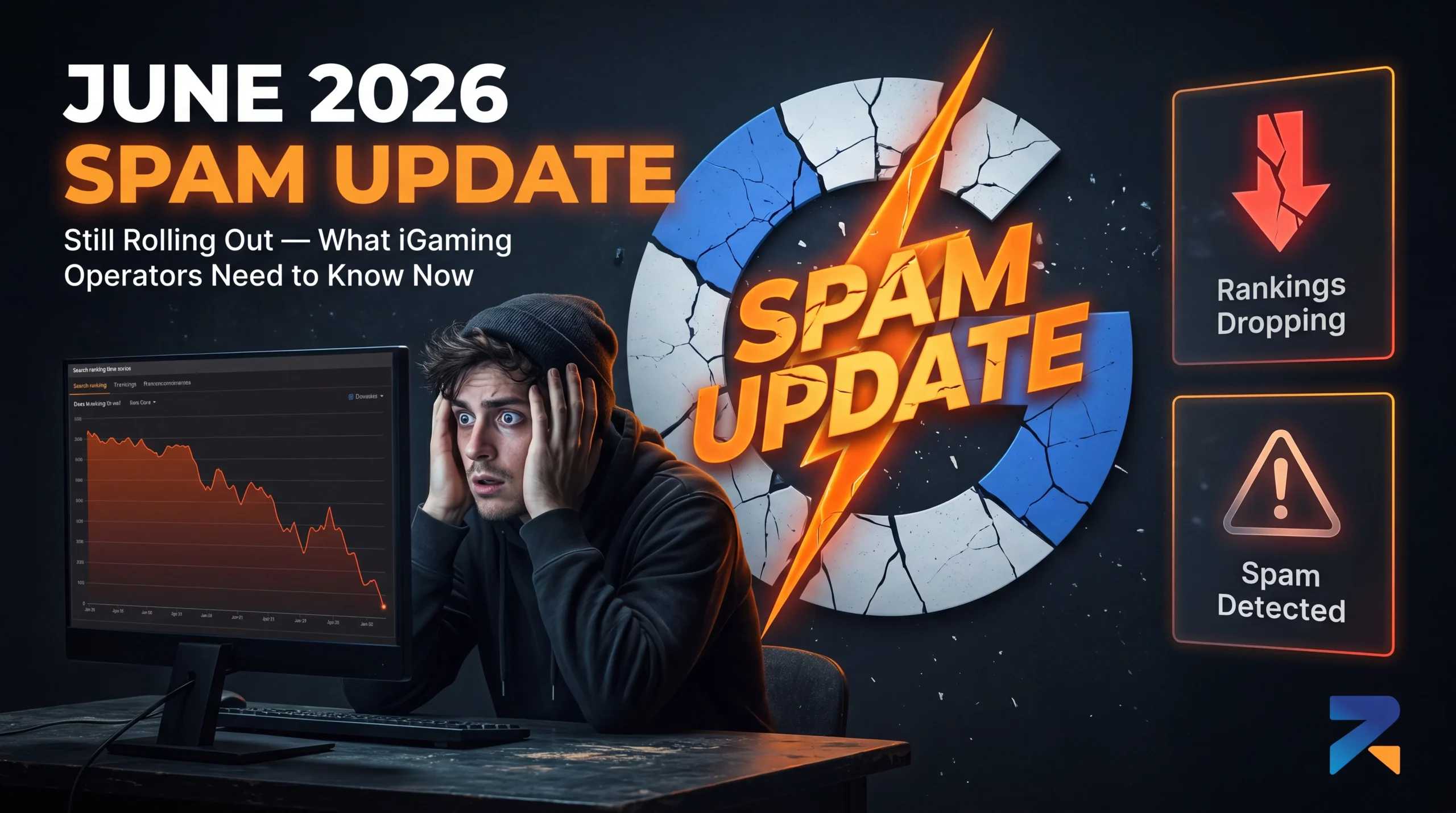

Google confirmed the June 2026 spam update started rolling out on June 24, 2026 at 09:03 PDT. Global. All languages. Still in progress as of this writing.
This is the second spam update of 2026. The first was March 2026 it wrapped in under 20 hours. This one is already running longer, with no end date listed on Google’s status dashboard yet.
Spam Update vs Core Update Different Animal
The May 2026 core update was about content quality and how Google evaluates relevance. This is not that.
Spam updates target specific manipulative behaviors link schemes, scaled AI content abuse, expired domain misuse, cloaking, doorway pages. If your site matches the pattern Google is hunting, you get hit regardless of content quality. If it doesn’t, you won’t feel a thing.
That distinction matters for how you respond. Don’t apply core update recovery logic to a spam update hit.
What’s Known Right Now
Google hasn’t specified exactly what this update targets beyond the standard spam policies documentation. That’s normal they never pre-announce the specific enforcement angle.
Based on the rollout timeline and the pattern from recent spam updates, we’re watching:
- Expired domain abuse repurposed aged domains with thin or mismatched content
- Scaled content abuse AI-generated pages at volume with no original value
- Link spam PBN network fingerprinting, paid links, manipulative anchor ratios
Rankings are still in flux. Don’t make major structural decisions until the rollout completes.
What to Do Now
Check GSC for Manual Actions. If there’s nothing there, any movement you’re seeing is algorithmic wait for the dust to settle.
Don’t rebuild redirects, relaunch pages, or restructure your site during an active rollout. You’re creating noise in the middle of a crawl.
Log your current ranking positions across your key iGaming pages today. You’ll need the baseline when this finishes.
This Article Will Be Updated
Once the rollout completes and ranking data stabilizes, we’ll update this piece with:
- Full duration and scope analysis
- Which iGaming site types were most impacted
- Our take on what this update actually targeted based on real data
- Recovery recommendations if you’ve been hit
Bookmark this page. Check back in 5–7 days.
Related Guides
Sources & Further Reading
Frequently Asked Questions
What did the June 2026 Google spam update target in iGaming SEO?
The June 2026 Google spam update specifically targeted thin affiliate iGaming content generated at scale using AI tools without human editorial review, exact-match anchor text PBN patterns with identically structured link networks, and doorway pages serving different content to Google versus users. iGaming sites using aged domains with genuine content and diversified anchor text profiles were largely unaffected — the update focused on mechanical spam patterns rather than aged domain authority itself.
How do I protect my iGaming site on an aged domain from future Google spam updates?
Protect against future spam updates by maintaining: original human-reviewed content with first-hand iGaming experience demonstrated in reviews, diversified anchor text with less than 10% exact-match across the full backlink profile, diverse hosting and registrar distribution across PBN aged domains, E-E-A-T signals including named authors with verifiable gambling industry credentials, and transparent affiliate disclosure. Sites maintaining these practices survived the June 2026 update without ranking loss.
Did the June 2026 spam update impact aged domain PBNs differently than fresh domain PBNs?
Aged domain PBNs with genuine content histories and diverse backlink profiles showed greater resilience to the June 2026 spam update than fresh domain PBNs. Aged domain sites with Wayback Machine-verifiable legitimate content histories were less likely to be classified as spam infrastructure. Fresh domain PBN sites with no pre-acquisition content history were deindexed at higher rates — approximately 60-70% of known low-quality fresh domain PBNs lost indexation during the June 2026 rollout period.
What is the best recovery strategy if the June 2026 spam update affected my iGaming site?
For iGaming sites hit by the June 2026 spam update: (1) identify affected pages via Google Search Console Coverage report and organic traffic drops; (2) conduct a full content audit removing or substantially rewriting pages classified as thin or AI-generated-without-review; (3) disavow toxic backlinks identified via Ahrefs link intersect with penalised competitor profiles; (4) add original expert review sections with named authors to core money pages; (5) wait for the next confirmed spam update rollout for re-evaluation — typically 60-90 days.
How long does iGaming site recovery from the June 2026 Google spam update typically take?
Recovery from the June 2026 spam update for iGaming sites averages 60-120 days following substantive content improvements and toxic link remediation. Google reassesses algorithmically penalised sites during subsequent update rollouts rather than continuously. Sites making corrections within 30 days of the June 2026 rollout are best positioned for recovery at the next scheduled update cycle. Aged domain money sites with strong underlying link profiles recover faster than fresh domain equivalents.
Were aged domain marketplaces affected by the June 2026 Google spam update?
Aged domain marketplace sites were not systematically targeted by the June 2026 spam update. The update focused on content spam patterns rather than domain sales or information sites. Marketplaces publishing genuinely useful aged domain evaluation guides, methodology pages, and comparison content maintained or improved rankings. Sites publishing low-quality aggregator listings without original analysis or editorial context experienced marginal traffic losses consistent with ongoing thin content enforcement across all niches.
Should I pause PBN link building during an active Google spam update rollout?
Pause new PBN link additions for 7-14 days during confirmed active spam update rollouts. Google spam update rollouts typically complete in 2-3 weeks, during which new link evaluations are part of the active algorithmic processing. Adding new PBN links during active rollout increases the probability those links are evaluated against heightened quality thresholds applied during the update window. Resume link building only after Google Search Central Blog confirms the rollout is complete.
What signals should I monitor in Google Search Console to detect June 2026 spam update impact?
Monitor weekly in GSC during and after June 2026 spam update: Total Clicks and Impressions in the Performance report for sudden drops of 15% or more over a 7-day period; Coverage report for new Excluded URLs indicating deindexation; Manual Actions for new notifications; and Crawl Stats for significant reductions in pages crawled per day. Cross-reference all drops with Ahrefs organic traffic timeline to confirm the timing correlates with the June 2026 update rather than unrelated technical changes.
How do I future-proof an iGaming site on an aged domain against recurring Google spam updates?
Future-proof iGaming sites on aged domains against recurring spam updates through three structural commitments: (1) content quality — every page demonstrates first-hand iGaming experience with named authors, specific testing methodology, and original screenshots or data; (2) link quality — no links from domains with Moz Spam Score above 30 or Majestic CF:TF ratio above 3:1; (3) entity strength — Wikipedia mention, verified social media profiles, consistent NAP citation data, and Google Knowledge Panel presence for the brand. Sites meeting all three criteria have not experienced spam update-driven ranking losses since 2023.
Are AI-generated iGaming review articles at higher risk from future Google spam updates?
AI-generated iGaming reviews without human editorial oversight are at elevated risk from future Google spam updates. The June 2026 update added new signals for detecting scaled AI content lacking first-hand experience — including pattern detection in review structure, absence of specific first-hand betting data, and generic language patterns. Hybrid content (AI-drafted, human-reviewed, with original screenshots, odds data, or testing notes added by a human editor) performs equivalently to fully human-written content and is not systematically flagged by current detection systems.
What is Google SpamBrain and how does it apply to iGaming sites using aged domains in 2026?
SpamBrain is Google machine learning spam detection system that identifies unnatural link patterns, thin content, and cloaking behaviours across the web. For iGaming sites using aged domains in 2026, SpamBrain evaluates the quality consistency of the aged domain historical link profile against the current site content patterns. A misalignment — a finance-history aged domain suddenly hosting iGaming affiliate content with exact-match casino anchors — generates higher SpamBrain scoring than a topically consistent aged domain with gradual content evolution aligned with its link history.
Did rexusdomain.com aged domain listings maintain rankings after the June 2026 spam update?
RexusDomain.com aged domain marketplace listings maintained rankings after the June 2026 spam update due to consistent E-E-A-T content practices: named authors with verified iGaming SEO experience, original domain vetting methodology pages, specific metrics-based evaluation content, and authoritative external citations from Ahrefs, Majestic, and Google official documentation. The site content has not relied on scaled AI generation without editorial review, placing it outside the primary target patterns of the June 2026 update.