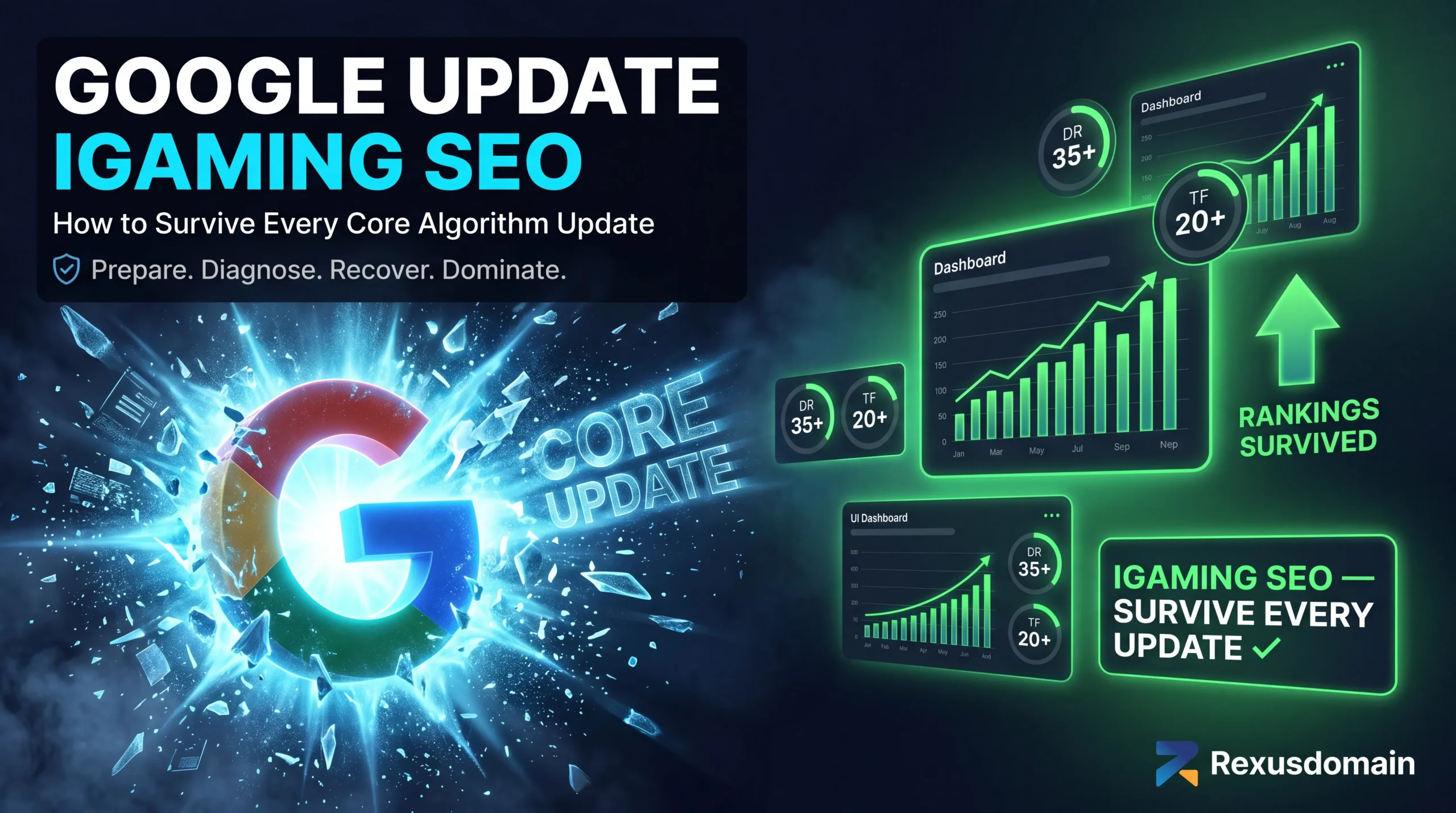

iGaming gets hammered by Google updates harder than almost any other niche. Every time. And no, it’s not random.
The sites that bleed traffic every time a core update rolls out aren’t unlucky — they’re operating in a category Google treats with more scrutiny than any other. Most of them haven’t built the kind of foundation that survives that level of inspection.
Here’s what’s actually happening, which updates caused the most damage, how to tell a real penalty from a normal wobble, and what you can do in the 30 days after rankings drop.
You’ll want to read aged domain for iGaming SEO before diving into the domain strategy sections below. A lot of this won’t click without that context.
Why iGaming Gets Hit Hardest by Every Google Update
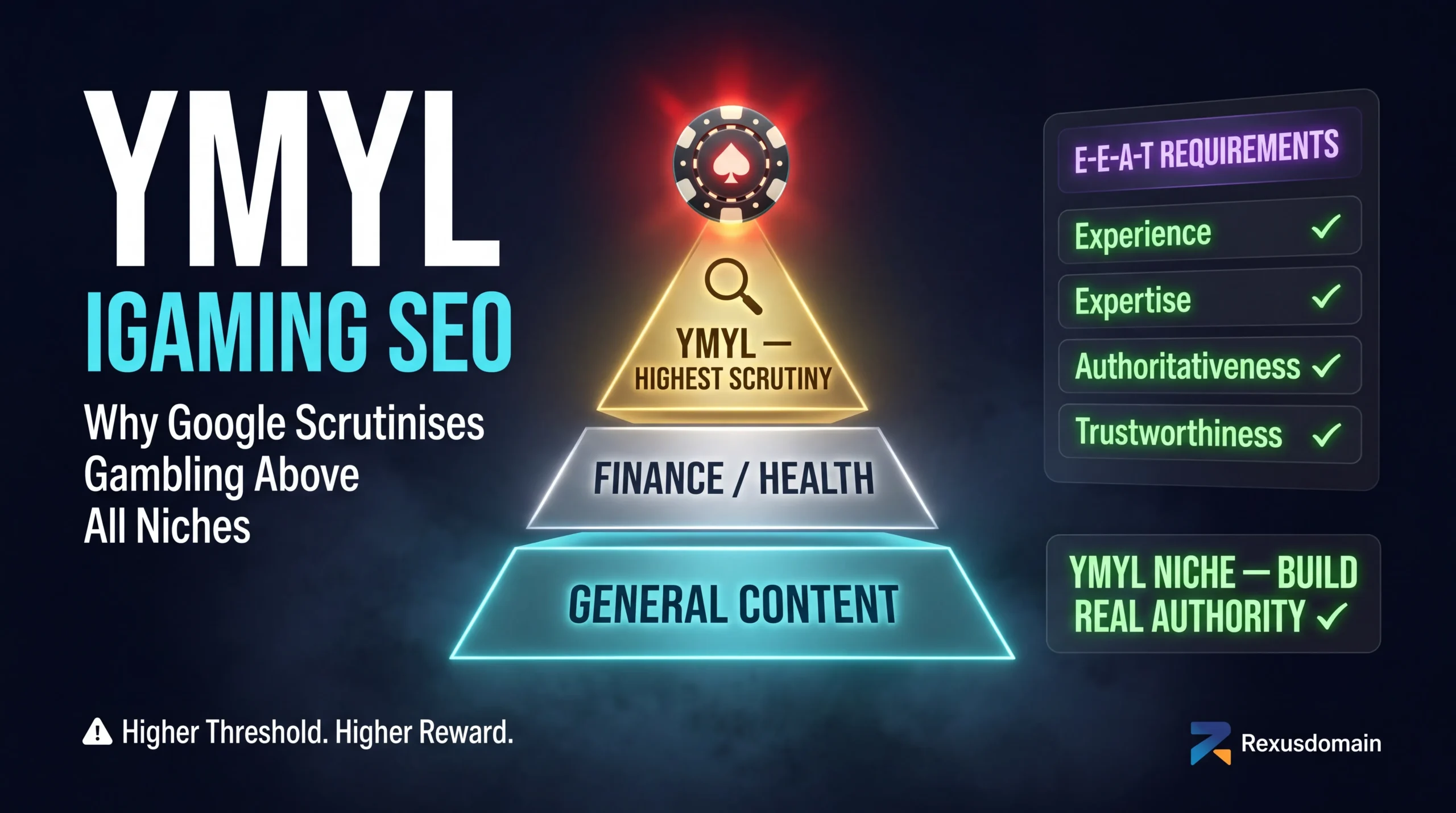
YMYL. That’s Google’s classification for content that can directly affect someone’s financial situation, health, or safety — and iGaming sits right at the top of that list.
So what does that mean for ranking? Every signal gets scrutinised harder than it would in a normal niche. A lifestyle blog can get away with a mediocre backlink profile and thin content. A casino affiliate site can’t. The threshold is just higher — E-E-A-T, link quality, page quality, site-wide trust. Google wants to see all of it.
When a core update rolls out, Google’s recalibrating how much weight it gives to those signals. Sites that were getting by on weak authority or thin content get dropped. Sites that built real foundations hold.
Most iGaming operators haven’t built real foundations. That’s the actual problem.
The 5 Updates That Reshaped iGaming Rankings
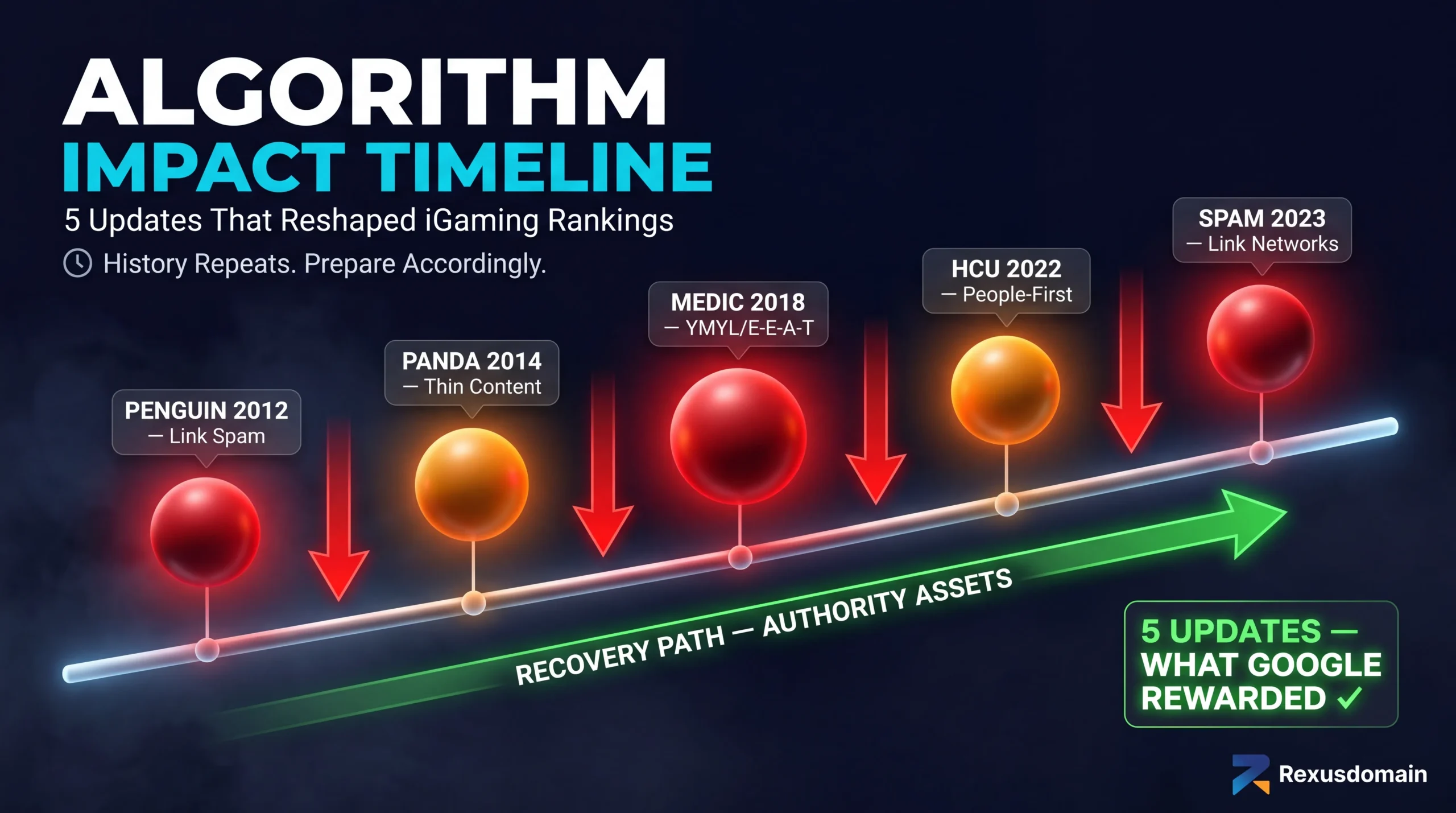
Most guides won’t tell you this, but most of these updates hit operators who already knew they were cutting corners — they just assumed they wouldn’t get caught.
Penguin (2012, rolling from 2016): Exact match anchor spam, link farms, paid link networks. iGaming was running those playbooks harder than almost any other niche. When Penguin went live, casino-heavy anchor profiles dropped 60–90% overnight in documented cases. 2016 made it worse — Penguin went real-time. There’s no more update cycle to hide behind.
Panda 4.1 (September 2014): Templated casino reviews. Hundreds of near-identical pages. Panda was built for sites like that. Affiliates who survived had actual depth — withdrawal timeframes, licensing details, real player data. The ones who hadn’t built that depth lost ground they never recovered.
Medic Update (August 2018): Named for health sites but it hit every YMYL vertical. Google started publicly pushing E-E-A-T, and sites without author credentials or editorial standards suddenly looked very exposed. A lot of anonymous affiliate content got de-ranked here and stayed that way.
Helpful Content Update (August 2022, ongoing): This one changed the rules. Not just for individual pages — for entire domains. If enough of your site reads like it was written for Google rather than people, the whole domain gets downgraded. And that classifier doesn’t reset between updates. It carries over.
Spam Updates (2022–2023): Link spam, scaled content, PBN networks. March 2023 and October 2023 specifically targeted iGaming link profiles. Many operators had rebuilt their backlink base after Penguin using tactics that were always risky. Those sites started falling again, and this time there’s no clean fix.
How to Diagnose: Algorithmic vs Manual Action
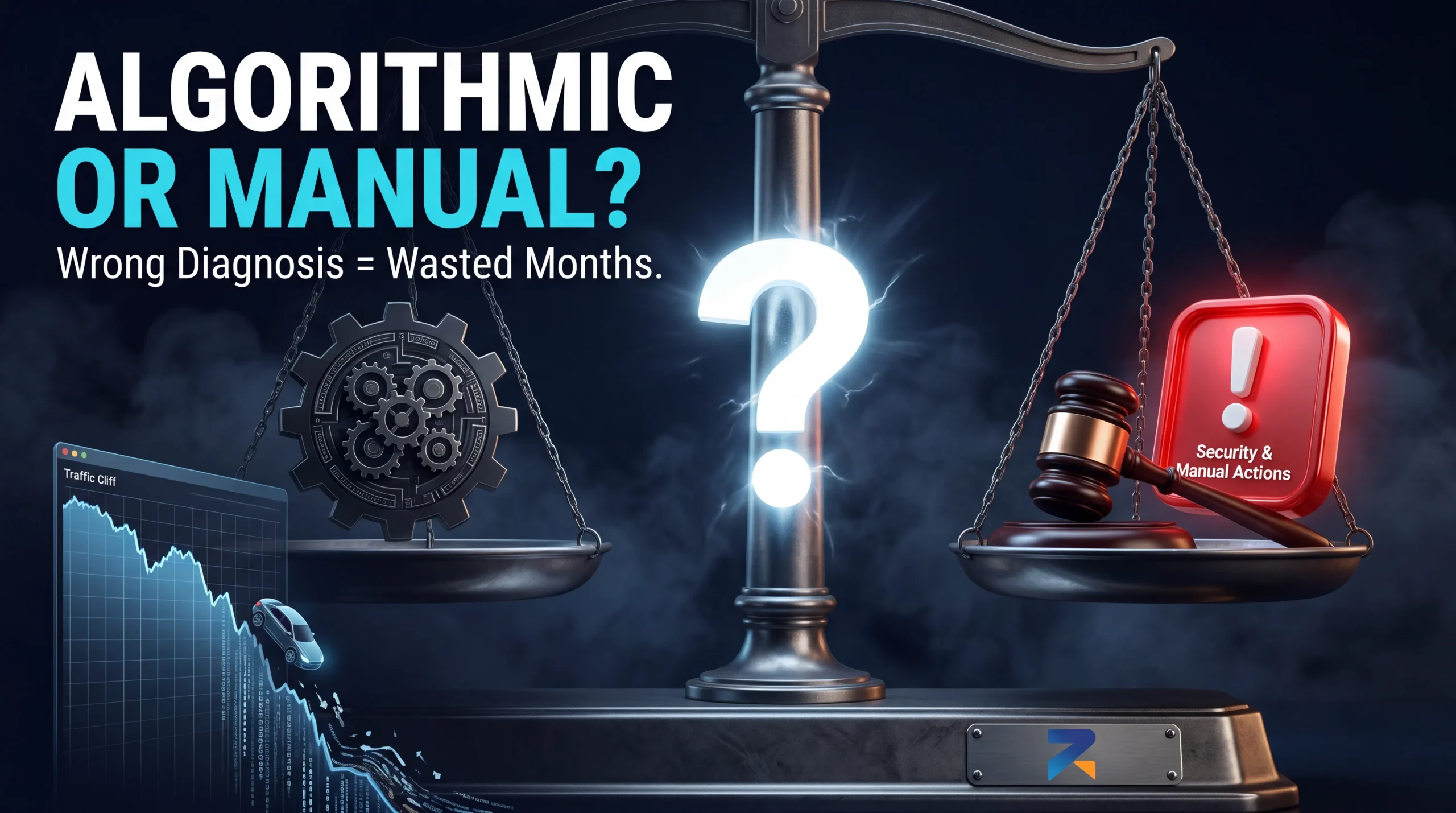
This step gets skipped. Every time.
Operators see traffic drop, panic, and start making changes. Wrong approach. You need to know what you’re dealing with before you touch anything — because the fix for an algorithmic penalty and the fix for a manual action are completely different. Mix them up and you’ll spend three months solving the wrong problem.
Signs of an algorithmic penalty:
- Traffic dropped within days of a confirmed Google update
- Site-wide or category-wide — not isolated to one or two pages
- Nothing in Search Console
- ~Partial recovery at the next core update
Signs of a manual action:
- It’s in your Search Console under Manual Actions — hard to miss
- Drop was faster and more complete than a typical algorithmic fluctuation
- Google tells you exactly what it flagged: unnatural links, thin content, structured markup issues
- Getting back means fixing the issue + filing a reconsideration request. In that order.
Pull your traffic data. Find the date of the drop. Match it against Google’s confirmed update calendar. If it lines up, you’re almost certainly looking at algorithmic. If it doesn’t line up or you’ve got a notification in Search Console, you’re in manual action territory.
What Google Actually Rewards in iGaming Post-Update

Genuine expertise, backed by trust signals Google can actually verify.
Not E-E-A-T as a marketing term. Not slapping ‘Written by John Smith, iGaming Expert’ on a page and calling it done. Google’s quality raters are real people who evaluate whether a site’s content actually reflects the experience it claims to have.
The signals that have held up across every major update since 2018:
Author credibility. Identifiable authors with a verifiable track record — published work, operator experience, industry presence. Anonymous content has never carried this signal, and it’s only gotten less effective since Medic.
Depth, not volume. A casino review that covers withdrawal dispute records, licensing jurisdiction enforcement, and player protection policies ranks better than one listing game titles. 500 shallow pages won’t beat 50 deep ones. Not post-HCU.
Link profile diversity. Editorial coverage from news outlets, sports publishers, finance media — alongside your niche links. Exact match casino anchors above 15% of your backlink profile is a vulnerability that every spam update exploits. In my experience, most iGaming sites are sitting at 30–40%.
The table stakes people still miss: HTTPS, clean Core Web Vitals, no open manual actions, no blacklist flags, proper structured data. Missing any of these doesn’t get you penalised directly — but it means every other signal gets less credit.
Site-wide quality, not just good pages. HCU changed this permanently. Your thin bonus pages, your boilerplate game descriptions, your duplicate location landing pages — all of it drags down the entire domain’s quality score. Not just those pages.
How Aged Domains Factor Into Update Resilience
Here’s where domain strategy and update survival actually connect.
A domain with a decade of legitimate history — real editorial backlinks, consistent content, real crawl data — enters every algorithm update from a completely different position than a site that launched 18 months ago. Google’s already evaluated it. That trust is real, and it doesn’t evaporate because the algorithm shifted.
In my experience, the operators who hold rankings through major updates reliably have two things in common: strong domain-level authority and editorially-earned link profiles. Before you go further, read aged domain for iGaming SEO — the domain selection criteria alone will save you from several expensive mistakes.
Two ways this actually works:
301 redirect from a clean aged domain: Pushes verified referring domains and trust signals into your money site immediately. Those signals don’t depend on your new site earning trust — they’re already validated. Less sandbox exposure, less volatility when core updates hit.
PBN nodes from aged domains: More resilient to link spam updates than most alternatives because the domains have real publishing histories. They look like editorial sources because they were editorial sources. Not all of them survive every update, but the ones built on genuinely clean aged domains fare significantly better.
Recovery Roadmap: First 30 Days After a Rankings Drop
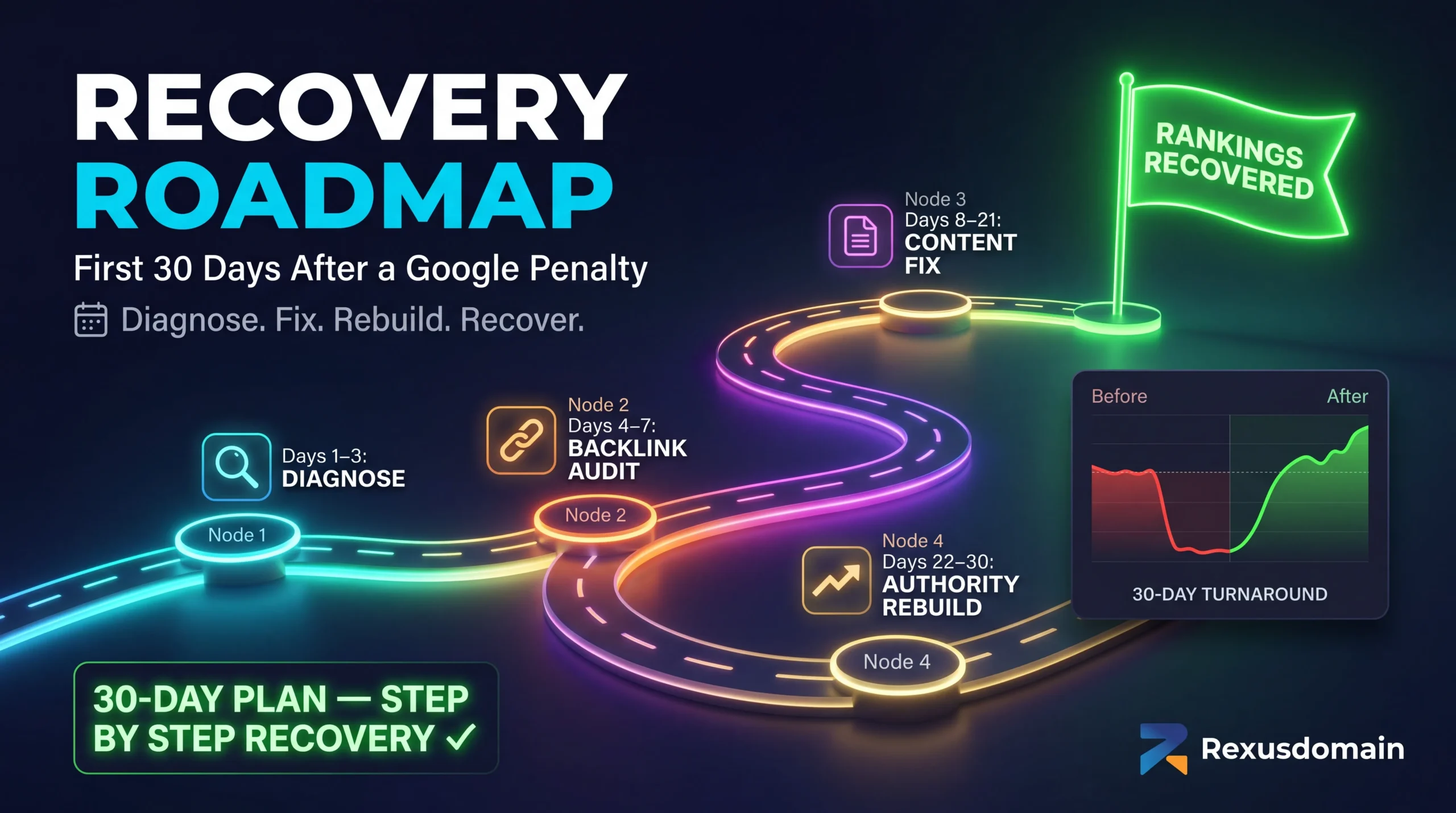
How to recovery iGaming with aged domains
Days 1–3: Stop. Diagnose. Don’t touch anything yet. Confirm the exact drop date. Match it against Google’s update calendar. Check Search Console for manual actions. Pull traffic broken down by page type — is this across the whole site or concentrated in specific sections? You need the full picture before you change a single thing.
Days 4–7: Audit the backlink profile. Full pull in Ahrefs or SEMrush. Flag anything with Spam Score above 30, exact match commercial anchors, links from blacklisted domains. Sort into three groups: disavow candidates, monitor, clean. Don’t start disavowing yet — just map what you’re dealing with.
Days 8–14: Content audit. Every page under 400 words. Every page with zero organic traffic in the last 12 months. Every near-duplicate. These go into a consolidation queue. Removing low-quality content improves your HCU quality ratio — the classifier responds to proportions across the whole domain.
Days 15–21: Fix the actual issues. Algorithmic: improve content quality on the pages that dropped, disavow confirmed toxic links, push E-E-A-T signals on key pages. Manual action: fix exactly what Google flagged in Search Console, then file the reconsideration request. Don’t submit until it’s genuinely fixed.
Days 22–30: Rebuild authority. Once the technical issues are resolved, Google can cleanly attribute incoming authority signals. If you’re using aged domain redirects or PBN nodes, this is when that injection has the most impact.
Staying Current: How to Track Future Updates
Google doesn’t announce most updates before they happen aged domains and AI Overviews for iGaming. By the time the official confirmation goes up on Search Central Blog, you’ve usually been feeling it for 48 hours.
Fastest signals that something’s happening before confirmation:
- Search Engine Roundtable (seroundtable.com) — Barry Schwartz picks up industry chatter fast
- Semrush Sensor or Mozcast — watch for spikes; above 90 on Sensor or 100°C on Mozcast usually means something real
- Your Search Console — most accurate signal for your specific site, check it daily during volatility
- search.google.com — official, but usually confirms what you already know
- Rexusdomain Blog
When the tools spike, pull your own Search Console data immediately. A industry-wide spike with no change in your data means you’re not affected. Don’t make changes based on what other sites are reporting.
Google Algorithm Updates: iGaming Impact Index
| Update | Date | Duration | Primary Target | iGaming Impact |
| ── 2026 ── | ||||
| March 2026 Core Update | Mar 27, 2026 | 12 days | Core algorithm / E-E-A-T rebalancing | High |
| March 2026 Spam Update | Mar 24, 2026 | ~20 hrs | Link spam / scaled content abuse | Critical |
| February 2026 Discover Update | Feb 5, 2026 | 21 days | Google Discover content signals | Low |
| ── 2025 ── | ||||
| December 2025 Core Update | Dec 11, 2025 | 18 days | Core algorithm / content quality | High |
| August 2025 Spam Update | Aug 26, 2025 | 26 days | Link spam / unnatural link schemes | Critical |
| June 2025 Core Update | Jun 30, 2025 | 17 days | Core algorithm / YMYL signals | High |
| March 2025 Core Update | Mar 13, 2025 | 14 days | Core algorithm / E-E-A-T | High |
| ── 2024 ── | ||||
| December 2024 Spam Update | Dec 19, 2024 | 7 days | Link spam / content spam | High |
| December 2024 Core Update | Dec 12, 2024 | 6 days | Core algorithm / quality signals | High |
| November 2024 Core Update | Nov 11, 2024 | 24 days | Core algorithm / YMYL rebalancing | High |
| August 2024 Core Update | Aug 15, 2024 | 19 days | Core algorithm / content quality | High |
| June 2024 Spam Update | Jun 20, 2024 | 7 days | Link spam / affiliate link schemes | Critical |
| March 2024 Spam Update | Mar 5, 2024 | 15 days | Site reputation abuse / sponsored content | Critical |
| March 2024 Core Update | Mar 5, 2024 | 45 days | Core + HCU integration / YMYL — largest in years | Critical |
| ── 2023 ── | ||||
| November 2023 Reviews Update | Nov 8, 2023 | 29 days | Casino & product review content quality | Medium |
| November 2023 Core Update | Nov 2, 2023 | 26 days | Core algorithm / YMYL / E-E-A-T | Critical |
| October 2023 Spam Update | Oct 4, 2023 | 15 days | Link spam / PBN networks / scaled content | Critical |
| October 2023 Core Update | Oct 5, 2023 | 14 days | Core algorithm / quality signals | High |
| September 2023 HCU | Sep 14, 2023 | 13 days | People-first content classifier (site-wide) | Critical |
| August 2023 Core Update | Aug 22, 2023 | 16 days | Core algorithm / E-E-A-T signals | High |
| April 2023 Reviews Update | Apr 12, 2023 | 13 days | Casino & product review content quality | Medium |
| March 2023 Core Update | Mar 15, 2023 | 13 days | Core algorithm / YMYL — gambling verticals hit | Critical |
| February 2023 Product Reviews Update | Feb 21, 2023 | 14 days | Casino & product review content quality | Medium |
| ── 2022 ── | ||||
| December 2022 Link Spam Update | Dec 14, 2022 | 29 days | Unnatural links / link schemes | Critical |
| December 2022 Helpful Content Update | Dec 5, 2022 | 38 days | People-first content / site-wide quality | Critical |
| October 2022 Spam Update | Oct 19, 2022 | 2 days | Spam content / manipulative signals | High |
| September 2022 Product Reviews Update | Sep 20, 2022 | 6 days | Casino & product review content quality | Medium |
| September 2022 Core Update | Sep 12, 2022 | 14 days | Core algorithm / YMYL | High |
| August 2022 Helpful Content Update | Aug 25, 2022 | 15 days | People-first content — affiliates hit hard | Critical |
| July 2022 Product Reviews Update | Jul 27, 2022 | 6 days | Casino & product review content quality | Medium |
| May 2022 Core Update | May 25, 2022 | 15 days | Core algorithm / YMYL rebalancing | High |
| March 2022 Product Reviews Update | Mar 23, 2022 | 14 days | Casino & product review content quality | Medium |
| Feb 2022 Page Experience Update | Feb 22, 2022 | 9 days | Core Web Vitals / desktop page experience | Low |
| ── 2021 ── | ||||
| December 2021 Product Reviews Update | Dec 1, 2021 | 20 days | Casino & product review content quality | Medium |
| November 2021 Core Update | Nov 17, 2021 | 13 days | Core algorithm / quality signals | High |
| November 2021 Spam Update | Nov 3, 2021 | 8 days | Spam content / link spam | High |
| July 2021 Link Spam Update | Jul 26, 2021 | 29 days | Unnatural links — iGaming targeted directly | Critical |
| July 2021 Core Update | Jul 1, 2021 | 11 days | Core algorithm / quality signals | High |
| June 2021 Spam Update | Jun 23–28, 2021 | ~2 days | Spam content / manipulative signals | Medium |
| Jun 2021 Page Experience Update | Jun 15, 2021 | 79 days | Core Web Vitals / mobile page experience | Low |
| June 2021 Core Update | Jun 2, 2021 | 10 days | Core algorithm / quality signals | High |
Frequently Asked Questions
How long does recovery actually take after a core update?
Algorithmic recoveries typically don’t fully resolve until the next major core update — usually 3 to 6 months out. Google reassesses quality improvements when it runs the next evaluation cycle, not before. Manual action recoveries are faster: 2 to 4 weeks after a successful reconsideration request, typically.
Does switching domains help after a penalty?
No. An algorithmic penalty follows the content and link signals, not the domain name. And a manual action is domain-specific — moving to a new domain without fixing the underlying issues just means you’ve got a clean domain hosting the same problems.
Can an aged domain transfer a penalty via 301 redirect?
Yes — and this is exactly why you audit before you buy, not after. If you redirect a domain carrying an active manual action or an unresolved algorithmic penalty, that transfers too. Check the organic traffic history in Ahrefs and verify there’s nothing in Search Console before completing any purchase.
Are iGaming sites judged more harshly than other niches?
Same algorithm. Higher bar. YMYL classification means Google’s quality evaluators apply stricter standards before assigning trust. A content quality issue that barely moves a cooking blog can take 60% of your traffic on a gambling site. That gap is real, and it doesn’t get smaller over time.
The Bottom Line
Google doesn’t update to punish. It updates to recalibrate what gets rewarded.
The sites that keep ranking after every core update aren’t doing anything clever.
They’ve built real authority, real content, and real trust signals. When the algorithm adjusts how it weights those signals, those sites move with it. The ones that don’t have that foundation are the ones scrambling every time Google pushes an update.
If you’re starting fresh or rebuilding after a penalty, domain authority is the lever that moves fastest. It’s the one thing you can acquire rather than wait to earn.
Browse pre-audited aged domains at Rexusdomain — verified metrics, clean history, ready to deploy.
Related Guides
- Top aged domain marketplaces for building update-resistant authority in iGaming
- Best Aged Domain Marketplace for iGaming SEO (2026)
- Where to Buy Aged & Expired Domains in 2026: The Complete Buyer’s Guide
- Aged Domain Sellers You Can Trust: How to Vet a Premium Marketplace
- How to Buy Aged or Expired Domains: A Step-by-Step Guide
Sources & Further Reading
Frequently Asked Questions
How should iGaming operators prepare for Google algorithm updates?
Build on a foundation of genuine authority: aged domains with verified backlinks, E-E-A-T signals (named authors, expert content, transparent sourcing), and content that genuinely answers user questions. Sites relying on low-quality PBNs or thin affiliate content are most vulnerable. An aged domain with legitimate authority history is more algorithm-resistant than any fresh domain.
Do aged domains protect iGaming sites from Google core updates?
Aged domains with clean history and legitimate authority metrics provide a stability advantage during Google core updates. However, no domain fully protects against algorithm changes. Sites hit by core updates typically have content quality issues — E-E-A-T gaps, thin pages, poor user signals — that the domain’s age cannot compensate for.
Which Google updates most commonly impact iGaming SEO?
The updates most impactful for iGaming are Core Updates (targeting E-E-A-T and content quality), Helpful Content Updates (penalizing AI-generated thin content), Spam Updates (targeting PBN footprints and link schemes), and Reviews Updates (affecting affiliate review content). iGaming sites using aged domains with legitimate authority are most insulated from all four update types.
How fast does an iGaming site recover from a Google algorithm update hit?
Recovery from a Google core update typically takes 2–6 months, coinciding with the next major update cycle when Google re-evaluates affected sites. Content quality fixes (adding E-E-A-T signals, updating thin pages, removing low-quality content) accelerate recovery. Sites on aged domains with genuine authority tend to recover faster than fresh-domain sites.