

Every operator hits this fork in the road eventually. You’ve got the budget, the money site is live on a clean aged domain, and now you need links. Fast. The question comes up in every Telegram group and every Discord server you’re in: PBN on aged domains, or guest posting?
Most people answer based on whichever method they already know how to do. That’s the wrong way to pick.
The real answer comes down to your timeline, your budget, and how much risk you’re okay carrying on a domain you’ve already put money into. Let’s go through both, with actual numbers, so you can make this call instead of guessing.
What Are You Actually Buying With Each Method?
A PBN built on aged domains gives you control. You own the domain, you own the content, you own the anchors, you own the timing. If you’ve read our guide on building a PBN for iGaming SEO using aged domains, you already know the core idea each node is its own aged domain with its own DR, its own referring domains, its own history. You’re stacking authority on top of authority.
Guest posting is the opposite. You’re borrowing someone else’s authority for a paragraph or two. You write the piece, you pitch it or pay for the slot, and their domain links out to yours. You don’t own that page. You don’t decide if it stays up next year. An editor does, or a site owner does, or whoever buys that publication does after it gets flipped.
Same word “backlink” but underneath, these are two completely different games.
Show Image
Speed to Rankings: PBN vs Guest Posting
If you’re racing the clock and in iGaming you always are PBN wins on speed. But only if it’s built right.
A PBN on aged domains is live the moment you hit publish. No pitching, no waiting on an editor’s inbox, no negotiating with a webmaster who takes three weeks to reply to a single email. Buy the domains, set up the sites, point the links, done. Operators on a tight timeline can have a five-to-ten domain PBN live and pointing at the money site in two to three weeks.
Guest posting moves at the speed of other people’s inboxes and that’s the honest version of it. Outreach for iGaming content realistically converts at 2-5%, and that’s before the back-and-forth on price, content approval, and whenever they feel like publishing. One post can take a week. It can also take six. Now multiply that by the 15-20 links most aged domains need for a tier-1 push, and you’re looking at two to four months minimum if you’re doing it the legitimate way.
PBN speed only counts, though, if the domains were properly vetted first. A PBN on dirty aged domains doesn’t speed anything up it just speeds up the penalty. Run every domain through the same checks in how to audit an aged domain before you buy. Skip that and your “fast” PBN turns into a six-month cleanup job.
Cost Breakdown: The Real Numbers
This is where it gets uncomfortable, because the upfront math looks worse for PBN even though the long-term math usually favors it.
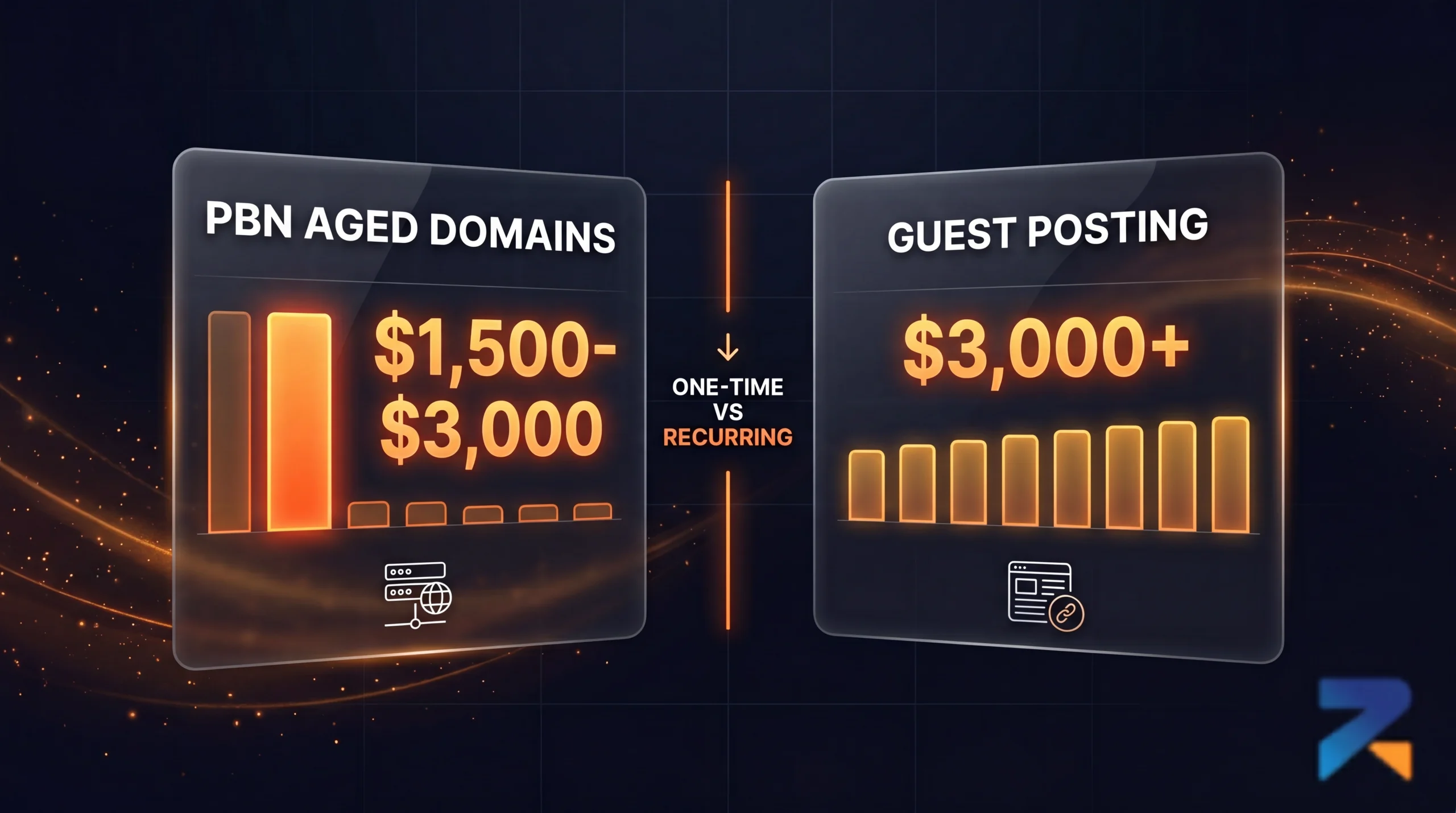
PBN aged domains for tier-1 use DR 20+, Trust Flow above 15, clean history, niche-relevant sit around $80 to $300 each, depending on metrics and TLD. Ten of those and you’re already at $1,500 to $3,000 before hosting, content, or any setup time. Then add separate hosting if you’re doing it right, since putting all ten on one server is asking for trouble. Figure another $5-15 per domain per month on top.
A single iGaming guest post on a site with real traffic and DR 30+ runs $150 to $500 often more, because gambling content is restricted on most ad networks and publishers know it, so they price accordingly. Ten guest posts at $300 average is $3,000. For links you don’t own. On pages someone else can pull, rewrite, or repurpose whenever they feel like it.
Run that forward a year. The PBN is a one-time spend on something you control indefinitely. The guest posts are a recurring cost if you want to keep your link velocity up, because publishers do site cleanups and your links go with them.
We’ve watched an operator spend $3,000 on guest posts over six months and lose 30% of those links within a year to exactly that a publisher cleanup. Meanwhile the PBN domains were still sitting in his hosting account, still doing their job, untouched.
Risk Profile: Which One Gets Penalized Harder

Neither method is risk-free. Anyone telling you otherwise is selling something.
PBN risk is footprint risk. Ten domains on the same host, same theme, same anchor pattern, registered around the same time that’s a pattern, and patterns get noticed. Footprint detection has gotten a lot sharper since 2023. Varied hosting, varied themes, varied registration dates, varied content quality across the network that’s not optional anymore. That’s the baseline.
Guest posting risk is link spam classification risk, and this is the part people miss. If your guest posts are obviously paid, with exact-match commercial anchors, on sites with nothing to do with your niche Google’s link spam systems pick that up just as easily. A “guest post” that’s 400 words padding around one link to a casino site, on a blog with no real editorial process, reads the same to Google as a weak PBN link. Doesn’t matter what you call it.
That’s the trap a lot of operators fall into assuming guest posting is automatically “safer” because it sounds more legitimate on paper. It’s only safer when the placement is genuinely relevant and the site has real traffic and an editorial calendar. A guest post on a dead blog with zero organic visitors carries about the same risk as a thin PBN node. It just looks nicer in a spreadsheet.
Anchor Text Control: Where PBN Has a Clear Edge
This one doesn’t get talked about enough, and in iGaming it matters more than in almost any other niche.
With a PBN, every anchor is yours to decide. Branded, naked URLs, partial-match, a small slice of exact-match commercial built the way our anchor text strategy for iGaming aged domains guide lays out, on purpose, in proportion.
Guest posting takes that control away from you. Editors rewrite your suggested anchor. Some strip it down to branded-only no matter what you ask for. If your strategy needs a specific ratio of partial-match anchors hitting money pages, guest posts make that ratio inconsistent at best and sometimes impossible.
Here’s why that matters. When a site tanks after a core update, the anchor profile is one of the first things people check. We’ve run anchor text audits on sites that crashed, and more often than not, the root cause is a lopsided profile built from links the owner didn’t actually control the wording on.
When Guest Posting Actually Wins
To be clear this isn’t an anti-guest-posting article. There are situations where it’s the better call.
Brand signal diversity is the big one. A PBN, however clean, is still a network you own. Google’s trust models lean toward links from sites with independent ownership, real audiences, history that has nothing to do with you. A handful of genuinely earned placements on established gambling or affiliate sites sends a different signal it says other people in this space are actually talking about you.
Durability is another. A guest post on a publication that’s been running for ten years, with real traffic and an active team behind it, will likely outlast most PBN nodes. Your PBN domain is something you have to keep paying for and keep maintaining, or it starts decaying the way we covered in aged domain link equity decay.
And geo-specific authority. Entering a regulated market like Sweden or the Netherlands? A guest post on a real local-language publication carries geo-relevance that’s hard to fake with a PBN unless you happen to be sitting on aged domains with genuine history in that exact market.
The Hybrid Approach Most Top Operators Actually Use
Here’s what operators who’ve been doing this for years actually do and it’s not picking a side.
The split usually lands around 60/40 or 70/30 in favor of PBN for raw link volume. The PBN does the heavy lifting: most of the referring domains, the anchor distribution, the link velocity you need in the first 60-90 days after launching on a fresh aged domain (more on that side of things in building an iGaming money site on an aged domain).
Guest posts get saved for where independent authority actually matters usually the homepage and one or two core money pages, not spread thin everywhere. Three to five strong placements on real publications do more for trust than fifteen mediocre ones.
If you genuinely have to pick one go PBN first, especially right after launch when speed and control matter most. Add guest posting once the site has some organic traction and you can afford to wait on placements.
Practical Takeaway
Before you spend a dollar on either this month, pull your money site’s backlink profile and compare referring domain count against the top 3 for your main keyword. Under 50% of their count? Go PBN you need volume, and you need it under your control. Close to parity on volume but your DR/DA ratio still looks weak next to theirs? That’s low-trust links dragging you down, and a few strong guest post placements will move that needle faster than ten more PBN domains.
Either way, both strategies stand on the same foundation the quality of the aged domains underneath them. A PBN on poorly vetted domains, or a guest post routed through a redirect chain on a toxic domain, both fail the same way. Start with verified, pre-audited inventory and this whole decision gets a lot simpler. That’s the entire point of Rexusdomain domains ready to deploy, not ones you spend another week finding out are useless.
Related Guides
Sources & Further Reading
Frequently Asked Questions
Is PBN still effective for iGaming SEO in 2026?
Yes — PBNs remain effective for iGaming SEO in 2026 when built with aged domains that have genuine authority metrics (DR 20+, TF 15+) and clean backlink profiles. The key is quality over quantity: a 5-domain PBN with properly aged, niche-relevant domains outperforms a 50-domain network of low-quality drops.
Which is faster for building aged domain authority — PBN or guest posting?
PBN links built on aged domains with existing authority metrics (DR 25+, TF 15+) deliver faster ranking results than guest posts — typically 4–8 weeks versus 3–6 months for guest post impact. However, PBN links carry higher algorithmic risk if domains are poorly vetted or the network is identifiable.
How many PBN domains do I need for an iGaming money site?
For a new iGaming money site in a mid-competition market, 5–10 properly vetted PBN domains with DR 20+ provides a functional foundation. Tier-1 markets like UK, Canada, or Australia typically require 15–25 high-authority PBN nodes plus sustained guest post outreach to achieve first-page rankings.
What domain metrics should PBN domains have for iGaming SEO?
Minimum recommended metrics for iGaming PBN domains: DR 20+ (Ahrefs), TF 15+ (Majestic), spam score under 5% (Moz), minimum 30 referring domains from diverse C-class IPs, clean Wayback Machine history, and no manual penalty history. Niche relevance to your target market is a bonus but not always achievable.