
Domain Reputation Explained: SEO Authority Isn’t the Same as Email or Security Reputation
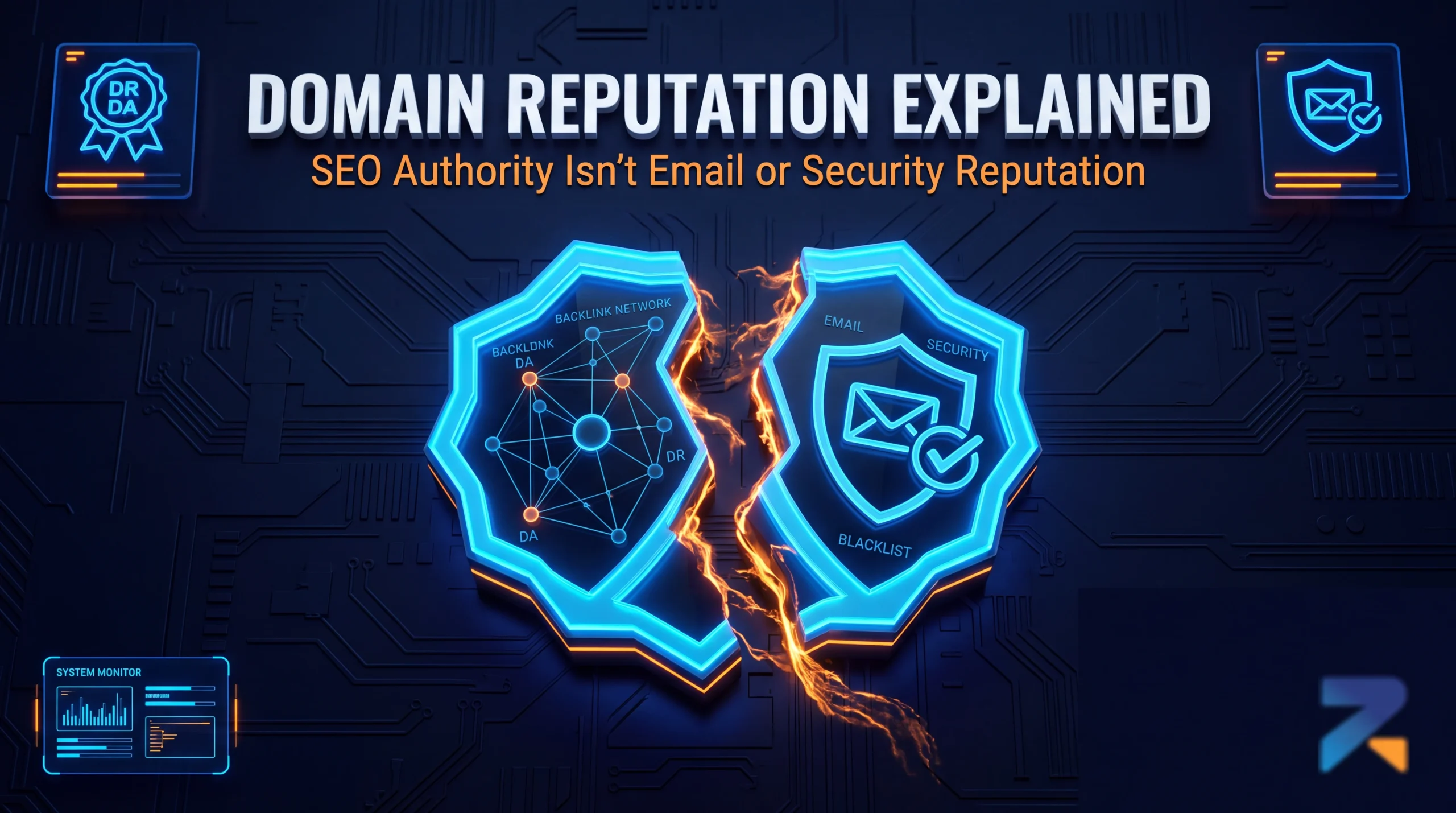
“Domain reputation” gets used for two completely different things: SEO authority (how much a search engine trusts a domain’s content and backlinks) and email/security reputation (whether mail servers and browsers flag a domain as spammy or malicious) a domain can score well on one and poorly on the other, and checking only one before buying an aged domain misses real risk.
Last updated: August 2026.
Two Different Systems, One Overused Term
SEO tools report “authority” using metrics like DA, DR, or TF, built from backlink data. Email and security systems report “reputation” using entirely separate signals: sending history, spam complaint rates, inclusion on blacklists like Spamhaus or Barracuda, and malware/phishing flags from services like Google Safe Browsing. These systems don’t share data with each other. A domain can have a strong backlink profile and a terrible email sending history, or the reverse a clean security record with no SEO value at all.
Why This Matters for Aged Domain Buyers
Most aged-domain due diligence focuses on the SEO side backlinks, indexation, penalty status. That’s necessary but incomplete if you plan to send email from the domain, host it behind a CDN, or use it for anything beyond a static content site:
- A domain previously used for spam campaigns can carry a poor email-sending reputation even if its backlink profile looks clean, since the two are tracked independently. This can mean your first emails from the domain land in spam folders regardless of DKIM/SPF setup.
- A domain flagged historically for malware or phishing may still show on cached blacklist data or browser warning lists even after the content is gone and the flag would normally expire, particularly if the domain changed hands multiple times without anyone requesting delisting.
- A domain with strong SEO metrics can still fail a security reputation check if a previous owner used it briefly for something abusive between periods of legitimate use something a backlink-focused audit alone won’t surface.
How to Check Each Type of Reputation Separately
- SEO authority: third-party tools (Ahrefs, Moz, Majestic) plus a manual backlink profile review, covered in DR, DA, and TF explained for aged domains.
- Email/sending reputation: blacklist lookup tools (MXToolbox, Spamhaus lookup) checked against the domain and any historical mail server IPs associated with it, if known.
- Security/malware history: Google Safe Browsing’s transparency report and the Wayback Machine’s capture history, to see whether the domain shows any historical association with malicious content.
None of these checks substitute for the others a clean result on one doesn’t imply a clean result on the rest.
Can a Damaged Reputation Be Fixed?
Email and security reputations generally recover with time and clean usage, unlike a Google manual action which usually requires an explicit reconsideration process. Blacklist entries typically expire or can be requested for removal once the underlying issue (spam volume, malware) is resolved and the domain has a period of clean activity. This makes reputation repair more of a waiting-and-monitoring process than a one-time fix budget for a monitoring period before relying on the domain for email delivery specifically.
Frequently Asked Questions
Is domain reputation the same as domain authority?
No. Domain authority (and similar third-party metrics like DR and TF) measure SEO-relevant backlink strength. Domain reputation, in the email and security sense, measures sending history, spam complaints, and malware/phishing flags a completely separate system with no shared data.
Can an aged domain have good SEO metrics but a bad email reputation?
Yes, and this is common. A domain’s backlink profile and its email-sending history are tracked by entirely different systems. A domain can look strong on DA/DR and still land in spam folders if a previous owner used it for spam campaigns.
How do I check if an aged domain is on an email blacklist?
Blacklist lookup tools like MXToolbox or a direct Spamhaus lookup will check the domain (and associated mail server IPs, if known) against major blacklists. This should be checked separately from any SEO-focused backlink audit.
Does a bad reputation follow a domain forever?
Not usually. Blacklist entries and security flags typically expire or can be resolved through a delisting request once the underlying issue is fixed and the domain shows a period of clean activity unlike a Google manual action, which generally needs an explicit reconsideration request.
Related Guides
Sources & Further Reading