
You just bought the domain. Transfer cleared, DNS is resolving, and you’re sitting there staring at an empty server.
Most people at this point open cPanel, install WordPress, and start copying the same affiliate site structure they’ve seen everywhere — homepage, some casino reviews, a blog section with a few bonus articles. And they wonder six weeks later why the domain isn’t moving.
The problem isn’t WordPress. It’s not the content either. It’s that they never stopped to ask which kind of deployment actually fits what they’re trying to do. In iGaming, “building a money site on an aged domain” isn’t one thing. There are four genuinely different approaches operators use, and they’re not interchangeable. A single landing page in Indonesia will eat a full WordPress site alive for the same keyword. Not because the landing page is better written — it almost certainly isn’t — but because all the domain’s authority is sitting behind one URL instead of being spread across two hundred pages that mostly don’t rank for anything.
Before you install anything, that’s the decision you need to make.
One thing before we get into it
I’m starting from the point where the domain is already in your hands and the audit is done. If you’re still deciding whether an aged domain is the right foundation for your money site, read this first: why aged domains are the default choice for iGaming money sites. Clean history confirmed, metrics verified, no manual penalties lurking in the background.
If you skipped that part, go do it first. Auditing an aged domain before you buy is the actual foundation — Wayback Machine checks, backlink profile analysis, blacklist verification, all of it. Everything I’m covering here assumes that work is already behind you. Building on a domain you haven’t properly audited is just expensive guessing.
Alright. Deployment.
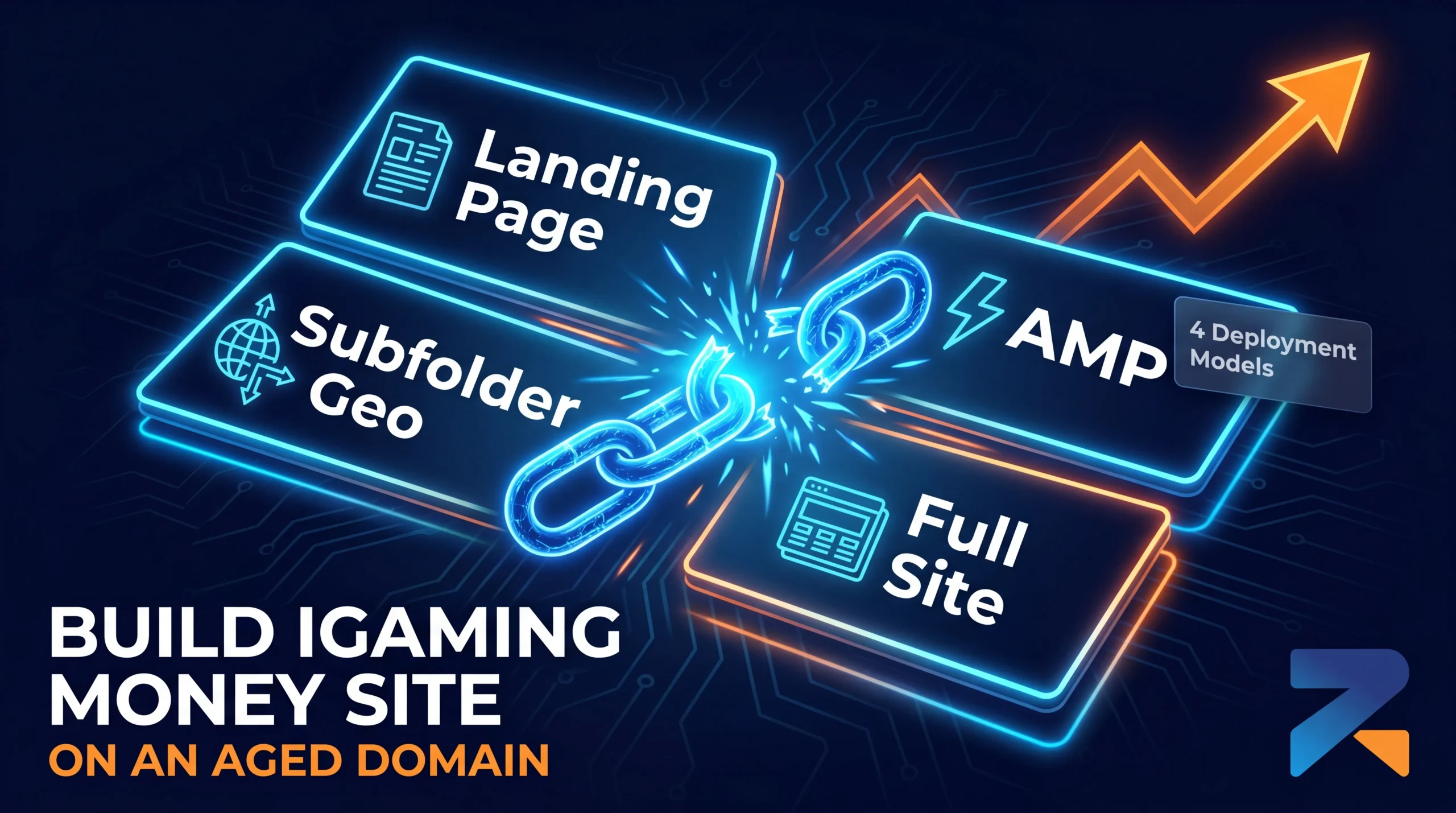
The four models — and why you need to pick one before you touch anything
The reason most guides on this topic are useless is they treat deployment like it’s one universal process anchor text audit for iGaming. TLD selection shapes your geo-targeting before a single page is built it’s not a detail to revisit later: .com vs ccTLD for iGaming aged domains. It isn’t. How you deploy determines your tech stack, your content approach, what you put in robots.txt, how you handle indexing — basically everything downstream.
Here’s what operators are actually doing out there:
Single landing page (top page). One page. One keyword. Every ounce of the domain’s authority concentrated behind a single URL. No navigation menu sending crawlers off in fifteen directions, no blog section diluting crawl budget, no category pages that rank for nothing. Just one well-built page doing one job.
This is the dominant approach in Southeast Asian markets — Indonesia, Thailand, the Philippines — where operators are going after specific keywords hard and fast. Something like slot online terpercaya or casino online uang asli, or a branded search term they need to own defensively. The logic is simple: if the domain has DR 35 and 150 referring domains and you put all of that behind one page, that page is going to compete. Split it across a hundred pages and suddenly each page has a fraction of that weight. It’s not complicated, but a lot of operators still build the hundred-page site out of habit.
AMP landing page, mobile-first. In Indonesia, somewhere between 78 and 85 percent of iGaming searches happen on mobile. Thailand is similar. Vietnam is higher. And in tier-2 cities in any of these markets, 4G is the reality — not fast 4G either. A standard WordPress page loading at 3.8 seconds on a decent connection becomes a 7-second page when the signal drops. Players don’t wait. They go back to the SERP and click the next result.
AMP strips the page down, serves it from Google’s own cache, and gets it in front of the user in under a second. For mobile organic traffic in SEA, an AMP landing page on an aged domain isn’t some optional enhancement — it’s often what separates ranking from not ranking. The setup is a paired strategy: AMP version for mobile indexing, full canonical page for desktop. Both live on the same domain, both carry the same authority.
Subfolder geo structure. This one’s for operators running multiple country targets and don’t want to buy and manage a separate aged domain per market. The aged domain becomes the authority hub and each market gets its own subfolder: /id/ for Indonesia, /th/ for Thailand, /ph/ for the Philippines. The key reason subfolders beat subdomains here is that Google treats subfolders as part of the root domain, so the DR 40 and 200 referring domains the root domain has actually flow down to /id/ and /th/. Subdomains don’t work the same way — they tend to get treated more like separate sites, which means that authority stays upstream and your geo pages start from a much weaker position.
The tradeoff is real though. Multi-geo structures require properly implemented hreflang (which almost everyone gets wrong the first time), genuinely distinct content per subfolder rather than translated copies of the same page, and careful internal linking so that authority distributes correctly rather than pooling at the root and never reaching the pages that actually need to rank.
Full money site. The familiar one. WordPress, pillar pages, casino reviews, slot guides, bonus comparisons, a blog. The full affiliate architecture. This is the right call when you’re playing a long game — building topical authority across a wide keyword set, generating traffic from hundreds of long-tail queries over 18 to 24 months, becoming the kind of resource Google treats as authoritative because the breadth and depth of the content earns it.
It’s also the slowest, the most expensive to build correctly, and the most likely to fail when the content doesn’t match the topical history of the domain underneath it. A sports media domain pointing its authority toward a casino slots review site is going to transfer authority less cleanly than a sports media domain powering a sports betting affiliate. The backlinks came from sports context. That context matters.
The choice between these four depends on how many keywords you’re going after, which market, and how fast you need something to happen. Single landing page is the fastest. Full money site is the most durable. AMP and geo subfolder are specialized depending on the situation.
Lock in that decision before you do anything else. Seriously, everything after this point is conditional on it.
Before you build: check these things first
Same checklist regardless of which model you’re going with.
DNS propagation first — don’t assume it’s done just because your local browser resolves the domain. Use whatsmydns.net and test from locations that include your target market. A domain that resolves fine from Europe can still be propagating in Southeast Asia twelve hours later.
Get the domain into Google Search Console before any content goes live. Don’t wait. Register ownership now, get the baseline data clean. An aged domain entering GSC pre-content gives you a proper baseline for indexing, coverage, and manual actions. If there’s a manual penalty the previous audit missed, you’ll see it here before it bites you mid-build.
Take a screenshot of current Ahrefs or SEMrush metrics — DR, DA, referring domain count, estimated organic traffic. This is your before state. You want this number on record because referring domain counts sometimes dip by 5 to 10 percent immediately after a transfer as links get re-crawled under the new owner. That’s normal. A drop of 30 percent that doesn’t bounce back within two weeks is not normal, and you need the baseline to know the difference.
Also check whether the previous owner left any active redirects or old hosting configurations running. It happens. Old redirect chains that nobody cleaned up can interfere with how Google reads the new deployment.
Building the single landing page
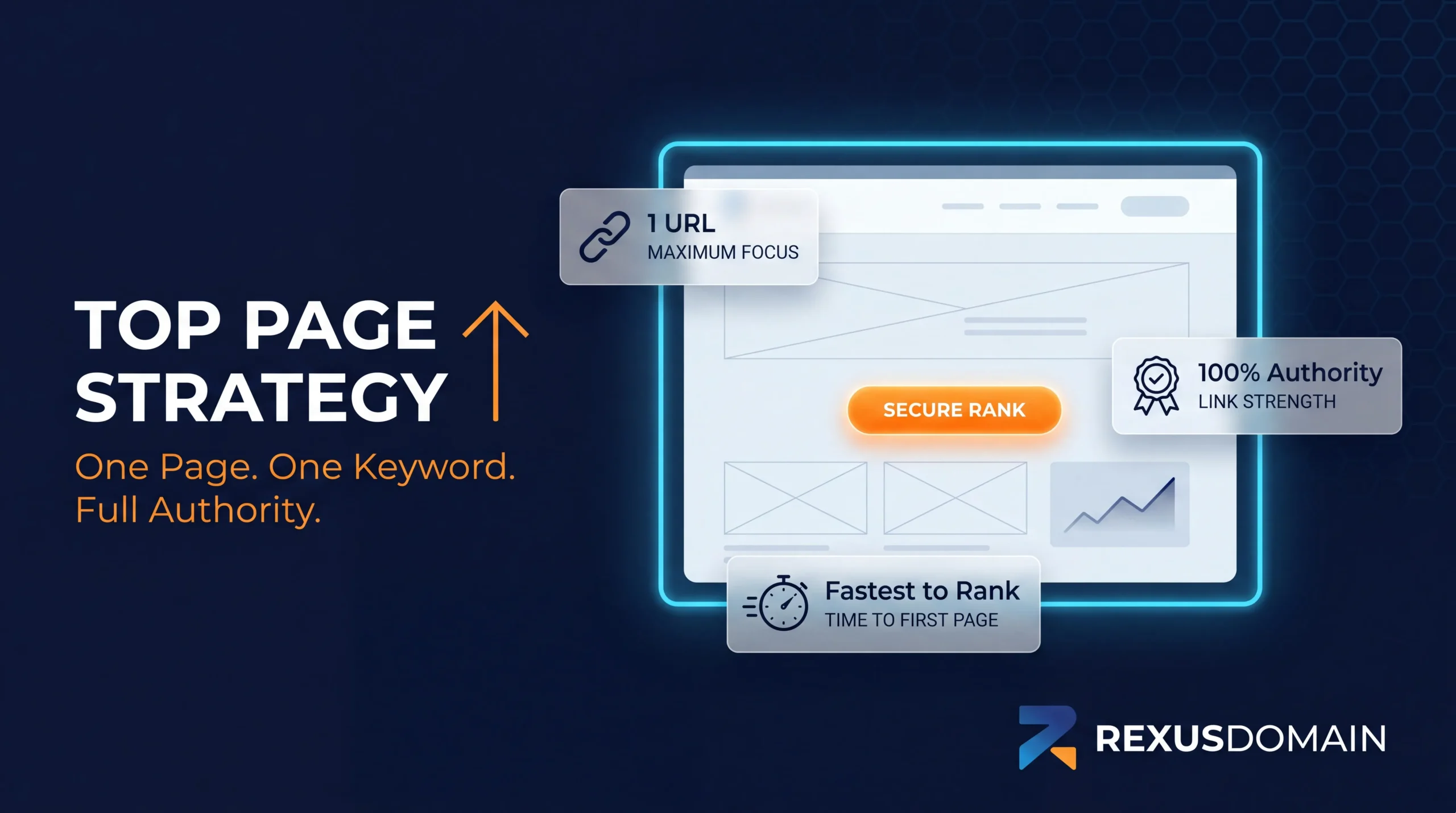
The thing people keep getting wrong here is thinking they’re building a website. They’re not. They’re building one page. That distinction matters more than it sounds because it changes every technical and content decision that follows.
Don’t use WordPress for a single landing page deployment. The overhead is pointless — WordPress installs dozens of default pages, multiple crawlable URL structures, script queues, and comment endpoints that serve no purpose when the only thing that needs to exist is one URL. Use a static HTML file or a minimal PHP setup that serves one page and nothing else. If you need to edit the content without touching code, a simple headless CMS or even a basic admin interface bolted on is sufficient. The page should load in under two seconds. A clean static HTML file with optimized images gets there without difficulty. A WordPress install needs significant work just to be competitive on speed.
What the page actually needs to contain: an opening section that answers the search query immediately — not a company background, not a philosophical introduction about online casinos. If the keyword is “best online casino Indonesia,” the first thing the user reads needs to directly address that. Specific information, not generic warmth.
After the opening, a review or comparison section with concrete data. Bonus amounts and their actual wagering requirements. Withdrawal speeds for the payment methods the target market actually uses. Game counts and specific titles. Players landing from organic in iGaming are comparing options, and they leave fast if you give them nothing to compare.
Trust signals that satisfy YMYL review: licensing information, responsible gambling links, age verification notice. This isn’t optional in the iGaming category. Google’s quality evaluators look for these specifically when assessing gambling pages. An iGaming landing page without licensing disclosure and responsible gambling resources is a weaker YMYL document — it will rank lower than a comparable page that has them.
An FAQ section with FAQPage schema. This does two things: captures secondary search intent around the main keyword, and creates eligibility for FAQ rich results which lift click-through rate without improving position. In competitive markets, that CTR difference is meaningful.
For robots.txt on a landing page deployment: block everything except the main URL. If WordPress is installed for any reason, block /wp-admin/, /wp-login/, default post archive structures, author pages, tag pages, all of it. An aged domain shouldn’t be handing crawl budget to admin endpoints.
Building the AMP page
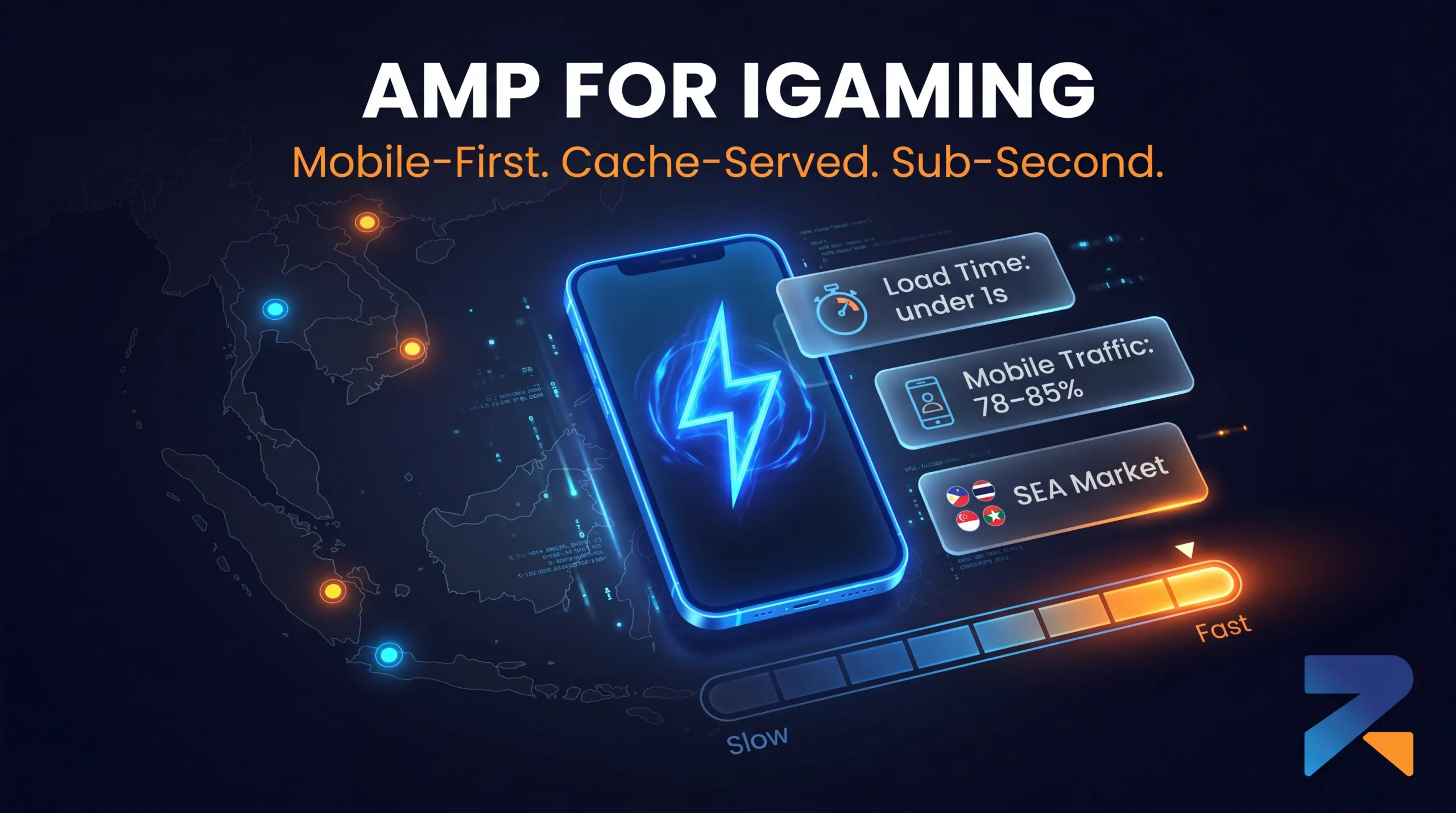
AMP is worth addressing upfront because there’s a lot of lazy “AMP is dead” commentary floating around, usually from people who don’t run sites in markets where mobile connection speeds are the actual constraint. In Indonesia, Thailand, and Vietnam — three of the most active iGaming markets in Southeast Asia — it still matters and operators who understand this are using it.
The honest limitation: AMP restricts what you can put on the page. Standard JavaScript-based live chat, most standard affiliate tracking pixel implementations, complex promotional overlays — these don’t work inside AMP’s component model. If your monetization or user journey depends on those things firing on the landing page itself, AMP is the wrong approach for that page. You can still use AMP as the mobile discovery layer and hand off to a full page for the actual registration flow.
The technical build: AMP is standard HTML with AMP’s restricted spec applied. Any component that isn’t plain HTML needs an AMP-specific equivalent — <amp-img> instead of <img>, <amp-analytics> for tracking, <amp-form> for any form element. No arbitrary JavaScript runs. The AMP runtime handles behavior within those constraints.
For the canonical pair to work correctly: your AMP page needs <link rel="canonical"> pointing to the full non-AMP version, and your full page needs <link rel="amphtml"> pointing back to AMP. Without that bidirectional relationship, Google doesn’t serve the AMP version from cache.
Validate with Google’s AMP Validator before you submit anything. An AMP page with validation errors doesn’t get served from Google’s cache, which means you lose the exact advantage you built the AMP page to get. Validate, fix errors, then submit the AMP URL to Search Console under the AMP report and monitor it separately from the canonical.
Building the subfolder geo structure
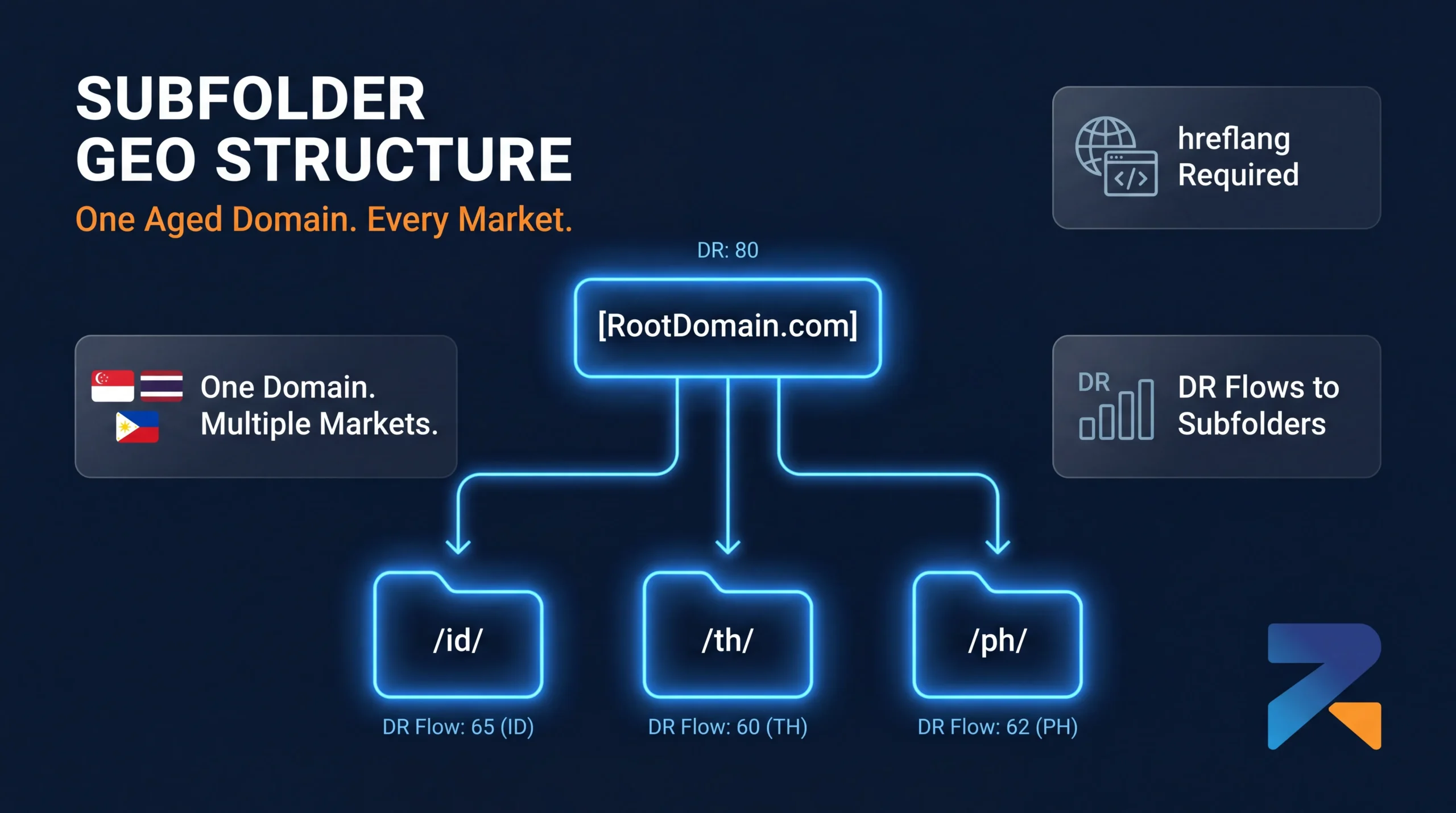
This one requires the most architecture thinking upfront because mistakes here are genuinely painful to undo after the fact. Getting hreflang wrong, publishing thin translated content across geo pages, using subdomains instead of subfolders — any of these will undermine the authority transfer from the aged domain rather than multiply it.
The subfolder vs. subdomain question is settled for competitive iGaming. Subfolders inherit authority from the root domain subdomain vs subdirectory vs root domain for iGaming SEO. Subdomains get treated more independently by Google in high-competition verticals, which means your geo pages start from a weaker position and you’ve bought a DR 40 aged domain to power pages that act more like new sites. Subfolder is the call.
Hreflang: every page in the geo structure must reference all other language or region variants plus an x-default fallback. The annotation has to be reciprocal — if your /id/ page references /th/, your /th/ page must also reference /id/. Missing reciprocal tags cause Google to ignore the whole hreflang implementation as if it isn’t there. A simple implementation for a three-market SEA setup looks like this:
<link rel="alternate" hreflang="id" href="https://domain.com/id/" />

<link rel="alternate" hreflang="th" href="https://domain.com/th/" />

<link rel="alternate" hreflang="ph" href="https://domain.com/ph/" />

<link rel="alternate" hreflang="x-default" href="https://domain.com/" />
Content per subfolder has to be genuinely different. Translating the Indonesian page into Thai and pointing hreflang at it isn’t a geo content strategy. Google’s spam detection in iGaming is sophisticated enough to identify translated thin content, and the YMYL scrutiny in gambling makes the response fast. Local payment methods, local currency, local bonus structures, local regulatory disclaimers — each market needs content that reflects how players in that market actually use these products.
Authority flow through internal linking: the root page is your strongest URL. Link it to each subfolder. Cross-link between subfolders. Don’t create geo pages and leave them orphaned from the main navigation — orphaned pages on a geo structure get minimal crawl budget regardless of how strong the root domain is, which defeats the entire purpose of the deployment.
Building the full money site
If you’re going this route, the content architecture needs to be built around the domain’s actual topical history before you plan a single page. Pull the domain from the Wayback Machine and map what it covered historically to your intended site structure. A domain that spent eight years as a sports media site has a backlink profile built around sports content. That authority transfers most cleanly to a sports betting affiliate. Route it toward casino slots content and the topical relevance of the incoming links to the pages that need them weakens.
The site structure that holds up in 2026: a homepage targeting your broadest keyword, category pages for product types (slots, live casino, sports betting, poker, crash games), individual review pages at the leaf level, and editorial content — game guides, strategy pieces, explainers — feeding authority upward to the category pages. Internal links flow from editorial to category, from category to homepage. Every new page that gets published should receive at least one internal link from an existing page on launch day. Orphaned pages in iGaming just sit there burning crawl budget.
On E-E-A-T: Google’s quality rater guidelines put iGaming in the YMYL category, which means the bar for author credibility, site transparency, and trust signals is higher than in almost any other niche. A full money site in this vertical needs real author bios — not stock photos with generic bios — an About page that actually explains who runs the site and what their credentials are, responsible gambling resources accessible from every relevant page, and licensing information where applicable. These aren’t cosmetic. During manual quality assessments, their absence is a concrete signal that the site is a thin affiliate rather than a real resource.
Technical baseline that applies to all four models
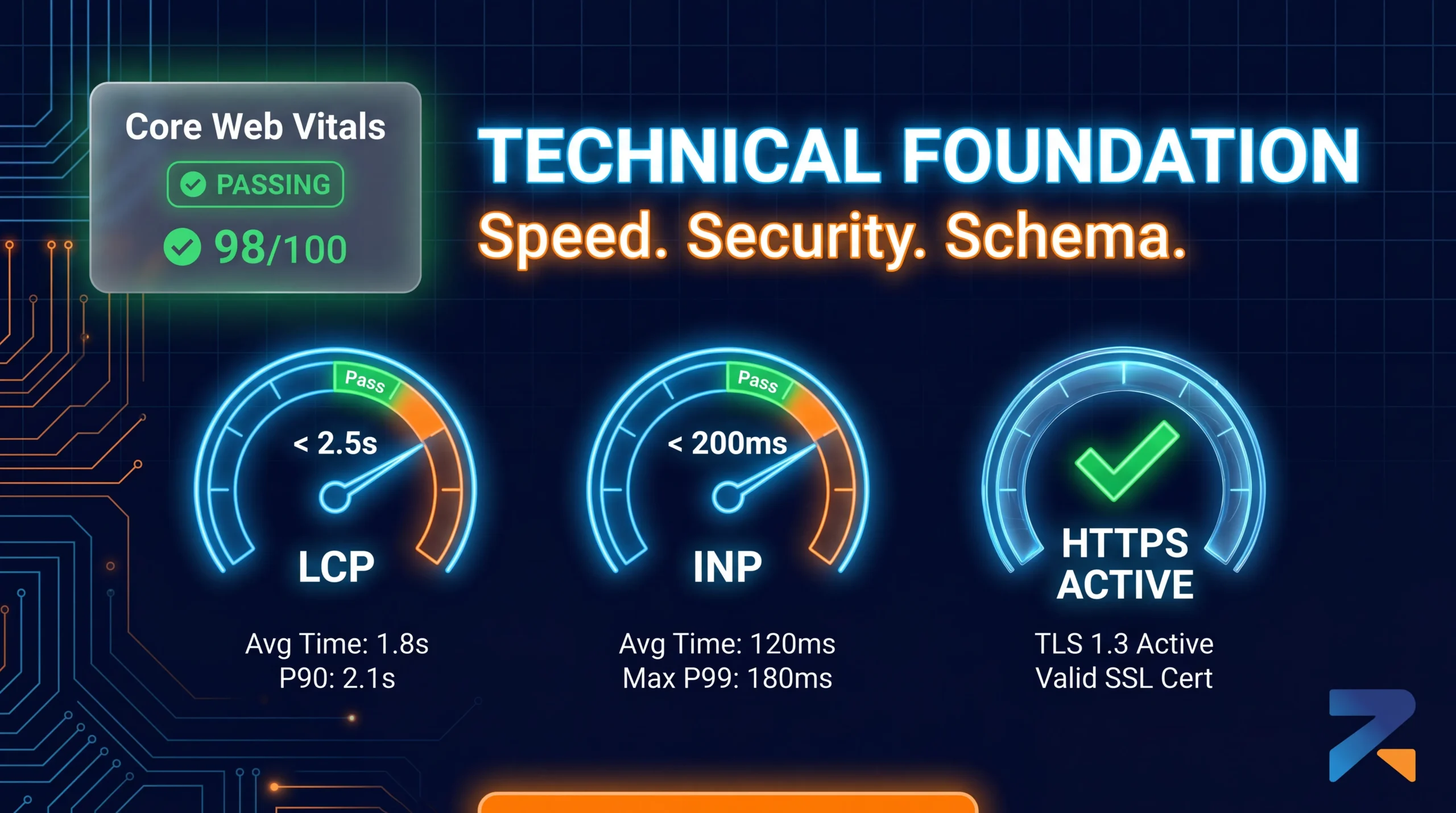
HTTPS before anything is crawled. An aged domain transitioning from previous hosting may have residual HTTP patterns in Google’s memory. Launch on HTTP and redirect later, and you introduce a brief inconsistency in how Google maps the authority chain across the ownership transition. SSL configured correctly before the first crawl.
Core Web Vitals: LCP under 2.5 seconds, INP under 200ms. iGaming pages are heavy — promotional images, tracking scripts, affiliate click handlers. Hitting these numbers in practice means server-side rendering or static generation for your key pages, deferred loading for everything non-critical, images in WebP or AVIF, and a CDN if your target market is geographically far from your server. React or Next.js without SSR will fail these in iGaming consistently. The content that matters — your headline, your main review, your CTA — needs to be in the HTML response, not rendered client-side after three rounds of JavaScript execution.
Crawl budget: block what doesn’t need to be indexed. Admin paths, staging URLs, URL parameters that create duplicate versions of the same page, author archives, tag pages. An aged domain has more crawl authority than a fresh domain — don’t spend it on pages that return no ranking value.
Schema: FAQPage on landing and content pages, Review markup on casino and game reviews, BreadcrumbList on full money sites. These create eligibility for rich results, not guarantees. In iGaming SERPs, the difference between a result with FAQ rich results and one without can be three to five percentage points of click-through rate. At the traffic volumes iGaming sites operate at, that’s not marginal.
The first 30 days: what’s normal and what isn’t
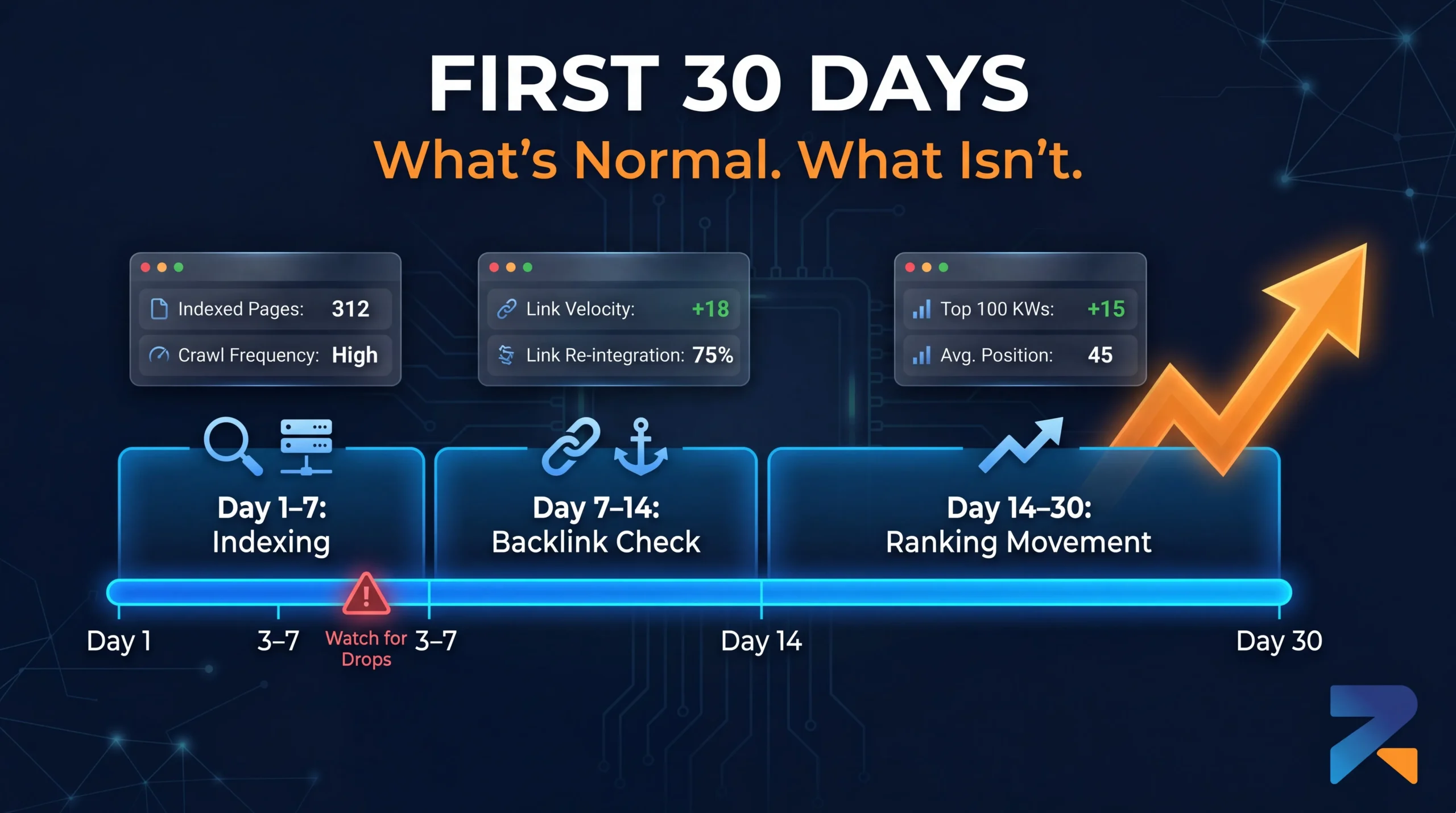
Aged domains index fast. Within 24 to 72 hours of going live, your pages should be in the index — compared to one to three weeks on a fresh domain. Don’t expect ranking movement yet in the first week. What you’re watching in Search Console is coverage (pages indexed, no errors) and the manual actions report.
Between days 7 and 14, check your referring domain count in Ahrefs or Majestic. A dip of 5 to 10 percent post-transfer is normal — links are being re-crawled under the new owner. If the count drops 30 percent or more and stays there past day 14, something is off and it’s worth investigating whether the backlinks were pointing to pages that no longer exist or whether there’s a technical issue with how the domain is resolving.
Days 14 to 30 are when you start to see impressions data for your target keywords in Search Console. On a strong aged domain with a single landing page targeting a mid-competition keyword, first-page impressions within this window is realistic. Full money sites and geo subfolder structures take longer — more content to crawl, more signals to accumulate.
One thing: don’t blast backlinks in the first two weeks. An aged domain doesn’t need an aggressive launch link campaign the way a brand new domain might — it already has authority. Dumping a hundred links on it in week one creates a velocity spike that looks manufactured against the domain’s existing organic link pattern. Wait until the site is indexed and impressions are registering, then begin building new links intentionally. When you get to that point, how you structure your anchor text strategy for iGaming makes a meaningful difference in whether the new links push rankings or just add noise.
A red flag worth knowing: if you see an active decline in the residual traffic the domain was carrying — not just absence of new traffic, but a drop from whatever baseline existed before you launched — between days 3 and 7, pull the manual actions report immediately. That pattern usually means something in the domain’s history that the audit missed is surfacing.
This isn’t a 301 redirect — don’t mix the two
Worth being explicit about this because the confusion comes up constantly. Deploying a money site on an aged domain and using an aged domain for a 301 redirect are two different strategies, and running both at the same time on the same domain doesn’t give you the benefits of either.
A 301 redirect means the aged domain stays empty. It points its authority at your actual money site on a different domain. The aged domain is a pipe. All the link equity flows through it to wherever you’ve aimed it.
Building your money site on the aged domain means the aged domain is the site. It ranks directly. Nothing needs to transfer anywhere because the thing ranking in Google is the domain itself.
Both approaches work fine. Using a 301 redirect from an aged domain makes sense if you already have an established money site and you want to boost its authority without starting a second site from scratch. Building directly on the domain makes more sense if you’re creating a new asset that needs to rank on its own.
What doesn’t work: redirecting an aged domain to your money site while also building content on it. Google sees the redirect, tries to figure out the relationship between the two destinations, and the resulting signal is muddier than either clean approach would produce. Pick one.
Where people still get this wrong
The deployment model question trips people up because the iGaming SEO conversation mostly happens around full money sites — that’s the visible, public-facing world of casino affiliate sites and review portals. The single landing page strategies, the AMP builds, the geo subfolder structures — those are how operators actually run things, and they don’t write blog posts about it.
So someone buys a clean aged domain with DR 32 and 180 referring domains, and their frame of reference is the full affiliate site. They build 50 pages of content over two months, watch rankings trickle in slowly, and conclude that aged domains are overhyped.
What they should have done — given they were targeting a single competitive keyword in the Indonesian market — is built one page, optimized it correctly, added a paired AMP version, and been ranking within three to four weeks instead of three to four months.
The domain didn’t underperform. The deployment model was just the wrong one for the job.
Related Guides
- Best aged domain marketplaces 2026 — top 7 platforms ranked
- Best Aged Domain Marketplace for iGaming SEO (2026)
- Where to Buy Aged & Expired Domains in 2026: The Complete Buyer’s Guide
- Aged Domain Sellers You Can Trust: How to Vet a Premium Marketplace
- How to Buy Aged or Expired Domains: A Step-by-Step Guide