

Buying an aged domain with a hidden manual penalty is one of the most expensive mistakes in iGaming SEO. You pay $500, $2,000, maybe more. You set up the site, redirect links, push content and nothing moves. Weeks pass. You run a site: search and the pages are there. But rankings? Zero.
Then you finally connect the domain to Google Search Console. And there it is: a manual action sitting in the inbox, placed months or years before you ever touched it.
The previous owner knew. Or didn’t care. Either way, it’s your problem now.
This is exactly why manual penalty detection has to happen before purchase not after. The problem is, you don’t have GSC access to the domain before you own it. So you’re working with signals, not confirmation. And in iGaming, reading signals accurately is the entire game.
Here’s how to do it properly.
Manual Penalty vs. Algorithmic Drop Know the Difference First
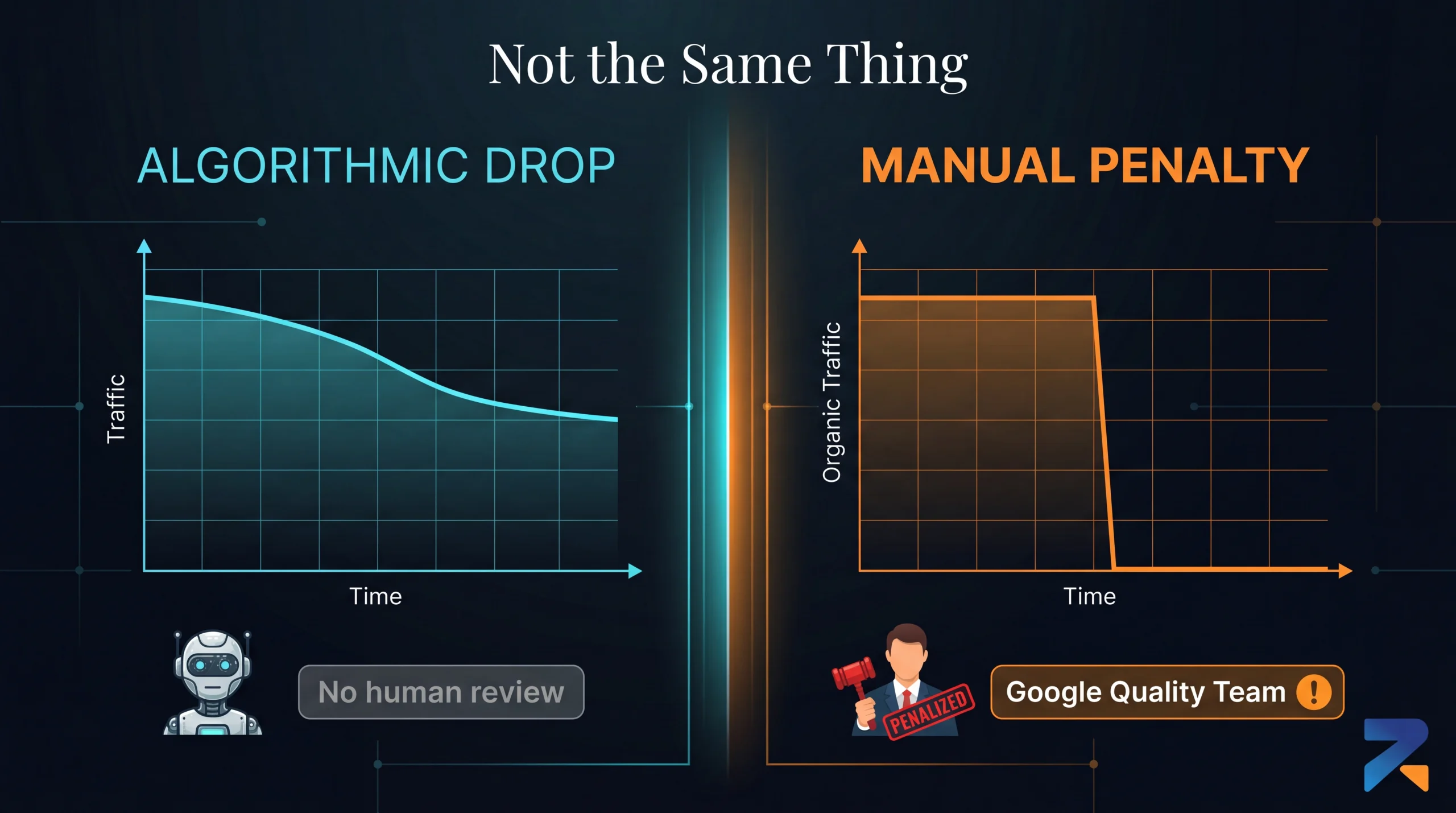
Most operators confuse these two. They’re not the same, and the detection method is completely different.
An algorithmic drop happens when Google updates a core signal and the domain loses rankings because it no longer fits what Google rewards. No human reviewed it. No action was filed. The domain recovers when you fix the underlying issue. The May 2026 Google Core Update is a recent example of how brutal those drops can look and how easy it is to misread them as something worse.
A manual penalty is different. A member of Google’s quality team reviewed the site and filed an action against it. It stays until a reconsideration request is submitted and approved. Fixing the content or removing bad links doesn’t automatically lift it. You have to formally request a review and Google has to agree.
For iGaming domains, manual penalties usually fall into three buckets: unnatural inbound links, thin/doorway pages (common with casino affiliate sites), or pure spam. All three are enforcement decisions, not algorithmic fluctuations.
The First Check: Run a site: Operator Test
Before you open Ahrefs or spend a single minute on the backlink profile, do this first.
Go to Google and search: site:domain.com
If the domain has pages indexed, you’ll see them. If the result shows zero pages or fewer than 5 on a domain that supposedly had hundreds of pages that’s a serious signal. A fully deindexed domain almost always has either a manual action or a severe algorithmic penalty behind it.
Cross-check this with what Wayback Machine shows for the domain’s content history. If there were 300+ pages live 18 months ago and Google now shows 0, something happened between then and now. You want to know what.
Also try: site:domain.com inurl:casino or site:domain.com inurl:slot if the domain had iGaming content and those pages aren’t surfacing at all, that’s a red flag on top of a red flag.
Traffic Cliff vs. Gradual Decline: Reading Third-Party Data
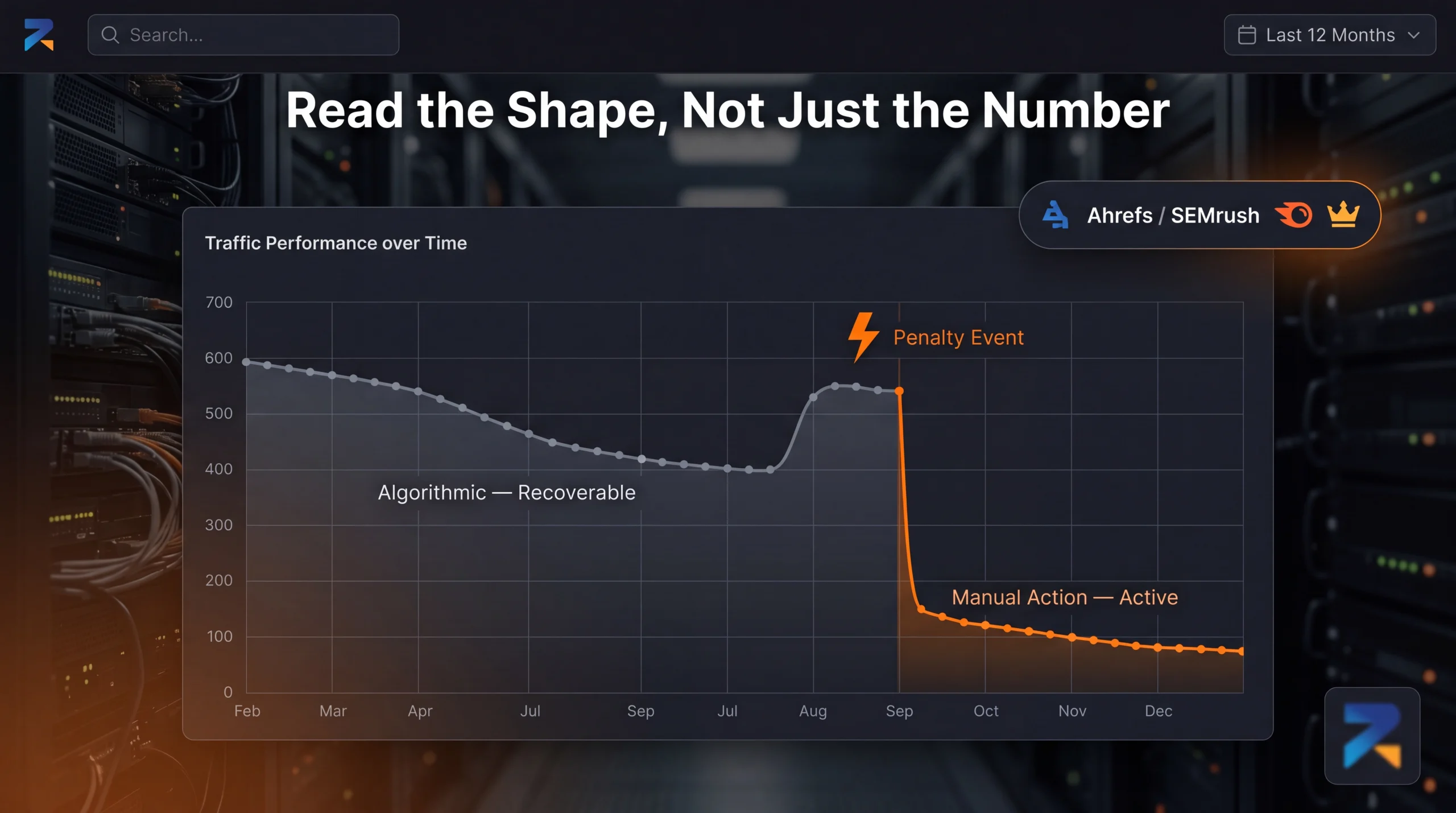
Ahrefs and SEMrush both estimate organic traffic over time, even for domains you don’t own. This data isn’t perfect, but it’s directionally accurate enough to detect penalty events.
What you’re looking for is the shape of the traffic curve.
A gradual decline over 12–18 months is usually algorithmic the site aged, lost links, content went stale. That’s recoverable. A cliff edge where traffic drops 70–90% in a single month is a different story. That’s either a core update hit or a manual action.
Here’s how to differentiate: pull the traffic history in Ahrefs and map the drop against known Google update dates. If the drop aligns perfectly with a documented core update, it’s likely algorithmic. If it happened in a quiet period no major updates that month a manual penalty is far more likely. The Google algorithm updates guide for iGaming SEO has a full timeline you can use to cross-reference drop dates against confirmed update windows.
We’ve seen this pattern repeatedly with iGaming domains that get listed on marketplaces after a penalty. The seller drops the price, attributes it to “algorithm volatility,” and moves on. The buyer inherits the manual action without knowing it existed.
Check Backlink Velocity Right Before the Traffic Drop
Manual actions for unnatural links leave a footprint in the backlink data. Pull the domain’s referring domain growth chart in Ahrefs. Look at what happened to the link profile in the 3–6 months before the traffic cliff.
If you see a massive spike in referring domains hundreds of new links in a short window followed by a sharp traffic drop, the sequence is almost certainly: aggressive link scheme → Google review → manual action → penalty enforced.
This is textbook. In iGaming specifically, this pattern shows up constantly on domains that ran link farms, bought bulk GSA links, or participated in link exchanges targeting casino keywords. The spike is visible. The consequence is visible. The manual action itself isn’t but you can infer it.
Also check the type of links in that spike period using Majestic’s historic index. Sitewide links, exact-match anchor text repeated across hundreds of domains, links from .xyz or .top domains with DA under 5 all of this points to a link scheme that likely triggered a manual review. The backlink types guide for iGaming SEO breaks down exactly which link patterns draw Google’s attention fastest.
The Google Cache Test
This one is simple and often overlooked.
Search cache:domain.com in Google. If the page is cached, Google is actively crawling and indexing it which means there’s no active deindexation happening. If the cache returns nothing, the domain may have been removed from Google’s index.
Note: Google has been rolling back the cache: operator over time, so it may not work for every query. But when it does work, a missing cache on a domain claiming to have strong SEO history is a significant warning sign.
Check Google’s Public Spam Reports and Community Records
This sounds obscure, but it’s worth doing for high-value domain purchases.
For notable penalty events, SEO communities often document what happened. Search the domain name in combination with terms like “penalty,” “deindexed,” “manual action,” or “spam” across SEO forums, Black Hat World threads, and Twitter/X.
Operators who’ve been penalized sometimes talk about it. Or they complain about it publicly while asking for help. That public record doesn’t disappear.
For iGaming domains specifically, check if the domain was ever used as part of a known link network. Some penalty events from 2018–2022 around casino-focused PBNs are well-documented in the SEO community. If the domain appears in any of those discussions, treat it as a hard pass.
Disavow File Presence: A Telling Detail
You can’t see another owner’s disavow file directly. But you can ask the seller. If you’re purchasing a domain from a marketplace or private seller, ask directly: “Was a disavow file ever submitted for this domain?”
A seller who has nothing to hide will answer the question. Someone trying to offload a penalized domain will deflect, get evasive, or claim they don’t know.
A disavow file existing isn’t automatically a red flag it means someone tried to clean up the backlink profile. But a disavow file combined with a traffic cliff and a suspicious link spike is a red flag. It tells you: someone built bad links, got penalized, tried to recover, and then sold the domain instead of waiting for the reinstatement.
The Reconsideration Request Signal
Here’s something most people miss: if a domain received a manual action, the only path to recovery is a submitted reconsideration request. If that request was denied or never submitted the manual action is still active.
You can sometimes detect this by checking the timeline. If the domain had a penalty-shaped traffic event and then showed no recovery in the 6–18 months that followed, the reconsideration request was either never filed or was rejected. The manual action is likely still live.
Compare this to a domain that dropped hard and then partially recovered over 4–8 months that pattern is more consistent with an algorithmic hit that the site naturally recovered from. A flat line at zero after a cliff edge, lasting more than a year, almost always means an active manual action with no approved reconsideration.
Red Flags Specific to iGaming Domains
iGaming domains have some penalty patterns that are niche-specific. Keep these in mind.
Thin affiliate content at scale. Domains that ran hundreds of near-identical casino review pages copy-paste templates with different bonus amounts were hit hard in multiple Google updates. If Wayback Machine shows this type of content at scale, and traffic dropped in 2022 or 2023, it’s likely related to Google’s Helpful Content system or a manual spam action.
Exact-match anchor text overload. If the domain’s top anchors are “best online casino,” “real money slots,” and “casino bonus” in exact match all pointing to a single destination that’s a red flag. This pattern triggers manual review in competitive niches. Run it through the anchor text audit framework for iGaming to know exactly what ratio signals manipulation versus natural link growth.
Doorway page history. Some iGaming domains were set up purely as doorway pages thin, GEO-specific pages designed to funnel traffic to a single casino brand. Google explicitly targets these. If Wayback Machine shows this structure and there’s a corresponding traffic drop, don’t buy.
The Pre-Purchase Manual Penalty Checklist
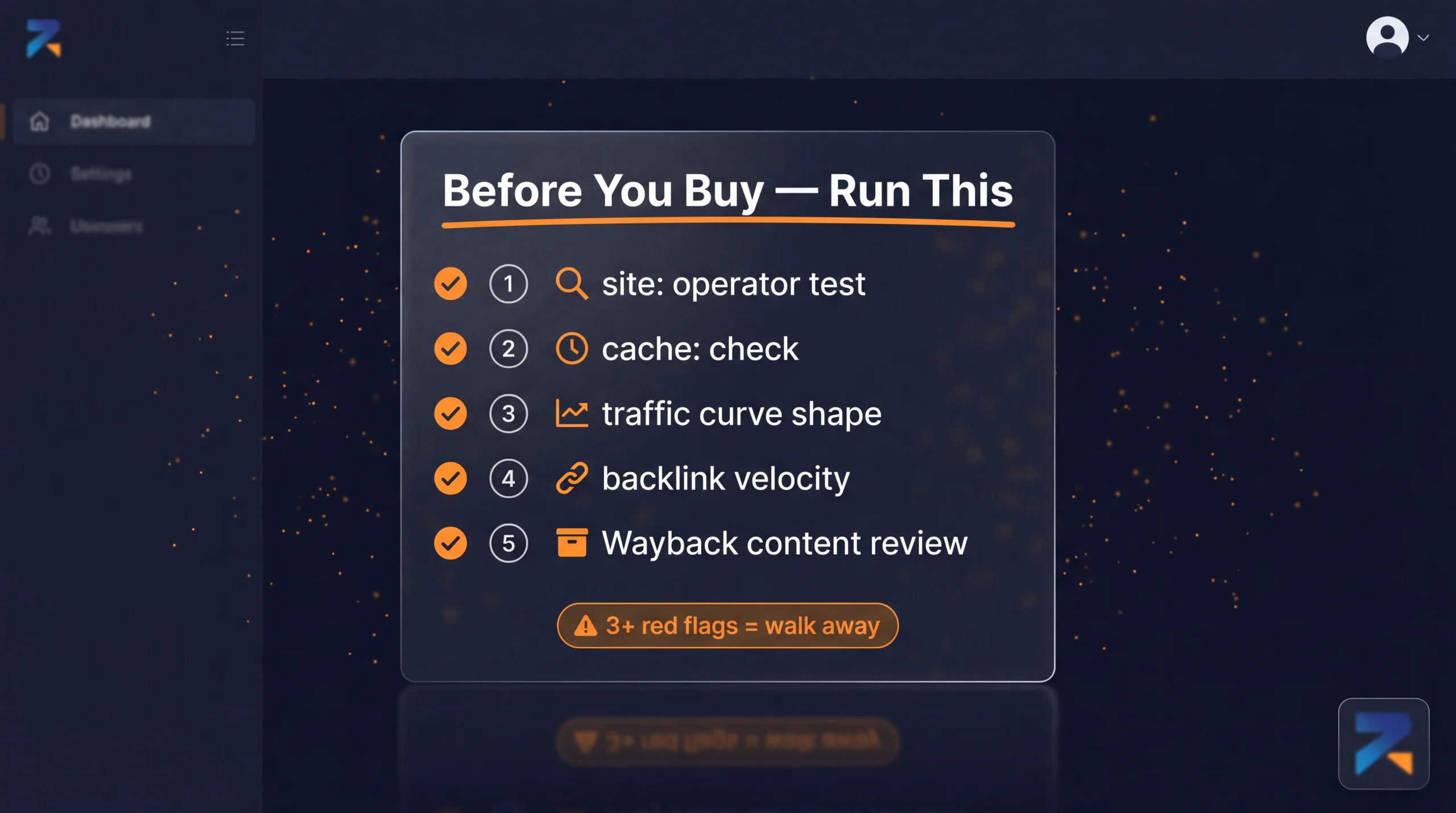
Run this before you commit to any aged domain purchase:
- site:domain.com how many pages indexed? Is it consistent with the site’s history?
- cache:domain.com is Google actively crawling and caching the domain?
- Ahrefs traffic history what’s the shape of the curve? Cliff or gradual?
- Cross-reference the traffic drop against Google update dates does it align with an update or happen in a quiet window?
- Backlink velocity pre-drop was there a link spike before the traffic collapsed?
- Wayback Machine content review was there thin, doorway, or templated casino content at scale?
- Forum and community search does the domain appear in penalty discussions or known link network exposés?
- Ask the seller directly about disavow files and reconsideration request history.
- Check anchor text distribution is it overloaded with exact-match gambling keywords?
- Evaluate post-drop recovery flat line = likely active manual action. Partial recovery = likely algorithmic.
None of these checks individually confirm a manual penalty. But if three or more of these signals show up on the same domain, walk away. iGaming domains are not cheap, and the cost of building on a penalized foundation is orders of magnitude higher than the cost of finding a better domain.
If you’re evaluating multiple domains simultaneously and need a cleaner read on their full SEO health, the aged domain audit guide for iGaming covers the complete due diligence process manual penalty checks sit on top of that foundation, not in place of it.
The domains worth buying are the ones where none of this applies clean traffic history, diverse link profile, no cliff events, no sketchy content in the archive. They exist. You just have to know what to filter out first.
Rexusdomain pre-vets every aged domain before it gets listed history checked, backlink profile reviewed, no hidden penalties. So operators in iGaming aren’t walking into the purchase blind.
Related Guides
- Best Aged Domain Marketplace for iGaming SEO (2026)
- Best aged domain marketplaces 2026 — top 7 platforms ranked
- How to Build a PBN for iGaming SEO Using Aged Domains
- Where to Buy Aged & Expired Domains in 2026: The Complete Buyer’s Guide
- Aged Domain Sellers You Can Trust: How to Vet a Premium Marketplace
Sources & Further Reading
Frequently Asked Questions
How do I check if an aged domain has a manual penalty before buying it?
You cannot check Google Search Console for manual actions on a domain you do not own. Before purchase: (1) ask the seller to screenshot the Search Console Manual Actions report — legitimate sellers will provide this; (2) check if the domain is indexed by searching site:thedomain.com in Google; (3) look for sudden traffic drops in Wayback Machine archive gaps indicating deindexation periods; (4) check Spamzilla for penalty history flags; (5) test keyword rankings — a penalised domain ranks for nothing, even its own brand.
Can a manual penalty on an aged domain transfer to a new owner?
Yes. Manual actions attach to the domain, not the registrant. If you acquire a domain with an existing unresolved manual action, the penalty follows the domain under your ownership. You will need to submit a reconsideration request to Google explaining new ownership, the corrective actions taken, and why the domain no longer violates webmaster guidelines. Google approves reconsideration requests for change-of-ownership scenarios where the new owner genuinely remediated the violation.
How long does Google manual penalty reconsideration take for an aged iGaming domain?
Google manual penalty reconsideration typically takes 2-4 weeks for a first review, with a decision communicated via Search Console. If the initial reconsideration request is denied, corrections can be resubmitted after implementing requested changes — second reviews often take another 2-4 weeks. Complex cases involving link schemes on iGaming domains can take 3-6 months through multiple review cycles. The clock only starts once the request is submitted with evidence of remediation.
What types of manual penalties commonly affect aged iGaming domains?
Common manual penalties on aged iGaming domains: (1) unnatural links — buying links violating Google Webmaster Guidelines; (2) thin content — affiliate doorway pages without substantial original content; (3) cloaking — showing different content to Google than to users; (4) pure spam — low-quality content generated at scale; (5) user-generated spam — casino comment spam on forums or blog sections. Unnatural links is by far the most prevalent penalty type on iGaming domains acquired from secondary markets.
Should I buy an aged iGaming domain with a known manual penalty?
Only acquire a manually penalised aged domain if: (1) the price reflects a significant discount (60-80% below unpenalised equivalent); (2) the penalty cause is clearly identifiable and remediable (link scheme, not cloaking); (3) the domain has demonstrably strong underlying metrics (TF20+, 50+ quality referring domains) that justify the remediation effort; (4) you have experience submitting successful reconsideration requests. Fresh domain investment typically produces better ROI than penalty remediation for first-time aged domain buyers.
Can I use a manually penalised aged domain as a PBN link source?
No. A domain with an active manual action should never be used as a PBN link source. Manual actions suppress the domain authority that makes aged domains valuable as link sources. Google assesses the quality of linking domains when evaluating links to money sites — links from manually penalised domains may trigger manual review of the money site itself if Google identifies the link pattern. Remediate or discard penalised domains; do not integrate them into active link building infrastructure.