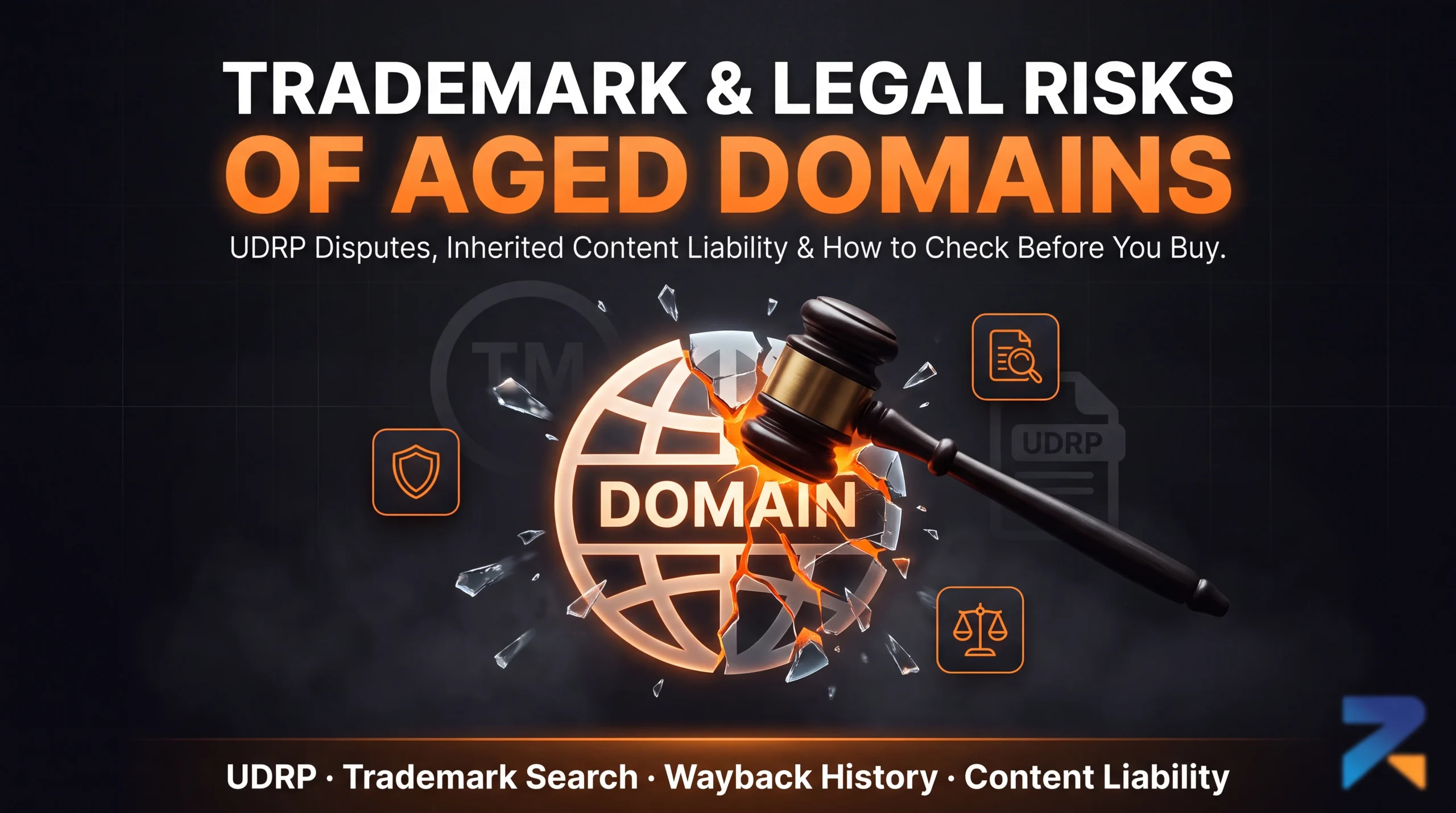

Trademark and Legal Risks When Buying an Aged or Expired Domain
Buying an aged or expired domain carries a legal risk most buyers never check for: the domain’s name or its prior content history can expose the new owner to a trademark dispute, a UDRP complaint, or liability for content published before they ever owned it. These risks are separate from the SEO due diligence most guides focus on, and they can result in losing the domain entirely sometimes without compensation regardless of how much was paid for it.
Last updated: July 2026.
Trademark Risk: Buying a Name, Not Just a Domain
A domain name that incorporates or closely resembles a registered trademark carries legal exposure independent of its SEO metrics. This risk exists whether the trademark issue is obvious (a domain containing a well-known brand name) or subtle (a domain that was coincidentally similar to a trademark registered years after the domain itself was first created). Buyers evaluating a domain purely on Domain Rating or Trust Flow can miss this entirely, since trademark conflicts don’t show up in backlink tools.
What Is a UDRP Complaint?
The Uniform Domain-Name Dispute-Resolution Policy (UDRP) is the standard process trademark holders use to challenge domain ownership without going to court. A successful UDRP complaint can result in the domain being transferred to the trademark holder or cancelled outright the current owner has no automatic right to compensation, even if they paid a marketplace or private seller for it in good faith. UDRP cases are typically decided within a few months and rely on three factors: whether the domain is identical or confusingly similar to a trademark, whether the current owner has a legitimate interest in the name, and whether the domain was registered and used in bad faith.
Why Aged Domains Carry More of This Risk Than New Registrations
A brand-new domain registration is, at minimum, registered by someone making an active choice about the name today. An aged or expired domain’s name was often chosen years earlier, for reasons the current buyer has no visibility into. Two scenarios create disproportionate risk in this market:
- The domain was always trademark-adjacent. Some aged domains were registered specifically to resemble a brand name, sometimes for typosquatting or affiliate arbitrage. Buying that domain doesn’t erase the original bad-faith registration in a UDRP proceeding panels look at the full history, not just the current owner’s intent.
- A trademark was registered after the domain. Even a domain with no bad-faith history can become a target years later if a business registers a similar trademark and decides to pursue the name. This is less common but not rare, particularly for short, generic-sounding domains.
Inherited Content Liability
Trademark disputes aren’t the only legal exposure. A domain’s prior content history can create liability that transfers to the new owner in more subtle ways:
- Defamation or false statements published under the domain’s previous ownership can still be indexed by search engines and archived by the Wayback Machine, creating reputational risk even after the content is removed.
- Copyright-infringing material hosted historically can trigger DMCA takedown requests directed at the current owner, even for content they never uploaded.
- Regulatory history — a domain previously used in a regulated industry (gambling, finance, health claims) may carry scrutiny or blocklisting from third-party services that doesn’t reset with new ownership.
How to Check Before You Buy
- Run a trademark search on the exact domain name (minus the TLD) through your country’s trademark office database, and check the USPTO’s TESS database for U.S. exposure regardless of where you’re based, since U.S. trademark holders file UDRP complaints against domains worldwide.
- Search the domain’s full history in the Wayback Machine specifically for brand names, logos, or content that suggests it was ever positioned as an alternative to or copy of an existing company.
- Check UDRP case databases (WIPO and the Forum both publish searchable case records) for the domain name itself a domain that has already survived or lost a UDRP complaint has a documented history worth knowing before you buy.
- Ask the seller directly whether the domain has ever been the subject of a legal dispute, trademark complaint, or takedown request, and get the answer in writing as part of the sale.
Frequently Asked Questions
Can I lose a domain I paid for if someone files a UDRP complaint?
Yes. A successful UDRP complaint can result in the domain being transferred or cancelled regardless of what the current owner paid for it or how long they’ve held it. There is generally no compensation from the UDRP process itself for the losing party.
Does buying a domain from a reputable marketplace protect me from trademark disputes?
Not automatically. A marketplace’s vetting process typically focuses on SEO metrics and content history, not trademark exposure. Buyers should independently check trademark databases regardless of where they purchase the domain.
Am I liable for content that was on the domain before I bought it?
It depends on the type of liability. Search engines and archives can keep old content visible even after a change of ownership, and copyright holders can still send takedown requests to the current registrant. Reviewing the domain’s full content history before purchase is the main way to avoid inheriting this kind of exposure.
How do I check if a domain has trademark risk before buying it?
Search the exact domain name in trademark databases (like USPTO TESS for U.S. exposure), review its content history in the Wayback Machine for brand-adjacent use, and check UDRP case records for any prior disputes involving that domain.